






It usually starts the same way. You set an alarm for 1:30 a.m. Then 3:00 a.m. Then 4:45. By morning, you’ve repositioned your spouse or parent several times through the night, each turn a careful negotiation of limbs that can no longer help themselves. You’re exhausted in a way that sleep doesn’t fix. And you know you’ll do it again tonight.
Neuromuscular conditions, ALS, multiple sclerosis, muscular dystrophy, spinal muscular atrophy, Guillain-Barré syndrome, and related diagnoses, share a defining clinical feature: progressive loss of the muscle strength needed to move in bed. When that ability goes, the burden shifts entirely to whoever is in the room.
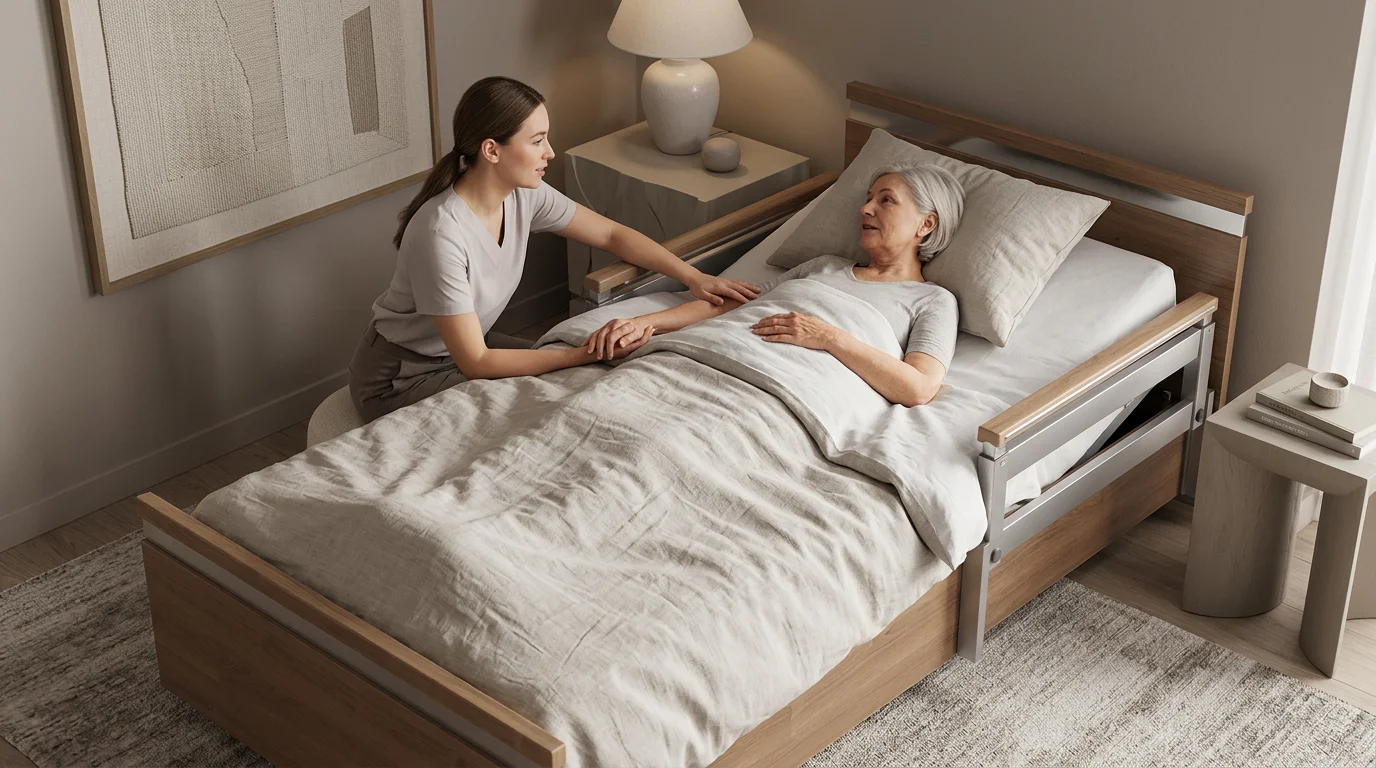
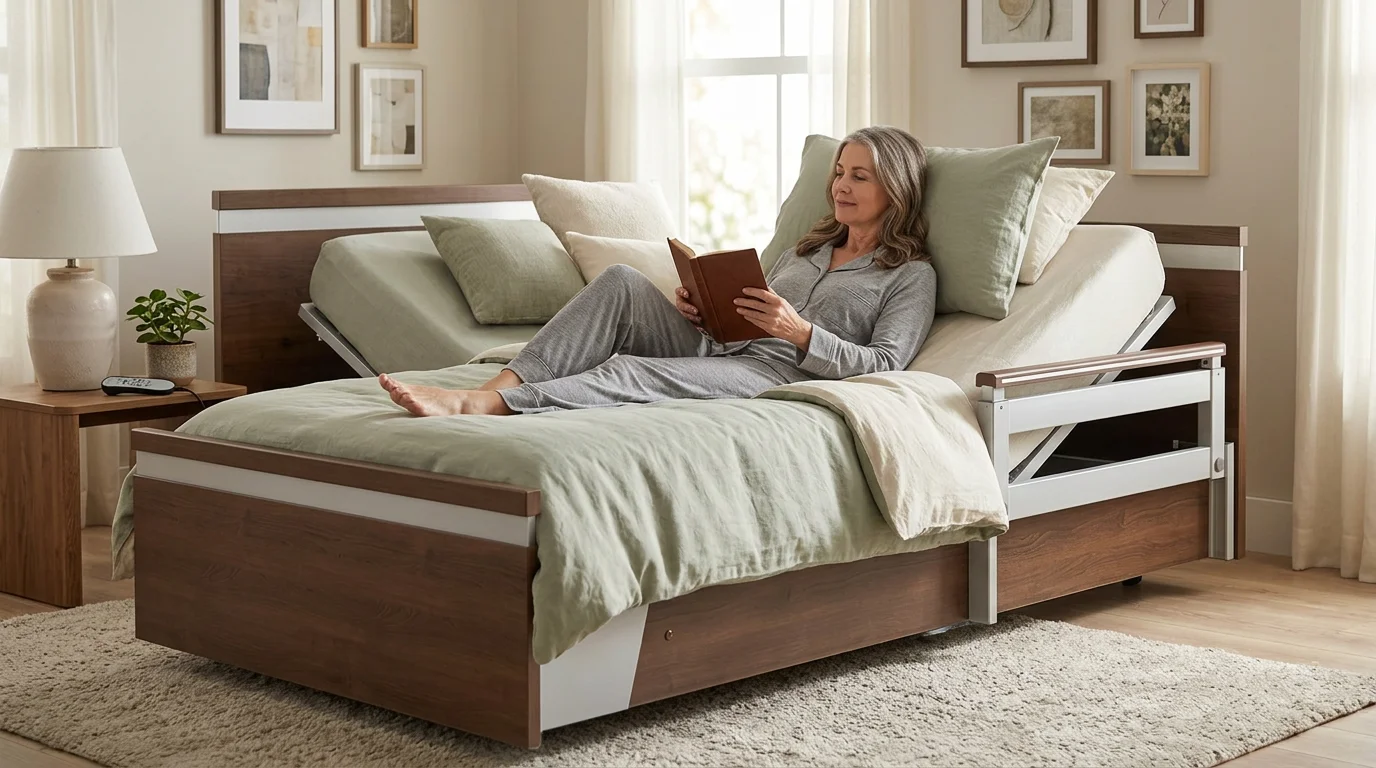
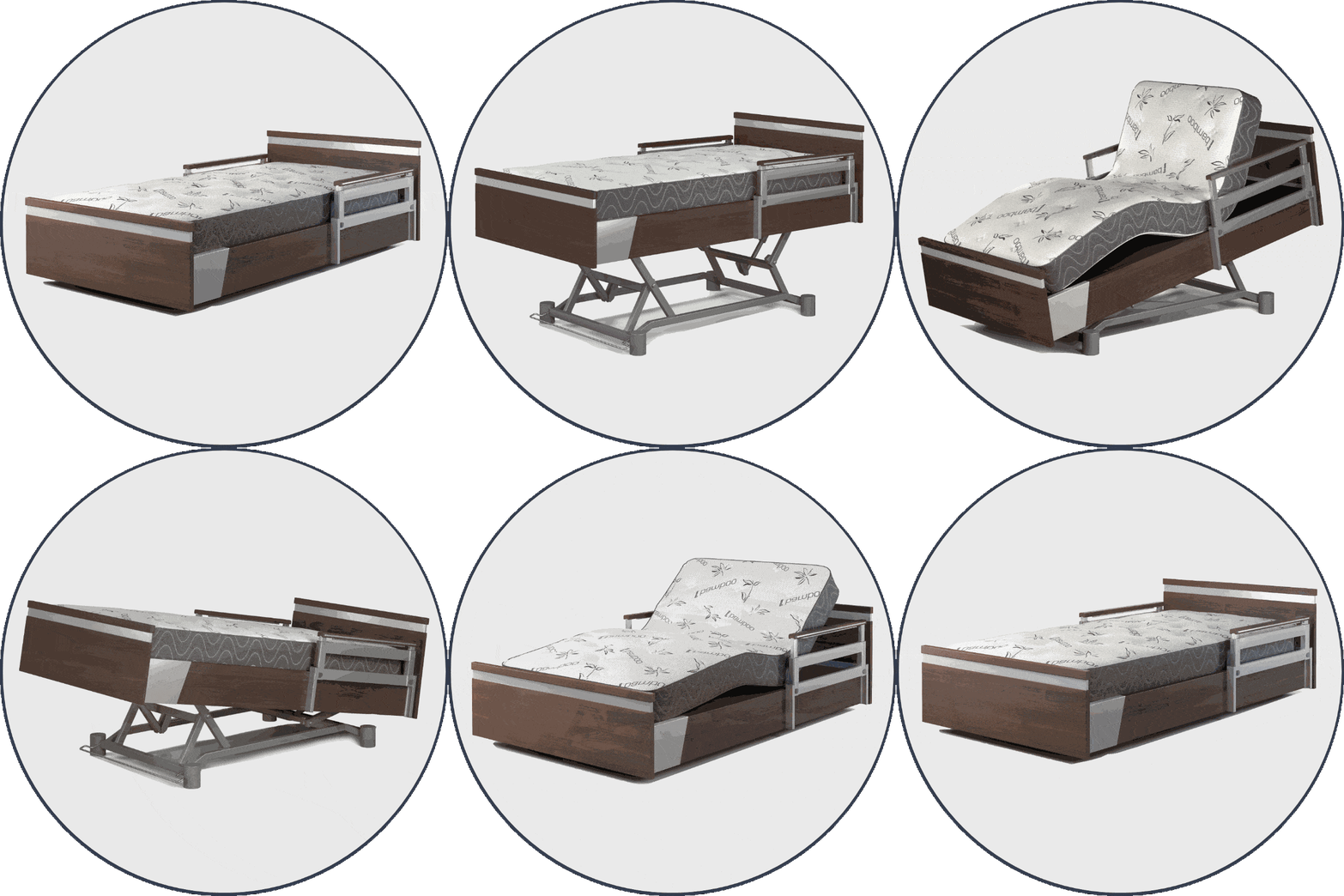
The right home hospital bed for neuromuscular weakness doesn’t eliminate that burden. But it changes it significantly. Height-adjustable frames protect caregiver backs. Head elevation supports breathing without the constant sling of pillows. Quiet motors let patients reposition themselves at 2 a.m. without waking anyone. And the right mattress can reduce overnight turns from hourly to twice a night.
This guide covers what you need to know: which features matter, when to make the transition, how to protect yourself as a caregiver, and what each neuromuscular condition specifically requires. Use it as a starting point, then follow the condition-specific links to find detailed guidance for your situation.
What Neuromuscular Weakness Means for Sleep and Bed Care
The term “neuromuscular weakness” covers a broad family of conditions that affect the nerves controlling muscle movement, the muscles themselves, or both. What they share is a trajectory: as the disease progresses, voluntary movement becomes harder, then impossible, in an expanding range of muscle groups. The conditions most likely to lead families toward home hospital beds include:- ALS (amyotrophic lateral sclerosis): Prevalence of 7.7 per 100,000 in the U.S., with an estimated 24,821 cases identified in 2017, a figure that may undercount the actual total by as much as 30%.1
- Multiple sclerosis: Approximately 1 million people in the U.S. are living with MS,2 with mobility impairment affecting a significant portion as the disease progresses.
- Muscular dystrophies (Duchenne, Becker, FSHD, LGMD, myotonic): Collectively affecting an estimated 1 in every 5,000 to 10,000 people worldwide.3 Duchenne alone affects approximately 15,000 individuals in the U.S. and more than 300,000 globally.4
- Spinal muscular atrophy (SMA): A genetic condition affecting motor neurons, with non-ambulatory phases that create significant overnight care demands.
- Guillain-Barré syndrome, myasthenia gravis, CIDP, and peripheral neuropathy: Conditions ranging from acute-onset to chronic that create periods of profound weakness.
- Paralysis and spinal cord injury: Conditions with permanent loss of motor function below the level of injury.
Recognizing When It’s Time to Transition to a Hospital Bed
The most consistent finding from ALS, muscular dystrophy, and SMA caregiver communities is this: families wait too long. The hospital bed carries an emotional weight that standard medical decisions don’t, it signals progression, loss of normalcy, a shift in how the bedroom feels. Caregivers report feeling retrospective regret, saying they should have made the switch months before they did. The clinical need is clearer than the emotional decision. Consider transitioning when you observe any of the following: Physical signals from the person in your care: – They can no longer assist with turning, they can’t push with their feet, shift their hips, or use their arms to help reposition – Transfers (bed to wheelchair, bed to commode) require two people to do safely – They need the head of the bed elevated to 30 degrees or more to breathe comfortably during sleep – They’ve started sliding toward the foot of the bed during the night – They report pain or discomfort at bony prominences (heels, sacrum, hips, shoulders), an early pressure injury warning sign Caregiver signals: – You’re waking more than twice a night to reposition – Your back, shoulders, or knees are showing strain from manual repositioning – Transfers have become unsafe, the bed is the wrong height for the equipment you’re using – A Hoyer lift or other mechanical lift has been recommended but doesn’t fit under the current bed Practical triggers: – A physician, occupational therapist, or home health nurse has recommended a hospital bed – A hospital or rehabilitation discharge is upcoming and the current sleeping arrangement won’t support the care plan – Respiratory therapy has recommended head elevation that standard beds and pillow assemblies can’t reliably maintain If two or more of these apply, the transition is overdue. The standard bed is no longer a safe or sustainable platform for care.The Five Features That Matter Most for Neuromuscular Conditions
Not all hospital beds are built for the demands of progressive neuromuscular care. A basic semi-electric bed adjusts head and foot position but leaves height fixed, which means every repositioning task happens at whatever height the frame sits. Full-featured adjustable hospital beds offer a different category of function.1. Hi-Lo Height Adjustment
The ability to raise and lower the entire bed frame, from ultra-low (10″ platform height on the Aura Premium home hospital bed) to a working height of 39″, is the single most important feature for neuromuscular caregiving. It serves three functions:- Caregiver ergonomics: Raising the bed to working height eliminates stooping during repositioning, which is directly linked to caregiver back injury. Research on DMD caregivers finds that between 27–49% reduce their working hours or stop working entirely,7 with physical strain a significant contributing factor.
- Hoyer lift clearance: A floor-based mechanical lift requires clearance under the bed frame. If the bed can’t raise high enough, the lift can’t fit, and manual transfers continue unnecessarily.
- Fall safety: Lowering to the minimum height (17″ to the top of the mattress on FallSafe Ultra-Low models) reduces injury risk when a patient rolls or falls during repositioning attempts.
2. Head and Foot Elevation
Independent head and knee adjustment addresses two overlapping needs in neuromuscular care. Head elevation to 30–45 degrees supports breathing, a critical function as respiratory muscle weakness progresses in ALS, DMD, and SMA. Knee elevation (the “Zero Gravity” position) prevents the person from sliding toward the foot of the bed when the head is raised, which is the most common complaint caregivers report after a hospital bed is delivered.3. Full-Electric Operation with Hand Control
Full-electric means all adjustments, head, foot, height, are operated by a wired or wireless hand controller, not manually cranked. This matters for two reasons. First, it means the person in the bed can operate the bed independently, even with minimal hand strength. In late-stage ALS and advanced MD, the ability to adjust one’s own position, without asking anyone for help, is often the last domain of physical self-direction. Caregivers in ALS communities describe this with unusual emotional weight: the hand controller is what independence looks like when everything else is gone. Second, full-electric operation requires no caregiver effort for positional adjustments, reducing cumulative strain.4. Quiet Motor Operation
Hospital beds are used in homes, not clinical facilities. An 80-decibel motor running at 2 a.m. in a shared bedroom is not a theoretical inconvenience, it disrupts the sleep of everyone in the house. The Aura Premium bed operates at 54 dB(A), quieter than a normal conversation, which matters in households where a caregiver needs whatever sleep they can get between repositioning intervals.5. Trendelenburg and Reverse Trendelenburg
Trendelenburg (feet raised above head) supports circulation and can ease certain respiratory positioning needs. Reverse Trendelenburg (head above feet) is useful for GERD, which occurs with elevated frequency in ALS patients due to bulbar involvement, and for conditions where head-up positioning without hip flexion is preferred. These are clinical features, they should be used under guidance from the treating physician or occupational therapist, but they provide a positioning range that a basic adjustable bed cannot match.Solving the Sliding Problem
The most common complaint caregivers report after a hospital bed is delivered is not about the bed, it’s about what the bed reveals. When the head is elevated to 30–45 degrees for respiratory support, and the knee section is flat, gravity pulls the patient continuously toward the foot of the bed. Caregivers describe using rolled towels, foam wedges, body pillows, and slings in various combinations, none of which hold through the night. This is not a product defect. It’s physics. And it has specific solutions. Knee elevation is the first fix. When the knee section of the bed rises simultaneously with the head section, which properly programmed positions like Zero Gravity do, it creates a hip support that significantly slows downward migration. A basic semi-electric bed that elevates only the head doesn’t provide this. Mattress surface matters more than most people expect. The foam mattress that comes with a rental or entry-level hospital bed is often smooth-sided and slippery against standard linens. Higher-friction mattress surfaces, specifically designed for adjustable hospital beds with articulating sections, reduce sliding substantially. Mattresses that “valley out”, where the foam compresses unevenly at the articulation point between head and body sections, accelerate sliding rather than prevent it. This is a common community complaint about lower-quality hospital bed mattresses. Alternating pressure air mattresses change the equation. Caregivers in ALS and SMA communities have discovered, often through trial and error rather than clinical guidance, that alternating pressure air mattresses significantly reduce the frequency of overnight manual repositioning. By cyclically inflating and deflating air cells, the mattress performs micro-repositioning automatically, which can extend the interval between manual caregiver turns from every 60–90 minutes to two or three times per night. The 2019 international pressure injury clinical guideline recommends alternating pressure air mattresses for patients at moderate to high risk of pressure injuries.8 For neuromuscular patients who are effectively immobile overnight, that risk level applies. What doesn’t help: Most foam wedge assemblies, specially positioned pillows, and DIY barriers fail because they don’t account for the full range of nighttime movement and the effect of gravity over several hours. A properly configured full-featured hospital bed, with knee elevation, appropriate mattress, and a flat or slightly reverse-Trendelenburg option, addresses the problem structurally rather than through workarounds.Overnight Repositioning: Reducing the Caregiver Burden
Research on SMA caregiving found that 70.9% of family caregivers report consistently disturbed sleep.9 In ALS communities, caregivers describe turning schedules running every 60 to 90 minutes through the night, sometimes requiring a second adult in the room for safe repositioning. The cumulative sleep deprivation, compounding week after week, is described as one of the most destabilizing aspects of advanced neuromuscular caregiving. A hospital bed with hi-lo adjustment, full-electric positioning, and a pressure-redistributing mattress doesn’t eliminate overnight turning. But it changes its character. How often you need to turn a bedridden person depends on several factors: the person’s baseline risk for pressure injury, their skin condition, their ability to make any micro-movement on their own, and the support surface they’re lying on. On a standard mattress with no adjustability, every turn is fully manual and requires full-body repositioning. On an alternating pressure air mattress, some of that micro-repositioning happens automatically, extending intervals between manual turns and sometimes making them unnecessary between major position changes. The frame itself helps. When a bed can be raised to working height in seconds, repositioning becomes a one-person task instead of requiring a second helper. When the head section can be raised and lowered electrically while the caregiver manages limb positioning, the physical coordination required is reduced. These are not small improvements at 3 a.m. What caregivers consistently say, looking back: they wish they had understood this before the bed arrived. The bed doesn’t just make the patient more comfortable, it changes what caregiving overnight actually costs the caregiver.Protecting the Caregiver: Ergonomics and Back Injury Prevention
Caregiver back injury is not a side effect of neuromuscular caregiving, it is a predictable outcome when the caregiving environment isn’t set up correctly. The combination of bending at hip height dozens of times per day for repositioning, performing transfers without appropriate lift equipment, and doing this while sleep-deprived creates an injury profile that ends caregiving relationships prematurely. Between 27–49% of Duchenne muscular dystrophy family caregivers reduce their working hours or stop working entirely.7 Informal caregiving in neuromuscular conditions averages 33–44 hours per week on top of other responsibilities. The physical demands compound over time in ways that are gradual enough to miss until the injury happens. The height-adjustable bed directly addresses the most injury-prone caregiving tasks: Repositioning: At working height (typically 28–32″ for a standing caregiver), repositioning requires far less lumbar loading than bending over a bed at hip height. The caregiver stands upright, uses leg strength rather than back, and doesn’t have to reach across the bed frame at an awkward angle. Transfers using a Hoyer lift: Floor-based mechanical lifts require clearance beneath the bed frame, typically a minimum of 6–9 inches. If the bed can’t raise sufficiently, the lift can’t slide into position, and manual transfers continue. A caregiver who’s been doing manual transfers for months while a Hoyer lift sits unused in the corner, because nobody told them the bed could be raised high enough, is a real scenario described in DMD caregiver communities. Transfer height: The transfer position on a well-designed hospital bed sits at 21″, matching the standard wheelchair seat height for level transfers. This eliminates the dangerous lift-and-lower of transferring from a non-adjustable surface to a lower or higher seat. Protecting yourself as a caregiver is not self-indulgent. If your back fails, the care arrangement fails.Medicare Coverage for Hospital Beds With Neuromuscular Diagnoses
Navigating Medicare Part B coverage for hospital beds is genuinely confusing, and neuromuscular caregivers report significant delays, sometimes months, between when a bed becomes medically necessary and when it arrives, because of documentation and coverage uncertainty. The basics: Medicare Part B covers hospital beds as durable medical equipment (DME) when certain conditions are met. The bed must be medically necessary, ordered by a physician, and supplied by a Medicare-enrolled DME supplier who accepts Medicare assignment. Semi-electric vs. full-electric: This is the most common coverage question for neuromuscular patients. Medicare typically covers a semi-electric bed (head and foot adjustment only, no height adjustment) as the base benefit. A full-electric bed (which adds height adjustment) requires documented medical necessity for the height function, typically that caregiver injury risk or transfer safety requires height adjustment. This documentation should come from the treating physician or occupational therapist, ideally with specific clinical justification. Neuromuscular diagnoses and coverage: ALS, MS, muscular dystrophies, SMA, and related diagnoses generally qualify patients for hospital bed coverage under Medicare when functional limitations meet the criteria. The qualifying documentation typically includes the diagnosis, documented difficulty with bed mobility, and a statement of medical necessity. The rental model: Medicare typically covers hospital beds under a rental arrangement, not outright purchase, for the first 13 months. After that, ownership transfers to the beneficiary. The rental beds provided through Medicare-enrolled DME suppliers are frequently basic models, functional, but not designed for long-term residential use or aesthetic integration. For families choosing to purchase a higher-quality bed privately, either because the rental model doesn’t meet their needs or because they want a bed that functions well over years of progressive care, the cost guide for home hospital beds provides a realistic frame for what private-pay investment looks like compared to long-term rental costs. For specific coverage questions, the treating neurologist or a DME specialist who works with neuromuscular patients is the most reliable resource. Coverage rules shift, and general guidance isn’t a substitute for your specific situation.Conditions This Guide Covers
This page is the hub for SonderCare’s complete neuromuscular condition library. Each link below goes to a dedicated guide covering what that specific condition requires from a home hospital bed, including positioning needs, clinical considerations, and product recommendations. This hub is part of the larger conditions that benefit from a home hospital bed resource.ALS and Motor Neuron Disease
ALS creates progressive weakness that typically begins in the limbs or in speech and swallowing before spreading to trunk and respiratory muscles. As the disease advances, the bed becomes central to managing respiratory positioning, reducing caregiver overnight burden, and preserving what autonomy remains.- How hospital beds help with ALS, the complete guide for ALS care at home
- Daily positioning techniques for ALS and motor neuron disease, detailed positioning guidance
Multiple Sclerosis
MS presents with highly variable progression, some people maintain strong mobility for decades, while others experience rapid decline in specific functional domains. When mobility is significantly affected, hospital bed features support positioning, reduce spasticity-related discomfort, and enable safer overnight care.Muscular Dystrophy
The dystrophies vary significantly in progression speed and which muscle groups are affected first, but all eventually involve trunk and respiratory muscle weakness that creates home bed care needs. Pediatric cases require careful attention to weight capacity, mattress safety, and bed sizing.- How hospital beds help with muscular dystrophy, overview
- How hospital beds help with Duchenne muscular dystrophy
- How hospital beds help with Becker muscular dystrophy
- How hospital beds help with FSHD (facioscapulohumeral)
- How hospital beds help with LGMD (limb-girdle)
- How hospital beds help with myotonic dystrophy
Spinal Muscular Atrophy (SMA)
SMA is a genetic condition affecting motor neurons that causes progressive muscle weakness. Non-ambulatory individuals, particularly SMA Type 1 and 2, have significant overnight positioning and pressure injury prevention needs. The introduction of gene therapy and disease-modifying treatments has changed the trajectory for many patients, but home bed care remains a central component of daily living for many families.Episodic and Immune-Mediated Neuromuscular Conditions
Guillain-Barré syndrome, myasthenia gravis, and CIDP (chronic inflammatory demyelinating polyneuropathy) involve periods of acute weakness, sometimes severe, that may resolve partially or completely, or may follow a relapsing course. Home hospital beds are relevant during active phases and for ongoing care in chronic forms.- How hospital beds help with Guillain-Barré syndrome
- How hospital beds help with myasthenia gravis
- How hospital beds help with CIDP
Peripheral Neuropathy, Paralysis, and Spinal Cord Injury
Peripheral neuropathy creates sensory and motor weakness in a pattern that varies by cause and extent. Paralysis and spinal cord injury involve permanent motor loss at and below the injury level, with lifelong bed positioning, pressure injury prevention, and transfer needs.- How hospital beds help with peripheral neuropathy
- How hospital beds help with paralysis
- How hospital beds help with spinal cord injury
How to Choose the Right Bed for Neuromuscular Conditions
For most neuromuscular conditions, the functional requirements converge on a few non-negotiable features: full-electric operation, hi-lo height adjustment, true head and knee elevation, and a mattress surface that supports pressure redistribution. Where families differ is in their priorities around aesthetics, caregiver ease, and how much the bed will be used for repositioning versus independent adjustment. For caregivers prioritizing function and durability: The Aura Premium home hospital bed ($6,999) delivers the complete feature set: FallSafe Ultra-Low height (10″ platform, 17″ to mattress top), full head and knee articulation, Zero Gravity and Comfort Chair positions, Trendelenburg and reverse Trendelenburg, hi-lo from 10″ to 39″, and a pre-programmed 21″ transfer height. It’s certified to International Hospital Standard and carries a 5-year comprehensive parts warranty, relevant for conditions where the bed will be in daily clinical use for years. For households where the bedroom’s residential character matters: The Aura Platinum home hospital bed ($8,499) adds fully upholstered side panels in Slate Gray Crypton fabric, giving the bed the appearance of premium bedroom furniture rather than medical equipment. Caregivers in ALS and MS communities raise the hospital-room aesthetics question consistently, the Platinum directly addresses it without compromising any clinical function. For mattress selection: The standard hospital bed mattress, often a basic foam pad, is insufficient for extended neuromuscular care. For patients at low-to-moderate pressure injury risk, the Signature Hybrid mattress (individually wrapped pocket coils plus high-density orthopedic foam, reversible soft/firm) provides superior pressure redistribution and durability compared to a foam-only surface. For patients at moderate to high pressure injury risk, typically those who cannot make any independent micro-movements in bed, the Alternating Pressure Air mattress (18 air bladders, pump system cycling through inflation and deflation) provides active pressure redistribution that clinical guidelines recommend for this population.8 For accessories: The overhead Trapeze Helper Bar ($369) is highly relevant for patients who retain some arm strength, it allows pulling up from supine, adjusting position, and assisting with transfers with minimal caregiver help. The Underbed Auto-Nightlight ($219) is practical for overnight caregiving, lighting the floor during repositioning without disturbing others. The Portable Battery Back-Up ($149) provides emergency lowering during power outages, critical for patients who depend on the bed’s position for breathing. For a detailed feature-by-feature buying guide, see how to choose a home hospital bed. For the pressure sore prevention framework that guides mattress and repositioning decisions, SonderCare’s complete guide covers clinical recommendations alongside practical home-care application.Making the Decision
Caregivers in neuromuscular communities describe the hospital bed decision as something they wish they’d made sooner and something they were glad they didn’t delay further. The emotional difficulty of the transition is real, a hospital bed in the bedroom looks like what it is, and what it represents. That acknowledgment matters. But the practical reality is that the right bed changes the nature of home care at the level of day-to-day survivability. A caregiver who is sleeping four interrupted hours per night cannot sustain that for months or years. The bed that raises to working height, positions correctly, and holds position through the night is not a convenience purchase, it’s a care infrastructure decision. The conditions covered in this guide are ones where the disease sets the timeline. The bed decision doesn’t have to wait for a crisis to prompt it. To speak with someone who can help assess your specific situation, contact SonderCare for a free consultation with a home care bed specialist. Most families find that a 20-minute conversation answers the questions they’ve been researching for weeks.References
- Mehta P, et al. “Prevalence of amyotrophic lateral sclerosis in the United States using established and novel methodologies, 2017.” Amyotrophic Lateral Sclerosis & Frontotemporal Degeneration. 2022. https://pmc.ncbi.nlm.nih.gov/articles/PMC9568617/
- National Multiple Sclerosis Society. “Prevalence of Multiple Sclerosis.” 2023. https://www.nationalmssociety.org/about-the-society/who-we-are/research-we-fund/ms-prevalence
- LaPelusa A, Dayton F, Hu VJ. “Muscular Dystrophy.” StatPearls. NCBI Bookshelf, 2024. https://www.ncbi.nlm.nih.gov/books/NBK560582/
- CureDuchenne. “What is Duchenne?” 2025. https://cureduchenne.org/about/what-is-duchenne/
- Zaidi SRH, et al. “Pressure Ulcer.” StatPearls. NCBI Bookshelf, 2024/2025. https://www.ncbi.nlm.nih.gov/books/NBK553107/
- Zaidi SRH, et al. “Pressure Ulcer.” StatPearls. NCBI Bookshelf, 2024/2025. HAPI cost estimate >$26.8 billion (2019 data). https://www.ncbi.nlm.nih.gov/books/NBK553107/
- Caregiver burden literature: DMD family caregiving studies (MDA, Muscular Dystrophy News). See also social research report, 2026-06-19.
- EPUAP/NPIAP/PPPIA (Ed. Haesler E). “Prevention and Treatment of Pressure Ulcers/Injuries: Clinical Practice Guideline, The International Guideline. Third Edition.” 2019. https://www.internationalguideline.com/2019
- Song W, et al. “Rehabilitation management for patients with spinal muscular atrophy.” PMC, 2025 (SMA caregiver sleep disturbance data from referenced caregiver burden studies). https://pmc.ncbi.nlm.nih.gov/articles/PMC12243183/