






Home Hospital Beds for Spinal Muscular Atrophy: An Evidence-Based Guide to Safety, Benefits & Reimbursement
How Medical-Grade Beds Support SMA: A Compassionate, Data-Driven Path to Safety and Dignity
Navigating the SMA Care Paradox: Powerful Tools, Missing Proof—What Loving Families Need to Know
We understand how overwhelming it can feel to research care equipment. You’re looking for clear answers to keep your loved one safe and comfortable, but often find conflicting or generic advice. Here is a central, frustrating paradox: while adjustable, medical-grade home hospital beds for Spinal Muscular Atrophy (SMA) are widely considered essential for comprehensive SMA home care, a systematic search of all medical literature from 1990 to 2025 found zero clinical trials proving their benefits specifically for Spinal Muscular Atrophy.
This guide exists to bridge that gap for you. We translate strong, indirect clinical rationale into specific, actionable steps you can use. Our goal is to empower you with the data, safety protocols, and reimbursement pathways needed to make confident decisions, so you can focus on what matters most—enhancing your loved one’s safety, dignity, and quality of life at home.
The Four Clinical Pillars Supporting an SMA Hospital Bed
The case for a home hospital bed for Spinal Muscular Atrophy is built on four pillars of support, drawn from robust evidence in similar conditions like ALS and general critical care. While not SMA-specific, this foundation is clinically compelling and forms the basis for the medical necessity you can discuss with your care team.
Respiratory Support & Aspiration Prevention for SMA Patients
For a loved one with SMA, particularly with weak respiratory muscles, positioning is a gentle, non-invasive therapy. Elevating the head of the bed (HOB) is a critical daily practice.
- Actionable Guidance for Caregivers: Maintaining a head-of-bed elevation of ≥30 degrees during rest and sleep may be beneficial.
- Why It Matters: This position uses gravity to help prevent reflux and may reduce the risk of aspiration, a leading cause of pneumonia. It can also make breathing feel easier by improving mechanics.
Respiratory Positioning Guidelines
| Guideline/Study Population | Recommended Intervention | Key Finding/Rationale |
|---|---|---|
| ICU Patients (General) | HOB elevation to a minimum of 30° | Is associated with a reduced risk of aspiration. |
| COVID-19 Patients (Mechanically Ventilated) | Semi-recumbent position (30-45°) | Standard of care for ventilated patients. |
| Patients with Impaired Cough Reflex (e.g., ALS) | HOB elevation >30° | May improve breathing mechanics and reduce aspiration pneumonia risk. |
| Muscular Dystrophy Patients | Inclined position | Can help reduce airway obstruction and improve breathing. |
Pressure Injury Prevention & Advanced Mattress Technology
When a loved one is spending more time in bed, their skin is at an extremely high risk for pressure injuries (bed sores). A standard mattress is simply not enough. The right hospital bed for SMA patients should be paired with an advanced pressure-redistribution surface to protect their skin and comfort.
- Actionable Guidance for Caregivers: Pair the adjustable bed frame with a medically appropriate support surface, often categorized by Medicare as a Group 2 or 3 mattress.
Pressure-Redistribution Mattress Comparison
| Technology | Mechanism of Action | Evidence Strength (for SMA) |
|---|---|---|
| High-Specification Foam | Conforms to body contours to distribute weight. | Very Low (Extrapolated) |
| Alternating Pressure Air Mattress (APM) | Air cells cyclically inflate/deflate to shift pressure points. | Very Low (Extrapolated) |
| Low Air Loss (LAL) System | Redistributes pressure + manages skin microclimate (moisture/temp). | Very Low (Extrapolated) |
Mobility, Safety & Essential Caregiver Ergonomics
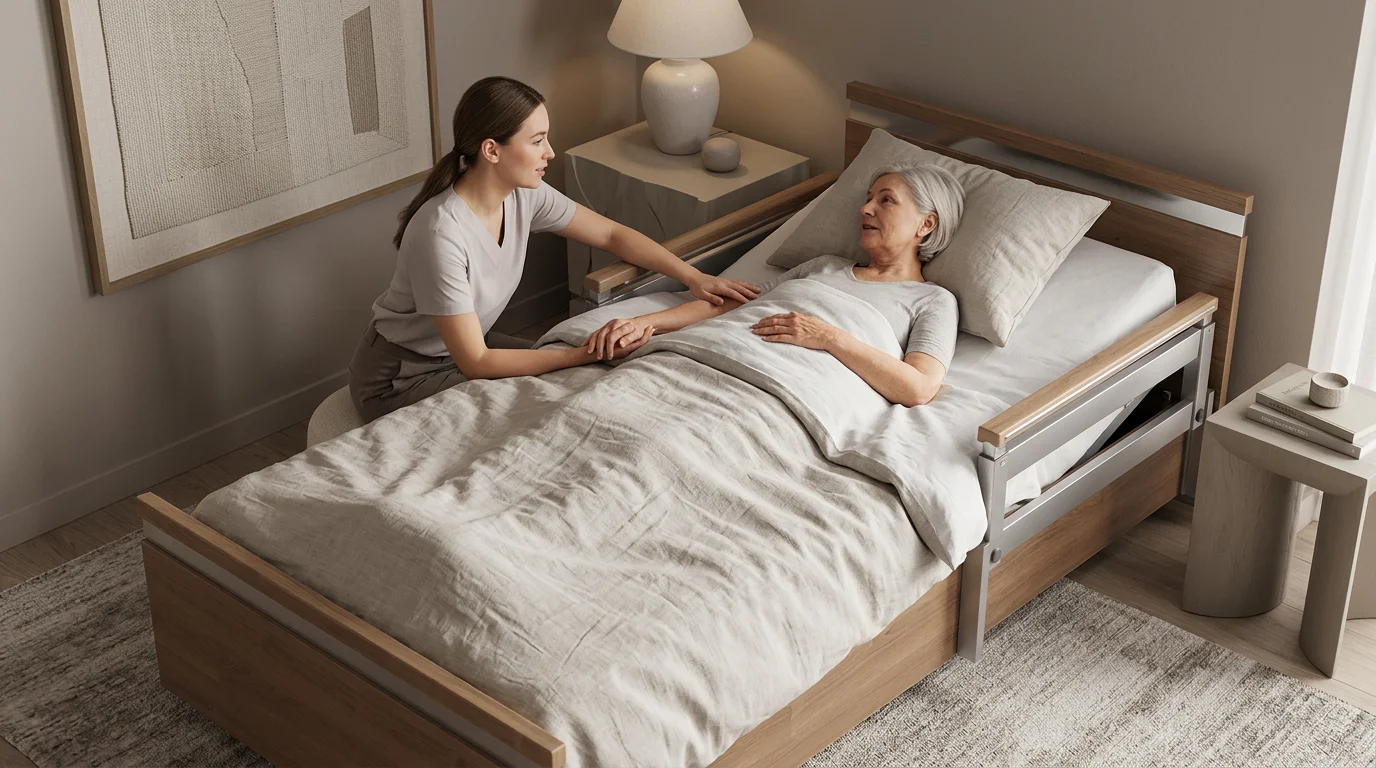
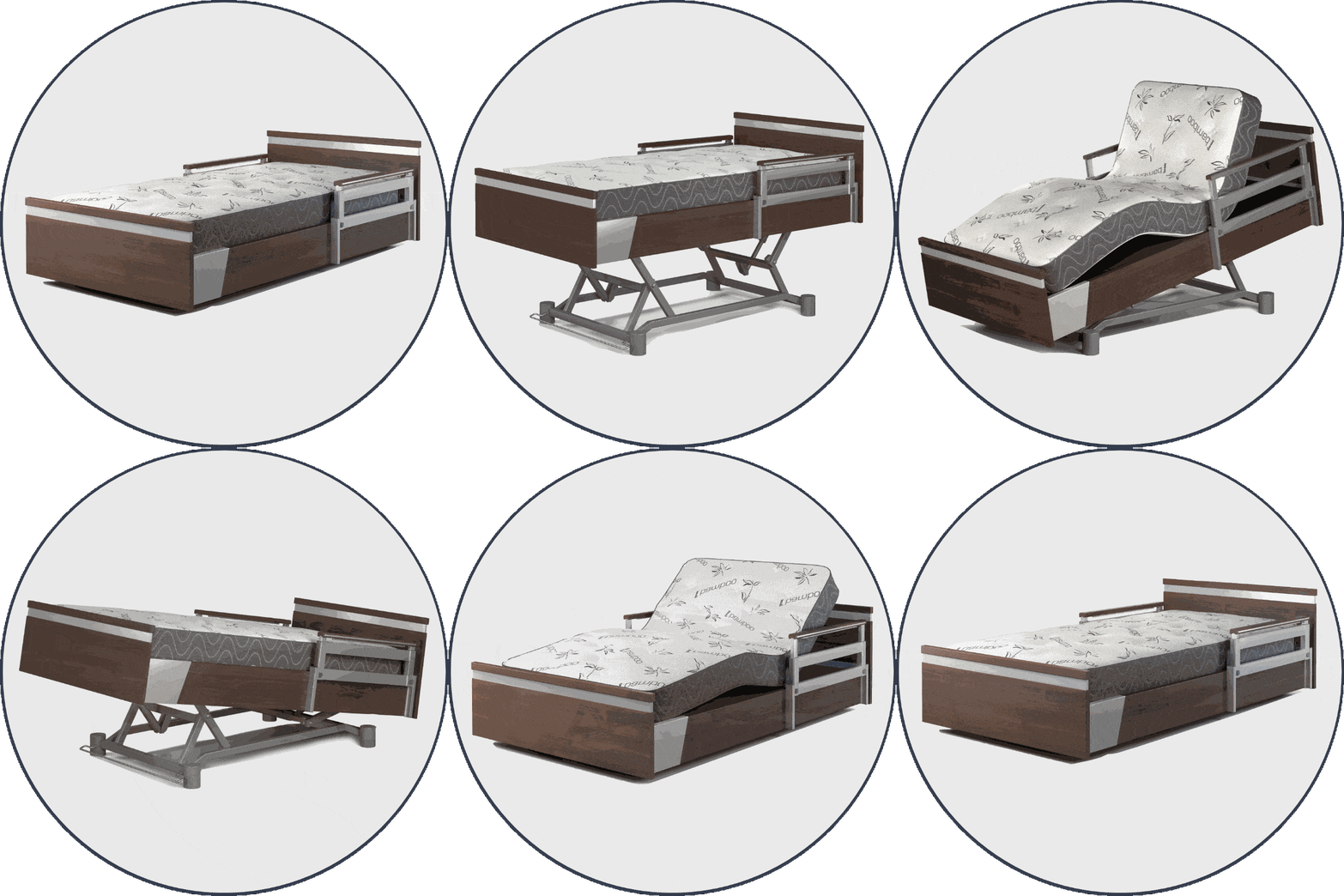
Variable height adjustability is a critical feature for safety—for both your loved one and for you. A bed that lowers brings the surface close to a wheelchair for safer, more dignified transfers. A bed that raises to a caregiver’s waist-level can help protect your back during personal care, dressing, or therapy, helping you provide care sustainably.
Promoting Autonomy & Quality of Life for Spinal Muscular Atrophy
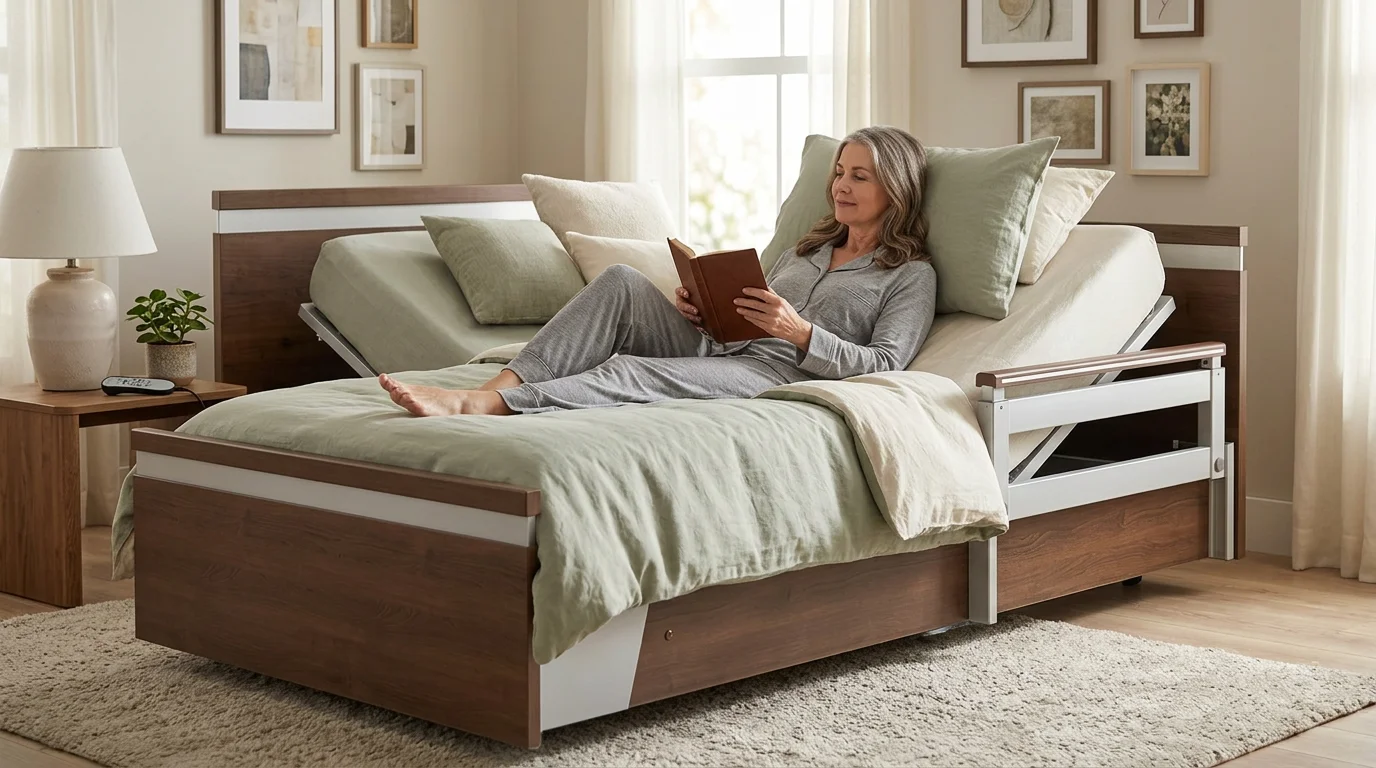
Independence is central to dignity. A bed with a simple, patient-operated hand control can allow your loved one to change positions for comfort, to reach a book, or to join a conversation without having to ask for help. Features like an overhead trapeze bar can aid in small, independent movements. Importantly, modern home hospital beds are designed with residential aesthetics, helping this important tool blend into a bedroom and preserve a sense of normalcy and personal style.
The Safety Imperative: Mitigating Lethal Risks with Knowledge
The therapeutic benefits are only valuable if the environment is safe. The risks are real and quantified, but being armed with this specific data empowers you to prevent them.
The Stark Reality of Bed Entrapment for SMA Patients
Entrapment occurs when a body part is caught between the mattress, bed rails, or frame. The data is sobering, and it’s why we focus relentlessly on bed safety standards:
- Between 1985 and 2009, the FDA received 803 reports of patient entrapment in bed rails, resulting in 480 deaths.
- A 2025 report detailed a fatal entrapment between a bed and a bed lever.
- SMA-Specific Risk: This risk is magnified for children with SMA due to small body size and low muscle tone, which can allow a limb or the head to slip into gaps that would not entrap an adult.
The Non-Negotiable Bed Safety Standard: IEC 60601-2-52
This international standard exists specifically to prevent the tragedies noted above. Do not procure a bed without verified compliance. It is your family’s primary safeguard.
- Standard Name: IEC 60601-2-52
- What it Does for You: It sets maximum allowable dimensional gaps in the entire bed system to prevent entrapment of the head, neck, chest, and limbs.
IEC 60601-2-52 Compliance Checklist
| IEC 60601-2-52 Principle | Description | Implication for SMA Procurement |
|---|---|---|
| Dimensional Gap Limits | Specifies maximum allowable gaps in the bed system. | Mandatory: Procure only certified compliant beds. |
| Side Rail Integrity | Rails must withstand specific forces. | Critical: Ensures safe use for repositioning. |
| Locking Mechanisms | Adjustable components must lock securely. | Essential: Prevents unexpected movement. |
| Risk Assessment | Requires manufacturer entrapment risk analysis. | Verification: Request compliance docs during procurement. |
Additional Hazards: Tubing & Ventilator Integration
For those using BiPAP, ventilators, or feeding pumps, tubing can become entangled in moving parts. Comprehensive caregiver training on organized tubing management is a non-negotiable part of safe implementation and your peace of mind.
Pediatric-Specific SMA Bed Considerations: Where Adult Standards Fail
Applying adult equipment and protocols to children with SMA is inadequate and can be dangerous. This section highlights the gaps so you can advocate more effectively.
- Anthropometric Mismatch & Entrapment: Gaps deemed “safe” by adult standards can still be lethal for a small, hypotonic child. There is a critical lack of pediatric-specific bed safety protocols, making your vigilance and the IEC standard even more crucial.
- Scoliosis, Contractures & Pressure Mapping: Body deformities create unique, high-pressure points. Standard pressure maps fail here. Guidelines for custom-molded bed surfaces or specialized positioning systems are virtually non-existent for the pediatric SMA population.
- Caregiver Handling for Growing Bodies: The physical strain of handling a growing child with significant weakness increases over time. Dedicated studies on safe patient handling techniques for caregivers of children with neuromuscular conditions are needed to better support your family’s journey.
The Economic Case & U.S. Reimbursement Pathway for SMA Beds
Cost-Avoidance ROI Model: An Investment in Prevention
Justifying a bed is often about demonstrating its value in preventing far more expensive and painful complications. These statistics show why this investment in safety and prevention matters.
| Item | Estimated Cost | Complication Prevented | Estimated Cost of Complication | ROI Insight |
|---|---|---|---|---|
| Group 2 Pressure-Reducing Surface (e.g., APM, LAL) | ~$2,500 | Stage 2+ Pressure Ulcer | ~$21,000 (average) | Break-even after preventing one ulcer. |
| Total Electric Hospital Bed | ~$2,000 – $5,000 | Fall with Injury / Aspiration Pneumonia | >$10,000 per hospitalization | ROI driven by avoiding admissions. |
U.S. Medicare Coverage “Cheatsheet”: Your Documentation Roadmap
Securing electric hospital bed Medicare coverage requires precise documentation aligned with policy. Two absolute prerequisites are a face-to-face encounter and a Written Order Prior to Delivery (WOPD) signed by the prescribing physician. Use this table to guide your conversation with the doctor.
| Item | Relevant HCPCS Codes | Key Medicare Policy | Clinical Documentation Tip for SMA |
|---|---|---|---|
| Semi-Electric Bed | E0260 | LCD L33820, LCA A52508 | Document need for positioning (e.g., HOB >30°) not possible in a standard bed. |
| Total Electric Bed | E0265 | LCD L33820, LCA A52508 | 1. Document patient can operate controls. 2. Document need for frequent, complex position changes for pain, respiration, or care. |
| Powered Pressure-Reducing Mattress (Group 2) | E0277 | LCD L33642, LCA A52490 | Document history of ulcers OR immobility + a comorbidity (e.g., incontinence, malnutrition). For SMA, explicitly link profound immobility and NIV/ventilator use to high skin breakdown risk. |
European Funding Landscape
Access is often fragmented. While the European hospital bed market is projected to reach $2.62 billion by 2033, no specific, uniform coverage policies for SMA home beds were identified across major systems like the NHS (UK), GKV (Germany), or in France. This creates a funding vacuum, meaning access often depends on local policies or determined individual appeals.
The Private Pay Workflow: Respiratory Safety & Independence
For families living with SMA, standard insurance criteria often fail to account for the nuanced needs of severe muscle weakness. The Private Pay option allows you to bypass the “medical necessity” bottleneck and secure a bed that proactively addresses respiratory health and autonomy.
- Solving the “Distal Weakness” Gap: Medicare typically defaults to Semi-Electric beds, which require a manual hand crank to adjust height. For SMA patients with significant hand weakness, this is physically impossible. Private pay ensures access to Fully Electric (Hi-Lo) beds, giving the user total control over their environment via a soft-touch remote.
- Advanced Respiratory Positioning (Trendelenburg): Standard insurance beds rarely offer Trendelenburg (tilting the bed frame). However, for SMA type 1 and 2, this position can be vital for postural drainage and secretion clearance. Private pay grants immediate access to beds with these therapeutic tilt functions.
- Speed During Respiratory Crises: When respiratory function declines or after a surgery (like spinal fusion), waiting 3–6 months for insurance approval is dangerous. Private pay allows for rapid delivery, ensuring the home is ready for discharge or immediate care needs.
- Using Pre-Tax Dollars (HSA/FSA): You can often use Health Savings Accounts (HSA) or Flexible Spending Accounts (FSA) for the purchase. A Letter of Medical Necessity (LMN) from your pulmonologist or neurologist is usually required to validate the expense for tax purposes.
- Financing Options: Many premium manufacturers offer 0% interest financing (e.g., Affirm, CareCredit), allowing families to amortize the cost of a sophisticated, respiratory-friendly bed over 12–24 months.
Your SMA Hospital Bed Procurement Criteria & Implementation Checklist
Regulatory Cross-Walk for Safe Procurement
Understand which standard governs which risk, so you know what to ask for.
| Area of Concern | IEC 60601-2-52 | FDA Guidance | NPIAP Guidance |
|---|---|---|---|
| Bed Entrapment | Primary source for dimensional standards. | Issues safety alerts and tracks events. | Not a primary focus. |
| Pressure Injury Prevention | Not a primary focus. | Not a primary focus. | Primary source for surface selection. |
| Fall Prevention | Addresses stability & rail integrity. | Provides general guidance. | Not a primary focus. |
The 12-Point Procurement Checklist for SMA (Your Family’s RFP Template)
When evaluating home hospital beds for Spinal Muscular Atrophy, this checklist is your minimum requirement for safety and function. (Responsible Party: Family/Care Coordinator with Clinician & DME Supplier).
- Full Electric Articulation (Head, Foot, Height).
- Height Range: Extends from a safe, ultra-low height (as low as 40 cm) to a caregiver-friendly 80 cm or higher.
- IEC 60601-2-52 Compliance (Request the certificate).
- HOB Elevation: Capable of ≥ 30 degrees.
- Patient-Operable Hand Control (wired or wireless).
- Compatibility with Group 2 (APM/LAL) surfaces.
- Secure Side Rails with compliant, entrapment-safe gaps.
- Supports an overhead trapeze bar.
- Weight Capacity appropriate for patient + equipment.
- Emergency Lowering Function (battery backup).
- Pinch-Free Frame Design for safe tubing management.
- For Pediatrics: Explicitly designed for pediatric anthropometry or has proven adaptive solutions.
Implementation Roadmap & KPI Dashboard
A structured, careful rollout ensures safety and allows you to see the positive impact.
Step-by-Step Workflow for Families & Care Teams:
- Cohort Selection (Clinical Team Lead): Select a pilot cohort of 10-15 patients for initial rollout.
- Baseline Data Capture (Data Coordinator): Collect 3-6 months of pre-bed data on: aspiration pneumonia events, pressure injury incidence, caregiver burden scores, and unplanned hospital admissions.
- Comprehensive Training (OT/PT & DME Supplier):
- Clinicians: On Medicare documentation requirements.
- Therapists: On assessing the individual for bed features.
- Families/Caregivers: Hands-on, in-home training for safe bed operation, assisted transfers, emergency procedures, and tubing management. This step is non-negotiable.
- Post-Implementation Tracking (Care Coordinator): Monitor the KPIs below at 1, 3, 6, and 12 months to gauge success.
Mandatory KPI Dashboard Metrics:
- Rate of aspiration pneumonia (events per year).
- Incidence of Stage 2+ pressure injuries.
- Number of falls during transfers.
- Caregiver burden scores (e.g., using the Zarit Burden Index).
- Hospital admission rates for preventable complications.
The Case for a High Quality Hospital Bed for Better SMA Care
The paradox remains: the clinical rationale for home hospital beds in SMA is strong and compassionate, but the direct evidence is absent. This places the burden of proof on families and clinicians during prior authorization processes—a reality we understand and seek to help you navigate.
To establish a true standard of care that all families can rely on, we must generate the evidence. This requires:
- A Proposed Research Trial: A 120-patient randomized controlled trial (SMA Types II/III) with a 12-month follow-up, measuring a composite endpoint of pressure injury incidence and respiratory-related hospitalizations.
- Advocacy: For funding from NIH, Cure SMA, and other foundations to support this vital research.
- Collaboration: Between neuromuscular clinics, rehabilitation engineers, and DME providers to systematically collect real-world data.
- Document Meticulously: Work with your neurologist or physiatrist to detail every point of medical necessity, using the specific language from Medicare LCDs (L33820, L33642) found in this guide.
- Demand Safety Certification: Do not accept any bed without verified IEC 60601-2-52 compliance. Your loved one’s safety depends on it.
- Invest in Training: Insist on comprehensive, hands-on training from your DME supplier and OT/PT before the bed is used. Your confidence in using the equipment is key.
- Become an Advocate: Share your experiences and data with patient advocacy groups to help build the collective case for better coverage and dedicated research.
While the perfect evidence base is still being built, you can take informed, precise action today. By focusing on specific safety standards, detailed clinical documentation, and structured implementation, you can secure a tool that promotes health, preserves dignity, enables safer care, and ultimately supports a life of greater comfort and independence at home.
References & Sources
- Spinal muscular atrophy clinical aspects – review article https://www.sciencedirect.com/science/article/pii/S3050475925006360
- Understanding the experiences of adults with spinal muscular atrophy https://journals.sagepub.com/doi/full/10.1177/22143602251377241
- Top Conditions That Benefit From a Home Hospital Bed https://www.sondercare.com/learn/hospital-beds/conditions-benefit-home-hospital-bed/
- A Guide to Bed Safety Bed Rails in Hospitals, Nursing Homes and Home Health Care – FDA https://www.fda.gov/medical-devices/hospital-beds/guide-bed-safety-bed-rails-hospitals-nursing-homes-and-home-health-care-facts
- IEC 60601-2-52:2009(en), Medical electrical equipment – ISO https://www.iso.org/obp/ui/en/#!iso:std:36067:en
- The economics of pressure relieving surfaces https://pmc.ncbi.nlm.nih.gov/articles/PMC7951755/
- Medical Policy – Providence Health Plan https://www.providencehealthplan.com/-/media/providence/website/pdfs/providers/medical-policy-and-provider-information/medical-policies/mp403.pdf
- 8 Tips for Making Your Home More SMA-Friendly https://www.healthcentral.com/condition/spinal-muscular-atrophy/tips-for-making-your-home-sma-friendly
- Spinal Muscular Atrophy In-Home Care https://www.togetherinsma.com/en_us/home/living-with-sma/in-home-care.html
- Physical and Respiratory Rehabilitation in Spinal Muscular Atrophy https://www.mdpi.com/2076-3417/15/8/4398
- How Can Hospital Beds Help Muscular Dystrophy? https://www.sondercare.com/learn/hospital-beds/how-hospital-beds-help-muscular-dystrophy/
- HEAD OF BED ELEVATION IN THE ICU – Surgical Critical Care https://www.surgicalcriticalcare.net/Guidelines/head%20of%20bed%20elevation.pdf
- Guideline Clinical management of COVID-19 – NCBI https://www.ncbi.nlm.nih.gov/books/NBK582435/pdf/Bookshelf_NBK582435.pdf
- How Can Hospital Beds Help Muscular Dystrophy? (Secondary Reference) https://www.sondercare.com/learn/hospital-beds/how-hospital-beds-help-muscular-dystrophy/
- Preventing pressure injuries in individuals with impaired mobility https://pmc.ncbi.nlm.nih.gov/articles/PMC12330434/
- The experience of using a hospital bed alternative at home https://pmc.ncbi.nlm.nih.gov/articles/PMC9987729/
- Implications of an adjustable bed height during standard nursing tasks https://pubmed.ncbi.nlm.nih.gov/11083155/
- FDA MAUDE Database – Bed Entrapment Report 2025 https://www.accessdata.fda.gov/scripts/cdrh/cfdocs/cfmaude/detail.cfm?mdrfoi__id=22369843&pc=FNL
- A Guide for Modifying Bed Systems and Using Accessories to Reduce Risk of Entrapment https://www.fda.gov/medical-devices/hospital-beds/guide-modifying-bed-systems-and-using-accessories-reduce-risk-entrapment
- Effectiveness of pressure-relieving mattresses on pressure ulcers https://wounds-uk.com/journal-articles/effectiveness-of-pressure-relieving-mattresses-on-pressure-ulcers/
- Europe Hospital Beds Market Size, Growth & Analysis, 2033 https://www.marketdataforecast.com/market-reports/europe-hospital-beds-market