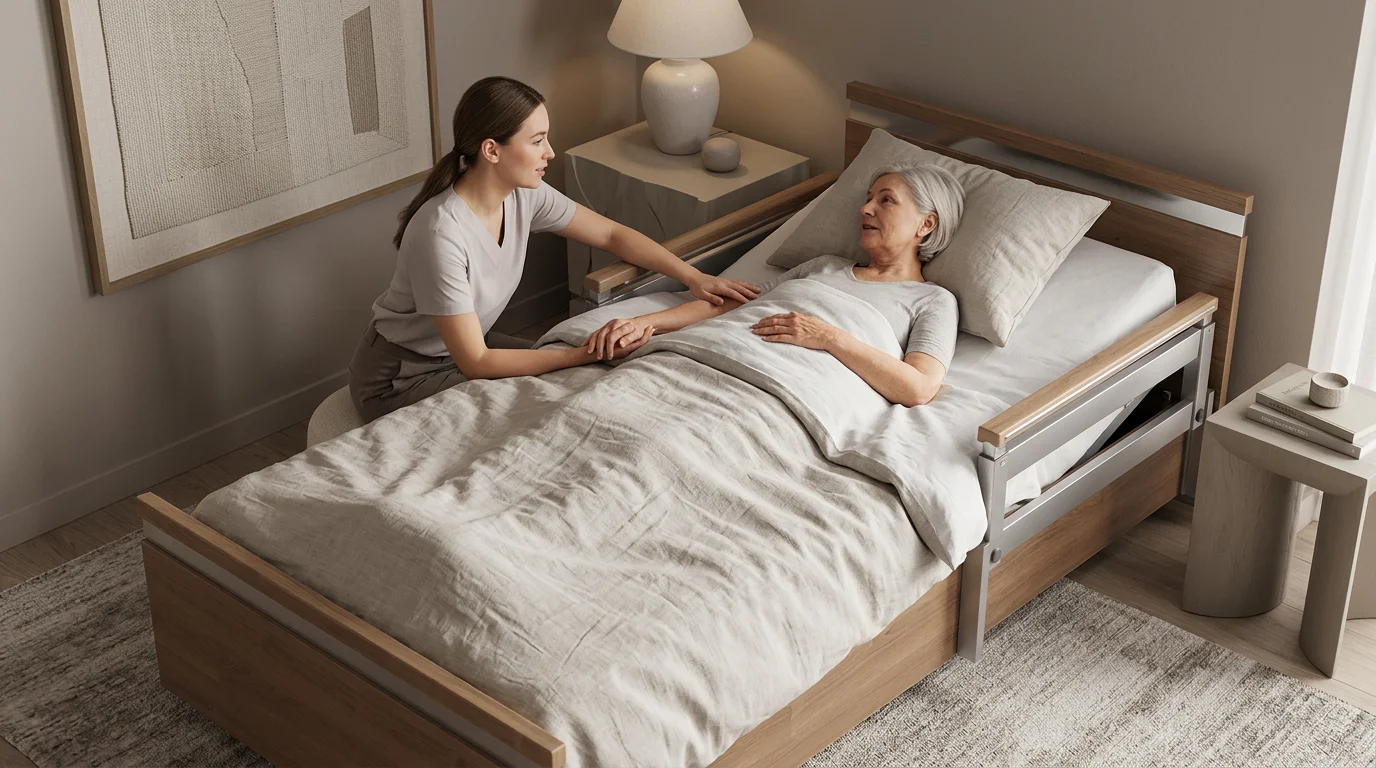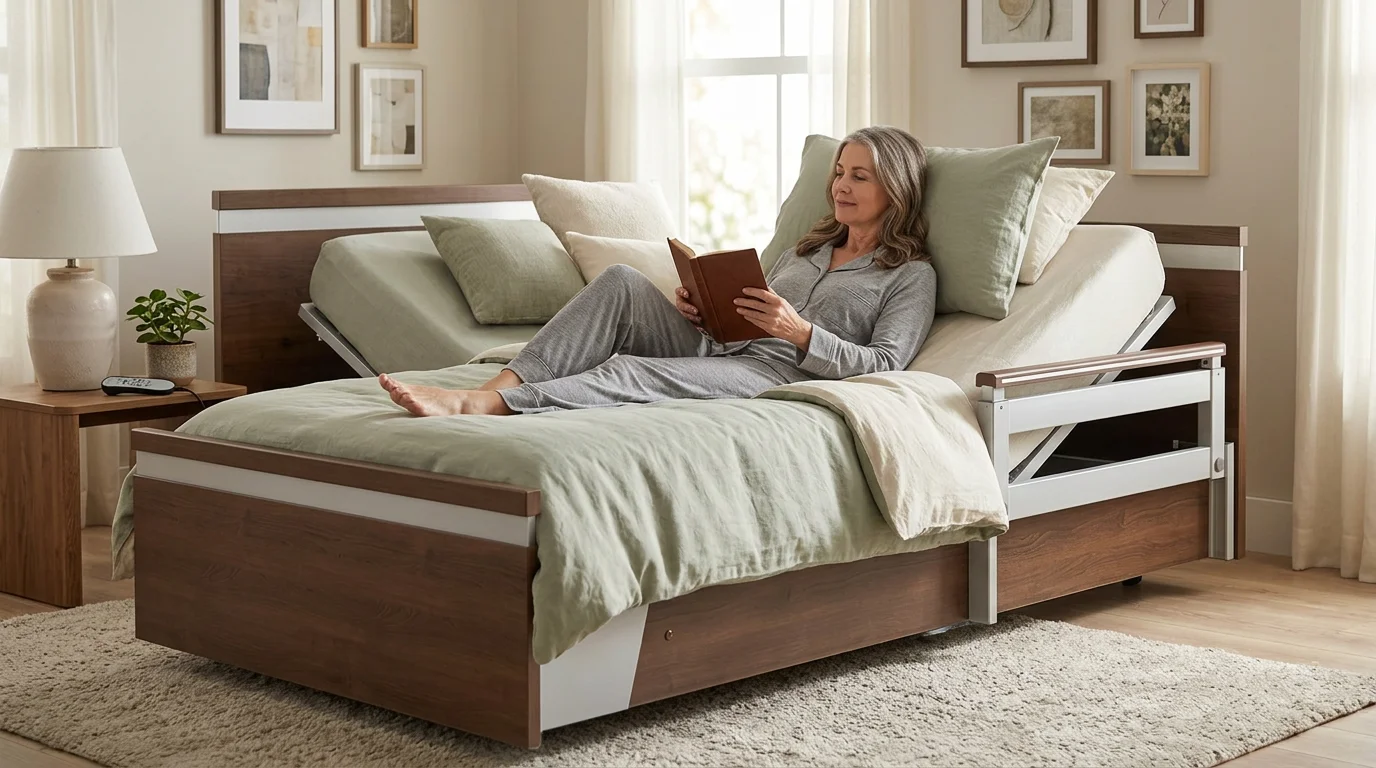



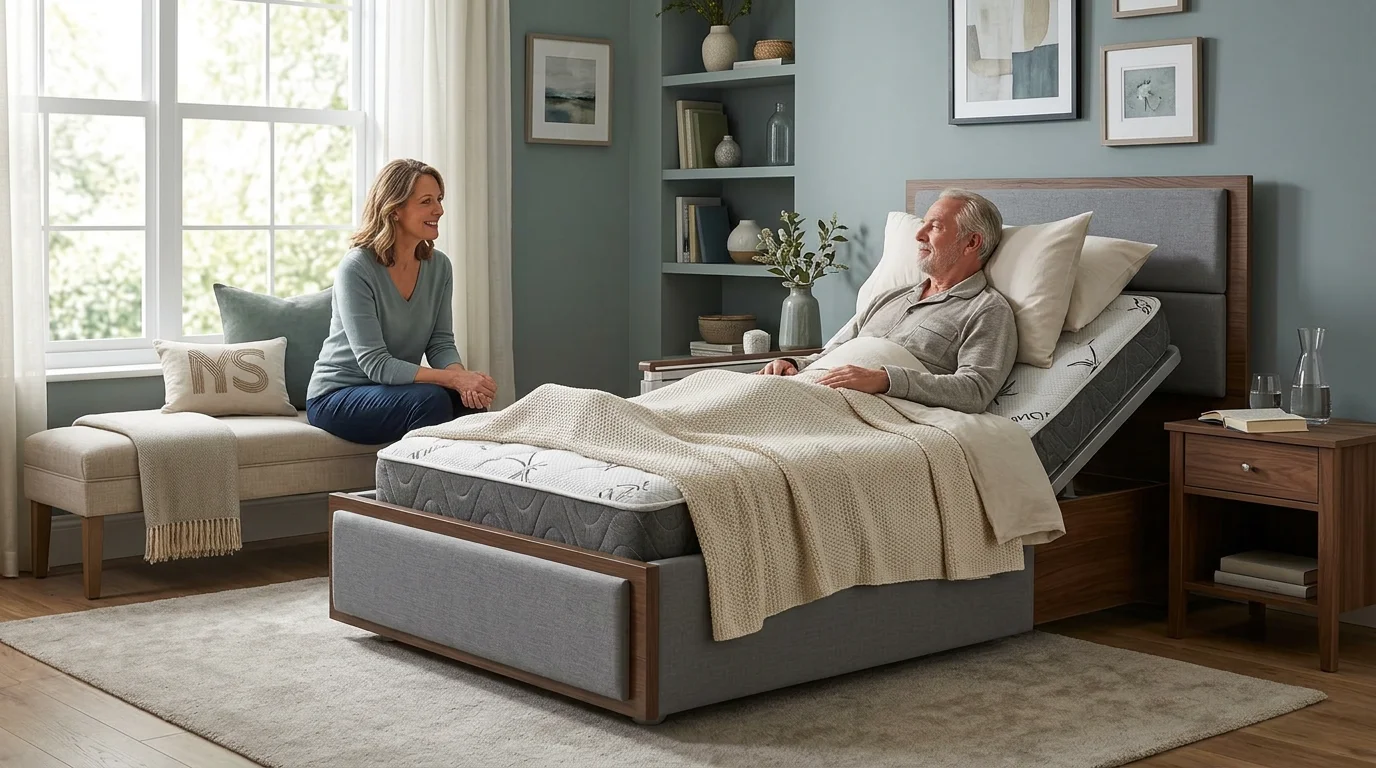





You already know the 2am problem. Your partner’s legs lock in a spasm, and neither of you can sleep until someone repositions. Or maybe it’s the morning routine, lifting legs that feel like dead weight from the floor to the mattress, bracing your back against a bed frame that’s exactly the wrong height. You’ve been doing this on a standard bed for months, and something is going to give.
A home hospital bed doesn’t solve multiple sclerosis. But it changes the physical math of living with it, for both the person with MS and the person caring for them. This guide explains exactly what hospital beds help with, which features matter most, and when it makes sense to make the transition.
MS affects nearly 1 million people in the United States2 and approximately 2.8 million people worldwide,1 making it one of the most common neurological conditions that caregivers encounter at home. Among the conditions that benefit from a home hospital bed, MS is notable because the right equipment can meaningfully slow caregiver burnout and reduce injury risk, for both people in the room.
What MS Does to Sleep and Mobility
Multiple sclerosis attacks the protective myelin sheath around nerve fibers, disrupting the signals the brain sends to muscles and organs. The result is a symptom cluster that makes standard bedroom furniture a genuine safety problem.
The symptoms most relevant to sleep and bed use:
- Muscle weakness and spasticity, Legs and limbs may feel impossibly heavy, and muscles can tighten involuntarily, especially during periods of rest
- Fatigue, MS-related fatigue is pervasive; more than 59% of people with MS report it across a global meta-analysis of 44,000 patients3
- Sleep disruption, People with MS experience moderate-to-severe sleep problems at nearly twice the rate of the general chronically ill population4
- Bladder urgency, Frequent nighttime trips to the bathroom increase fall risk
- Reduced sensation, Decreased feeling in limbs means pressure injuries can develop silently, without pain warning
None of these symptoms is caused by the bed. But a poorly suited bed amplifies every one of them.
Height Adjustment: The Benefit Nobody Tells You About
Ask any caregiver who has used a height-adjustable hospital bed what changed first, and the answer is almost always the same: their back.
A standard residential bed sits at a fixed height, usually 24 to 26 inches, which is fine when you’re getting in and out of it yourself. When you’re assisting someone else, that fixed height forces you into a chronic bending posture that clinicians have linked directly to shoulder injuries and lower back strain in home caregivers.
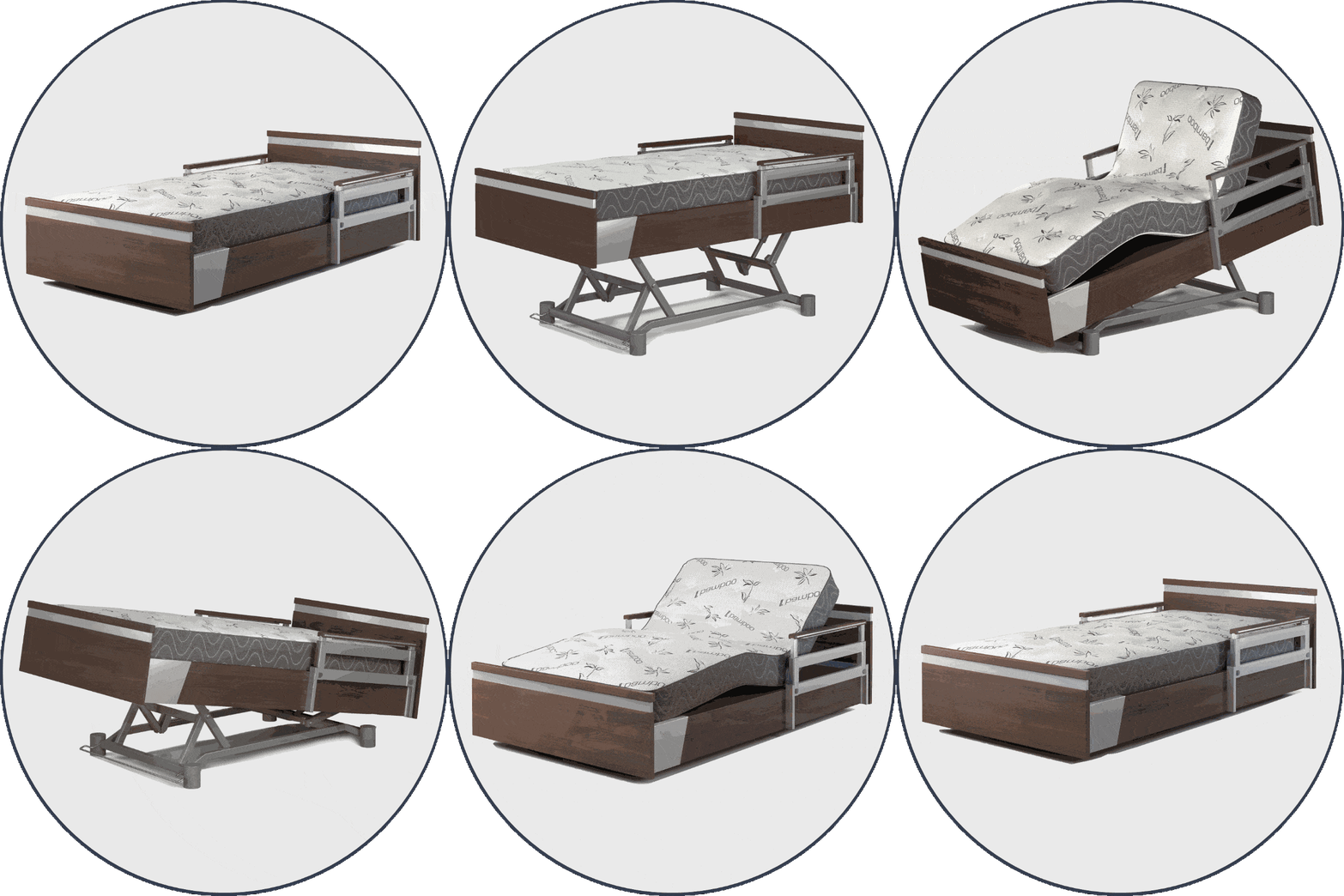
The Aura Premium home hospital bed adjusts from 10 inches at its lowest platform to 39 inches at its highest. In practical terms, that means a caregiver can raise the bed to working height, standing upright, using their legs instead of their back, for dressing, washing, and repositioning. Then lower it to a safe transfer height for helping the person with MS sit on the edge and transfer to a wheelchair or commode. Then lower it further for sleep.
That range makes a substantial difference. Caregivers who discover height adjustment consistently describe it as something no one told them about at the start, a feature that would have saved years of physical strain.
For the person with MS, height adjustment also changes what is possible independently. At the right height, a person with partial mobility may be able to sit up, swing their legs to the side, and push off without assistance, where the same move on a too-low or too-high bed required a caregiver’s help.
Nighttime Spasticity and the Repositioning Burden
MS muscle spasms are clinically worse at night. When the body is still for long periods, muscles tighten, and the resulting spasms can wake both the person with MS and whoever is sleeping nearby. This isn’t a niche complaint. It is one of the most consistent experiences across MS caregiver forums, and it drives a significant share of sleep disruption for both people in the household.
Clinical guidelines for anyone with MS-related immobility recommend repositioning every two hours to prevent pressure injuries and manage spasticity.7 Without a bed that makes repositioning possible, those two-hour intervals fall entirely on the caregiver’s body, and compliance studies show that achieving two-hour turns manually is physically demanding; caregiver compliance drops significantly when repositioning requires full manual lifting.8
A fully electric hospital bed changes this in two ways.
First, the backrest and knee adjustments, controlled by a hand remote, let the person with MS shift their own position if their hands and arms retain enough strength. A 2am spasm doesn’t have to wake a caregiver if the person can reach the remote and make a small adjustment themselves. This is one of the strongest independence benefits a hospital bed provides for MS patients in earlier-to-mid disease stages.
Second, as MS progresses and independent control becomes harder, the same remote lets a caregiver reposition from the side of the bed, lifting the head section, adjusting the knee break, or changing the bed height, without having to physically move their partner’s body. That’s not a small convenience. For someone doing two-hour turns through the night, it’s the difference between a sustainable caregiving situation and one that ends in injury.
For more guidance on repositioning schedules, see our guide on how often to reposition a bedridden person.
Safe Transfers and Fall Prevention
Getting out of bed is the highest-risk moment of the care day for most people with MS. The combination of muscle weakness, reduced sensation, and postural instability means that an awkward transfer on a fixed-height bed can end in a fall, sometimes with serious consequences.
A home hospital bed addresses this through three specific mechanisms:
1. Transfer height pre-programming. The Aura Premium has a pre-programmed 21-inch transfer position designed specifically for safe bed-to-wheelchair or bed-to-commode moves. At 21 inches, a person with partial mobility can plant their feet flat on the floor before standing, which dramatically reduces the instability window during transitions.
2. FallSafe Ultra-Low Height. When lowered to its minimum, the Aura’s platform sits at 10 inches, 17 inches to the top of the mattress. This ultra-low position is designed for people with high fall risk who might roll or slide off the edge of the bed. If a fall does occur from this height, the distance to the floor and the resulting impact are significantly reduced compared to a standard-height bed.
3. Assist side rails. Hospital bed rails provide a stable grip point for the person with MS to pull themselves to sitting, stabilize during a transfer, and prevent rolling during sleep. They are not intended as standing aids, but as positional stabilizers, and that function matters every time someone shifts position during the night.
For a broader look at reducing fall risk at home, our fall prevention guide covers the full picture of bedroom modifications and equipment choices.
Pressure Injuries: Why MS Immobility Creates Real Risk
The National MS Society is specific about this: it is not MS itself that creates pressure sore risk, it is immobility.7 When someone with MS spends long periods in one position, the sustained compression of skin against the mattress reduces blood flow to vulnerable tissue. Because reduced sensation is common in MS, the person may not feel the pain that typically signals a developing pressure injury.
The clinical and economic stakes are real. Pressure injuries in the US healthcare system account for more than $26.8 billion in annual costs,6 and immobility has been identified as a primary independent risk factor for their development.5 For people cared for at home with MS, preventing pressure injuries requires two things: regular repositioning and a mattress that actively redistributes pressure.
The MS Society recommends changing position every two hours and using a pressure-distributing mattress, explicitly noting that standard foam egg-crate overlays are not adequate for at-risk patients.7
SonderCare offers two relevant mattress options for MS care:
- Signature Hybrid Mattress ($1,799), Coil spring and foam construction with individually wrapped pocket coils and a copper-infused cover. The pocket coils respond to body movement to redistribute pressure, making it a strong choice for people with MS who can still reposition somewhat independently.
- Alternating Pressure Air Mattress ($2,999), Eighteen air bladders cycle inflation automatically, providing continuous pressure redistribution without manual turning. This is the clinical-grade option for people with advanced MS and significant pressure sore risk.
For a complete guide to mattress selection and pressure injury prevention, see our pressure sore prevention guide.
When Is the Right Time to Get a Hospital Bed for MS?
One of the most consistent patterns in MS caregiver communities is waiting too long. Caregivers describe operating in crisis mode for months, absorbing the physical strain of manual transfers, sleeping poorly because repositioning requires waking up, before someone tells them that a better option exists.
There is no single “right moment,” but these are clear signals that a standard bed is no longer working:
- Leg-lift failure: The person with MS can no longer swing their legs onto the mattress independently, and every transfer requires manual lifting
- A fall event: Any fall during a transfer or in the night is a signal that bed height, positioning, and rail support need to be reassessed immediately
- Nighttime repositioning every two hours: If you are waking on a schedule to manually turn your partner, a powered bed is not a luxury, it is a clinical necessity
- Emerging pressure sore risk: Any skin redness that does not resolve within 30 minutes of pressure relief warrants immediate attention and a pressure-redistributing mattress
- Caregiver back or shoulder pain: If the person doing the caregiving is being injured by the work, the equipment is wrong
The people who delay longest are often those who think they are “not bad enough yet” for a hospital bed. MS is a progressive condition. Starting with the right equipment before a crisis keeps options open and prevents caregiver injury before it compounds.
Adjustable Bed vs. Hospital Bed: What’s the Difference?
This is the most common question caregivers ask before making a decision. Consumer adjustable beds, from brands like Sleep Number and Tempur-Pedic, offer head and foot elevation. They are designed for comfort preferences, not care needs.
| Feature | Consumer Adjustable Bed | Home Hospital Bed (Aura) |
|---|---|---|
| Head / foot elevation | Yes | Yes |
| Full hi-lo height adjustment (10″–39″) | No | Yes |
| Pre-programmed transfer position | No | Yes (21″) |
| FallSafe ultra-low height | No | Yes (10″ platform) |
| Assist side rails | No | Yes (included) |
| Hospital certification | No | Yes (International Hospital Standard) |
| Weight capacity | 400–700 lbs typical | 500 lbs (Aura) |
| Trendelenburg / Reverse Trendelenburg | No | Yes (under medical supervision) |
The gap that matters most for MS care is height adjustment. Without it, caregivers work at the wrong height. Without a transfer position, safe transitions require manual lifting. Without rails, nighttime repositioning provides nothing to grip. A consumer adjustable bed is fine for a healthy person who wants to read in bed. It is the wrong tool for MS care.
For a full breakdown of how to evaluate these options, our guide to choosing a home hospital bed covers every major decision point.
Which Hospital Bed Works Best for MS?
The right bed for MS depends on disease stage, caregiver situation, and how much the bedroom aesthetic matters to the household.
Aura Premium Home Hospital Bed, $6,999
The Aura Premium is the core recommendation for MS care. It includes the full positioning suite, hi-lo from 10 to 39 inches, FallSafe ultra-low, Zero Gravity, Cardiac Chair, and Trendelenburg (for use under medical supervision), along with assist side rails, a 500 lb weight capacity, and certification to the International Hospital Standard. The quiet 54 dB motor won’t disrupt sleep during nighttime adjustments. For the majority of MS care situations, this bed covers every clinical need.
Aura Platinum Home Hospital Bed, $8,499
The Aura Platinum has identical clinical capabilities to the Aura Premium, with one meaningful upgrade: fully upholstered Slate Gray Crypton side panels. For families where the bedroom aesthetic matters, where the person with MS has been resistant to equipment that makes the room feel clinical, the Platinum is the option that removes that objection. Same safety, residential appearance.
Aura Companion Bed, $12,999
For spousal caregivers who want to continue sleeping in the same room, the Aura Companion is a split-king configuration that allows each side to be adjusted independently for comfort positioning (head elevation, knee adjustment) while both sides move together for hi-lo adjustments. This means a caregiver can raise the bed to assist their partner without the caregiver’s own sleeping surface changing.
SonderCare’s white-glove delivery includes full setup, installation, a walkthrough of all controls, and debris removal. Rush delivery is available in one to three business days for urgent situations.
Helping Someone With MS Live Better at Home
A home hospital bed for MS isn’t about giving up, it’s about doing more with less physical cost. The right bed protects the caregiver’s back, reduces the physical burden of nighttime repositioning, lowers fall risk during transfers, and creates a system for pressure injury prevention that doesn’t require manual effort every two hours through the night.
MS is a condition that changes over time. The right equipment at the right moment doesn’t just manage today’s needs, it preserves the caregiver’s ability to keep providing care and keeps the person with MS at home longer.
If you’re not sure which bed matches your specific situation, SonderCare’s bed experts have helped thousands of families navigate this decision. There is no pressure, just a conversation about what your situation actually requires.
Speak with a SonderCare expert, no obligation, just guidance from people who know the equipment.
References
-
Walton C, Walorska M, Bhatt M, et al. “Rising prevalence of multiple sclerosis worldwide: Insights from the Atlas of MS, third edition.” Multiple Sclerosis Journal. 2020;26(14):1816–1821. https://pmc.ncbi.nlm.nih.gov/articles/PMC7720355/
-
National Multiple Sclerosis Society. “Who Gets Multiple Sclerosis?” https://www.nationalmssociety.org/understanding-ms/what-is-ms/who-gets-ms
-
Yi X, Zhang Y, Du Q, Jiao J. “Global prevalence of fatigue in patients with multiple sclerosis: a systematic review and meta-analysis.” Frontiers in Neurology. 2024. https://www.frontiersin.org/journals/neurology/articles/10.3389/fneur.2024.1457788/full
-
Bamer AM, Johnson KL, Amtmann D, Kraft GH. “Prevalence of sleep problems in individuals with multiple sclerosis.” Multiple Sclerosis Journal. 2008;14(8):1127–1130. https://pmc.ncbi.nlm.nih.gov/articles/PMC2845464/
-
Lindgren M, Unosson M, Fredrikson M, Ek A-C. “Immobility, a major risk factor for development of pressure ulcers among adult hospitalized patients: a prospective study.” Scandinavian Journal of Caring Sciences. 2004;18(1):57–64. https://pubmed.ncbi.nlm.nih.gov/15005664/
-
Peterson A, Doiron R, Bauer C, et al. “Preventing pressure injuries in individuals with impaired mobility: Best practices and future directions.” Journal of Surgical Research. 2025. https://pmc.ncbi.nlm.nih.gov/articles/PMC12330434/
-
National Multiple Sclerosis Society. “Pressure Sores and Multiple Sclerosis.” https://www.nationalmssociety.org/managing-ms/treating-ms/advanced-care-needs/pressure-sores
-
Asiri S. “Turning and repositioning frequency to prevent hospital-acquired pressure injuries among adult patients: Systematic review.” INQUIRY: The Journal of Health Care Organization, Provision, and Financing. 2023. https://pmc.ncbi.nlm.nih.gov/articles/PMC10699153/