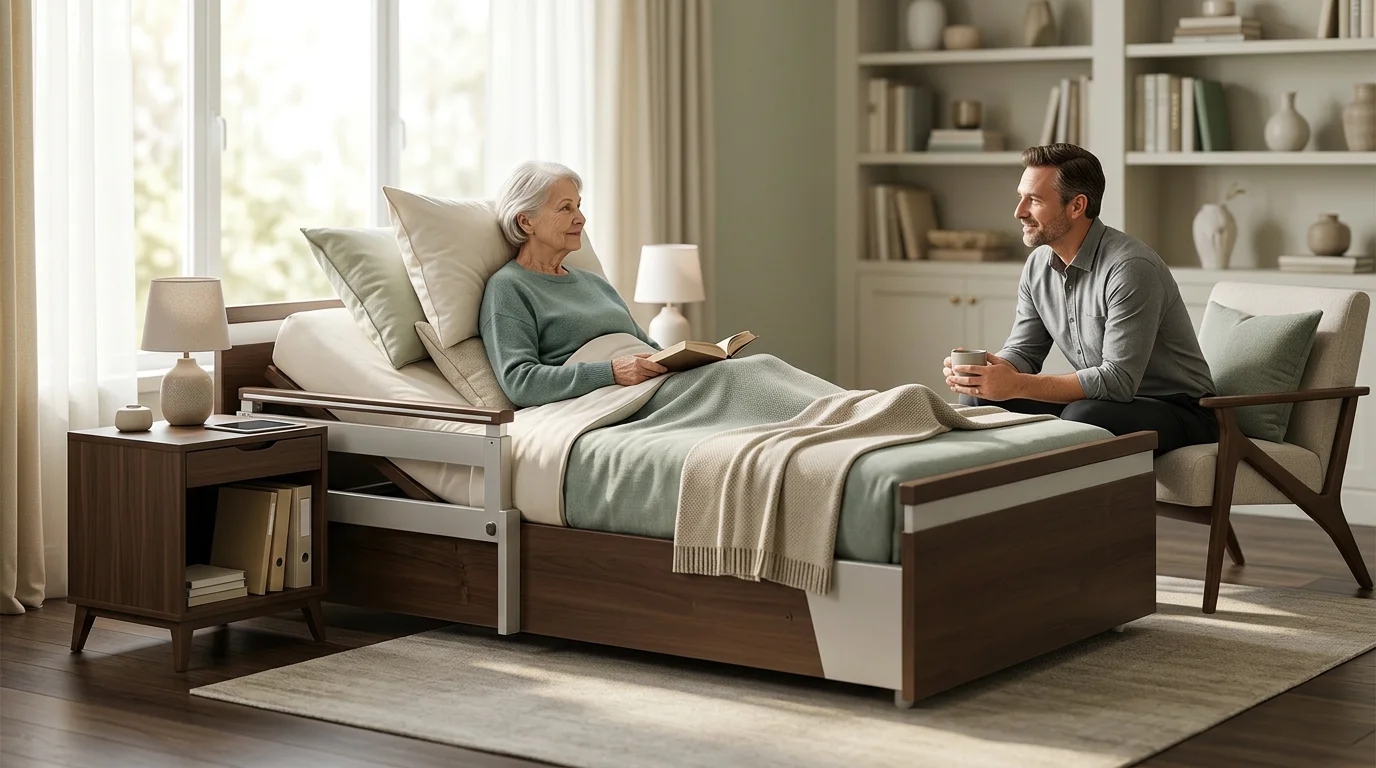
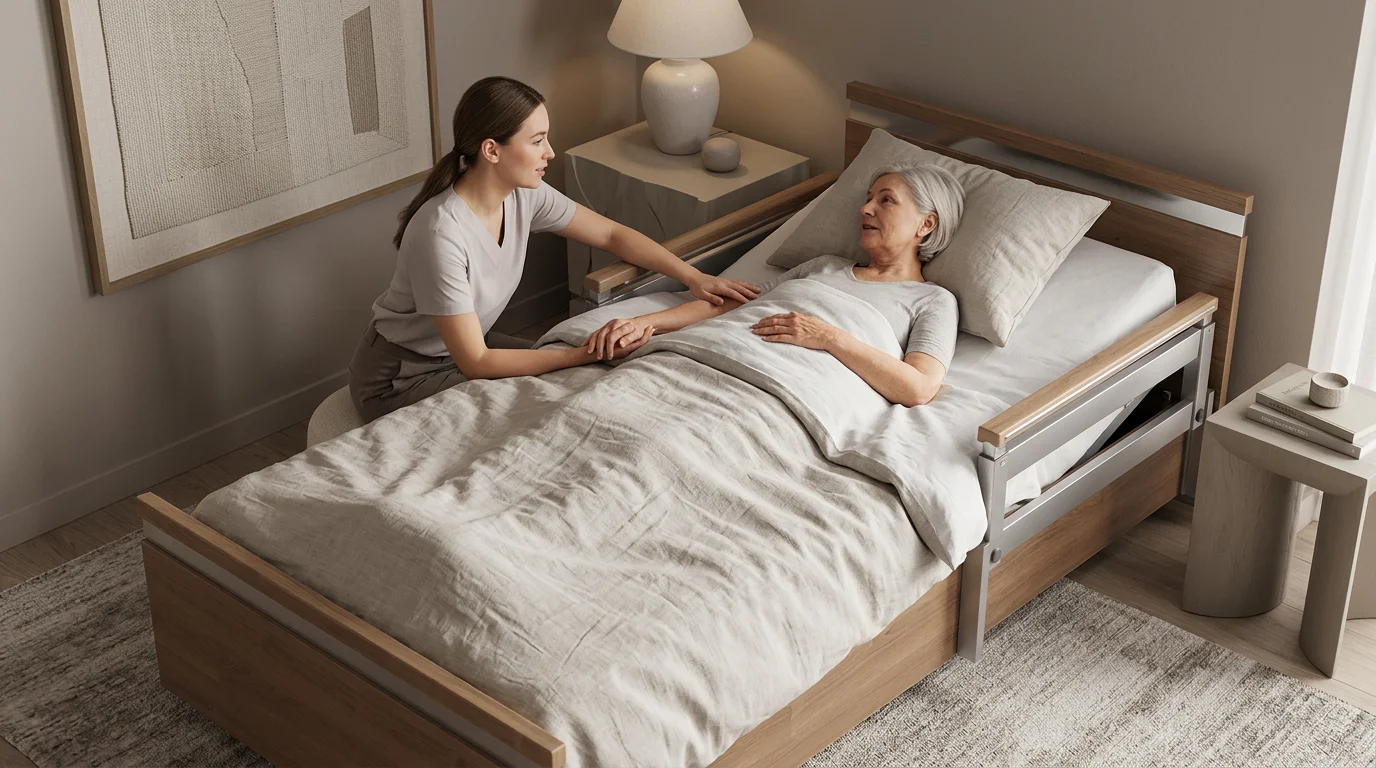
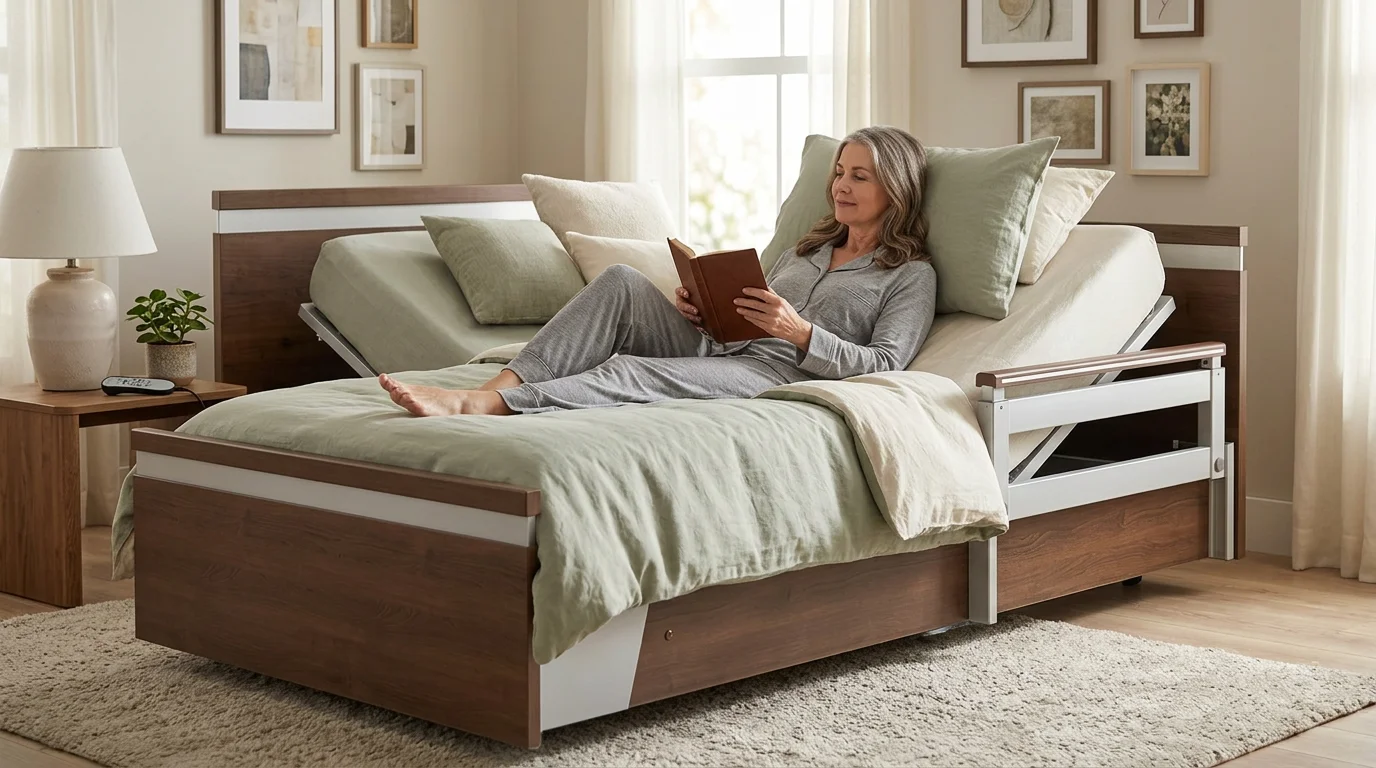
When Ellen’s husband came home from the hospital after his stroke, she had 48 hours to figure out how they were going to pay for a home hospital bed. The discharge nurse handed her a pamphlet about Medicare DME suppliers. The internet gave her 17 different answers to the same question. Her insurance company put her on hold for 40 minutes. Two days later, with her husband arriving home that afternoon, she still didn’t have a clear picture of what was covered, what wasn’t, and how to bridge the gap between what insurance would pay for and what would actually keep him comfortable.
You already know you need a bed. What you need now is a clear funding map.
This guide walks through every funding path available to families paying for a home hospital bed in 2026: Medicare and Medicaid, VA benefits, HSA and FSA accounts, financing options, tax deductions, and long-term care insurance. For each path, you’ll know what’s typically covered, what questions to ask your plan or provider, and when private pay is simply the faster, better option. At the end, there’s a decision framework to help you match your situation to the right strategy.
Jump to the section that fits your situation:
–
How much does a home hospital bed cost?
–
Medicare coverage for hospital beds
–
Medicaid and state waiver programs
–
VA Aid and Attendance benefits
–
HSA and FSA accounts
–
Financing options and payment plans
–
Tax deductions for medical equipment
–
Long-term care insurance
–
Private pay: when to skip the forms
–
Which funding path fits your situation?
How Much Does a Home Hospital Bed Actually Cost?
Before exploring funding paths, it helps to know the number you’re working toward.
Home hospital beds range from roughly $1,500 to $15,000 purchased outright, depending on features, build quality, and certification level. For context:
- Basic manual or semi-electric rental: $150-$300/month (typical DME rental)
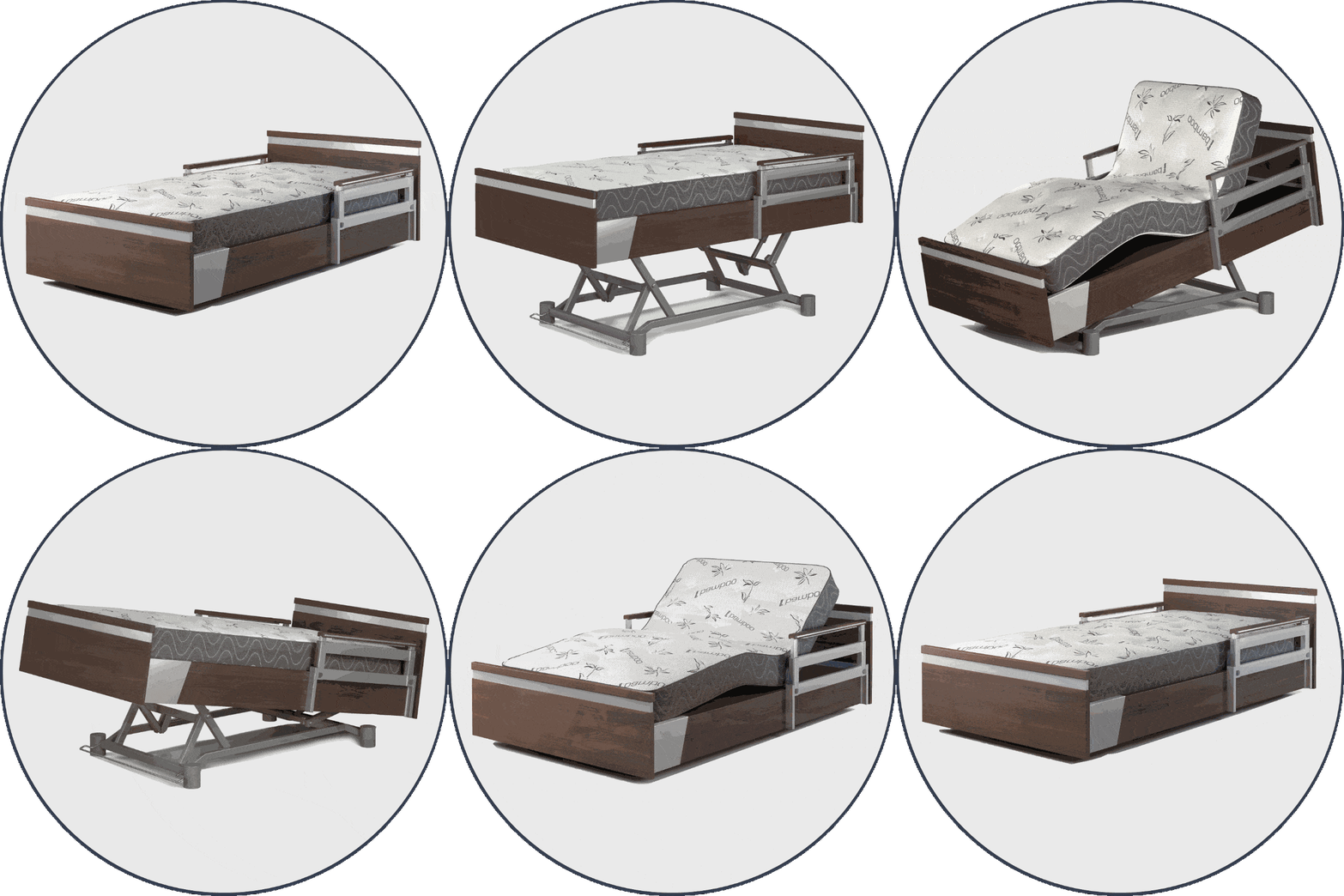
- Entry-level residential bed (owned): $3,999, the SonderCare Impulse Essential, which provides head and knee adjustment plus height adjustment in a residential-style frame
- Full hospital-certified home bed (owned): $6,999, the SonderCare Aura Premium, which adds full hospital certification, the FallSafe ultra-low height (10″ platform), Trendelenburg tilt, Zero Gravity position, and a 500 lb weight capacity
- Premium upholstered home bed (owned): $8,499, the SonderCare Aura Platinum, identical clinical specifications with fully upholstered side panels in premium Crypton fabric for a furniture-grade appearance
Add a mattress ($899-$2,999), accessories ($89-$789 each), and White Glove delivery ($599-$1,199), and a complete furnished setup runs $8,000-$13,000 at the premium level. For a detailed breakdown of what drives those numbers, see the
complete hospital bed cost guide.
One calculation worth doing upfront: rental beds typically cost $150-$300/month. At $2,400-$3,600 per year, a rental that extends 3-4 years often costs more than owning, without the quality, the features, or the dignity of a bed that actually belongs in a home.
Medicare Coverage for Home Hospital Beds
Medicare Part B covers hospital beds as durable medical equipment (DME) when prescribed by a physician for home use and when certain medical necessity criteria are met.
1 Understanding what “typically covered” means, and what it doesn’t, is the first step to building a realistic funding plan.
What Medicare generally requires
For a hospital bed to qualify under Medicare Part B, your physician must document that you meet at least one of the following clinical criteria:
1
- You need to change body position frequently to relieve pain, avoid pressure injuries, or improve circulation
- Your medical condition requires the head or feet to be elevated above heart level
- You cannot safely get in and out of an ordinary bed
You also need a Medicare-enrolled DME supplier (not all suppliers accept Medicare assignment), and the equipment must be prescribed specifically for medical necessity, not comfort or convenience.
When all criteria are met, Medicare Part B covers 80% of the Medicare-approved amount after the annual Part B deductible ($257 in 2025), leaving you responsible for the remaining 20% plus deductible costs.
1 Supplemental Medigap insurance may cover some of that remainder depending on your plan.
The important distinction: what Medicare covers vs. what SonderCare is
This matters, and we’ll say it directly: SonderCare home hospital beds are premium private-pay products. Medicare’s DME benefit covers standard manual and semi-electric hospital beds through Medicare-enrolled suppliers at Medicare-approved amounts. SonderCare’s pricing and features place our beds outside the standard DME coverage category, much the way a luxury car exists outside the scope of a standard vehicle fleet contract.
If your priority is a bed that meets Medicare’s minimum functional criteria, a Medicare-enrolled DME supplier can help you navigate that path. If your priority is a bed that provides hospital-grade clinical safety, genuine fall prevention, residential aesthetics, and a dignified home environment, the
Aura Premium home hospital bed is what you’re looking for. Many families use both: Medicare covers a basic rental bed initially, then choose to upgrade to private pay once they understand the quality gap.
Questions to ask your Medicare plan or DME supplier:
– Does my diagnosis qualify for the medical necessity criteria?
– What specific documentation does my physician need to provide?
– What is the Medicare-approved amount for the bed type I need?
– Does this supplier accept Medicare assignment?
For deeper guidance on the Medicare qualification process, see
what kind of hospital bed Medicare will pay for.
Medicaid and State Waiver Programs
Medicaid coverage for home hospital beds varies significantly by state, and the answer to “does Medicaid cover this?” depends almost entirely on which state you’re in and which Medicaid program applies to your situation.
Standard Medicaid plans in most states do cover basic DME including hospital beds when medically necessary, following criteria similar to Medicare’s. However, Home and Community Based Services (HCBS) waivers, which fund home care for people who would otherwise need nursing facility care, may have different provisions, different approved equipment lists, and different supplier networks.
2
The key variables to confirm with your state Medicaid office or a Medicaid planning specialist:
- Is a home hospital bed covered under your specific Medicaid plan or waiver?
- Is there a preferred or mandatory DME supplier list?
- Does a physician prescription for medical necessity apply, and what documentation is required?
- Is there a prior authorization process?
- Is there a cost-sharing requirement (spend-down, co-pays)?
Like Medicare, Medicaid coverage applies to standard DME-category beds, not premium private-pay products. If you’re coordinating Medicaid coverage with a premium bed, the most common approach is using Medicaid for other covered home care services while funding the bed privately.
Questions to ask your Medicaid caseworker or benefits counselor:
– What DME is covered under my waiver or plan?
– Which suppliers in my area accept Medicaid for hospital beds?
– What is the prior authorization process and timeline?
VA Benefits and Aid & Attendance for Veterans
Veterans and their surviving spouses who need help with activities of daily living may qualify for VA pension benefits, specifically Aid and Attendance, a program that can significantly offset the cost of home care equipment including hospital beds.
Aid and Attendance is a needs-based benefit available to wartime veterans (and surviving spouses) who require the regular aid of another person for personal care, have a disability that keeps them largely confined to bed, or are a patient in a nursing home or assisted living facility due to physical or mental incapacity.
3
The 2025 maximum monthly benefit rates for Aid and Attendance are:
3
– Single veteran: up to approximately $2,358/month
– Married veteran (with spouse): up to approximately $2,795/month
– Surviving spouse: up to approximately $1,515/month
These benefits are not earmarked for specific expenses, they go to the veteran or surviving spouse to use for any qualifying care costs, which can include the purchase of home medical equipment like a hospital bed.
The application process involves VA Form 21-2680 (Examination for Housebound Status or Permanent Need for Regular Aid and Attendance) and documentation of qualifying service and medical need. Processing times vary; some families work with an accredited VA claims agent to navigate the process more quickly.
Questions to ask the VA or an accredited VA claims agent:
– Does my service record and medical condition meet Aid and Attendance eligibility criteria?
– What documentation do I need from my physician?
– How long is the current processing timeline?
– Can I receive retroactive benefits once approved?
– Does Aid and Attendance affect any other VA benefits I currently receive?
The VA also has a separate Home Improvements and Structural Alterations (HISA) grant program for certain home modifications, and a Veterans Directed Care program in some states that allows veterans to self-direct home care funds. Confirm with a VA benefits specialist which programs are available to you.
HSA and FSA: Tax-Advantaged Accounts for Medical Equipment
Health Savings Accounts (HSA) and Flexible Spending Accounts (FSA) can be powerful tools for paying for a home hospital bed, because they let you use pre-tax dollars for qualifying medical expenses, effectively reducing the cost by your marginal tax rate.
Under IRS Publication 502, qualifying medical expenses include amounts paid for equipment and supplies “needed for a reason related to a diagnosed medical condition.”
4 Home hospital beds generally meet this standard when:
- You have a documented medical condition requiring the bed
- A physician provides a Letter of Medical Necessity (LMN) stating the diagnosis, the clinical need for the equipment, and the expected duration
A Letter of Medical Necessity is a document from your physician (doctor, nurse practitioner, or other qualified provider) that documents your condition and explains why the specific equipment is medically necessary. This letter protects the expense in the event of an IRS audit, the IRS can request documentation for up to three years after filing.
4
The 2025 HSA contribution limits are $4,300 for individual coverage and $8,550 for family coverage. FSA plans are employer-sponsored with a maximum annual contribution of $3,300 (2025). If you’re purchasing a bed that exceeds your available HSA/FSA balance, you can sometimes time contributions strategically across plan years, but verify the specifics with your plan administrator.
This is not tax advice. Every plan has its own rules, and an expense that’s HSA-eligible under IRS rules may still require specific documentation under your particular plan. A Letter of Medical Necessity does not guarantee reimbursement from every plan.
Questions to confirm with your HSA or FSA administrator:
– Is a home hospital bed a covered expense under my plan?
– What documentation do I need (prescription, LMN, itemized invoice)?
– Can I use my account for the mattress and accessories as well?
– Is there a pre-approval or prior authorization process?
– Can I submit a receipt for reimbursement after the fact?
Financing Options: Spreading the Cost Over Time
For families who want to own a premium home hospital bed but prefer not to pay the full cost upfront, financing options can make it more accessible.
SonderCare offers financing options that allow qualified buyers to spread payments over time. The specifics of available financing, including interest rates, term lengths, and qualification criteria, are best discussed directly with a SonderCare specialist who can walk through current options based on your situation.
Contact SonderCare to ask about financing for any bed in the lineup.
When evaluating any financing arrangement for medical equipment, the key questions to ask are:
- What is the annual percentage rate (APR)?
- What is the total cost over the loan term vs. paying upfront?
- Is there a prepayment penalty?
- What happens if there is a change in need during the loan term?
- Is the financing offered through the manufacturer, a third-party lender, or a healthcare financing specialist?
Some families also explore medical credit cards (such as CareCredit) or personal loans for medical expenses. These are general financial products that can be applied to medical purchases, confirm terms carefully before committing, as promotional 0% APR periods often convert to high rates if not paid off within the promotional window.
The rent-vs-own math: a standard DME rental costs roughly $150-$300 per month. At $200/month, that’s $2,400/year. If care need extends 3+ years, owning a bed, even financed, often costs less over the same period while delivering meaningfully better quality, features, and dignity. The
rent or buy guide runs through this calculation in detail.
Is a Home Hospital Bed Tax Deductible?
Home hospital beds may qualify as a deductible medical expense on your federal income tax return, but there’s an important threshold that applies.
Under IRS rules, you can deduct qualifying medical expenses only to the extent they exceed
7.5% of your adjusted gross income (AGI).
4 For a household with $80,000 AGI, only medical expenses above $6,000 would be deductible. If your total qualifying medical expenses in a given year, including the bed, mattress, home modifications, prescriptions, medical appointments, and other covered expenses, exceed that threshold, the amount above 7.5% becomes deductible.
Hospital beds are specifically included as deductible capital expenses in IRS Publication 502 when purchased for a medical reason and used primarily for that purpose.
4
Recordkeeping matters: retain the physician’s prescription, a Letter of Medical Necessity, the itemized invoice, and proof of payment. The IRS can audit medical deductions up to three years from the filing date.
This is not tax advice. Tax deductibility depends on your specific AGI, total medical expenses, and filing situation. Consult a qualified tax professional before making purchase decisions based on expected deductions.
Questions to ask your tax professional:
– Given my total medical expenses this year, do I likely exceed the 7.5% AGI threshold?
– Does a home hospital bed qualify as a capital medical expense in my situation?
– What documentation do I need to support this deduction?
– Does my state income tax have its own medical deduction rules?
Long-Term Care Insurance and Home Hospital Beds
Long-term care (LTC) insurance policies vary enormously in what they cover, and the details of your specific policy matter more than any general rule.
Many LTC policies cover durable medical equipment, home modifications, and home care services that help a policyholder meet the benefit trigger (typically the inability to perform two or more Activities of Daily Living, or cognitive impairment). Whether a home hospital bed qualifies depends on your policy’s specific DME provisions, whether it requires a licensed care agency to administer benefits, and whether there is a home modification benefit limit.
Some policies pay benefits directly to the policyholder (indemnity policies), while others reimburse for specific approved services (reimbursement policies). In a reimbursement model, a home hospital bed would need to be an approved covered expense under your policy’s DME schedule.
If you purchased your LTC policy before 2015, the definitions and coverage may differ significantly from newer policies. Reviewing the policy’s Certificate of Insurance or working with the insurer’s care coordinator can clarify what’s applicable.
Questions to ask your long-term care insurer:
– Does my policy cover durable medical equipment?
– Is a home hospital bed specifically covered under the DME provisions?
– What documentation does my physician need to provide to trigger benefits?
– Is there a waiting/elimination period before DME benefits begin?
– Does my policy require equipment to be rented vs. purchased?
– Does a nurse case manager need to assess and approve the equipment?
Private Pay: When Skipping the Forms Is the Right Choice
Linda had spent three weeks on hold with Medicare, waiting for prior authorization on a standard DME hospital bed. When it finally arrived, it looked exactly like what it was, a rental bed in institutional gray with a thin foam mattress. Her mother, who had spent 40 years building a beautiful home, wept when she saw it in her bedroom.
Linda called SonderCare that afternoon. Within four days, the
Aura Platinum, with its fully upholstered side panels, furniture-grade headboard in warm oak, and a Signature Hybrid mattress with individually wrapped pocket coils, was set up in her mother’s room. The delivery team removed all the packaging, adjusted the height, walked her mother through the remote, and left the room looking like it belonged.
Linda’s mother said it was the first time since her diagnosis that she felt like herself again.
Private pay is the right choice when:
- Speed is critical: Medicare and VA approval timelines can stretch weeks; White Glove Rush delivery from SonderCare arrives in 1-3 business days
- Dignity is non-negotiable: the aesthetic gap between a standard DME bed and a premium residential bed is significant, and it affects how the person in the bed feels about their home and themselves
- Clinical needs exceed standard DME: the FallSafe ultra-low height (10″ platform), hospital-grade certification, Trendelenburg positioning, and Zero Gravity capabilities are not available in standard Medicare DME beds
- Long-term care planning: for progressive conditions where the bed will be in place for years, owning a premium bed delivers far better long-term value than extended rental
Private pay also means no prior authorization delays, no preferred supplier restrictions, no coverage denials to appeal, and no need to coordinate documentation across multiple agencies. You make the decision, you get the bed.
For a full comparison of private pay vs. insurance-covered options, see
buying a home hospital bed without insurance coverage. And if you’re still deciding which SonderCare bed fits the clinical and lifestyle needs, the
expert buyer’s guide walks through every key decision.
Which Funding Path Fits Your Situation?
Here is a quick reference to match your situation to the most relevant funding paths. These are not mutually exclusive, many families combine two or three of these strategies.
| Your situation |
Most relevant funding paths |
| You have Medicare Part B and a qualifying diagnosis |
Explore Medicare DME coverage first; consider SonderCare as a private-pay upgrade |
| You are a veteran or surviving spouse with care needs |
Investigate VA Aid & Attendance; consider this income stream for any purchase |
| You have an HSA or FSA with available balance |
Use these accounts toward a private-pay purchase with a physician’s LMN |
| You have Medicaid and need home care equipment |
Contact your state Medicaid office about your specific waiver or plan coverage |
| You have an LTC insurance policy |
Review your DME provisions; contact your care coordinator |
| You need a bed within 48-72 hours |
Private pay with White Glove Rush delivery is the fastest path |
| Long-term care need (2+ years) |
Ownership often costs less than extended rental; financing can spread the upfront cost |
| Your priority is aesthetics and dignity |
Private pay for SonderCare; Medicare DME beds are not designed for residential settings |
| You want to combine strategies |
Use HSA/FSA toward partial payment; finance the remainder; track for potential tax deduction |
The most common path for SonderCare customers is
private pay, sometimes supplemented by HSA/FSA funds, not because insurance doesn’t help with standard equipment, but because the bed that meets the clinical and lifestyle needs at the same time tends to be the right investment.
Getting Clarity Before You Buy
Robert, a retired engineer researching options for his wife who was living with MS, spent two months investigating every funding option before calling SonderCare. He ultimately paid out of pocket, but he knew exactly why. Medicare would have covered a basic semi-electric bed through a DME supplier for roughly 80% of a $1,200 approved cost, leaving him with about $240 in out-of-pocket costs. But the Medicare-covered bed lacked the FallSafe ultra-low height his wife needed, and the DME rental unit had a waiting list. Robert used his HSA to cover a portion of the Aura Premium purchase, tracked the remaining cost as a potential medical expense deduction, and had the bed delivered in five days.
He knew his options. He made an informed choice. His wife has slept better since the night the bed arrived.
Paying for a home hospital bed doesn’t have to mean choosing between what’s covered and what works. With a clear picture of the funding paths available, and realistic expectations about what each path delivers, you can make a decision that serves the person in the bed, not just the paperwork.
Ready to talk through your options? SonderCare’s team can walk through which bed fits the clinical need, what financing looks like, and how most families approach the payment question.
Contact a SonderCare specialist, there’s no pressure, just answers.
Other Questions About Paying for a Home Hospital Bed
Does Medicare cover the full cost of a home hospital bed?
No. When a hospital bed qualifies as medically necessary DME, Medicare Part B covers 80% of the Medicare-approved amount after the annual Part B deductible ($257 in 2025). You are responsible for the remaining 20% and the deductible. Supplemental Medigap insurance may cover some of this remainder. SonderCare beds are private-pay and are not part of the Medicare DME benefit.
Can I use my HSA to pay for a home hospital bed?
Generally yes, hospital beds are typically qualifying medical expenses under IRS Publication 502 when used for medical reasons with a physician’s Letter of Medical Necessity. Confirm the documentation requirements with your specific HSA plan administrator before purchasing.
How long does Medicare approval take for a hospital bed?
Timeline varies, but prior authorization and DME supplier logistics typically take one to four weeks. If you need a bed faster, White Glove Rush delivery from SonderCare is available in 1-3 business days.
Is a home hospital bed tax deductible?
It may be deductible as a qualifying medical expense, but only to the extent your total medical expenses exceed 7.5% of your adjusted gross income. Consult a tax professional for guidance specific to your situation.
Does VA Aid & Attendance pay for a hospital bed specifically?
Aid & Attendance is an income benefit, not an equipment-specific reimbursement. If approved, the monthly benefit can be used toward any qualifying care expenses including a hospital bed. The VA does not pay the supplier directly; the veteran or surviving spouse receives the benefit and can allocate it accordingly.
References
- Centers for Medicare & Medicaid Services. “Hospital Beds, Medicare Coverage.” Medicare.gov. https://www.medicare.gov/coverage/hospital-beds
- Centers for Medicare & Medicaid Services. “Home and Community Based Services Waivers.” Medicaid.gov. https://www.medicaid.gov/medicaid/home-community-based-services/home-community-based-services-authorities/home-community-based-services-1915c/index.html
- U.S. Department of Veterans Affairs. “Aid and Attendance Benefits and Housebound Allowances.” VA.gov. https://www.va.gov/pension/aid-attendance-housebound/
- Internal Revenue Service. “Publication 502 (2025): Medical and Dental Expenses.” IRS.gov. https://www.irs.gov/publications/p502
- Internal Revenue Service. “Publication 969 (2025): Health Savings Accounts and Other Tax-Favored Health Plans.” IRS.gov. https://www.irs.gov/publications/p969