








What Does Hospital Bed Weight Capacity Actually Mean?
Not all weight capacity ratings measure the same thing. Two numbers appear on hospital bed specifications, and confusing them can create a dangerous mismatch between the bed and the person using it.
Safe Working Load (SWL) vs. Maximum Patient Weight (MPW)
Safe Working Load (SWL) is the total weight the entire bed system is designed to support. This includes the patient, the mattress, all bedding, and any accessories attached to or placed on the bed, IV poles, overbed tables, monitors, or personal items.1 Think of it as the bed’s absolute structural ceiling.
Maximum Patient Weight (MPW) is a simpler figure that represents the patient’s weight alone. Manufacturers calculate MPW by subtracting a standard allowance for the mattress and accessories from the SWL.2
Here is a practical example. The Stryker SV2, a standard hospital bed, has an SWL of 551 lbs but an MPW of only 474 lbs.2 That 77-lb difference accounts for the mattress and accessories. If a family member weighs 480 lbs, this bed would technically exceed its maximum patient weight, even though 480 is well below the 551-lb total capacity.
The takeaway: always ask whether the number you are reading is the SWL or the MPW. When a product page lists “weight capacity: 500 lbs,” clarify which measurement that represents before making a decision.
Why Rated Capacity Is Not the Same as Safe Capacity
Hospital beds undergo rigorous testing under international safety standard IEC 60601-2-52. This standard requires beds to withstand a static load of at least two times the Safe Working Load, or 4,000 Newtons, whichever is greater.3 A lateral stability test also applies a 2,200 N force to the mattress edge to confirm the bed will not tip during transfers.4
These safety margins exist for good reason. Real-world use involves dynamic forces that static weight alone does not capture. When a caregiver repositions a patient, when someone sits up quickly, or when a patient shifts their weight to the bed’s edge during a transfer, the instantaneous forces on the frame spike well above the patient’s resting body weight.
Medical equipment specialists recommend multiplying the patient’s weight by 1.5 to determine a truly safe bed capacity.13 A family member weighing 400 lbs should ideally use a bed rated for at least 600 lbs, not a bed rated at 450 lbs that technically accommodates their weight on paper.
Hospital Bed Weight Capacity Tiers Explained
Hospital beds fall into three broad capacity categories. Understanding which tier your loved one needs is the foundation of a safe choice.
Standard Home Hospital Beds (350-500 lbs)
Standard home hospital beds accommodate the majority of users. These beds typically feature a 36-inch sleep surface width and support patient weights between 350 and 500 lbs, depending on the model.7
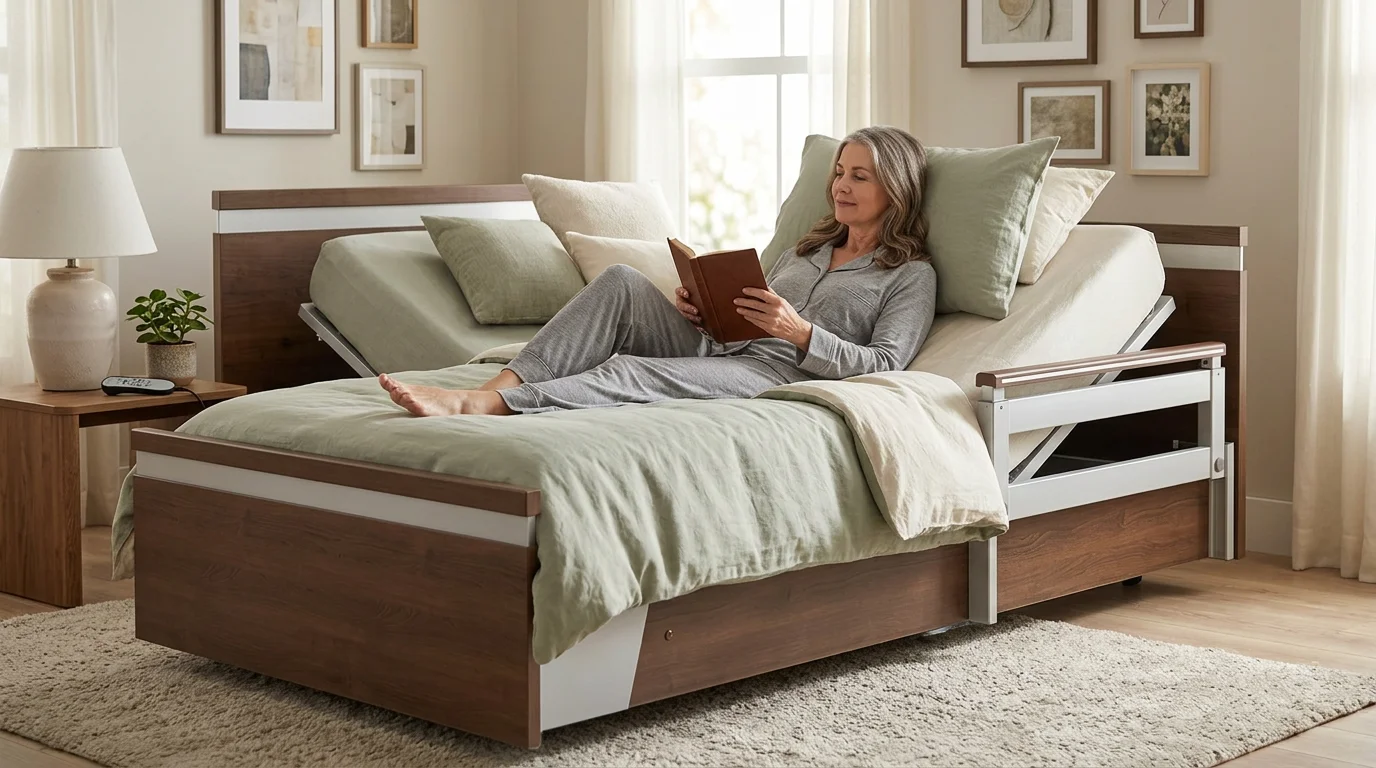
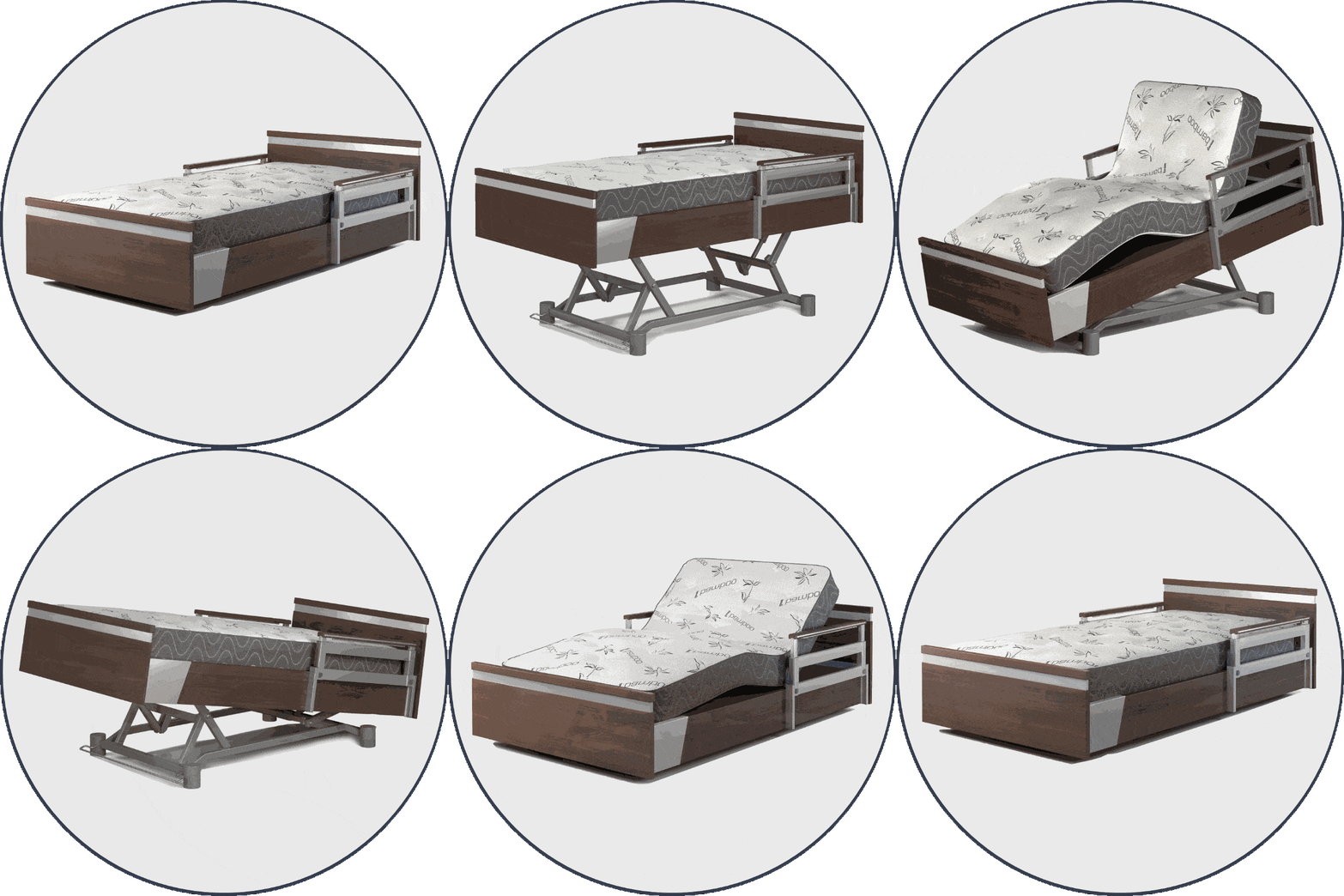
The SonderCare Aura Premium is a strong example in this category. With a 500-lb weight capacity and a 39-inch sleep surface, it provides three additional inches of width compared to most standard hospital beds, meaningful extra room for repositioning. It is certified to International Hospital Standard and includes the full positioning suite: Trendelenburg, Zero Gravity, Cardiac Chair, and FallSafe ultra-low height at just 10 inches. At $6,999, it delivers hospital-grade functionality in a furniture-grade design that does not turn a bedroom into a clinical space.
For lighter users who do not need the full clinical feature set, the SonderCare Impulse Residential Bed offers a 400-lb capacity at 36 inches wide for $3,999. It provides head, knee, and hi-lo adjustment in a residential comfort design, a practical choice when the primary need is adjustability rather than advanced medical positioning.
Heavy-Duty Hospital Beds (500-600 lbs)
When a family member weighs more than 350 lbs, clinical guidelines classify them as requiring bariatric equipment.10 Medicare recognizes this threshold: heavy-duty hospital beds are designated for patients whose weight exceeds 350 lbs.8
Heavy-duty beds reinforce their frames at stress points, use wider sleep surfaces (typically 42 inches), and employ more powerful motors to handle the increased load through all positions, including raising and lowering the full bed height. At this tier, features like integrated patient scales and powered transport systems begin appearing in hospital-grade models.
Extra Heavy-Duty and Bariatric Hospital Beds (600-1,000+ lbs)
For patients exceeding 600 lbs, extra heavy-duty beds provide the necessary structural reinforcement and width. The Hillrom Compella bariatric bed, for example, supports a maximum patient weight of 1,000 lbs and features powered width expansion from 40 to 50 inches.5 The Arjo Citadel Plus offers a similar 1,000-lb MPW with mattress width adjustable from 34 to 48 inches.14
These beds go beyond simple weight support. They integrate powered transport systems so a single caregiver can move the occupied bed safely, built-in scales for accurate weighing without risky transfers, and reinforced frames tested to withstand twice their rated Safe Working Load.3
Quick Reference: Hospital Bed Weight Capacity Tiers
| Tier | Patient Weight Range | Typical Width | Key Features | Price Range |
|---|---|---|---|---|
| Standard | Up to 500 lbs | 36-39″ | Basic to full positioning, hi-lo | $1,500-$8,500 |
| Heavy-Duty | 350-600 lbs | 42″ | Reinforced frame, wider surface | $2,000-$5,000 |
| Extra Heavy-Duty | 600-1,000+ lbs | 48-54″ | Powered width, transport drive, scales | $5,000-$15,000+ |
Why Bed Width Matters as Much as Weight Capacity
Many families focus entirely on weight capacity and overlook width, a mistake that can compromise safety and comfort even when the bed’s weight rating is adequate.
Research published in the Proceedings of the Human Factors and Ergonomics Society found that patients with a BMI greater than 35 who cannot reposition themselves laterally need a wider bed, regardless of their absolute weight.6 A person weighing 280 lbs with a BMI of 38 may need a wider bed than a person weighing 320 lbs with a BMI of 32, simply because body proportions determine how much space is required for safe turning.
When a patient is pressed against side rails during repositioning, three problems compound. First, the sustained pressure against the rail accelerates the development of pressure injuries. Second, the restricted movement reduces functional independence, the person cannot adjust their own position. Third, sleep quality deteriorates from the discomfort of being confined in a space that does not accommodate their frame.6
Clinical guidance recommends 42-inch beds for patients up to approximately 400 lbs, 48-inch beds for 400 to 600 lbs, and 54-inch beds for patients exceeding 600 lbs. The SonderCare Aura Extra Wide provides a 48-inch sleep surface with the same 500-lb capacity and full positioning capabilities as the standard Aura Premium home hospital bed. At $8,999, it serves patients who need more room for comfortable repositioning without sacrificing the furniture-grade aesthetic that keeps a home feeling like a home, not a medical facility.
How to Determine the Right Weight Capacity for Your Loved One
Choosing the correct capacity involves more than matching a number on a spec sheet to a number on a scale. Follow these three steps to arrive at a safe, practical choice.
Step 1: Calculate the Total Load
Start with your loved one’s current body weight, then add the mattress weight (typically 15 to 40 lbs depending on type), bedding (5 to 10 lbs), and any accessories that will sit on or attach to the bed. A bariatric-rated foam mattress can weigh 35 to 40 lbs on its own.
Next, apply the 1.5x safety buffer for dynamic forces.13 If your family member weighs 350 lbs, the effective load requirement is approximately 525 lbs, which means a bed rated at 450 lbs is insufficient even though the static body weight falls within the stated range.
Step 2: Consider Future Weight Changes
Health conditions, medications, reduced mobility, and fluid retention can all change a person’s weight significantly over the months and years they use the bed. Corticosteroids, for instance, can cause substantial weight gain. Choosing a bed with capacity headroom accounts for these changes without requiring a future equipment swap that is both costly and disruptive.
Step 3: Match Width to BMI and Mobility Level
| BMI Range | Mobility Level | Recommended Minimum Width |
|---|---|---|
| Under 30 | Any | 36″ (standard) |
| 30-35 | Mobile, can self-reposition | 36″ (standard) |
| 30-35 | Cannot self-reposition | 39-42″ |
| 35-45 | Any | 42-48″ |
| Over 45 | Any | 48″+ |
These are guidelines, not absolute rules. A conversation with your loved one’s care team, or a SonderCare bed expert, can refine the recommendation based on the specific clinical situation.
Does Medicare Cover Bariatric Hospital Beds?
Insurance coverage for hospital beds follows weight-based thresholds. Understanding where your family member falls in these tiers helps set realistic expectations about what will be covered.
Medicare defines a heavy-duty hospital bed as one supporting a patient weight greater than 350 lbs but not exceeding 600 lbs. An extra heavy-duty hospital bed covers patients exceeding 600 lbs.8 Both require documentation of medical necessity from the prescribing physician.
The most underserved group falls in the 300 to 350 lb range. These individuals often find standard beds uncomfortable or inadequate for safe repositioning, yet they do not meet the 350-lb threshold for Medicare-covered bariatric equipment. For this group, a private-pay option like the Aura Premium, with its 500-lb capacity, 39-inch width, and hospital-grade bedroom setup capabilities, provides the safety and comfort margin that insurance-covered basic equipment cannot match.
For patients who clearly qualify for Medicare coverage, the documentation process typically involves the physician confirming the patient’s weight, establishing medical necessity for a hospital bed, and specifying whether the weight exceeds the 350-lb or 600-lb threshold.
Common Weight Capacity Mistakes to Avoid
Families navigating this decision for the first time make several recurring errors that put their loved ones at risk.
Assuming the rated capacity applies to body weight alone. As discussed, the SWL includes everything on the bed. A 500-lb SWL does not mean a 500-lb person can safely use that bed.1
Ignoring mattress and accessory weight. A quality pressure redistribution mattress, bedding set, overbed table leaning on the frame, and an overhead trapeze can collectively add 50 to 80 lbs to the total load. That overhead can push a near-capacity bed past its limits.
Choosing based on weight alone without considering width. A bed rated for 600 lbs at 36 inches wide may technically hold the weight but provide no room for the patient to turn, reposition, or avoid pressing against side rails.6
Operating at maximum capacity long-term. Motors, actuators, and frame joints wear faster under sustained near-maximum loads. A bed consistently loaded at 95% of its capacity will degrade faster than one operating at 70%, meaning earlier component failures and more frequent repairs.
Not confirming transport capacity. A bed’s weight limit when stationary can be significantly higher than its limit when being moved. Dynamic forces from pushing an occupied bed over thresholds, into elevators, or around corners stress the frame and casters differently than a static load.9 Always verify the transport capacity separately.
Caregiver Safety and Weight Capacity
The right bed capacity protects more than the person lying in it. Caregiver injuries during patient handling, particularly boosting and repositioning, are among the most common workplace injuries in healthcare settings. The risk begins at as little as 50 lbs lifted at an awkward angle.11
Equipment failures are most likely to occur when standard beds are used beyond their rated capacity, or when accessories like side rails and mattresses are not also rated for the patient’s weight class.12 When a bed frame flexes under excessive load, transfer safety is compromised and fall prevention becomes unreliable.
Beds with full hi-lo adjustment, like the Aura Premium’s range from 10 inches (FallSafe ultra-low) to 39 inches, allow caregivers to raise the bed to a safe working height for repositioning, transfers, and daily care tasks. The pre-programmed 21-inch transfer position aligns the bed surface with standard wheelchair seat height, reducing the lifting and twisting that cause back injuries. For patients approaching or exceeding 350 lbs, compatibility with patient lift systems (ceiling-mounted or mobile Hoyer lifts) becomes essential rather than optional.
When the bed capacity matches the patient’s needs with adequate margin, every interaction becomes safer, for the person in the bed and for everyone helping with their care.
How Much Does A Home Hospital Bed Itself Weigh?
Home hospital beds come in multiple sizes, depending on the model and the user’s specifications. They can also accommodate a range of features. As such, the weight of a home hospital bed can vary. Conventional hospital beds measure 36 inches wide and 80 inches long, from the frame inside the headboard to the footboard; this is about the size of a twin. SonderCare also provides extra-wide options, including the 48″-wide Aura™ Premium Hospital Bed. Depending on the model you choose, you can expect your SonderCare luxury home hospital bed to be between 250 and 300 pounds.
When you think about the heavy-duty qualities you come to expect in a hospital bed, this isn’t too much. Hospital beds use lightweight and durable materials, letting them withstand more usage while still offering a high degree of comfort. After all, conventional hospital beds must be able to move down halls and into different rooms – it only makes sense that mobility is a defining feature, and keeping the weight of the equipment down is a part of that.
The weight of the bed itself can be a surprise to some customers, given how much it can support. Standard hospital beds typically have a maximum weight capacity of up to 450 pounds, but wider bariatric models can hold up to 750 pounds.
How Much Weight Is Added By The Mattress & Bed Accessories?
As you can see, hospital bed frames aren’t heavy, and neither are the mattresses and accessories that fit on them. The SonderCare pressure-redistributing mattresses are lightweight, made with materials like memory foam and an infused cooling gel. Even the premium Dream mattress, with an extra quilted layer, hypoallergenic covering and fluid-proof cover, is still incredibly light, even though it looks like a heavier luxury home-style mattress.
The accessories of a hospital are also light and durable because bed users must be able to use them. Hospital beds are very intuitive pieces of medical equipment, and if the user is medically or mentally able to use the adjustable features, weight must not be an issue. For example, the SonderCare multi-height assist rails will increase bed safety for residents, allowing for ergonomic entering and exiting of the bed; however, the resident must also be able to maneuver them.
Of course, when using a hospital bed, there’s more than just the frame and mattress. When a luxury hospital bed has many accessories, is it difficult to move? The answer is no – the design of hospital beds makes them easy to push. If you need to move your loved one’s bed on their behalf, you don’t have to worry about the weight.
How Much Weight Is Added By The Mattress & Bed Accessories?
As you can see, hospital bed frames aren’t heavy, and neither are the mattresses and accessories that fit on them. The SonderCare pressure-redistributing mattresses are lightweight, made with materials like memory foam and an infused cooling gel. Even the premium Dream mattress, with an extra quilted layer, hypoallergenic covering and fluid-proof cover, is still incredibly light, even though it looks like a heavier luxury home-style mattress.
The accessories of a hospital are also light and durable because bed users must be able to use them. Hospital beds are very intuitive pieces of medical equipment, and if the user is medically or mentally able to use the adjustable features, weight must not be an issue. For example, the SonderCare multi-height assist rails will increase bed safety for residents, allowing for ergonomic entering and exiting of the bed; however, the resident must also be able to maneuver them.
Of course, when using a hospital bed, there’s more than just the frame and mattress. When a luxury hospital bed has many accessories, is it difficult to move? The answer is no – the design of hospital beds makes them easy to push. If you need to move your loved one’s bed on their behalf, you don’t have to worry about the weight.
What Can I Do Once I Have Dismantled My Hospital Bed?
Once you have dismantled your hospital bed, you’ll find moving it easy. If you choose to move the bed without professional assistance, you must have at least one other person available to help. If you don’t have a partner in this, you can risk injury to your body or damage to the equipment by trying to do it yourself.
Always remember to lift carefully and make all moves using protective equipment. Moving straps are handy devices that transfer some weight off your back and arms when you’re lifting a heavier item. You can also use the specialized Transport Cart to move the bed on its side, allowing you to roll it through halls and doorways.
If you need help moving your home hospital bed or doubt your physical ability to safely move it, one of the best options is to call a team of professional movers. Find a company in your area that specializes in moving high-quality medical equipment.
Does The Home Hospital Bed’s Weight Make It Difficult To Move?
Hospital beds must be able to move, and this is also the case with home care beds. However, you must set up the bed first, and the size and weight of the hospital bed as delivered means that a single person cannot move it safely by themselves; at least two people should be ready to move it into the house. If you’re unsure about your ability to lift and maneuver the hospital bed, call a team of movers who specialize in handling medical equipment.
Once the bed is inside and set up, it is surprisingly easy to move around. All our hospital beds come with heavy-duty casters (wheels that allow for moving the bed in both straight and turning motions). The casters make it easy for caregivers and loved ones to move the bed to different parts of the room or house, even with the user in the bed.
SonderCare customers can take advantage of our “White Glove” delivery. If you choose this service, you’ll have your bed delivered to your residence and installed in your desired room, with all the packaging removed. It’s just one of the ways SonderCare works to put those who might feel overwhelmed by their new luxury hospital bed at ease.
Choosing the Right Hospital Bed Weight Capacity: A Decision Framework
Selecting the right hospital bed weight capacity comes down to three principles. First, understand the difference between Safe Working Load and Maximum Patient Weight, and always ask which number the manufacturer is quoting.2 Second, calculate total system load with a 1.5x safety buffer rather than matching body weight to a spec sheet number.13 Third, evaluate width alongside weight, because a bed that holds the load but confines the patient creates its own set of safety and comfort problems.6
SonderCare’s lineup addresses the most common home care scenarios: the Aura Extra Wide at 48 inches for those who need extra room, the Aura Premium at 39 inches and 500 lbs for the broadest range of users, and the Impulse Residential at 36 inches for lighter patients who prioritize comfort adjustability.
If you are uncertain which capacity and width are right for your family member’s situation, SonderCare’s bed experts can walk you through the specifics. Speak with a SonderCare expert for a personalized recommendation based on your loved one’s weight, mobility, and care needs, no pressure, just honest guidance from people who have helped thousands of families make this decision.
References
- Joerns Healthcare. UltraCare XT User/Service Manual. 2023-2024. Defines Safe Working Load as “total weight counting resident/patient, mattress, bedding accessories and any other equipment or persons likely to be on bed.”
- Stryker. SV2 (Model 7500) Spec Sheet. DFS 05/2017. Lists SWL of 250 kg (551 lbs) and MPW of 215 kg (474 lbs).
- International Electrotechnical Commission. IEC 60601-2-52: Medical Electrical Equipment, Particular Requirements for Basic Safety and Essential Performance of Medical Beds. Static strength test requires load of 2x SWL or 4,000 N, whichever is greater.
- International Electrotechnical Commission. IEC 60601-2-52. Lateral stability test requires 2,200 N (220 kg) load applied to side edge of mattress platform.
- Hillrom / Baxter. Compella Bariatric Bed Brochure (US-CS138-220001-v2 12/2024) and Product Cut Sheet (207196 rev2 21-MAY-2018). MPW: 453.6 kg (1,000 lbs); powered width expansion 101.6 cm to 127 cm (40″ to 50″).
- Wiggermann N. “What Bed Size Does a Patient Need? The Relationship Between Body Mass Index and Space Required to Turn in Bed.” Proceedings of the Human Factors and Ergonomics Society Annual Meeting. 2017. PMC5671795. Patients with BMI > 35 who cannot laterally reposition themselves require wider beds.
- Industry consensus from SERP analysis. Standard hospital beds rated 350-500 lbs capacity; sources include Rehabmart, Jiedemedical, Vitalitymedical, and Shkeling product specifications.
- Massachusetts Executive Office of Health and Human Services. Guidelines for Medical Necessity Determination for Hospital Beds. July 2019. Heavy-duty: patient weight >350 lbs, not exceeding 600 lbs. Extra heavy-duty: patient weight >600 lbs. Corroborated by Aetna Clinical Policy Bulletin 0543 and South Carolina Blues medical policy.
- Multiple manufacturer manuals note transport capacity may be lower than static SWL. Hillrom Compella and Arjo Citadel Plus feature powered transport systems rated for patients up to 1,000 lbs under specific hospital protocols.
- U. S. Department of Veterans Affairs. Bariatric Safe Patient Handling Guidebook. Bariatric patient handling protocols should activate when patient weight exceeds 350 lbs. Available from ASPHP.
- Online Journal of Issues in Nursing (OJIN). Essentials of a Bariatric Patient Handling Program. Vol. 14, No. 1, January 2009. Caregiver injury risk from lifting begins at 50 lbs at awkward angles; repositioning is the highest-risk activity.
- ResearchGate. Hignett S, Griffiths P. “Bariatric Hospital Bed Safety and Selection.” Equipment failures most commonly occur when standard beds are used beyond rated capacity. Publication link.
- Medical equipment specialist consensus from YouTube product review channels (SpinLife, HomeCare Hospital Beds). Recommended safety buffer: multiply patient weight by 1.5x for true safe operating capacity.
- Arjo. Citadel Plus Bariatric Care System Specification Sheet (01.0. US.EN.pdf) and Brochure (1.0. GB.EN.pdf). MPW: 453.6 kg (1,000 lbs); mattress width adjustable from 86.4 cm to 121.9 cm (34″ to 48″).