








When families ask how to get a hospital bed inside their home, they’re usually asking two questions at once. The first is logistical: will this thing actually fit through the door? The second is procedural: how do you even order one, and does insurance help?
The short answer to the first question is: yes, it will almost certainly fit. Professional delivery teams navigate this daily, and hospital beds are designed to be disassembled for exactly this reason. The short answer to the second question: there are three main pathways, Medicare/Medicaid, a hospital discharge order, or a direct private purchase, and each comes with its own timeline and requirements.
This guide covers both dimensions in full. You’ll learn how to measure your home’s path from front door to bedroom, how to get a physician’s order or buy direct, what to do before delivery day arrives, and what most families wish they had known before the truck pulled up. With over 63 million Americans providing unpaid family care, a 20 million increase since 20151, navigating this process is something millions of families face each year. It doesn’t have to be as complicated as it looks.
If you’re still deciding which bed to purchase, start with our complete guide to choosing a home hospital bed.
Will the Bed Actually Fit Through Your Door?
This is the question that sends caregivers to forums at 11 pm the night before delivery. The panic is understandable, but it’s almost always unnecessary.
A standard home hospital bed frame is approximately 36 inches wide. A standard interior doorway has a clear opening of 30 to 32 inches, narrower than the bed. But this is a known, solved problem. Delivery teams routinely disassemble the frame into sections: the head and foot panels are removed, the frame separates from the deck, and the components are carried through individually, then reassembled in the room. A well-trained delivery crew handles a standard doorway in minutes.
The measurement that actually catches families off guard isn’t the door, it’s the hallway turn. If your bedroom sits at the end of a 90-degree turn from the main hallway, delivery staff need roughly 42 inches of hallway width to pivot the main frame section around the corner. Older homes, in particular, can have tight hall widths that complicate things.
Before delivery day, walk the entire path from your front door to the destination room with a tape measure. Note:
- The clear width of your front door (subtract any weatherstripping)
- The narrowest point in each hallway
- Any 90-degree corners and the hallway width at those turns
- The clear width of the bedroom or room doorway
- Whether any doors need to come off their hinges temporarily
Removing a door from its hinges takes about five minutes and typically adds 1.5 to 2 inches of clearance, enough to resolve most borderline situations. Stripping decorative door-stop molding can gain another quarter inch. In pre-1950 homes with very narrow openings, some families do widen a doorway, which typically costs $300 to $800 through a handyman.
Stairs are a different matter. Most delivery teams decline to carry hospital bed components up stairways, and for good reason, the pieces are heavy and awkward. If the primary bedroom is on an upper floor, plan now for a ground-floor alternative. Living rooms, dens, and dining rooms work well and have practical advantages you may not have considered.
For detailed measurements by bed model and doorway configuration, see our hospital bed dimensions and doorway fitting guide.
How Do You Order a Home Hospital Bed? Three Pathways
Getting the bed through the door is a logistics problem. Getting the bed ordered is a paperwork problem, and sometimes a coverage problem. There are three pathways, and the right one depends on your situation.
Pathway 1: Medicare Part B and Medicaid
Medicare Part B covers home hospital beds as Durable Medical Equipment (DME) when a Medicare-enrolled physician documents medical necessity and the patient meets the clinical criteria.2
Those criteria are more specific than many families expect. Medicare’s Local Coverage Determination for hospital beds3 requires documented medical need in one or more of the following categories:
- The need to elevate the head of the bed more than 30 degrees due to aspiration risk, chronic pulmonary disease, or congestive heart failure
- Frequent changes in body position required by the medical condition
- Body weight above 350 pounds (which triggers coverage for a heavy-duty frame)
- Traction requirements that can only be met by a hospital bed
If the condition meets the criteria, your physician writes a Standard Written Order, you’re matched with an in-network DME supplier, and Medicare covers 80% of the approved amount after the Part B deductible. You’re responsible for 20% coinsurance. Medicare may allow you to rent, buy outright, or convert from rental to ownership after a set number of payments, ask your supplier which option applies to your situation.
A few practical notes: Semi-electric beds and basic variable-height frames are most commonly covered. Full-electric upgrades with advanced positioning features often fall outside what Medicare approves, leaving families to pay the difference themselves. If a full-electric bed is medically indicated, your physician may need to document why the simpler frame is insufficient.
Medicaid coverage varies by state. If your family member is on both Medicare and Medicaid (dual-eligible), Medicaid may cover the portion Medicare doesn’t.
Pathway 2: Hospital Discharge Planning
If your family member is coming home from an acute care stay, the hospital’s discharge planning team is your most direct route to a home hospital bed. Federal regulations under 42 CFR 482.43 require hospitals to maintain discharge planning processes that connect patients with appropriate post-acute equipment providers.4 The 2019 CMS Discharge Planning Final Rule further requires hospitals to help patients select DME suppliers using quality and resource-use information.5
In plain terms: you have the right to ask the discharge planner to connect you with a DME supplier and coordinate the bed delivery before your family member comes home. The bed can be waiting, assembled, in the room when they arrive. If time is critical, ask specifically about expedited delivery options.
This pathway has grown considerably alongside the federal Acute Hospital Care at Home initiative, which as of October 2024 included 366 hospitals across 38 states treating over 31,000 patients at home, and was extended for five more years in March 2026.6 For appropriate patients, hospital-level care at home is not just possible; it’s now a federal program with strong outcomes data.
Pathway 3: Private Purchase
If you’re not covered by Medicare, don’t meet the LCD criteria, need a bed quickly without navigating insurance paperwork, or want a wider selection than DME suppliers typically offer, including premium models that don’t look like clinical equipment, you can purchase directly from a manufacturer or retailer.
Private purchase eliminates the physician order requirement and gives you access to the full spectrum of home hospital beds, including furniture-grade designs that integrate into a residential bedroom rather than transforming it into a patient room. Out-of-pocket pricing ranges from roughly $500 for a basic manual frame to over $6,000 for a fully certified, full-electric residential model.7
For guidance on the rent-versus-buy decision, see our detailed breakdown: rent or buy a hospital bed for home.
Measure the Full Path, Not Just the Doorway
The most consistent advice in caregiver forums is a single sentence: measure your hallways, not just the door.
A full path measurement means checking every constraint between the delivery truck and the destination room, in order:
- Front entry: Clear width of the main door (usually 32–36 inches in homes built after 1990; narrower in older homes)
- Entry hall: Width of the main hallway, and whether it’s straight or has a turn
- Stair situation: If there are stairs between the front door and the destination room, identify an alternate ground-floor location now
- Corner clearance: Measure the hallway width at any 90-degree turn. You need roughly 42 inches of clear width to pivot the main frame section
- Bedroom door: Clear width including any molding or door stops
- In-room space: The bed needs 36 inches of clear space on the transfer side (the side the person gets out of bed toward) for caregiver access, measure whether your room accommodates this
- Outlet location: Identify the nearest grounded electrical outlet. Full-electric beds draw standard household current but need a reachable outlet. If the nearest outlet ends up behind the bed, you’ll be rerouting your room plan at the last minute
Flooring matters more than most people expect. Thick carpet creates resistance when repositioning the bed and can be a trip hazard around the base. If the destination room has deep-pile carpet, a hard floor surface near the bed’s perimeter or a low-profile area rug may help.
Choosing the Right Room: Bedroom or Living Area?
This decision is more emotionally complex than it appears, and it’s worth making it deliberately before the bed arrives.
The case for the bedroom: Privacy. The ability to close a door. Dignity and normalcy for someone who has spent decades sleeping in that space. For many families, and many individuals who will use the bed, the bedroom is the only acceptable option.
The case for a ground-floor common room: Bathroom proximity (often the most practical factor in homes where the primary bathroom is on the main floor). No stair access problem. Less isolation, the person remains part of household activity. Easier caregiver access without climbing stairs repeatedly throughout the day. Many families initially resist converting a living room or dining room, then discover it works better than expected.
There is no universally right answer. The most useful questions to ask:
- Is the primary bathroom accessible from both locations without stairs?
- Does the individual want to be part of household activity, or do they prefer quiet and privacy?
- Can caregivers access the transfer side of the bed without moving furniture repeatedly?
- Is the individual at fall risk, and does one location allow closer monitoring?
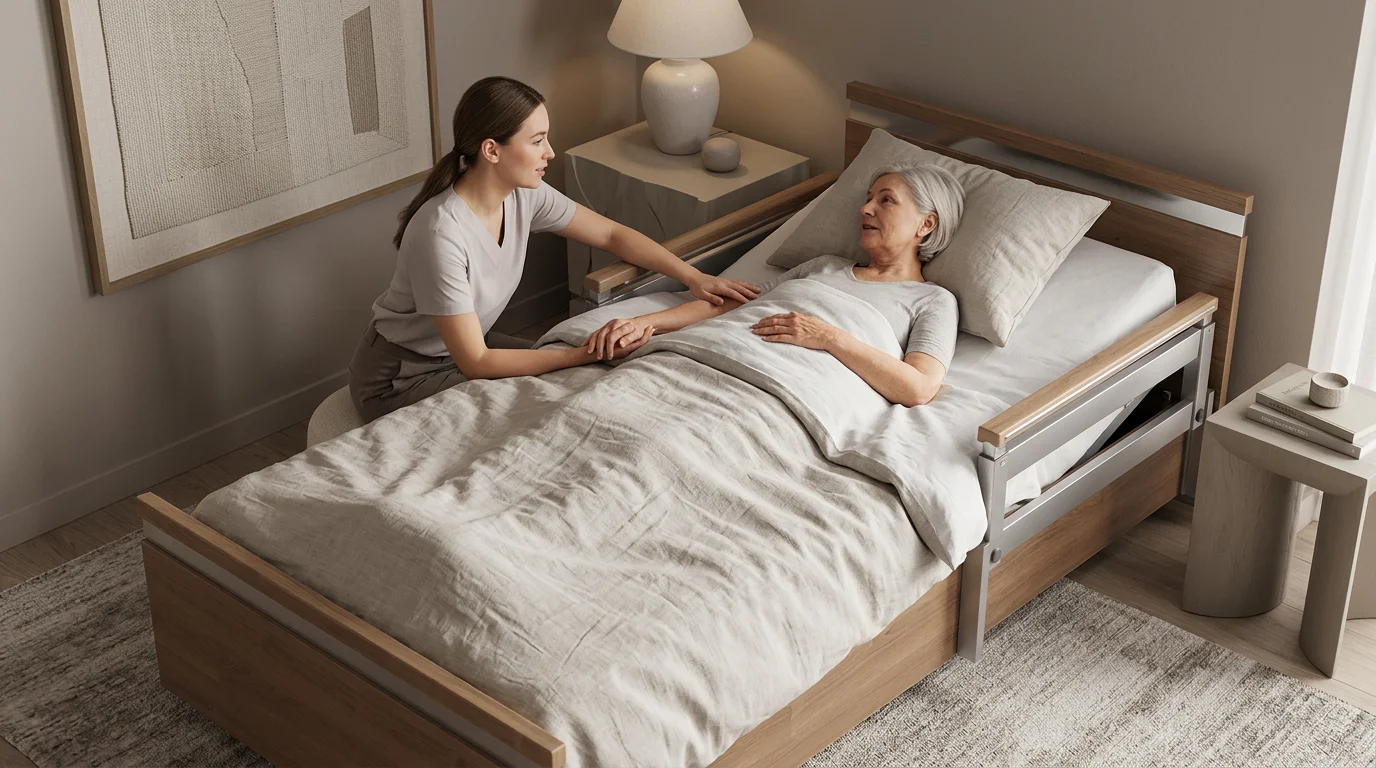
Whatever room you choose, think about how it will feel to the person using it. In communities that discuss palliative and hospice care, one of the most common emotional threads is an individual’s initial resistance to the bed itself, “it means I’m giving up.” A residential-style bed, covered with their own comforter and pillow, placed among familiar furniture and photos, almost always becomes “my bed” rather than “a hospital bed” within a few days.
For a complete guide to configuring whatever room you choose, see our resource on setting up a hospital-grade bedroom at home.
Preparing Your Home Before Delivery Day
Most delivery teams arrive ready to work, but they can only move as fast as the space allows. The families who report the smoothest deliveries did the following in advance:
One week before:
– Walk the full path and take measurements (see above)
– Identify the destination room and confirm outlet accessibility
– Move or store furniture that will obstruct the path or crowd the room
– Confirm with the delivery company whether they include in-room setup
The day before:
– Clear the delivery path completely, remove rugs, move side tables
– If a door needs to come off its hinges, remove it now
– Confirm the delivery window with the company
Day of:
– Have someone available to guide the team to the room and clear unexpected obstacles
– Know where the electrical outlet is and have it accessible
– Keep the room clear, the team needs working space to assemble
One specific item most families overlook: know exactly where the power outlet is before the bed arrives, and confirm it’s accessible from the intended bed position. Post it at the last minute, and you may have to rearrange your entire room layout on the spot.
How Hospital Bed Delivery and Setup Actually Work
Not all delivery is the same, and the difference matters more than most families realize before the truck arrives.
Drop-ship delivery: The delivery company brings the bed to your driveway or just inside the front door. The components are left disassembled for you to set up. Setup time by a prepared caregiver or family member who has watched an assembly video runs 45–90 minutes. This is the least expensive delivery option and the most common for basic DME-supplied beds.
White-glove delivery: A trained team delivers, assembles, and demonstrates the bed in the room of your choice, then removes all packaging. Setup in-room typically takes 15–30 minutes for a professional team. White-glove delivery is the standard for premium residential beds and is strongly recommended for anyone who is not comfortable with tool-based assembly, anyone whose home presents logistical challenges, or any situation involving an urgent discharge timeline.
SonderCare offers white-glove delivery options ranging from standard 10–21 business day delivery to a Rush option with 1–3 business day delivery for urgent situations. The white-glove team provides a complete feature walkthrough before leaving, so caregivers know how to operate every position and adjustment.
If you need to move the bed to a different room later, most frames can be partially disassembled and moved by two adults. A Transport Cart accessory ($199) makes this significantly easier without disassembly.
For a full breakdown of what white-glove service includes and when to choose it, see our white-glove delivery guide.
What Most Families Learn Too Late
Three things consistently surprise caregivers after the bed is set up. All three are worth knowing now.
The hand-crank problem. Manual hospital beds are less expensive and often more fully covered by basic insurance. But caregivers using a hand-crank bed for repositioning six or more times per day, common in any care situation involving frequent position changes, report back strain and physical fatigue within weeks. Community data consistently shows that caregivers who start with a manual bed and later upgrade to a full-electric model almost universally wish they had started with electric. If the care need will last more than a few weeks, plan for a full-electric bed from the start.
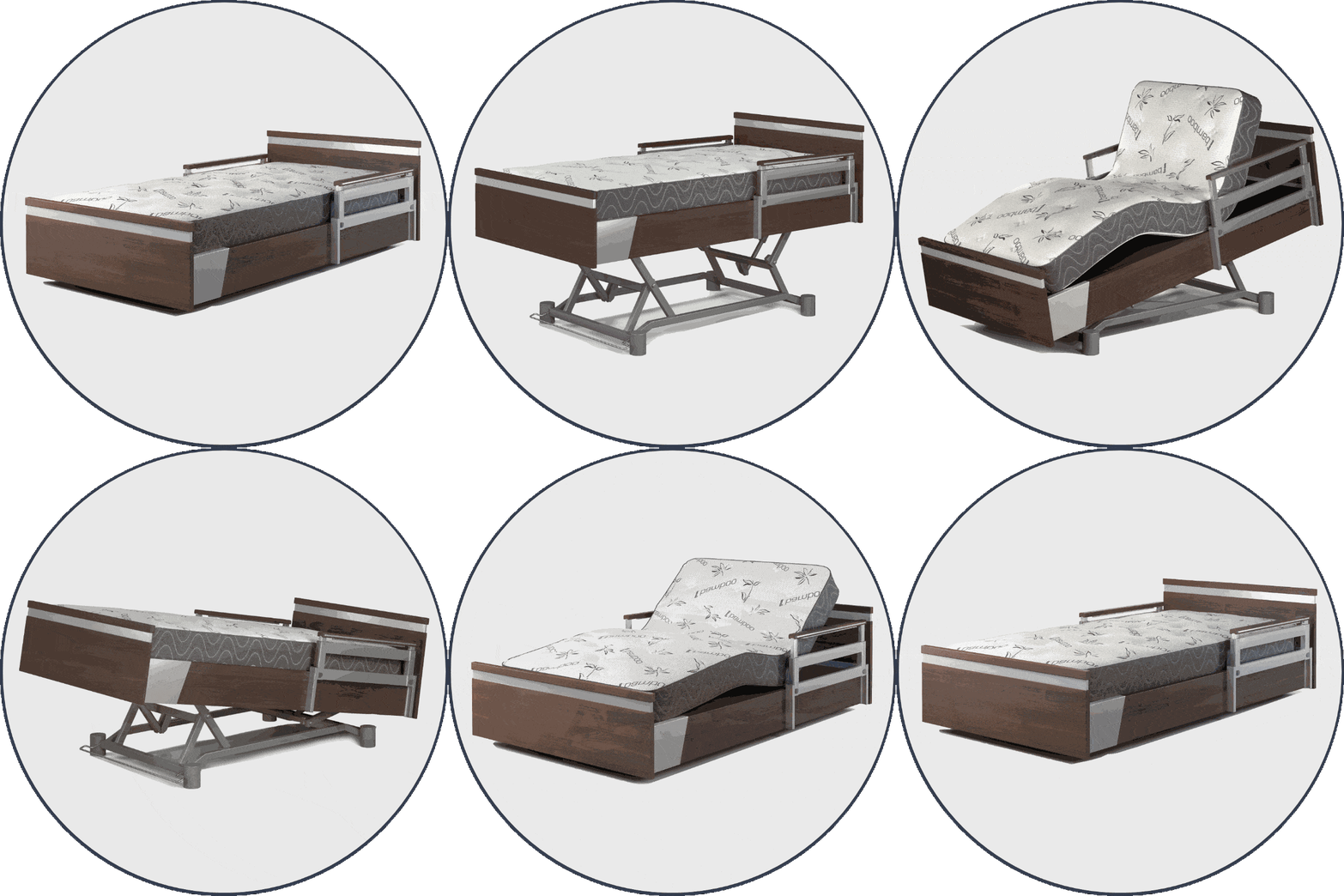
The difference matters clinically, too. Research on home-based care consistently shows that appropriate equipment, including adjustable positioning, reduces hospitalizations and improves comfort.8 A bed that can quickly and quietly adjust from flat to head-elevated to the FallSafe ultra-low position doesn’t require the caregiver to do manual lifting, which matters enormously for sustainable long-term home care.
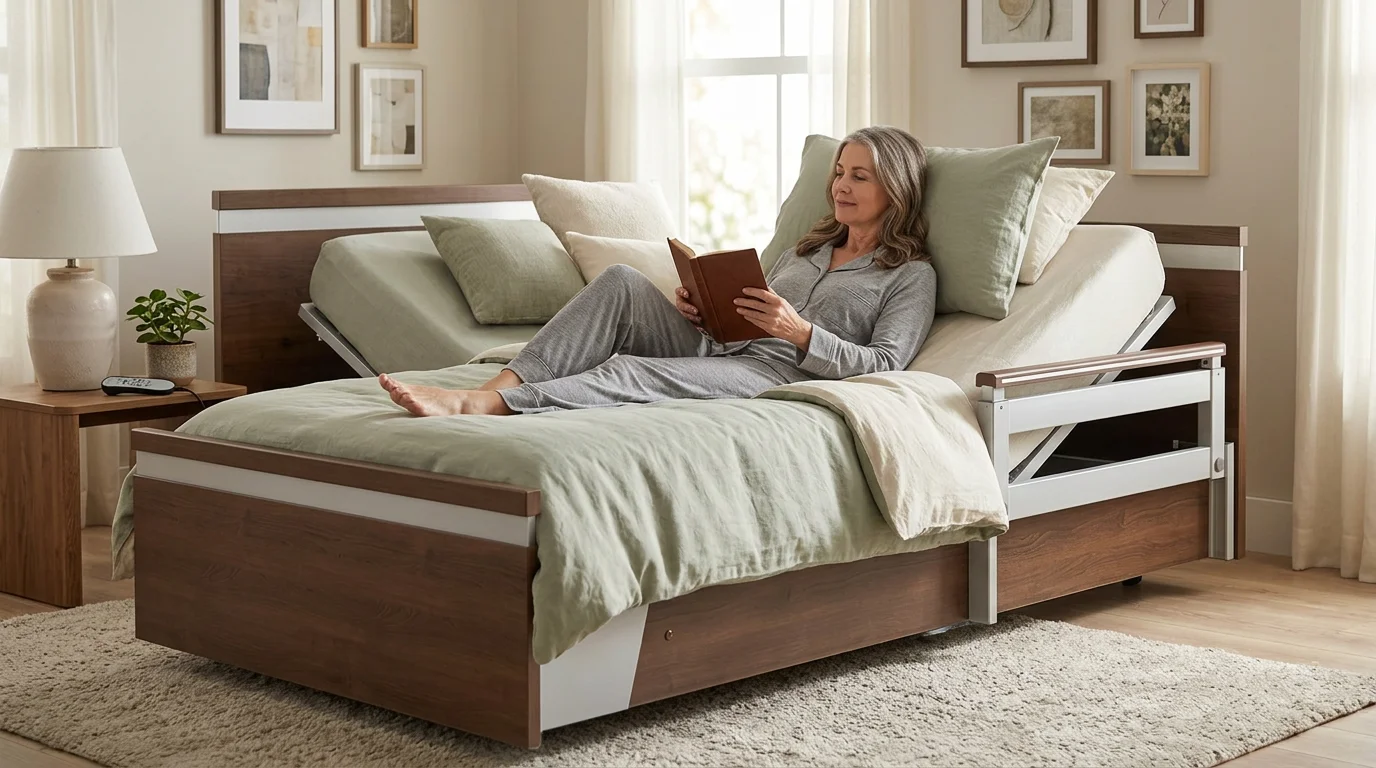
The aesthetic dimension. Families in the palliative and chronic condition communities report that patient resistance to the bed itself is one of the most underestimated challenges. A bed that arrives looking like a hospital room fixture, white metal frame, visible cranks, creates immediate psychological resistance in many individuals. Adding their own bedding, pillow, and familiar items from the nightstand helps significantly. So does choosing a bed designed for residential aesthetics from the start.
SonderCare’s Aura Platinum ($8,499) features fully upholstered side panels in Slate Gray Crypton fabric, a fixed upholstered headboard, and residential finishes that integrate into a home bedroom rather than announcing themselves as medical equipment. For families where the visual dimension matters to the person using the bed, this is not a luxury, it’s a meaningful part of care quality.
For families who need the same hospital-certified positioning capabilities in a more accessible entry point, the Aura Premium ($6,999) delivers the full clinical feature set, FallSafe ultra-low height at 10 inches, Trendelenburg, Zero Gravity, Cardiac Chair positioning, and 500-lb weight capacity, with residential-grade aesthetics and a 5-year comprehensive parts warranty.
For shorter-term recovery needs or situations where basic head/knee adjustability is the primary requirement, the Impulse Residential Bed ($3,999) provides a comfortable, entry-level home adjustable bed at a lower price point.
Accessories are easiest to order before setup. The accessories most caregivers wish they had ordered with the bed: assist rails that match the bed frame, a motion-activated Underbed Auto-Nightlight ($219) for safer nighttime transfers, and an overbed table if the person spends time reading, eating, or working from the bed. Ordering these at the same time as the bed ensures they arrive together and are sized to fit.
Bringing It All Together For The Delivery
Getting a home hospital bed inside your home is rarely as complicated as it looks at the outset. Beds are designed to come apart for delivery, professional teams handle tight doorways daily, and the right preparation makes the process smooth.
The three things that matter most before delivery day:
- Measure the full path, front door, hallway width, 90-degree turns, room door, caregiver clearance, and outlet location
- Choose the right ordering pathway, Medicare/insurance if you qualify, hospital discharge coordination if transitioning from inpatient care, or direct purchase for more choice and speed
- Choose the right delivery option, white-glove service for anything beyond a simple drop-off, and especially for any home with logistical challenges or time pressure
If you’re not sure which bed fits your situation, SonderCare’s bed experts can guide you through the decision without pressure. Call or reach out through our contact page, we help families navigate this every day.
Frequently Asked Questions About Getting a Hospital Bed at Home
How do I get a hospital bed at home?
There are three routes: through Medicare or insurance (a physician documents medical necessity and orders through a contracted DME supplier), by renting from a local supplier, or by purchasing privately — the fastest and most flexible path, with current models available for white-glove delivery.
What are the criteria to qualify for a hospital bed at home?
Medicare’s medical-necessity criteria require a documented condition that an ordinary bed can’t address — for example, needing head elevation, regular repositioning, or positioning to relieve pain or aid breathing — confirmed in a face-to-face visit and written order from your physician. The full 2026 rules are in our guide to what kind of hospital bed Medicare will pay for.
Will Medicare pay for a hospital bed in my home?
Yes, if the criteria above are met — but coverage is typically a rental of a basic semi-electric model from a contracted supplier, not a purchase, and not a premium full-electric bed. Most families choosing a residential-style bed pay privately or combine funding sources.
How much will Medicare pay for a hospital bed at home?
Medicare Part B pays 80% of the approved rental amount after your deductible, under a capped 13-month rental; you pay the remaining 20%. Exact amounts vary by region and billing code, so confirm with the supplier before delivery.
Can I rent a hospital bed for home use?
Yes — rental makes sense for short recoveries, while ownership usually wins beyond roughly 9–15 months once fees pass the purchase price. Our guide to renting vs. buying a hospital bed walks through the break-even math.
How quickly can you get a hospital bed at home?
Through insurance and DME suppliers, expect days to weeks depending on paperwork. Buying privately is faster: SonderCare’s rush white-glove option delivers and installs in 1–3 business days to most locations — see hospital beds for sale for current delivery options.
How can I get a free hospital bed at home?
If your loved one is on the hospice benefit, the hospice provides a hospital bed at no cost. Veterans may qualify through VA benefits and Aid & Attendance, some state Medicaid waiver programs cover equipment, and local medical-equipment loan closets lend beds in many communities.
How do I buy a hospital bed for home use?
Buying directly gives you the widest choice of residential-style, full-electric models. Start with our guide on how to choose a home hospital bed, then compare current models and prices.
Why would a patient need a hospital bed at home?
The three most common reasons: positioning (head and foot elevation for breathing, reflux, swelling, or pressure relief), safe transfers (height adjustment to the feet-flat position), and caregiver ergonomics (raising the bed for care tasks). Our overview of conditions that benefit from a home hospital bed goes deeper.
What are the alternatives to a hospital bed?
Depending on need: an adjustable bed for seniors (positioning without hi-lo height), bed risers for a fixed height boost, or assist rails for transfer support. If the need includes height adjustment or clinical positioning, see adjustable bed vs. electric hospital bed before deciding.
References
- AARP and National Alliance for Caregiving. Caregiving in the US 2025. Washington, DC: AARP, 2025.
- Centers for Medicare & Medicaid Services. “Hospital beds.” Medicare.gov coverage page. U.S. Department of Health and Human Services. https://www.medicare.gov/coverage/hospital-beds
- CGS Administrators, LLC for CMS. “LCD, Hospital Beds And Accessories (L33820).” Revised August 2024. https://www.cgsmedicare.com/jc/dpl/dpl_hospital_beds.pdf
- Electronic Code of Federal Regulations. 42 CFR 482.43, Condition of participation: Discharge planning. https://www.ecfr.gov/current/title-42/chapter-IV/subchapter-G/part-482/subpart-C/section-482.43
- Centers for Medicare & Medicaid Services. “CMS’ Discharge Planning Rule Supports Interoperability and Patient Preferences.” CMS Newsroom Fact Sheet, September 26, 2019. https://www.cms.gov/newsroom/fact-sheets/cms-discharge-planning-rule-supports-interoperability-and-patient-preferences
- Adams DN, Wolfe AJ, Warren JM, Hughes DL. “Lessons from CMS’ Acute Hospital Care at Home Initiative.” CMS Newsroom Blog, December 17, 2024. https://www.cms.gov/newsroom/blog/lessons-cms-acute-hospital-care-home-initiative; extended for five years March 2026 per AMA report.
- CareCredit. “Home hospital bed costs.” April 17, 2026.
- Vakkalanka JP, et al. “Outcomes Associated With Hospital at Home vs Traditional Inpatient Stay.” JAMA Network Open. 2026. DOI: 10.1001/jamanetworkopen.2026.9988. https://jamanetwork.com/journals/jamanetworkopen/fullarticle/2848612