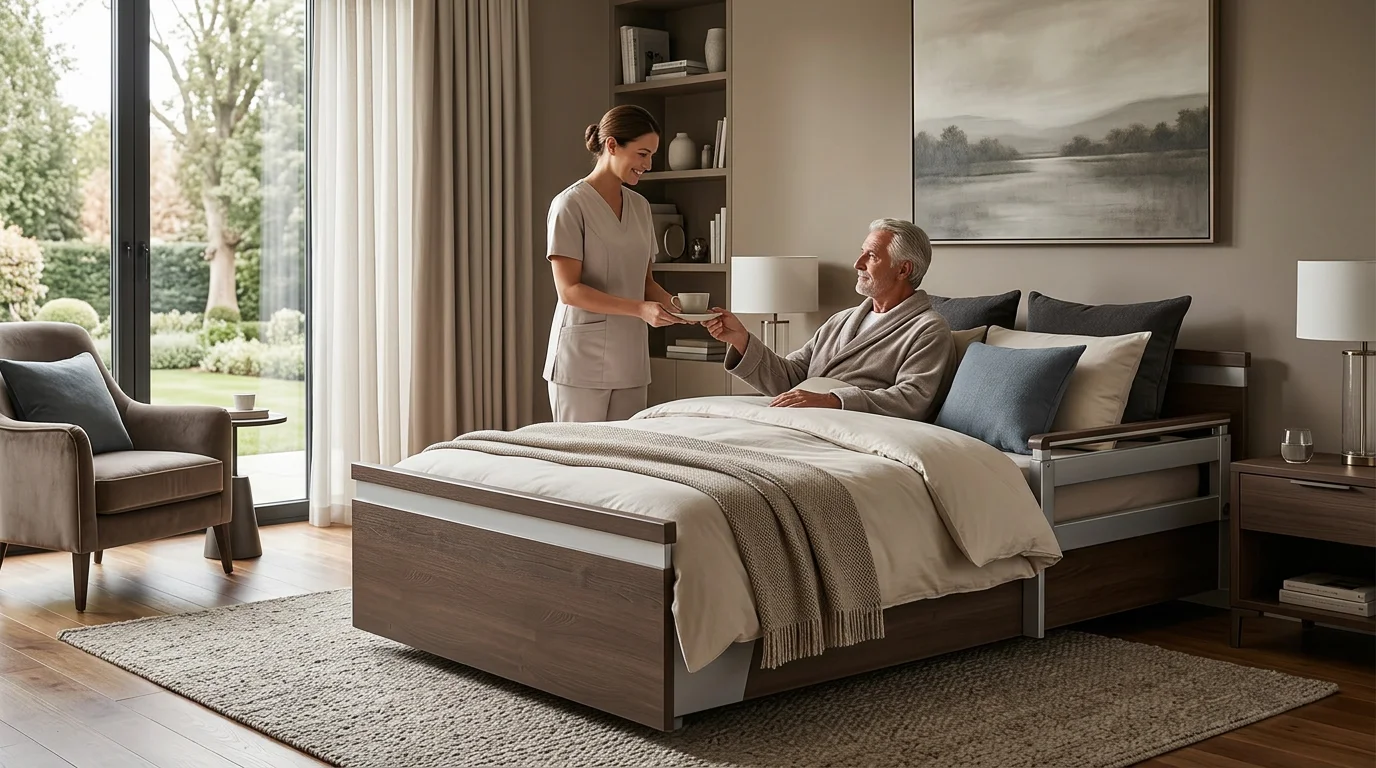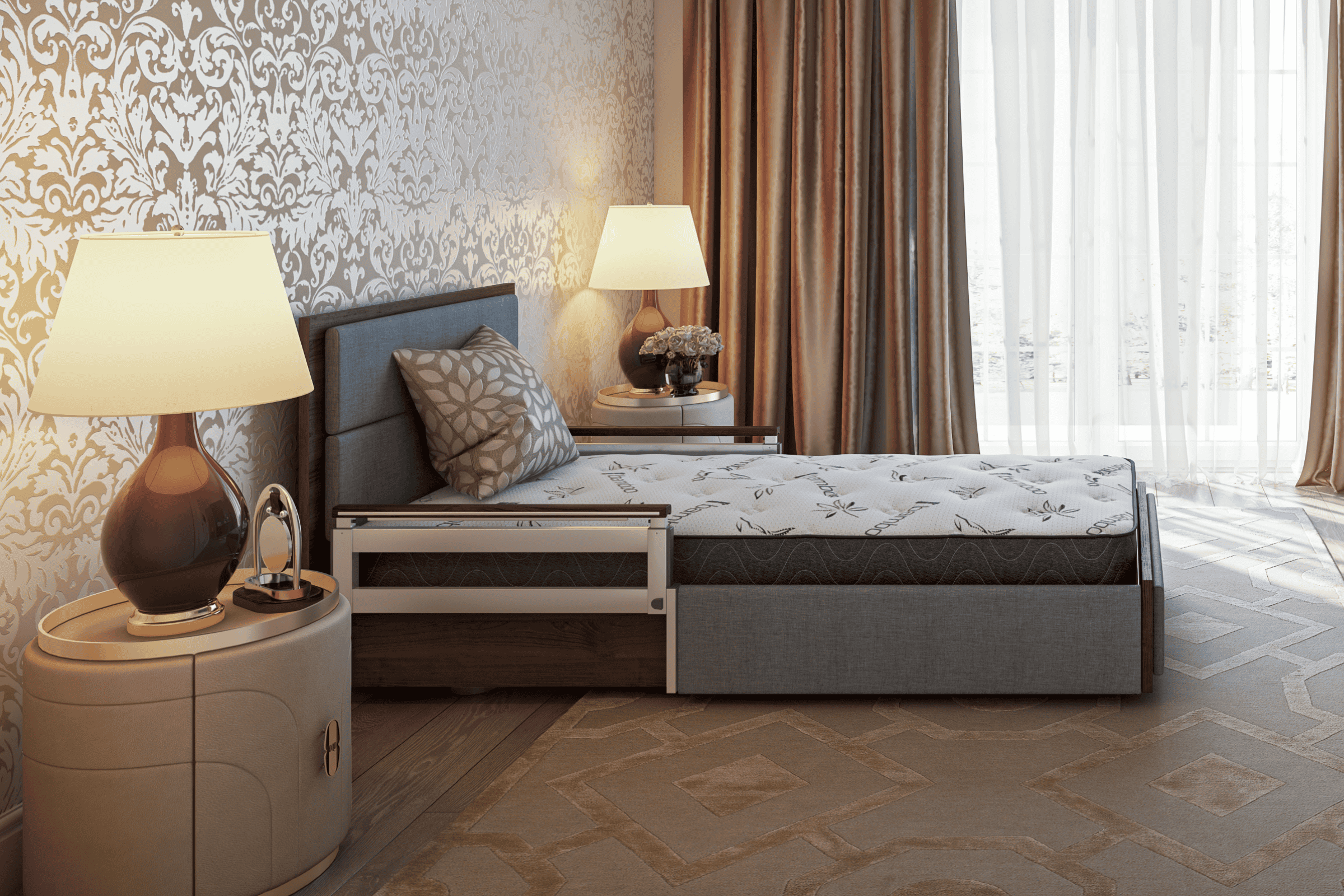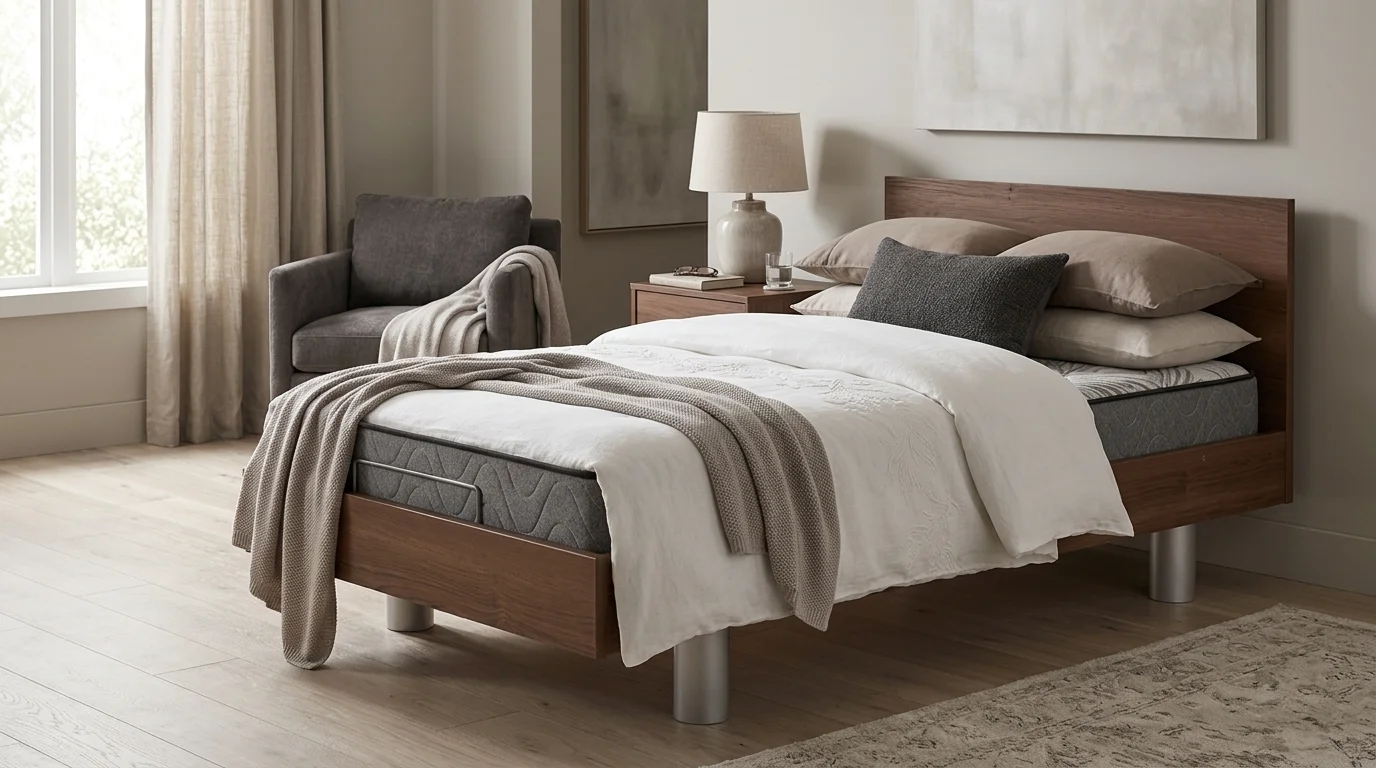







Choosing the best bed for a senior is one of those decisions that quietly shapes the next ten years of someone’s life. The right bed protects against falls, supports a body that needs gentler positioning, gives a caregiver back their lower spine, and keeps the bedroom from feeling like a hospital. The wrong one buys you replacement costs, sleep loss, and a room that signals decline to the person living in it.
This guide is the buyer’s guide we wished existed when we started building beds for seniors 25 years ago. It is evidence-based – every clinical claim is cited – and it is honest about what works and what does not. Some popular “fall safety” features have weaker evidence than the marketing suggests. Some clinical features are more useful than buyers realize. And the right bed for a senior is almost never the cheapest one.
The short answer: the best beds for seniors are full-electric adjustable wellness beds with hi-lo height adjustment that hits the ADA-recommended 20-to-23-inch transfer band1, quiet motors, half-length assist rails sized to FDA limits, and a residential look. For most seniors, the SonderCare Aura Premium ($6,999) is the right starting point; the Aura Extra Wide ($8,999) adds room; the Aura Platinum ($8,499) adds furniture-grade aesthetics; the Aura Companion Bed ($12,999) lets a couple stay sleeping side by side. Shop SonderCare adjustable beds for seniors or call 833-649-7772.
The Best Adjustable Beds for Seniors at a Glance
| Best for | SonderCare model | Price | Sleeping width | Weight capacity |
|---|---|---|---|---|
| Most senior home care needs (best overall) | Aura Premium | $6,999 | 39″ | 500 lbs |
| More room or larger users | Aura Extra Wide | $8,999 | 48″ | 500 lbs |
| A bedroom that should not look clinical | Aura Platinum | $8,499 | 39″ | 500 lbs |
| Premium + extra room | Aura Platinum Wide | $10,999 | 48″ | 500 lbs |
| Couples sleeping side by side | Aura Companion (split king) | $12,999 | 78″ (2 x 39″) | 700 lbs total |
Every model is full-electric and certified to International Hospital Standard. Plan to budget separately for a quality mattress.
What “Best Bed for Seniors” Actually Means
The phrase “best bed for seniors” gets used loosely. Some sources mean the most comfortable mattress. Others mean the safest frame. The most useful definition – the one we work from – covers four things at once: safer transfers in and out of bed, comfortable positioning that addresses real medical needs, a residential look that respects the bedroom, and a build quality that lasts a decade. A bed that scores well on three of four is not the best; it is a compromise.
Adjustable Bed vs. Consumer Adjustable Bed vs. Hospital Bed
Three categories of bed get pitched to senior buyers, and they are not the same.
- Consumer adjustable beds from mattress brands (Sleep Number, Tempur-Pedic, Saatva, Leggett & Platt) typically run $700 to $3,000. They get head and knee elevation right and include nice-to-haves like wall-hugger frames and massage. They do not include the wide hi-lo range a caregiver needs, the ultra-low position for fall safety, hospital-grade certification, or the clinical positioning (Trendelenburg, Cardiac Chair) that supports specific medical needs.
- Adjustable wellness beds for seniors like the SonderCare Aura line ($6,999+) close that gap: hospital-grade safety and positioning, but a residential look. This is the category most aging-in-place families need.
- Hospital beds are the right answer when daily clinical care is the primary use case. If you specifically need a hospital bed, see our companion buyer’s guide on how to choose a home hospital bed. For most senior buyers, an adjustable wellness bed is the better fit.
The Five Features That Make a Bed Best for a Senior
Hundreds of features get marketed on senior beds. Five of them have meaningful evidence behind them. Get these right and the rest is detail.
1. Hi-Lo Height Adjustment in the ADA Transfer Range
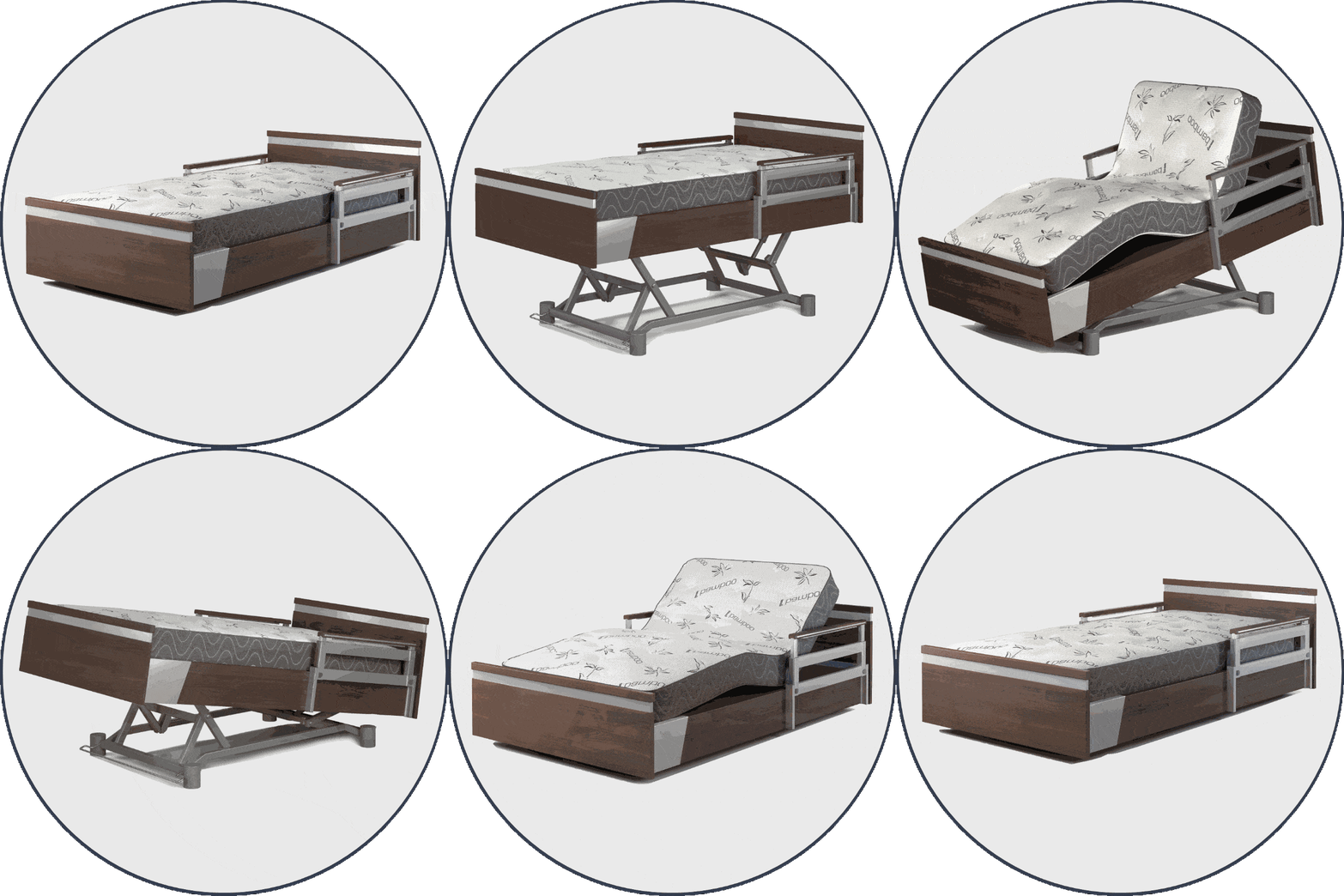
This is the feature with the strongest evidence behind it. The ADA National Network recommends a bed height of 20 to 23 inches from the floor to the top of the mattress for accessible transfers1, sitting with feet flat and knees near 90 degrees. Biomechanical studies show too-low beds significantly raise the hip torque required to stand, which destabilizes frail seniors2. A hi-lo bed that can hit and hold 20 to 23 inches reliably – and raise higher when a caregiver is providing care – is safer for the user and better for the caregiver. The Aura Premium has a pre-programmed 21-inch transfer height set inside the safe band.
2. Caregiver-Protective Height Range
The hi-lo lift matters as much for the caregiver as the user. A 2023 experimental study in Industrial Health of 33 clinicians performing in-bed care tasks found that placing the bed at an individually adjusted working height (versus a low fixed height) placing the bed at an individually adjusted working height substantially reduced lumbar disc compression depending on the task, and reduced trunk flexion from 73-81 degrees to 17-25 degrees3. OSHA guidelines recommend waist or elbow height for in-bed care tasks; one facility that implemented height-adjustable beds cut workers’ compensation costs from approximately $140,000 per year to under $4,000 per year4. The Aura raises to 39 inches for caregiver tasks. Consumer adjustable beds do not.
3. Ultra-Low Position – Useful, Not Magic
Here the marketing and the evidence diverge, and being honest about that builds trust. Ultra-low platforms (the SonderCare FallSafe drops to 10 inches) sound like an obvious fall-injury reduction, but the strongest evidence does not support that as a blanket claim. A cluster-randomized trial of 20 wards found no reduction in falls or fall injuries from introducing low-low beds5, and subsequent reviews echo the finding. The mechanical reason: video analysis of 2,377 falls in long-term care captured 30 hip fractures, and all of them occurred from standing height – not from bed falls6. The honest takeaway: ultra-low height is useful for selective supervised use with floor mats for the highest-risk users, but it is not a stand-alone fall-injury control. SonderCare gives you the option without false reassurance.
4. Half-Length Assist Rails (Not Full-Length Cages)
FDA Hospital Bed System Dimensional and Assessment Guidance requires gaps in the bed system to stay below 4.75 inches (120 mm) in Zones 1 to 3 and below 2.36 inches (60 mm) in Zone 4 to prevent head and torso entrapment7. The Consumer Product Safety Commission has documented thousands of bed-rail injuries from non-conforming portable rails over the past two decades, with more than three million units recalled since 2021. Half-length assist rails sized to FDA limits – what the SonderCare Aura includes – support transfers without the entrapment risk of full-length cages and without the false sense of security that can lead a confused user to climb over a rail and fall further.
5. Quiet Motors That Protect Sleep
The World Health Organization targets indoor nighttime sound levels below 30 dB(A) for healthy sleep, with maximum events below about 40 dB(A); awakenings become more likely as indoor levels exceed roughly 45-55 dB. The Aura’s electric motors operate at about 54 dB(A) at the source – quieter than typical conversation – which means a sleeping partner across the bed and a spouse in the next room are not woken by a nighttime adjustment. This matters more for seniors than for younger adults because sleep itself is more fragile with age (more on that below).
Health Benefits of Adjustable Beds for Seniors (Evidence-Backed)
Adjustable beds for seniors get credited with curing everything. The honest evidence supports several specific, measurable benefits.
Acid Reflux and GERD
Strong trial-level evidence. A 2021 systematic review of five controlled trials evaluating head-of-bed elevation for gastroesophageal reflux disease found the intervention reduced the percentage of time with esophageal pH below 4 by a mean of -9.5% (95% CI -14.8 to -4.12) compared with flat sleep8. A 2020 single-blind RCT of 39 pharmacologically treated GERD patients found 27 of 39 (69.2%) in the elevation group achieved a 10%+ improvement in the Reflux Disease Questionnaire score, versus 13 of 39 (33.3%) in the control group (RR 2.08; 95% CI 1.19-3.61)9. An adjustable bed lets a senior hold a 30-to-45-degree head elevation comfortably all night – something a stack of pillows cannot do safely.
Sleep Apnea and Snoring
De Barros Souza et al. (2017) studied 52 patients with obstructive sleep apnea, testing the effect of a mild 7.5-degree head-of-bed elevation. Apnea-Hypopnea Index dropped from a median 15.7 events/hour at flat to 10.7 events/hour with elevation (p<0.001) - a 31.8% average reduction. Minimum oxygen saturation rose from 83.5% to 87%. 61.5% of patients (32 of 52) responded10. For older adults with positional sleep apnea, this is the kind of intervention an adjustable bed delivers as a side effect of buying it.
Leg and Lower-Limb Edema
Ielapi et al. (2022) showed that a 15-degree leg elevation decreased ankle circumference by 2.7-2.8 cm versus 1.0 cm without elevation (p<0.001), with patient comfort perception independently predicted (beta=1.63, p=0.003)11. For seniors with venous insufficiency, dependent edema, or simply puffy ankles at the end of a long day, the foot-elevation function of an adjustable bed addresses a real problem with measurable results.
Pressure Redistribution and Back/Joint Comfort
Kim and Shin (2021) found that raising the legs from a 30-degree Fowler position to a semi-Fowler (zero-gravity-like) position reduced sacral interface pressure by 19-35%12. For seniors managing arthritis, chronic back pain, or recovery from a fall, the zero-gravity preset takes load off the lower spine and major joints. Combine that with a pressure-redistribution mattress (more below) and a senior’s bed becomes a meaningful pain-management tool.
Sleep That Fragments With Age
Sleep itself changes with age. Li, Vitiello, and Gooneratne (2017) found that wake-after-sleep-onset increases by approximately 10 minutes per decade from age 30 to 60, and older adults experience 2.7 times more nocturnal awakenings than younger adults13. The practical implication for a senior bed: small comfort details (quiet motors, smooth motion, the right transfer height at 2 a.m.) matter more for a 75-year-old than for a 35-year-old, because the 75-year-old’s sleep is more easily disrupted and harder to recover.
Best SonderCare Adjustable Beds for Seniors
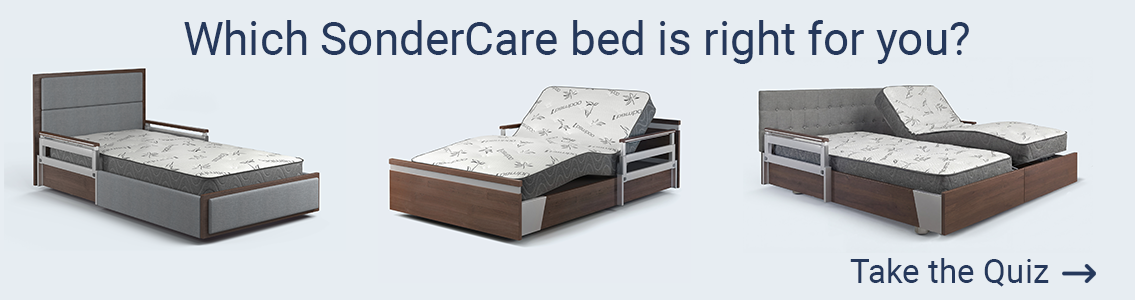
Four picks cover the most common buying situations. Each is featured on the comparison table above.
Best Overall: Aura Premium ($6,999)
For the widest range of senior home care needs, the SonderCare Aura Premium is the bed we recommend most. It delivers hospital-certified positioning – Trendelenburg, Zero Gravity, Cardiac Chair, Comfort Chair – in a 39-inch frame rated for 500 lbs. The FallSafe ultra-low position drops to a 10-inch platform for supervised low use; the 21-inch transfer height sits inside the ADA safe band; the 39-inch high position protects the caregiver’s spine. Quiet motors at 54 dB(A) keep nighttime adjustments from disrupting fragmented older-adult sleep.
Best Extra-Wide Senior Bed: Aura Extra Wide ($8,999)
The Aura Extra Wide widens the sleeping surface to 48 inches while keeping the full Aura positioning suite and 500-lb capacity. It is the right choice for seniors who shift position often, prefer more room than a standard adjustable bed, or whose caregiver sits on the edge during transfers.
Best Furniture-Grade Look: Aura Platinum ($8,499)
The Aura Platinum keeps every Aura Premium capability and adds fully upholstered side panels in Slate Gray Crypton fabric and a furniture-grade headboard. From across the room it reads as bedroom furniture, not equipment. The right pick for an affluent senior who refuses anything that looks medical (ICP 6) and the stubborn senior who values the bedroom’s aesthetic (ICP 2).
Best for Couples: Aura Companion Split King ($12,999)
This is the option most senior bed guides miss. When one partner needs care equipment but a couple wants to keep sleeping in the same bed, the Aura Companion Bed joins two independent 39-inch sleep surfaces into a 78-inch split king rated for 700 lbs total. Each side adjusts its own head and knee positions; both sides raise and lower together for transfers. For the deeper picture of how this works for senior couples, see our companion article on dual beds for senior couples.
The Mattress Matters as Much as the Bed
The single most-skipped step in choosing a senior bed is the mattress. A traditional innerspring will not bend with an adjustable base; a memory foam or hybrid pocket-coil mattress will. The SonderCare Dream Bamboo Quilt-Top ($1,299) is the most popular pairing for seniors – reversible soft and firm sides, cooling gel, a fluid-proof cover, and a firm edge for safe sitting. The Signature Hybrid ($1,799) adds individually wrapped pocket coils. For seniors with limited mobility who spend most of the day in bed, the Alternating Pressure Air mattress ($2,999) adds clinical-grade pressure redistribution supported by Cochrane review evidence. See the full SonderCare mattress lineup.
How to Choose the Best Bed for Your Senior
Three questions get most families to the right bed. Match the features to the answers.
How Much Help Does the Senior Need?
A senior who still gets in and out of bed independently does well with the Aura Premium and a memory-foam mattress with a firm edge. A senior with reduced mobility – whether from arthritis, Parkinson’s, post-stroke weakness, or progressive age-related loss – benefits from the same bed plus accessories like the Overhead Trapeze Helper Bar ($369), which Medicare covers as DME when medically indicated. For the deeper picture, see our companion article on the best bed for elderly with mobility issues. For very advanced age (90+), see our guidance on the best bed for a 100-year-old.
Who Else Sleeps in the Room?
Single sleepers do well with a 39-inch Aura Premium or Platinum. Senior couples who want to keep sleeping side by side need the Aura Companion split king. For broader buying considerations when the bed is shared at home, see our best beds for elderly at home guide.
What Should the Bedroom Look and Feel Like?
If the bedroom should look like a bedroom, the Aura Platinum’s upholstered finish closes the deal. If aesthetics matter less than budget, the Aura Premium gives every safety feature at a lower price.
Will Medicare Pay for an Adjustable Bed for a Senior?
The honest answer is “rarely for the bed most families want, sometimes for a basic one.” CMS Local Coverage Determination L33820 covers semi-electric beds as Durable Medical Equipment at 80% of the approved amount when a physician documents medical necessity. The CGS “Dear Physician” letter (revised August 2024) confirms total-electric beds are explicitly excluded14. The Medicare-covered bed is a basic frame – not a premium residential wellness bed. Most families who choose a SonderCare Aura pay privately or use Medicare’s capped-rental program (up to 13 months) as a bridge. For the detailed Medicare picture, see our guide to what kind of hospital bed Medicare pays for.
The Rent-vs-Buy Decision (Honest Math)
Rent-vs-buy advice for a senior bed is often mis-stated as a few weeks of breakeven. The honest math: typical full-electric hi-lo rental rates run roughly $200 to $395 per month, and a full-electric hi-lo home bed often starts around $2,699 to purchase. That puts the breakeven in the 7-to-14-month range. For aging-in-place care lasting more than a year, ownership is the better financial decision. For shorter-term care (post-surgical recovery, time-limited hospice), Medicare’s 13-month capped-rental can be the right path. Premium beds like the SonderCare Aura line are typically private-pay regardless.
Caregiver Safety Is Part of the Bed Decision
If a spouse, adult child, or family caregiver will be providing day-to-day care, the bed’s caregiver-protective features matter as much as the user-facing ones. Falls are the leading cause of injury for adults 65 and older, and the CDC reports that over 14 million older adults (about 1 in 4) report a fall each year – approximately 3 million ED visits annually, with over 38,000 deaths in 202115. The caregiver’s own health is often the limiting factor in how long a senior can stay at home. A bed that lets a caregiver work at hip height (39″ on the Aura), repositions the user electrically rather than manually, and includes a battery backup for power outages is the bed that lets a family caregiver keep doing the work. For more on bedroom-wide caregiver safety, see our fall prevention guide for seniors at home.
What About Bed Exit Alarms?
One feature that gets recommended often but does not have the evidence to support it. A hospital cluster-randomized trial that increased bed-alarm use found no significant reduction in falls (RR 1.09, 95% CI 0.85-1.53)16. A 2021 meta-analysis was worse: bed and chair sensors increased first-fall risk by about 20% (RR 1.20). The better strategies are environmental: a bed sized to the user, transfer training, half-rails, supervision when needed, and impact-absorbing floor mats for the highest-risk users.
Questions About Choosing Best Senior Bed
What is the best bed for seniors?
A full-electric adjustable wellness bed with hi-lo adjustment that hits the ADA-recommended 20-to-23-inch transfer band, quiet motors, half-length assist rails sized to FDA limits, and a residential look. The SonderCare Aura Premium ($6,999) is the most-recommended starting point.
What is the best adjustable bed for the elderly?
The Aura Premium for most situations; the Aura Platinum when bedroom aesthetics matter; the Aura Extra Wide when more room is needed; the Aura Companion for couples who want to keep sleeping side by side.
Do adjustable beds help with GERD, sleep apnea, and back pain?
Yes – with controlled-trial evidence. A 2021 systematic review showed head-of-bed elevation reduced esophageal acid exposure by 9.5%8; a 2017 study found 7.5-degree elevation cut apnea-hypopnea index by 31.8%10; a zero-gravity position reduced sacral pressure 19-35%12.
Will Medicare pay for an adjustable bed for a senior?
Medicare Part B covers basic semi-electric beds as DME at 80% of the approved amount with physician documentation per CMS LCD L33820. Total-electric and premium residential beds are excluded. See the dedicated Medicare hub linked above.
Are bed rails safe for an elderly person?
Half-length assist rails sized to FDA gap limits (under 4.75 inches in Zones 1-3, under 2.36 inches in Zone 4) are generally safer than full-length cages or non-conforming portable rails7.
Is it better to rent or buy a bed for a senior?
Breakeven is commonly 7 to 14 months. For care lasting more than a year, ownership wins; for shorter-term care, Medicare’s 13-month capped-rental can bridge the gap.
Talk to a SonderCare Senior Bed Expert
Choosing the best bed for a senior is one of those decisions worth a phone call. SonderCare bed experts have helped thousands of families pair the right Aura model with the right mattress for the right room – whether the senior is aging in place, recovering from surgery, managing a chronic condition, or just ready for a bed that does more. Every consultation is guidance, not a sales pitch.
Shop SonderCare adjustable beds for seniors or call 833-649-7772. For deeper guides in this silo, see:
- Best beds for elderly at home – broader buyer’s guide for adult caregivers
- Best bed for elderly with mobility issues – condition-specific picks
- Best bed for a 100-year-old – centenarian guidance
- Adjustable bed maintenance tips for seniors – keeping your bed in service for a decade
References
- ADA National Network. “Accessible Lodging” fact sheet. 2017. Recommended bed height 20 to 23 inches from floor to mattress top. adata.org/factsheet/accessible-lodging
- Merryweather A, et al. “Sit-to-stand performance in older adults: bed-height effect on biomechanics.” Work, 2015. DOI: 10.3233/WOR-152110
- Authors. “Effects of different bed heights on physical burden during in-bed care.” Industrial Health, 2023. Lumbar disc compression reduced 109%-67% with adjusted working height. DOI: 10.2486/indhealth.2022-0038
- OSHA “Safe Patient Handling” technical resources. Facility implementation case: worker comp costs reduced from ~$140,000/year to under $4,000/year after introducing height-adjustable beds. Larson D (2023) supports L4-L5 compression-force evidence base.
- Haines TP, et al. “Effectiveness of substituted patient observer for falls prevention: cluster randomised controlled trial.” J Am Geriatr Soc, 2010. No reduction in falls or fall injuries with low-low beds. PMID: 20398112
- Robinovitch SN, et al. “Video evidence of hip fracture mechanisms in long-term care.” Journal of Bone and Mineral Research, 2020. 2,377 falls captured; 30 hip fractures, all from standing height. DOI: 10.1002/jbmr.4048
- U.S. Food and Drug Administration. “Hospital Bed System Dimensional and Assessment Guidance to Reduce Entrapment.” 2006 (current). Zones 1-3 ≤120 mm (4.75 in); Zone 4 ≤60 mm (2.36 in). fda.gov hospital bed guidance
- “Head of bed elevation to relieve gastroesophageal reflux symptoms: a systematic review.” Sleep and Breathing, 2021. Mean difference in pH<4 exposure -9.5% (95% CI -14.8 to -4.12). PubMed: PMC7816499
- Villamil Morales IM, Gallego Ospina DM, Otero Regino WA. “Impact of head of bed elevation in symptoms of patients with gastroesophageal reflux disease.” Gastroenterol Hepatol, 2020. 27/39 (69.2%) vs 13/39 (33.3%) RDQ improvement; RR 2.08. DOI: 10.1016/j.gastrohep.2020.01.007
- de Barros Souza FJF, Genta PR, de Souza Filho AJ, Wellman A, Lorenzi-Filho G. “The influence of head-of-bed elevation in patients with obstructive sleep apnea.” Sleep and Breathing, 2017. AHI reduction of 31.8% with 7.5-degree head elevation. DOI: 10.1007/s11325-017-1524-3
- Ielapi N, et al. “Effects of leg elevation on lower limb edema and comfort: a quasi-experimental study.” 2022. 15-degree leg elevation decreased ankle circumference 2.7-2.8 cm vs 1.0 cm control (p<0.001).
- Kim H, Shin J. “Effects of body position changes on interface pressure at sacral and trochanteric prominences.” 2021. Semi-Fowler position reduced sacral pressure 19-35% vs 30-degree Fowler.
- Li J, Vitiello MV, Gooneratne NS. “Sleep in normal aging.” Sleep Medicine Clinics, 2017. WASO increases ~10 min/decade age 30-60; 2.7x more nocturnal awakenings in older adults. DOI: 10.1016/j.jsmc.2017.09.001
- Centers for Medicare & Medicaid Services. Local Coverage Determination L33820 – Hospital Beds and Accessories. CGS “Dear Physician” letter, revised August 2024. Semi-electric beds covered as DME at 80% with documented medical necessity; total-electric beds explicitly excluded. cms.gov LCD L33820
- Centers for Disease Control and Prevention. Older Adult Falls Data and Facts (reviewed January 2026). Falls are the leading cause of injury death among adults 65+; over 14 million (1 in 4) report a fall each year; ~3 million ED visits; over 38,000 deaths in 2021. cdc.gov/falls/data-research
- Shorr RI, et al. “Effects of an intervention to increase bed alarm use to prevent falls in hospitalized patients: a cluster randomized trial.” Annals of Internal Medicine, 2012. 27,672 patients across 16 units; rate ratio 1.09 (95% CI 0.85-1.53), no significant fall reduction. PMID: 22250144