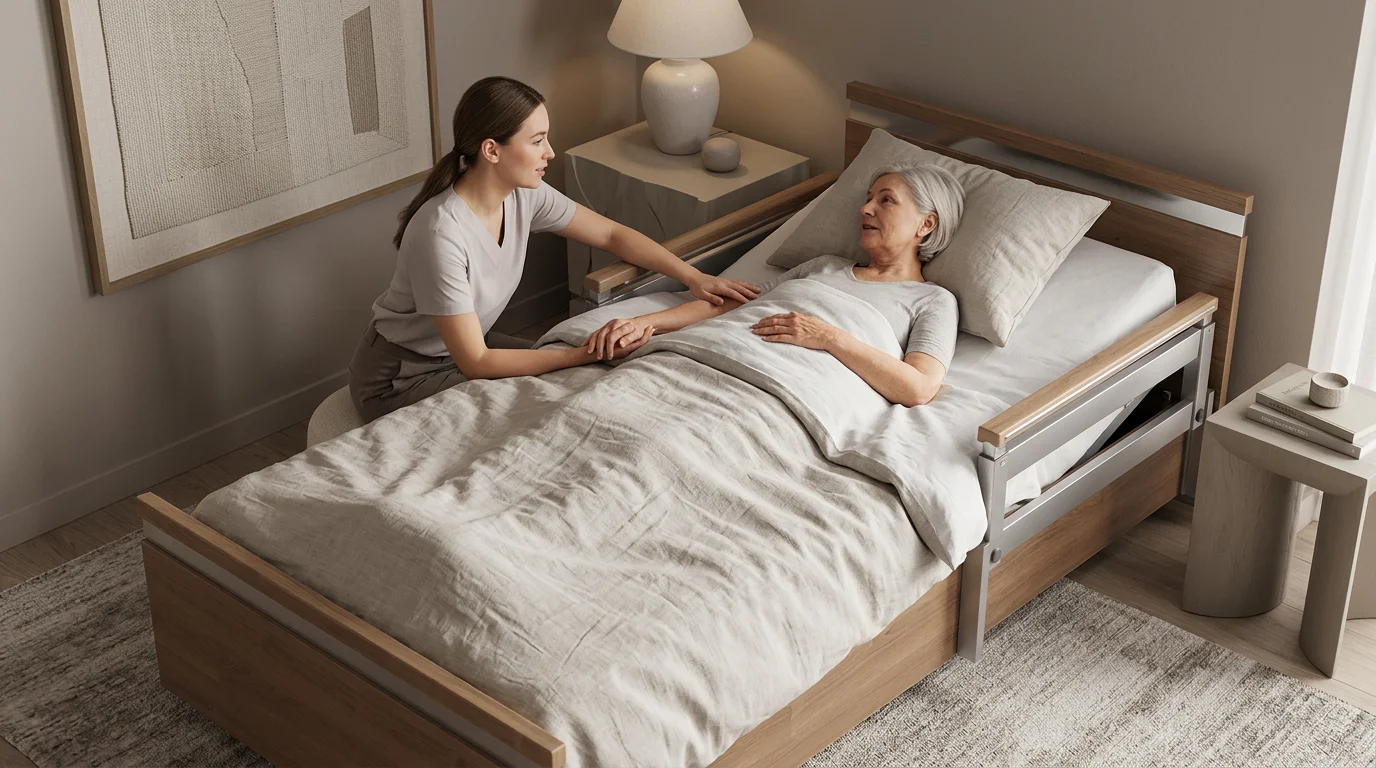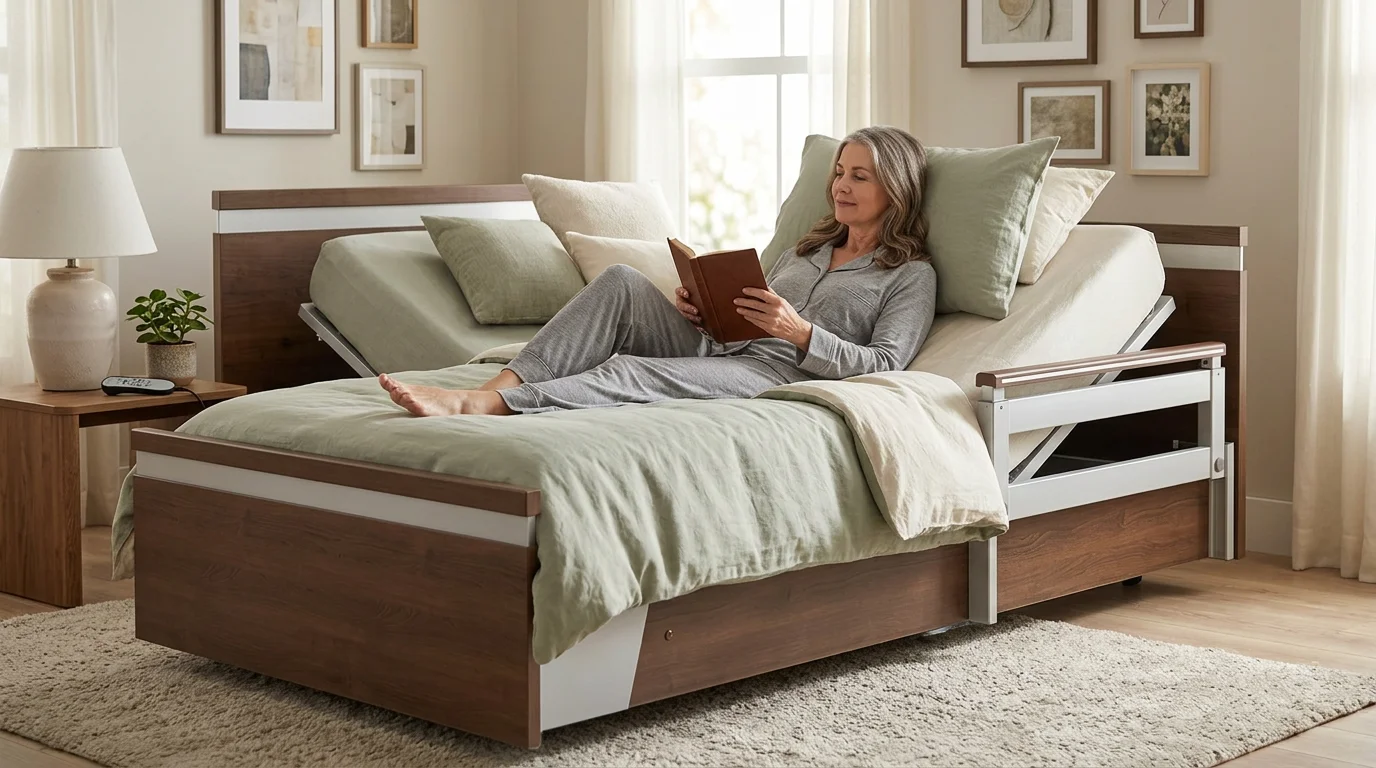







The short answer: the best bed for a 100-year-old is an adjustable wellness bed with quiet motors, gentle preset motion, a pressure-redistribution mattress, half-rails, and a residential look. The SonderCare Aura Platinum ($8,499) is the most-recommended choice for centenarians – same medical-grade safety as the Aura Premium, with fully upholstered side panels that keep the room feeling like home. Shop senior beds or call 833-649-7772.
Why the Bed Decision Is Different at 100
Buying a bed for a 100-year-old is not the same as buying a bed for any other senior. At a hundred, the body is more fragile, the skin is thinner, sleep is more fragmented, and balance is unreliable. Decisions that matter for a 75-year-old aging in place – mattress feel, design – still matter, but they share the stage with biology that is genuinely different at this age.
A 100-year-old also brings something the bed has to respect: a lifetime of preferences, habits, and quiet authority over their own space. The best bed for a centenarian is one that does the new safety work without making the room feel like a hospital, and without taking the bed away from them.
The Biology That Changes the Decision
Skin Becomes Less Forgiving
Aging skin remodels in ways that reduce its ability to handle pressure and shear. The dermis thins, vascularity and cellularity decline, collagen synthesis drops, elastic properties diminish, and the dermo-epidermal junction (the interface that gives skin its mechanical interlocking with the underlying tissue) flattens by more than one-third1. Subcutaneous fat over bony prominences – the body’s natural cushioning – diminishes with age, leaving the bone closer to the bed surface.
A 2025 meta-analysis of 70,340 elderly inpatients quantified the consequence: each additional year of age increased the odds of a pressure injury by 6% (OR 1.06, 95% CI 1.03-1.09), and immobility was strongly associated with pressure injury (OR 4.54, 95% CI 3.09-6.67)2. For a 100-year-old who spends most of the day in bed, those numbers compound: a pressure-redistribution mattress and routine repositioning are not optional choices, they are clinical necessities. The international Clinical Practice Guideline from EPUAP, NPIAP, and PPPIA (2019) is the consensus reference for pressure injury prevention and care3.
Sleep Becomes Longer but More Fragmented
Centenarians spend more time in bed than younger seniors. A 2024 study of 994 Chinese centenarians found a median total sleep time of 9.0 hours per day (IQR 8.0-11.0) with a median 1.0 hour of daytime napping4. By comparison, U.S. older adults aged 62-90 average 7.2 hours of sleep and 8.4 hours of time-in-bed by actigraphy5. Sleep itself becomes less efficient: in large cohorts of older adults, sleep efficiency averages 78-82% with considerable wake-after-sleep-onset (WASO) of 39-78 minutes6.
The practical implication: a bed for a 100-year-old needs to be comfortable for longer hours of daily use, support easy micro-position changes overnight, and have motors quiet enough not to disturb the lighter, more easily fragmented sleep.
Recovery from a Hip Fracture After 90 Is Different
Here is the data that should shape every fall-safety conversation about a centenarian. In a 2025 hospital cohort of hip-fracture patients, 0% of nonagenarians regained independent ambulation by discharge – compared with markedly better outcomes in patients aged 75-89. Nonagenarians had about twice the odds of being non-ambulatory at discharge (adjusted OR ~1.97)7. The implication is not pessimism; it is planning. For 90+ users, set up the bed and room for prolonged dependence, safe transfers, and good positioning – before there is an event.
The Five Features That Matter Most
1. A Pressure-Redistribution Mattress
A 100-year-old spends more time in bed than a 70-year-old and applies the same load to the same body points for longer. Cochrane review evidence supports both alternating-pressure air surfaces and high-specification foam over standard surfaces for reducing incident pressure injuries8. The right mattress relieves pressure: the SonderCare Dream Bamboo Quilt-Top ($1,299) with reversible soft/firm sides and cooling gel is the standard recommendation for centenarians on an adjustable bed. For very elderly users who spend most of the day in bed, the Alternating Pressure Air mattress ($2,999) adds clinical pressure redistribution that the Cochrane evidence specifically supports. See the full SonderCare mattress lineup. For deeper guidance on pressure care, see our pressure sore prevention guide.
2. Very Quiet Motors
Centenarians sleep lightly and are easily startled. The Aura’s electric motors run at about 54 dB(A) at the source – quieter than typical conversation – so a nighttime adjustment does not wake the user or anyone else in the house. Quiet operation also reduces the stress response that loud equipment can trigger in the very elderly, particularly those with dementia.
3. Gentle, Familiar Motion
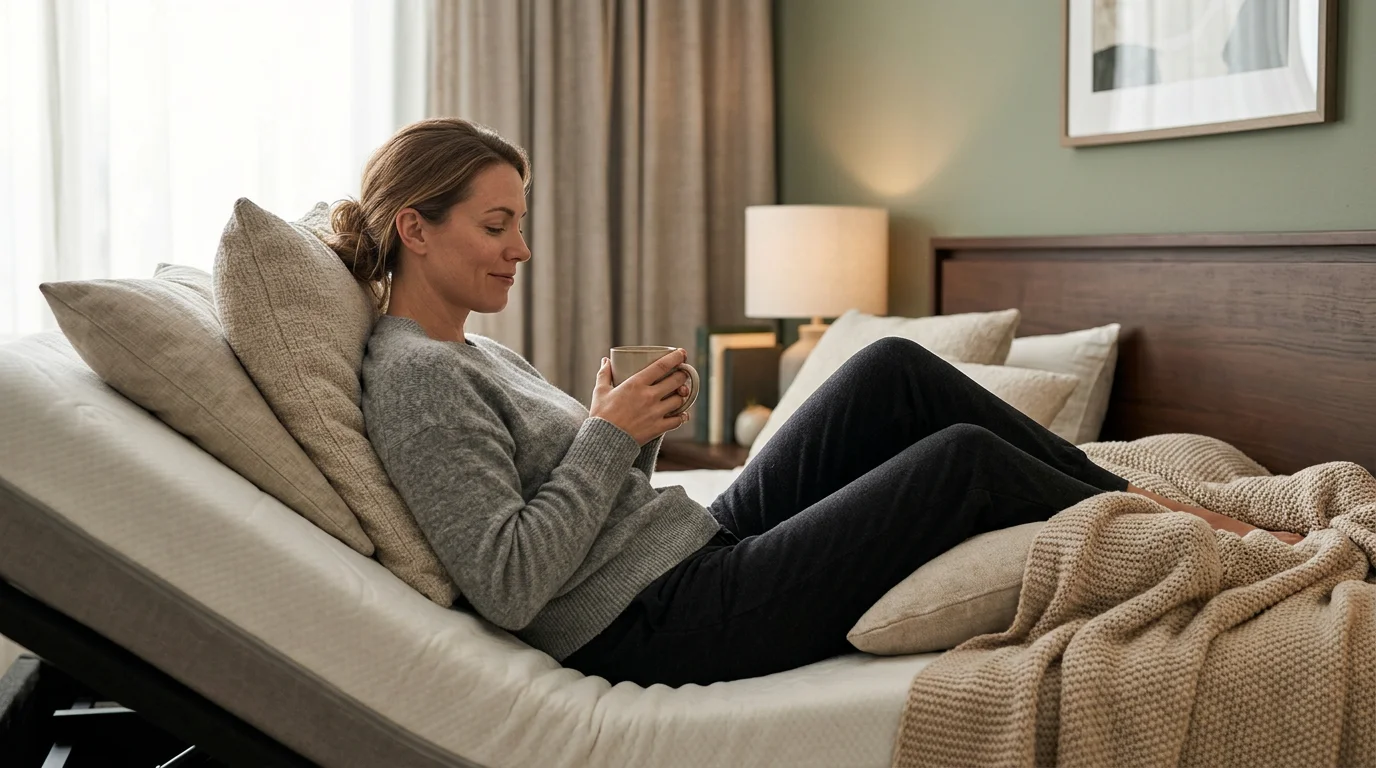
Steep tilts (Trendelenburg, Reverse Trendelenburg) are clinical features designed for medical procedures under guidance. For day-to-day use by a 100-year-old, stick to the gentler presets: Comfort Chair (a relaxed sitting position), Zero Gravity (a near-weightless reclined posture), and small head-and-knee adjustments. Modest head-of-bed elevation has additional benefits the trial evidence supports: it reduces nocturnal acid reflux9, and a 30-degree elevation position improves positional obstructive sleep apnea metrics in selected patients10. The Aura’s remote has dedicated buttons for these gentle positions.
4. Half-Rails for Hand Support (Not Entrapment Cages)
Centenarians need a handhold more than a barrier. SonderCare Aura beds include Multi-Height Assist Rails – half-rails sized for hand support during repositioning, not full-length cages. Half-rails preserve the user’s ability to exit the bed independently when they can; full-length rails can make a fall worse by increasing the height of one. Every gap in the bed system stays below the FDA’s 120 mm (4.75-inch) safe maximum for Zones 1-3 and 60 mm (2.36-inch) for Zone 4.
5. A Residential Look That Respects a Lifetime
A 100-year-old who has lived in the same house for fifty years should not have to live with equipment. The bed should read as bedroom furniture, not as a hospital piece – this is where the Aura Platinum’s upholstered side panels and furniture-grade headboard earn their place.
The SonderCare Picks for a 100-Year-Old
Aura Platinum – Best Overall for a Centenarian
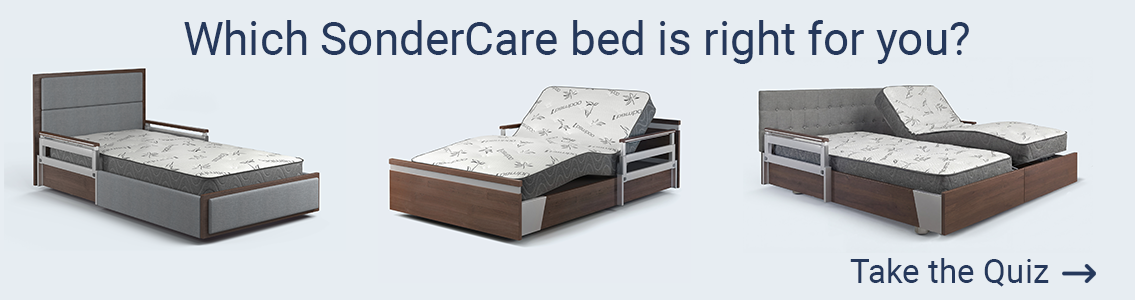
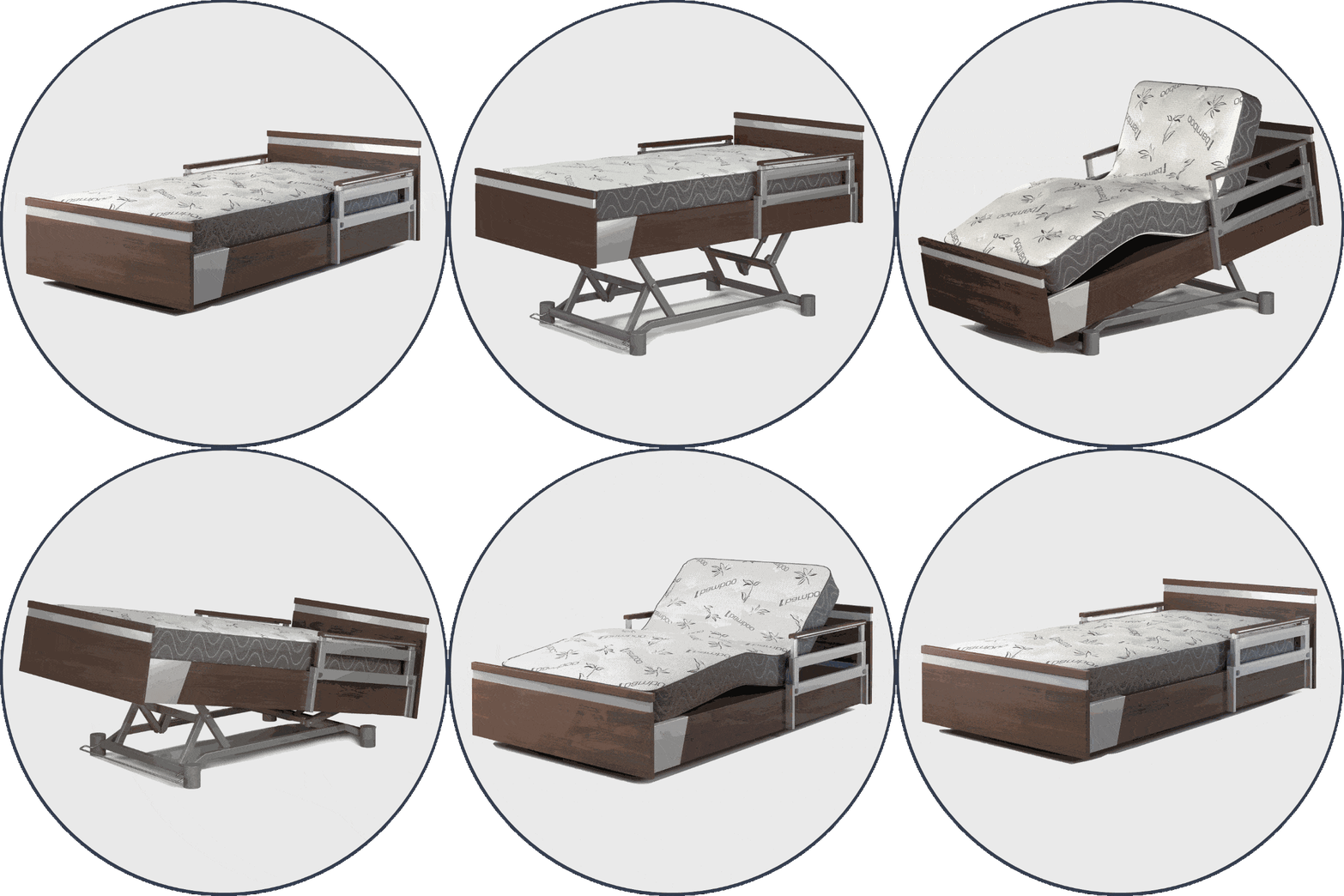
The SonderCare Aura Platinum at $8,499 is the right pick most of the time. Same hi-lo range, same quiet motors, same Zero Gravity and Comfort Chair presets as the Aura Premium – but with fully upholstered side panels in Slate Gray Crypton fabric and a furniture-grade headboard.
Aura Premium – When Aesthetic Matters Less Than Cost
The Aura Premium at $6,999 delivers every safety feature in the Platinum at a lower price point. Same 500-lb capacity, same hi-lo range, same medical certification – the visible side panels are simply less ornate.
Aura Extra Wide – When the Centenarian Shifts Position Often
Centenarians who shift in their sleep, who lie close to one edge, or whose caregiver needs to sit on the edge during a transfer benefit from the wider sleeping surface. The Aura Extra Wide ($8,999) widens the deck to 48 inches with every Aura Premium safety feature intact.
How to Help a 100-Year-Old Transition to a New Bed
A new bed at any age is a change. At 100, it is more of one. A few small choices make the transition easier.
- Keep the bedroom familiar. Same room, same direction the bed faces if possible, same nightstand on the same side, same bedding style. The bed itself is enough change.
- Introduce the bed at the lowest height first. A low setting reads as a low, easy bed rather than unfamiliar equipment. Raise it to caregiver height only when a caregiver is actively helping.
- Demonstrate one button at a time. The Aura’s backlit remote has dedicated buttons for head, knee, hi-lo, and the gentle presets. Show one, let the user try it, then the next.
- Use the white-glove delivery walkthrough. SonderCare’s white-glove delivery teams set the bed up, assemble the mattress on top, and walk family caregivers through the controls – which, for an elderly user, is the moment to involve them gently.
Fall Safety Beyond the Bed
For a 100-year-old, the bed is the centerpiece of fall safety, but the bedroom around it matters too: clear pathways, a night light, a phone within reach, a non-slip rug, easy access to a bathroom. Our fall prevention guide for seniors at home walks through the complete bedroom setup. For seniors of any age with mobility challenges affecting daily transfers, see our companion article on the best bed for elderly with mobility issues.
Mattress and Accessory Picks for a Centenarian
- Dream Bamboo Quilt-Top ($1,299) – the standard memory foam mattress for an adjustable bed at this age. Cooling gel, fluid-proof cover, firm edge, reversible soft/firm.
- Alternating Pressure Air mattress ($2,999) – for centenarians who spend most of the day in bed. Clinical-grade pressure redistribution supported by Cochrane evidence8.
- Underbed Auto-Nightlight ($219) – motion-activated floor light for safer nighttime exits.
- Heavenly Pillow ($189) – down-filled, waterproof-covered, gentle support for fragile necks.
- Overhead Reading Light ($179) – LED gooseneck mounted to the headboard.
More Questions About 100-year-old Bed Setups
What is the best bed for a 100-year-old?
A full-electric adjustable wellness bed with quiet motors, gentle preset motion, a pressure-redistribution mattress, and half-rails. The SonderCare Aura Platinum is the most-recommended pick for centenarians because it combines all of that with a furniture-grade look.
Why do pressure sores develop faster in very elderly people?
Aging skin thins and loses subcutaneous fat, the dermo-epidermal junction flattens by more than one-third (reducing shear resistance)1, and pressure-injury odds increase about 6% per year of age2. A pressure-redistribution mattress and routine repositioning are essential.
What kind of mattress is best for a 100-year-old?
An alternating pressure air mattress or a high-specification foam mattress – both are supported by Cochrane review evidence over standard surfaces for reducing incident pressure ulcers8. The SonderCare Alternating Pressure Air mattress is the right choice for low-mobility centenarians.
How long do centenarians sleep?
Longer than younger seniors – a Hainan centenarian cohort showed median total sleep of 9.0 hours per day plus 1.0 hour of daytime napping4. Plan for longer bed-use durations.
Is an adjustable bed safe for someone 100 years old?
Yes, when the bed is built to medical safety standards. The Aura line is certified to International Hospital Standard, with quiet motors, half-rails, and battery backup. Use gentle presets (Comfort Chair, Zero Gravity, modest head elevation – the last supported by trial evidence for GERD and OSA9) and avoid steep clinical tilts without medical guidance.
Talk to a SonderCare Senior Bed Expert
Choosing a bed for a 100-year-old is a tender decision. SonderCare experts have helped many families through it – matching the right Aura model, mattress, and accessories to the specific centenarian and the specific home. Every consultation is guidance, not a sales pitch.
Shop SonderCare beds for seniors or call 833-649-7772. For the broader buyer’s guide, see our complete guide to the best beds for seniors, or the best beds for elderly at home.
References
- Farage MA, Miller KW, Elsner P, Maibach HI. “Characteristics of the aging skin.” Wound Repair and Regeneration, 2013. Dermal thinning, decreased vascularity, dermo-epidermal junction flattening >33%, loss of subcutaneous fat. DOI: 10.1089/wound.2011.0356
- Wu Y, et al. “Risk factors for pressure injury in elderly inpatients: a meta-analysis of 70,340 patients.” BMC Geriatrics, 2025. OR 1.06 per year of age; immobility OR 4.54. DOI: 10.1186/s12877-025-06517-0
- EPUAP / NPIAP / PPPIA. Prevention and Treatment of Pressure Ulcers/Injuries: Clinical Practice Guideline. The International Guideline 2019. The international consensus reference for pressure injury prevention.
- Yang Y, et al. “Sleep patterns and cognitive function in Chinese centenarians.” Journal of Gerontology Series B, 2024. Median total sleep 9.0 h/day, daytime napping 1.0 h/day in 994 centenarians. DOI: 10.1093/geronb/gbad185
- Kurina LM, et al. “Sleep duration and all-cause mortality in older adults.” Sleep Health, 2015. U.S. older adults 62-90: 7.2 h sleep, 8.4 h time-in-bed. DOI: 10.1016/j.sleh.2015.09.004
- Li J, Vitiello MV, Gooneratne NS. “Sleep in normal aging.” Sleep Medicine Clinics, 2018. Sleep efficiency 78-82%, WASO 39-78 min. DOI: 10.1016/j.jsmc.2017.09.001
- Jimenez-Mola S, et al. “Functional recovery in nonagenarians after hip fracture.” Revista da Associacao Medica Brasileira, 2025. 0% regained independent ambulation by discharge in nonagenarians; adjusted OR ~1.97 for non-ambulation vs younger groups. DOI: 10.1590/1806-9282.20240796
- Shi C, et al. “Alternating pressure (active) air surfaces for preventing pressure ulcers.” Cochrane Database of Systematic Reviews, 2021. Alternating pressure air surfaces reduce incident pressure ulcers vs standard surfaces. See also McInnes E et al., Cochrane Support Surfaces Review. DOI: 10.1002/14651858.CD013620.pub2
- Schuitenmaker JM, et al. “Head of the bed elevation in adults with gastroesophageal reflux disease.” Neurogastroenterology & Motility, 2022. Trial evidence supports HOB elevation for nocturnal GERD. DOI: 10.1111/nmo.14385
- Iannella G, et al. “Positional therapy and the role of head-of-bed elevation in obstructive sleep apnea.” Journal of Clinical Medicine, 2022. 30-degree elevation improves positional OSA metrics in selected patients. DOI: 10.3390/jcm11195658