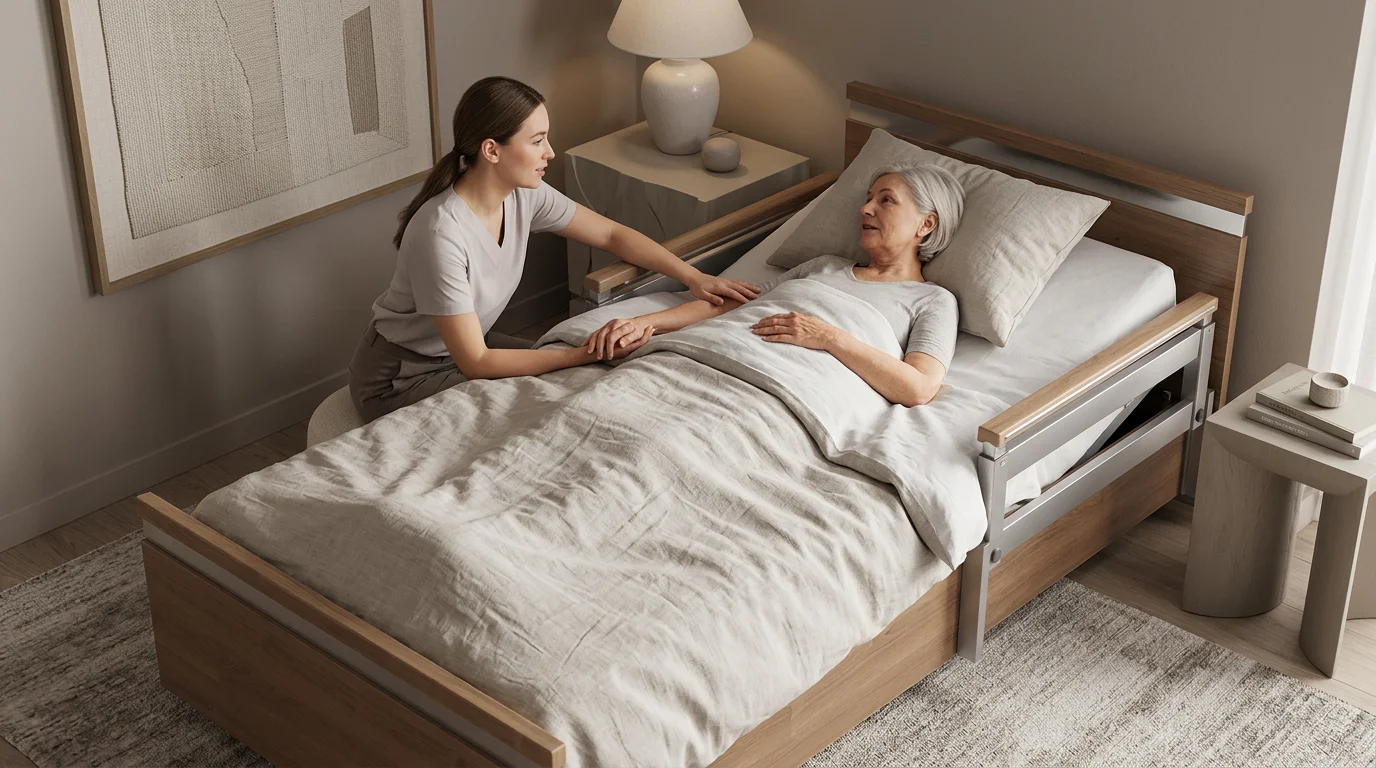






A caregiving situation often begins the same way. A parent comes home from the hospital, a spouse’s mobility declines, or a recovery takes longer than expected, and suddenly you’re doing things your body wasn’t designed for. Bending over a low mattress at midnight. Bracing against someone twice your weight during a transfer. Propping up pillows that flatten back down by 2am.
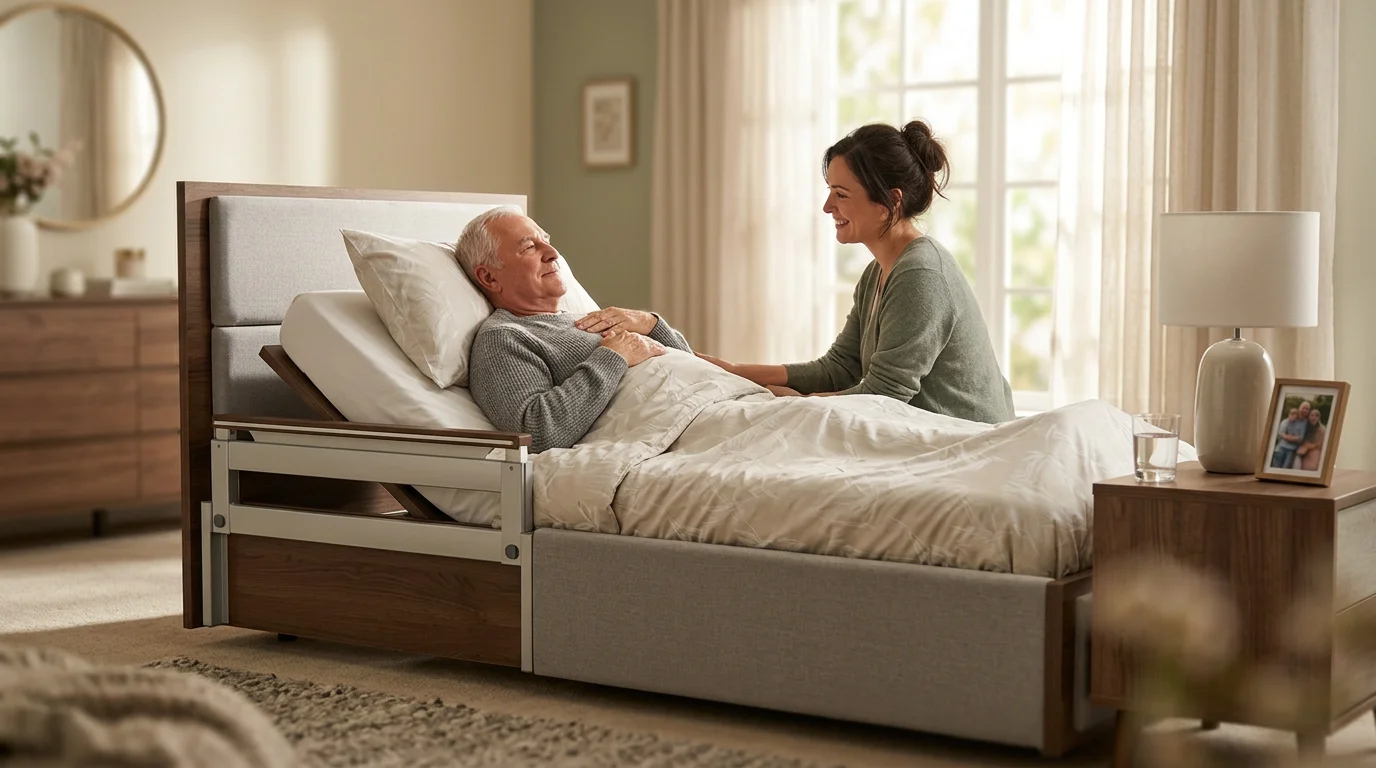
The benefits of adjustable hospital beds for home care go well beyond simple comfort. They address the physical and emotional strain at the center of family caregiving, protecting the caregiver’s body, reducing the clinical risks that threaten anyone requiring extended bed rest, and restoring a measure of independence and dignity to the person receiving care.
This guide covers what the evidence shows, what real caregivers report, and how to evaluate whether a home hospital bed is the right investment for your situation.
Hi-Lo Height Adjustment Protects the Caregiver’s Back
The single most cited benefit in caregiver forums isn’t a positioning feature or a clinical specification, it’s back pain relief. Nearly every thread about home hospital beds traces back to the same physical reality: repositioning, transferring, and providing care from a bed at the wrong height damages the caregiver’s body over time.
This isn’t just anecdote. The CDC’s Safe Patient Handling and Mobility program identifies adjustable-bed height adjustment as a core tool for reducing caregiver musculoskeletal injury during repositioning tasks.1 The National Institute for Occupational Safety and Health (NIOSH) specifically flags manual patient repositioning in fixed-height beds as a high-risk activity for musculoskeletal disorders (MSDs).2 And the scale of the problem is significant: MSDs affect an estimated 43–78% of healthcare workers globally, the same physical forces act on informal family caregivers who often work alone and without institutional support.3
A controlled biomechanical study published in Applied Ergonomics (Zhou et al., 2021) directly measured this effect. When caregivers repositioned patients using an adjustable-height bed set to the appropriate working height, spinal compression and shear forces were significantly lower than when the same task was performed at a fixed, standard bed height.4 Raising the bed to caregiver waist height before repositioning isn’t a luxury, it’s the mechanical difference between sustainable caregiving and injury.
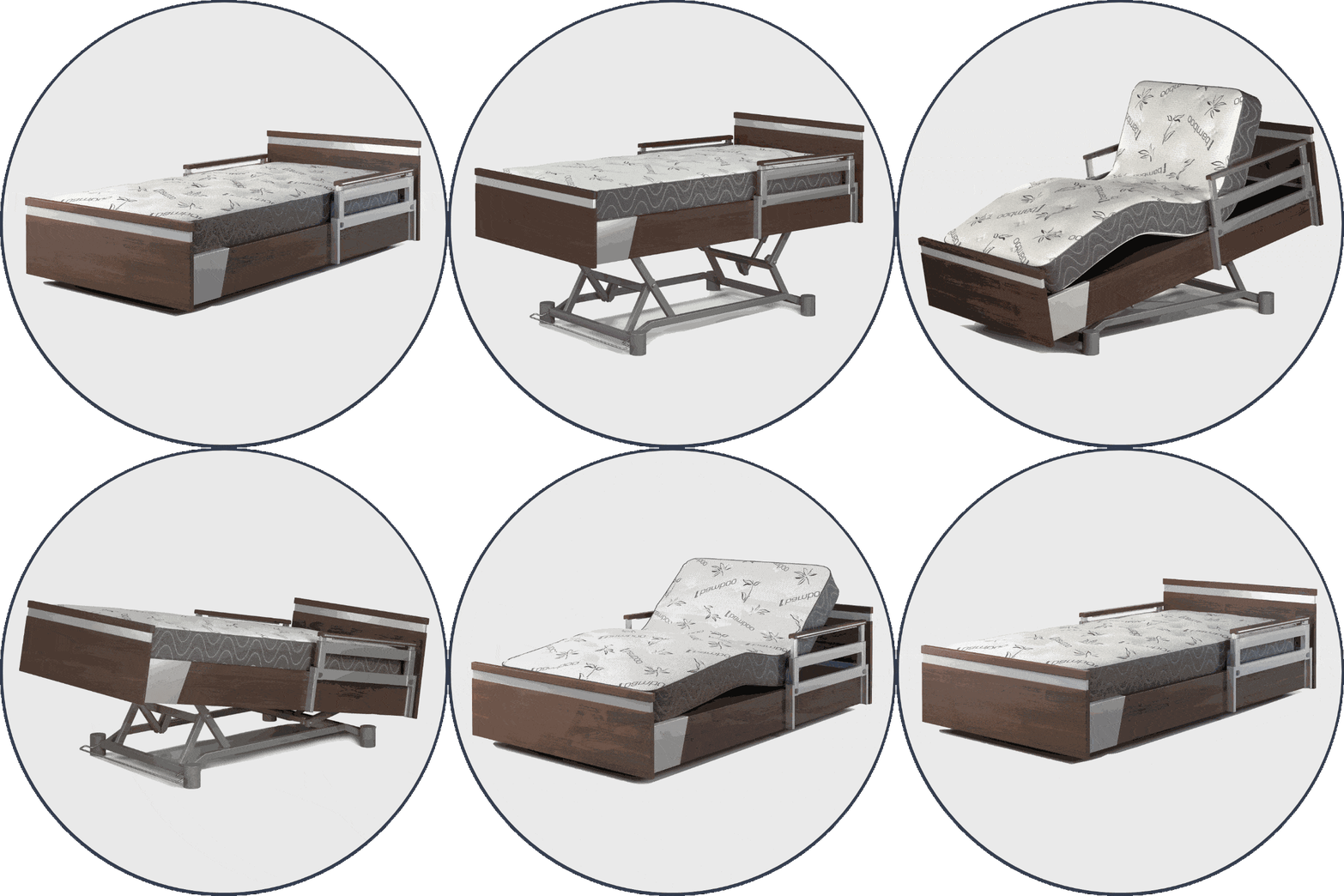
The Aura Premium home hospital bed adjusts from a 10″ platform height (FallSafe ultra-low) to a 39″ high position, covering the full range from safe transfer height to comfortable caregiver working height. For caregivers providing repositioning, wound care, or hands-on assistance multiple times per day, this range is the most-used feature on the bed.
Adjustable Positioning Reduces Pressure Injury Risk
Pressure injuries, also called pressure ulcers or bedsores, are the most feared complication for anyone requiring extended bed rest. They develop when sustained contact between skin and a surface cuts off blood flow to tissue over bony prominences: the tailbone, heels, hips, and shoulder blades. For families caring for someone who spends most of their time in bed, preventing them is a constant, exhausting responsibility.
The clinical scale of this problem is significant. The National Pressure Injury Advisory Panel (NPIAP) estimates overall pressure injury prevalence in the US at approximately 12.8%, with hospital-acquired pressure injuries affecting around 8.4% of inpatients.5 The Agency for Healthcare Research and Quality (AHRQ) estimates that pressure ulcers cost $9.1–$11.6 billion per year in the US, with per-patient treatment costs ranging from $20,900 to $151,700 per pressure ulcer.6 Prevention, not treatment, is the goal.
An adjustable hospital bed supports prevention through two distinct mechanisms.
Repositioning access. Scheduled repositioning, turning and shifting position every two to three hours, is the evidence-based cornerstone of pressure injury prevention. A Cochrane review of eight trials and 3,941 participants confirms repositioning as the primary preventive intervention, noting that whether repositioning occurs every two, three, or four hours matters less than whether it actually happens consistently.7 For family caregivers, this is the insight that changes everything: a bed they can raise to a comfortable working height makes the task physically manageable enough to sustain over weeks and months. A bed that keeps caregivers bent over at knee height does not.
Specialized support surfaces. The adjustable hospital bed frame is also what carries therapeutic mattresses. A Cochrane network meta-analysis of 21 trials and 2,362 participants found that alternating-pressure mattresses reduced pressure injury incidence by approximately 47% compared to standard hospital mattresses.8 These surfaces are designed specifically to fit adjustable hospital bed frames. SonderCare’s pressure redistribution mattress options, including the Alternating Pressure Air mattress for wound care applications, pair directly with the Aura bed frame.
For detailed protocols on skin inspection, repositioning schedule, and mattress selection by risk level, the pressure sore prevention and treatment guide covers the full picture.
Safer Transfers and Reduced Fall Risk
Falls during bed transfers are a documented fear across caregiver communities, and grounded in real risk. The moments of getting in and out of bed are among the highest-risk periods for anyone with reduced mobility, post-surgical weakness, or balance impairment. An adjustable home hospital bed addresses this through features that standard beds and consumer adjustable bases don’t offer.
Ultra-low height for fall risk reduction. The FallSafe Ultra-Low feature on the Aura line lowers the platform to 10 inches (17 inches to the mattress surface). When someone rolls or shifts during the night at this height, the distance to the floor, and the resulting potential for injury, is dramatically reduced compared to a standard bed frame at 25 inches or more. This is the same principle behind low-bed protocols in hospital fall prevention programs.
Pre-programmed transfer position. The Aura line includes a 21″ pre-programmed transfer height. This is the clinically established height that allows most individuals to place both feet flat on the floor with a stable base for a controlled sit-to-stand transfer. The position is accessible with a single button press, removing guesswork from a task that happens multiple times each day.
One important nuance: research shows that height-adjustable beds alone do not automatically eliminate fall-related injuries. A retrospective quality-improvement study found that without bundled protocols, including consistent use of positioning features, siderails, and patient-specific fall risk assessment, adjustable-height beds did not significantly reduce fall incidence at the study site.9 The bed creates the conditions for safer care; the training and consistent use of its features determines the outcome.
For a complete assessment framework, including environmental modifications, risk scoring tools, and when a hospital bed’s specific height features are indicated, the fall prevention guide for seniors at home covers all relevant factors.
Head and Foot Elevation for Breathing, Reflux, and Circulation
Many of the conditions that lead families to consider a home hospital bed involve positional symptoms: acid reflux that worsens when lying flat, leg edema that needs overnight elevation, breathing difficulties that require the upper body raised through the night. A standard bed offers no solution. Consumer adjustable bases offer head and foot incline for comfort, but typically stop there, no clinical height range, no Trendelenburg, no zero-gravity programming.
Head elevation and respiratory function. In settings where patients receive mechanical ventilation, head elevation is a clinical imperative. A meta-analysis found that semi-recumbent positioning at 30–45° reduced ventilator-associated pneumonia incidence by approximately 30% compared to supine positioning in mechanically ventilated patients.10 While most home care patients are not on ventilators, the mechanism applies directly: head elevation reduces aspiration risk, supports drainage, and eases the work of breathing for people living with COPD, congestive heart failure, or post-stroke dysphagia. For these individuals, the ability to program and hold a specific head angle, without relying on a stack of pillows that flatten by 2am, is clinically meaningful.
Zero Gravity positioning. The Aura line’s Zero Gravity preset places the body in a neutral alignment that distributes weight evenly across the support surface, reduces pressure at any single contact point, and takes spinal compression off the lumbar region. For someone who cannot tolerate lying flat but also cannot maintain a propped-up position, this programmed preset is often the most-used overnight setting.
Trendelenburg tilt. When a physician recommends head-down positioning to support circulation or venous return, the Aura line offers full Trendelenburg tilt (up to 17°) and Reverse Trendelenburg (up to 14°). A systematic review and meta-analysis of 16 studies and 333 patients found that the Trendelenburg position significantly increased stroke volume by an average of 11%, and also improved cardiac output and mean arterial pressure.11 This is a clinical position used under medical supervision, not a comfort setting. Its availability on a home hospital bed means a physician’s recommendation can actually be implemented at home.
To understand which positioning capabilities are available at each tier, and which require a full-electric hospital bed versus a semi-electric model, the guide on full-electric vs semi-electric hospital beds explains the functional differences.
Independence: The Benefit Families Underestimate
Most discussions about the benefits of adjustable hospital beds focus on the caregiver’s experience. But one of the most emotionally significant benefits belongs to the person in the bed.
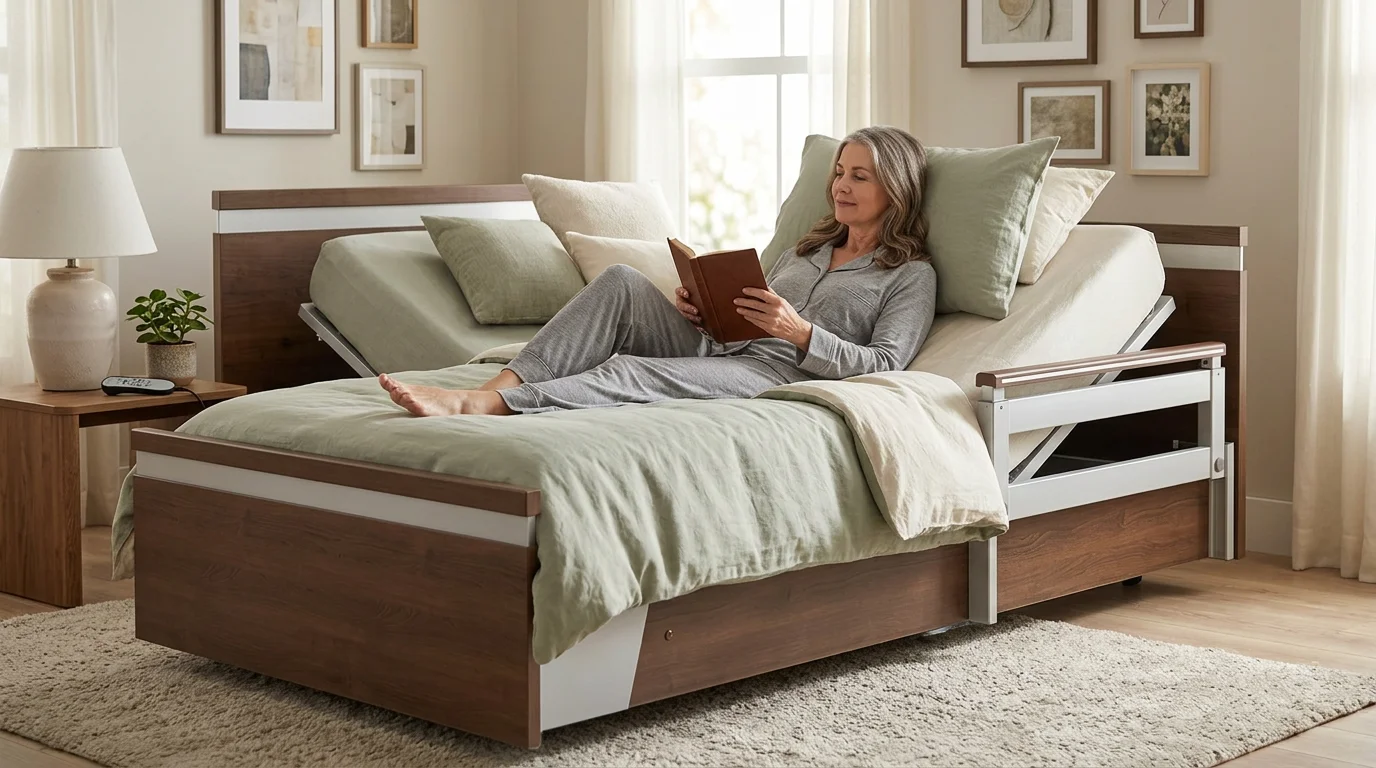
A fully electric home hospital bed with a hand controller means the person receiving care can raise the head of their own bed before a caregiver arrives in the morning. They can sit up for breakfast without asking for help. They can adjust their position at 3am without waking anyone. These are small acts, but they represent a form of control over one’s own environment that a standard bed, or a bed that requires caregiver-only operation, takes away entirely.
In caregiver communities, this is described consistently as the “dignity payoff.” The phrases that appear most often in forum discussions: “she has some dignity back”, “he raises it himself now”, “I didn’t realize how much it bothered him to need help for every little thing.” For seniors who have resisted care equipment, particularly anything that looks or feels medical, a bed they can operate from a handset reframes the entire category. It’s not a device being done to them. It’s a tool that extends their autonomy.
The hand controller on the Aura line operates all primary functions, head section, knee section, and hi-lo height, with clearly labeled, large buttons. The HC-146 model offers a key-switch locking option for situations where restricting access to certain adjustments is clinically appropriate.
If someone you’re caring for is resistant to the idea of a “hospital bed,” the guide on how to choose a home hospital bed covers how to frame the conversation, including positioning alternatives that feel like furniture rather than medical equipment.
Design That Doesn’t Look Clinical
The “hospital room” objection is legitimate. Traditional durable medical equipment (DME) hospital beds are designed for clinical environments. They’re utilitarian, steel-framed, and visually institutional. Placing one in a home bedroom signals, visually and symbolically, that something has fundamentally changed, and not in a way most families want to announce.
This objection most commonly comes from the senior themselves, and it should be taken seriously rather than dismissed. A person who feels their home has become a clinical space experiences a real loss, even when the care equipment serving them is medically appropriate.
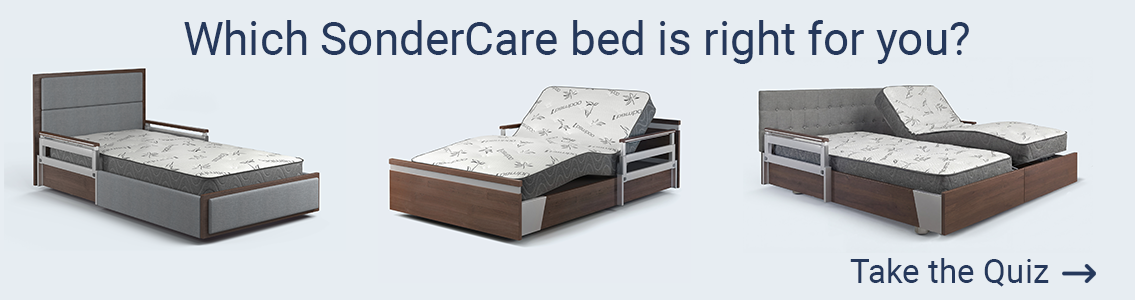
The Aura Platinum was designed to close this gap. Its upholstered side panels in Slate Gray Crypton fabric, premium upholstered headboard, and residential finishes integrate into a home bedroom rather than announcing it as a care space. The Aura Platinum carries the same clinical specifications as the standard Aura line, certified to the International Hospital Standard, manufactured under an ISO 13485-certified quality system, FallSafe Ultra-Low positioning, full Trendelenburg, while looking like furniture rather than equipment.
For families working with an interior designer, or for seniors whose home aesthetic matters deeply to their sense of self, the Platinum’s design language makes the conversation about getting the right bed significantly easier.
More Questions About Adjustable Beds That Help Caregivers
Does Medicare cover adjustable hospital beds for home use?
Medicare Part B may cover a home hospital bed when a physician prescribes it for a documented medical condition that requires positioning in bed. Standard coverage typically applies to a basic semi-electric or manual bed. Full-electric beds with advanced positioning features, like the Aura line, often involve a cost difference that the family pays out of pocket. Coverage depends on your specific plan, your physician’s documentation, and how the equipment is classified under your plan’s DME benefit. Speak with your physician and a Medicare advisor before purchasing. SonderCare’s team can clarify what documentation typically supports a bed prescription.
Will a home hospital bed fit through standard doorways?
The Aura Premium 39″ bed has an external width of approximately 40 inches (102.5 cm). Most standard interior doorways in North American homes are 32–36 inches clear, the bed typically cannot pass through fully assembled. SonderCare’s white-glove delivery team handles disassembly and reassembly during installation as part of the service. For homes with narrow doorways, tight hallways, or stairwell constraints, a pre-delivery conversation with the delivery team helps identify any access considerations before the delivery date.
Can a senior operate a home hospital bed themselves?
Yes. Fully electric beds like the Aura line include a hand controller that operates all positioning functions from the bed: head elevation, knee elevation, and hi-lo height adjustment. The handsets use large, clearly labeled buttons. Most cognitively intact seniors can operate all primary functions independently after a brief walkthrough, which SonderCare’s installation team provides on delivery day. A key-switch locking option is available for situations where restricting access to certain adjustments is appropriate.
What’s the difference between a hospital bed and a consumer adjustable bed?
A consumer adjustable base (like those from Sleep Number or Tempur-Pedic) adjusts the head and foot sections for sleep comfort and typically includes massage features. What it doesn’t include: hi-lo height adjustment, FallSafe ultra-low positioning, weight-rated siderails, Trendelenburg tilt, or clinical certifications. For someone with purely comfort-focused needs and no fall risk or care requirements, a consumer base may be adequate. For anyone with fall risk, repositioning needs, caregiver involvement, or clinically indicated positioning, a home hospital bed fills gaps a consumer base cannot address.
Is It Time to Make the Switch To An Adjustable Hospital Bed?
The most consistent sentiment across caregiver communities about adjustable hospital beds is this: “We waited too long.”
The decision is often deferred, the equipment feels like an admission, the price seems high relative to the immediate urgency, and families assume they can manage a little longer with what they have. The caregivers who have already made the transition consistently report that the combination of benefits, their own physical protection during repositioning, meaningful pressure injury prevention, safer transfers, positional support through the night, and the care recipient’s restored independence, made the investment obvious in retrospect.
If someone in your family requires repositioning, carries fall risk during transfers, spends significant time in bed, or struggles with positional symptoms like acid reflux or breathing difficulty, the benefits of an adjustable hospital bed address all of those concerns in a single piece of equipment.
Speak with a SonderCare expert to get guidance matched to your family member’s specific care needs, bedroom dimensions, and budget. There’s no pressure, just a straightforward conversation about what fits.
References
-
Centers for Disease Control and Prevention / National Institute for Occupational Safety and Health. “About Safe Patient Handling and Mobility.” Last reviewed May 9, 2024. https://www.cdc.gov/niosh/healthcare/prevention/sphm.html
-
Waters TR, et al. “NIOSH research efforts to prevent musculoskeletal disorders in the health care industry.” NIOSH Hazard Review, 2006. https://pubmed.ncbi.nlm.nih.gov/17130760/
-
“Musculoskeletal Disorders Among Healthcare Workers.” Springer Reference Works, 2021. https://link.springer.com/rwe/10.1007/978-3-319-74365-3_129-1
-
Zhou J, et al. “The effects of hospital bed features on physical stresses on caregivers when repositioning patients in bed.” Applied Ergonomics 92, 2021. https://www.sciencedirect.com/science/article/pii/S000368702030209X
-
National Pressure Injury Advisory Panel (NPIAP). “eCQM: What You Need to Know.” https://npiap.com/page/ecqm
-
Agency for Healthcare Research and Quality (AHRQ). “Preventing Pressure Ulcers in Hospitals: A Toolkit for Improving Quality of Care.” https://www.ahrq.gov/patient-safety/settings/hospital/resource/pressureulcer/tool/pu1.html
-
Gillespie BM, et al. “Repositioning for pressure injury prevention in adults.” Cochrane Database of Systematic Reviews, 2020; Issue 6. DOI: 10.1002/14651858. CD009958. pub3. https://pmc.ncbi.nlm.nih.gov/articles/PMC7265629/
-
Shi C, et al. “Beds, overlays and mattresses for preventing and treating pressure ulcers: an overview of Cochrane Reviews and network meta-analysis.” Cochrane Database of Systematic Reviews, 2021; Issue 8. DOI: 10.1002/14651858. CD013761. pub2. https://pmc.ncbi.nlm.nih.gov/articles/PMC8407250/
-
Ryan D, et al. “Evaluation of the Implementation of Low-Low Hospital Beds With Respect to Fall Frequency and Patient Harms: A Retrospective Analysis.” Journal of Advanced Nursing, 2025. DOI: 10.1111/jan.16507. https://pubmed.ncbi.nlm.nih.gov/39352080/
-
Pozuelo-Carrascosa DP, et al. “Body position for preventing ventilator-associated pneumonia in adults requiring mechanical ventilation: a network meta-analysis.” BMJ Open, 2022. https://pmc.ncbi.nlm.nih.gov/articles/PMC8864849/
-
Likhvantsev VV, et al. “Hemodynamic Impact of the Trendelenburg Position: A Systematic Review and Meta-analysis.” Journal of Cardiothoracic and Vascular Anesthesia, 2025. DOI: 10.1053/j.jvca.2024.10.001. https://pubmed.ncbi.nlm.nih.gov/39500675/