









You pulled back the sheet and saw it. A red patch over the tailbone. A small fluid-filled blister on the heel. A mark on the hip that wasn’t there yesterday. If you’re reading this late at night with your phone in one hand and your loved one asleep in the next room, start with this: a Stage 1 pressure injury, caught now, is genuinely reversible.3 Stage 2 injuries, the partial-thickness wounds that have just broken the skin, typically heal within one to three weeks of consistent home care, and published data show more than 70% closure within six months when caregivers follow the basics.3
That’s the hopeful half. The urgent half is just as real: an untreated Stage 1 can progress to Stage 2 within hours of continued pressure, and Stage 2 can deepen into harder-to-heal wounds if it isn’t offloaded right away.1,3 This guide walks you through evidence-based at-home treatment for Stage 1 and 2 pressure injuries, a realistic repositioning schedule that works for solo caregivers, and how to choose the right pressure-redistribution mattress for your situation. Every step here comes from clinical practice guidelines (NPIAP, AHRQ, WOCN), Cochrane systematic reviews, and major North American medical-information sources, not folk advice.
Start Here: The 60-Second Bedsore Triage
Pressure injuries, also called pressure ulcers or bedsores, affect more than 2.5 million people in the United States every year, with most developing over bony prominences: the sacrum (tailbone), heels, hips, shoulder blades, and elbows.6 Before you do anything else, confirm that what you’re looking at really is a pressure injury, and figure out which stage. The triage takes about a minute.
The blanching test: press, count to three, watch the color
Place a clean fingertip on the red area and press gently for about three seconds. Lift your finger. On healthy skin under temporary pressure, the spot momentarily turns pale (blanches) and then returns to its normal pink color. On a Stage 1 pressure injury, the redness does not turn pale: the area stays a dusky red, blue, or purple. This is what clinicians call non-blanchable erythema of intact skin, and it’s the formal NPIAP definition of a Stage 1 pressure injury.1 The skin is still closed, but the tissue underneath has been damaged by sustained pressure, and the body is signaling the breakdown.
Assessing dark skin tones: temperature, firmness, and pain
Visual blanching can be unreliable on darkly pigmented skin, and Stage 1 injuries are routinely missed in people with darker skin tones as a result. The NPIAP State of the Science paper on pressure injury in persons with dark skin tones recommends supplementing visual checks with three tactile assessments: skin temperature (a warm or unusually cool patch compared with the surrounding tissue), tissue firmness (an area that feels boggy, hard, or different from neighboring skin), and the person’s report of pain or tenderness when the area is touched.2 If any two of those three are abnormal over a bony prominence, treat it as a Stage 1 injury and start offloading right away.
Stage 1 vs Stage 2 Pressure Injuries: The Definitions That Matter
The NPIAP definitions are short, precise, and worth memorizing. They appear in every clinical practice guideline for a reason: misclassifying a wound leads to the wrong treatment. Here’s the at-a-glance contrast before the detail.
| Stage 1 | Stage 2 | |
|---|---|---|
| Skin status | Intact (closed) | Broken (partial-thickness loss) |
| What you see | Non-blanchable redness over a bony prominence | Shallow pink/red ulcer, or an intact or ruptured serum-filled blister |
| Visible tissue | None | Exposed dermis (no fat, tendon, or bone) |
| Typical recovery on consistent home care | Hours to a few days3 | One to three weeks for most; >70% closure within six months3 |
| First move | Offload completely; protect with a barrier or film dressing | Offload, cleanse with saline, apply a moist-wound-healing dressing |
| Avoid | Massage, alcohol, drying agents, antibiotic ointment | Hydrogen peroxide, iodine, heat lamps, “drying out” |
Stage 1: Non-blanchable erythema of intact skin
NPIAP defines Stage 1 as “intact skin with a localized area of non-blanchable erythema, which may appear differently in darkly pigmented skin.” The color change should not include purple or maroon. Those darker shades suggest a deeper, more serious deep-tissue injury and require an urgent clinical assessment.1 The skin is still closed and you can’t see fat or muscle, but the tissue is bruised from the inside. Caught at this stage and offloaded promptly, most Stage 1 injuries fully resolve within hours to a few days.3
Stage 2: Partial-thickness skin loss with exposed dermis
NPIAP defines Stage 2 as “partial-thickness loss of skin with exposed dermis. The wound bed is viable, pink or red, moist, and may also present as an intact or ruptured serum-filled blister.”1 The top layer of skin (the epidermis) and a portion of the layer underneath (the dermis) have been lost. You may see a shallow open ulcer with a pink or red base, or a clear-to-amber blister that’s intact or has ruptured. You will not see fat (yellow), tendon, or bone. Those features would indicate Stage 3 or 4 and require professional wound care.1
What it is NOT: moisture damage and Kennedy ulcers
Two conditions are routinely mistaken for Stage 2 pressure injuries, and both have different treatments. Incontinence-associated dermatitis (IAD) is moisture damage from urine or stool exposure. It tends to appear as diffuse red areas with blurry borders across the buttocks, perineum, and skin folds, not over a bony prominence. The NPIAP definition explicitly excludes IAD from Stage 2.1,12 IAD is treated with a barrier cream and a gentle, pH-balanced cleanser; offloading is helpful but not the primary intervention.12
The second is the Kennedy terminal ulcer, which can appear suddenly (often on the sacrum, in a butterfly or pear shape) during a person’s final days in comfort care and does not respond to standard pressure-injury care.13 If your loved one is in hospice and a wound erupts overnight that doesn’t match the Stage 1 or Stage 2 descriptions above, ask the hospice nurse about the possibility of a Kennedy ulcer before you blame yourself. Families carry an enormous amount of avoidable guilt around the skin changes that accompany comfort care; the science says some of these wounds are the body shutting down, not a failure of caregiving.13 For broader hospice, palliative support, and comfort guidance, our home hospice care guide covers the full picture.
At-Home Treatment for Stage 1 (Five Steps in the First Hour)
For a Stage 1 pressure injury, the goal is simple: stop the pressure that caused it, protect the skin, and prevent progression. Mayo Clinic and NPIAP/EPUAP/PPPIA international guidelines align on a five-step home protocol.3,1
- Relieve pressure right away. Reposition your loved one off the affected area completely. Use pillows or a foam wedge to hold the new position. A 30-degree lateral tilt is the standard offload for sacral injuries (more on this below).7
- Cleanse gently. Wash the area with mild soap and water, or a no-rinse pH-balanced cleanser. Pat dry; don’t rub. Friction on already-stressed tissue accelerates breakdown.4
- Protect with a barrier. Apply a zinc-oxide or dimethicone barrier cream, or place a transparent film dressing over the area to protect against friction and moisture.
- Inspect daily and document. Take a phone photo with the date and a coin or ruler in the frame for scale. That photo becomes invaluable when you call the home-health nurse, the family doctor, or hospice for a tele-visit.3
- Reposition every 2 to 4 hours. The traditional cue is every 2 hours; the realistic schedule depends on the support surface and the person’s risk profile (we cover this in the repositioning section).7
What NOT to put on a Stage 1 pressure injury
Stage 1 has intact skin. Triple-antibiotic ointment (Neosporin) is not appropriate; there’s no open wound for it to enter, and these ointments cause contact dermatitis in a meaningful percentage of users. Do not massage the red area, even though older first-aid manuals once recommended it. Both Mayo Clinic and WoundSource are explicit that massaging bony prominences “can cause more damage” by shearing fragile capillaries.3,11 Skip alcohol, witch hazel, hydrogen peroxide, and any drying agent. Modern pressure-injury management is built on protecting the skin, not toughening it up.
At-Home Treatment for Stage 2 (When the Skin Has Opened)
Once the skin is broken (even just a small blister) the rules change. The wound is now a portal for infection, and the goal shifts from prevention to active healing in a clean, moist environment.
Cleanse with saline, not antiseptics
The recommended cleansing solution for a Stage 2 pressure injury at home is sterile normal saline (0.9% sodium chloride). MedlinePlus instructs caregivers to use a “salt water (saline) rinse to remove loose, dead tissue” and explicitly tells them to avoid hydrogen peroxide and iodine unless a clinician has specifically directed otherwise.4 Both peroxide and povidone-iodine are cytotoxic; they kill the fibroblasts and new tissue cells the body is sending in to rebuild the wound bed.4 You can buy single-use saline bullets at any pharmacy. Squeeze gently across the wound, let the runoff fall onto a clean gauze pad, then pat the surrounding skin dry.
Choose a moist-wound-healing dressing
Cleveland Clinic recommends covering Stage 2 wounds with a hydrogel, hydrocolloid, alginate, or foam dressing. Which class to choose depends on how much fluid (exudate) the wound is producing.5
- Hydrocolloid dressings (such as DuoDERM-style products) suit dry-to-low-exudate Stage 2 wounds. They form a gel as they absorb fluid, support autolytic debridement (the body’s natural cleanup process), and can typically stay in place for several days.
- Foam or silicone-foam dressings handle moderate exudate and protect the surrounding skin from maceration. Many silicone-bordered foam dressings are designed to remain on the wound for up to 7 days, which dramatically reduces caregiver workload.
- Alginate dressings are reserved for high-exudate wounds and are usually placed under a foam secondary cover.
Ideally, your home-health nurse or wound-care clinician picks the first dressing class. Hospice and home-health agencies typically supply dressings on a standing order; ask specifically.
Solutions and devices to avoid
Skip heat lamps, hairdryers, and any “drying out” technique. These were taught a generation ago, but they desiccate the fragile granulation tissue that needs to migrate across the wound. The current standard, validated by Cochrane reviews, is moist wound healing under occlusive dressings.5,9 Likewise, skip iodine, hydrogen peroxide, and undiluted vinegar unless your clinician orders them for a specific reason.4
Repositioning Realities: The Honest Caregiver’s Schedule
Every clinical guideline says to reposition a person on extended bed rest every 2 hours. Most family caregivers cannot do that through the night without collapsing, and the published data say you may not have to. WOCN’s 2016 guideline calls for an individualized schedule based on risk, skin condition, comfort, and the support surface.7 AHRQ’s prevention toolkit goes further, recommending small 15-to-20-degree weight shifts every time you walk into the room, between full repositioning turns.6
The TEAM-UP cluster-randomized trial in nursing homes found that 2-, 3-, and 4-hour repositioning intervals produced equivalent results when residents were on a high-specification foam mattress with a consistent monitoring system. That trial doesn’t give you license to skip turning, but it does say the gap between a 2-hour and a 3-hour interval is not the gap between a wound and no wound. What matters is the consistency of the offload and the quality of the support surface.
The 30-degree rule (and why a wedge beats stacked pillows)
When you turn your loved one onto their side, don’t exceed a 30-degree lateral tilt. WOCN explicitly recommends the 30-degree side-lying position because it offloads both the sacrum and the bony bump on the side of the hip (the greater trochanter) without creating a new pressure point on either.7 Going to a full 90-degree side-lying position simply shifts the injury risk from one bony prominence to another.
A solid foam positioning wedge (designed to NPIAP “rule of 30” geometry) holds the position better than three or four stacked pillows, which tend to slide as the person breathes and shifts. Wedges are what keep solo caregivers in the game: once you achieve the position, you don’t have to fight gravity for two hours to maintain it.
Heel offload is non-negotiable
Heels are the second-most-common site for pressure injuries, and they aren’t protected by repositioning the rest of the body. The heel must be continuously floated off the bed surface. Place a slim pillow lengthwise under the calf so the heel hangs free in the air, or use a heel-protector boot. Do this whether your loved one is on their back or their side, and whether you’re turning every 2 hours or every 4. Heel offload is independent of turning frequency.7
When you’re alone at night: the small-shifts approach
The CDC has documented that nearly 4 in 10 family caregivers experience insufficient sleep, and a sizeable share sustain a physical injury (most often to the lower back) in the course of caregiving. You cannot prevent a Stage 1 injury by running yourself into the ground. The honest, evidence-aligned approach for solo overnight caregivers has four parts: (1) start the night on a high-quality pressure-redistribution mattress, (2) place the person in a 30-degree lateral position with a wedge, (3) use a heel-suspension setup, and (4) make small 15-to-20-degree shifts every time you check on them, instead of a full turn that wakes them and exhausts you.6 For a deeper look at the timing question, our companion article on how often to reposition a loved one on extended bed rest walks through the full protocol.
Mattress Selection for Pressure Injury Care: A Decision Tree, Not a Brand List
The single biggest equipment decision in pressure-injury care is the support surface. International guidelines and the 2021 Cochrane network meta-analysis (which pooled data on more than 12,000 patients across nearly 100 trials) frame the decision in three branches.8
Branch 1: High-specification foam (the baseline)
For an at-risk person who can still shift their own weight, or who has a consistent caregiver to reposition them, the international clinical practice guideline recommends a high-specification reactive foam mattress (HSFM) as the minimum standard.8 This is not the foam mattress on a standard residential bed; it’s a denser, multi-zone foam designed to redistribute pressure across a larger surface area. SonderCare’s pressure redistribution mattresses sit in this category, with viscoelastic memory-foam layers, cooling gel, and fluid-proof covers built for daily care use.
Branch 2: Alternating-pressure mattress (active treatment)
An alternating-pressure mattress for home use (APM) uses a pump and chambers that cyclically inflate and deflate to redistribute pressure mechanically. It earns its place when the person can’t be repositioned often enough manually, when an active Stage 2 wound isn’t healing on a foam surface, or when the caregiver’s physical limits genuinely cannot meet a 2-hour turning schedule. The 2021 Cochrane review of alternating-pressure surfaces concluded there is “low-certainty evidence that alternating pressure (active) air surfaces compared with foam surfaces may reduce the incidence of pressure ulcers.”9
Translate that honestly: an APM helps, especially in active treatment, but it isn’t a single fix. The Cochrane evidence is rated “low-certainty,” and caregiver forums are full of stories where the mattress alone failed because no one was repositioning, watching nutrition, or offloading the heels. The proven approach is the bundle: mattress plus repositioning plus skin care plus nutrition.9
Branch 3: Low-air-loss (when moisture is the enemy)
Low-air-loss systems push a continuous airflow through micro-perforated covers, wicking heat and moisture away from the skin. They are the right call when incontinence and excessive perspiration are macerating the skin and standard moisture management (barrier cream, frequent changes, fluid-proof bedding) has not been enough. Many home-care low-air-loss systems combine alternating pressure with low-air-loss in one frame.
For a deeper side-by-side comparison of foam, alternating-pressure, and gel-hybrid options, our guide to the best mattress for someone on extended bed rest walks through the trade-offs in detail.
How a hi-lo home hospital bed protects the caregiver
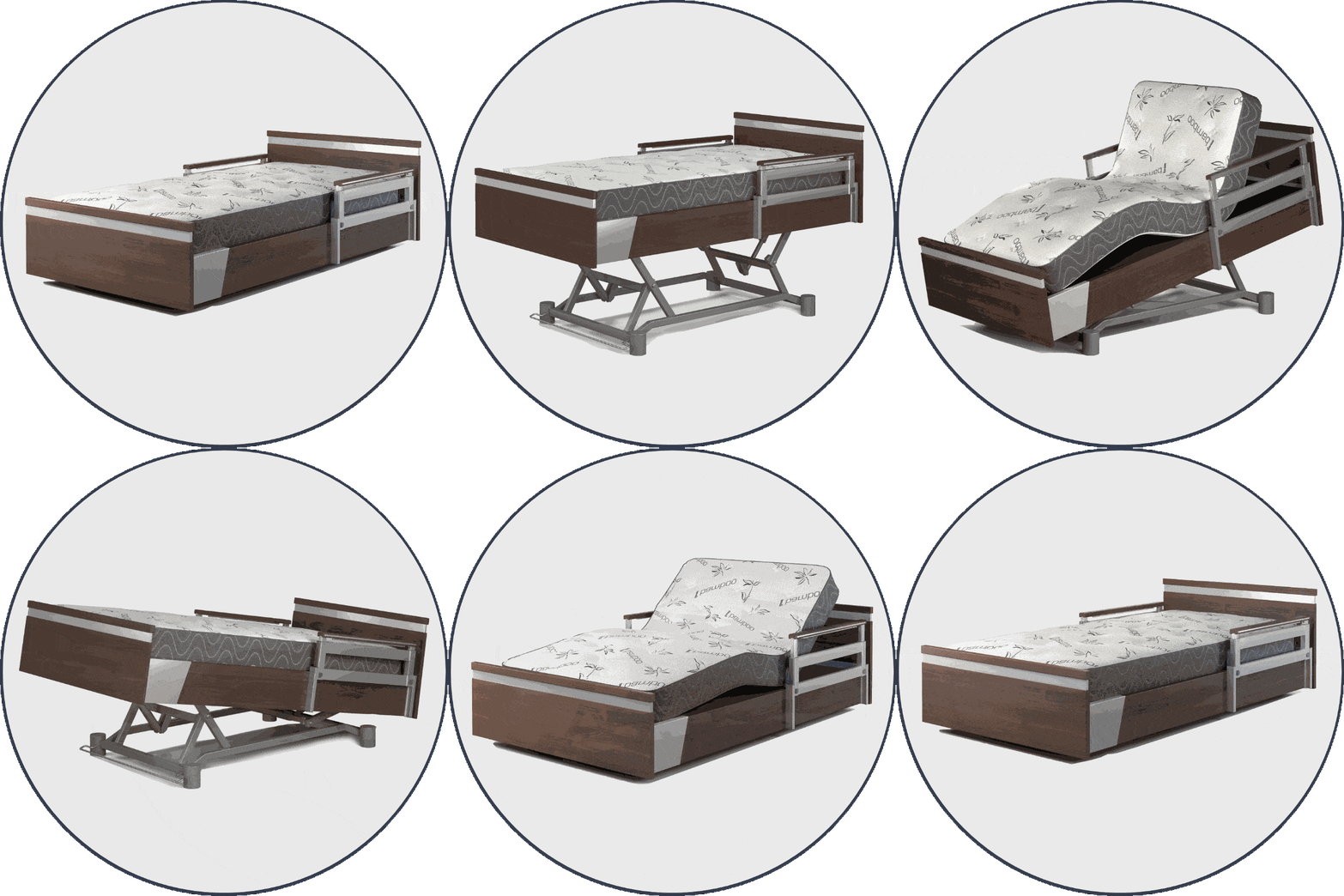
The mattress matters, and so does the frame underneath it. A standard residential bed sits at a fixed height that puts the caregiver’s lumbar spine into a chronic 30-to-40-degree forward flexion every time they reposition, change a dressing, or change a brief. Industry data consistently show that more than three-quarters of family caregivers report low-back discomfort, and roughly one in three sustains a caregiving-related injury. A height-adjustable home hospital bed lets you raise the surface to your hip level for any task, then lower it to a 10-inch ultra-low height for fall protection during sleep. The Aura Premium home hospital bed is designed exactly for this purpose, with a residential, furniture-grade frame and the full Aura positioning range: Comfort Chair, Zero Gravity, and clinician-directed Trendelenburg tilt for situations where a doctor or nurse has prescribed it. For pressure-injury care, the combination of a hi-lo frame and an appropriate pressure-redistribution mattress is the equipment foundation that lets every other intervention work.
The Four Pieces of Bad Advice You’ll See Online
Some of the most-circulated bedsore advice on the internet is actively harmful. Four myths come up almost daily in caregiver forums, and correcting them is part of doing this right.
Myth 1: Donut or ring cushions help
They do not. Cleveland Clinic states it directly: “Don’t sit on a donut. This will spread the pressure outward.”5 The ring shape causes venous congestion in the surrounding tissue and concentrates pressure on the rim of the donut, which can create a brand-new ring of injury where there was none before. Donuts are contraindicated by Mayo, Cleveland Clinic, MedlinePlus, and the international clinical practice guidelines.5,3,4
Myth 2: Massage the redness to “improve circulation”
Massage of an inflamed bony prominence shears the fragile capillaries that are already failing. Both Mayo Clinic and WoundSource are explicit: do not massage the skin near or on a pressure injury.3,11 If a parent or grandparent taught you this, set the lesson aside. Modern wound science is firm on the point.
Myth 3: Heat lamps and hairdryers “dry out” Stage 2 wounds
The current evidence-based standard is moist wound healing: keeping a thin layer of clean, controlled moisture over the wound bed under an occlusive dressing.5 Drying out a Stage 2 wound damages the granulation tissue and slows closure.
Myth 4: Hydrogen peroxide and iodine are good cleansers
Both are cytotoxic to the fibroblasts and keratinocytes the body sends to rebuild a wound. MedlinePlus tells caregivers to avoid them unless a provider specifically approves their use.4 Saline does the cleansing job without harming new tissue. Save the peroxide for the medicine cabinet; it has its uses, but pressure-injury care isn’t one of them.
Nutrition, Incontinence, and the Other Inputs That Move the Needle
Pressure injuries don’t just happen on the surface; they reflect what’s happening systemically. A 2014 randomized controlled trial published in the Annals of Internal Medicine found that an 8-week course of an oral nutritional formula enriched with arginine, zinc, and antioxidants significantly improved healing of Stage 2 to Stage 4 pressure ulcers in adults who were malnourished.10 Talk with the family doctor or a registered dietitian about adequate protein intake (often 1.0 to 1.5 grams per kilogram of body weight per day in someone who is actively healing), targeted vitamin C and zinc, and whether a wound-specific supplement is appropriate.
Incontinence accelerates skin breakdown, and as noted earlier, IAD is frequently misdiagnosed as a Stage 2 pressure injury. Recent industry analysis suggests that nearly half of “Stage 2” wounds in some incontinent populations are actually moisture damage.12 Manage moisture aggressively: change briefs as soon as they’re soiled, cleanse with a pH-balanced no-rinse cleanser (not soap), apply a zinc-oxide barrier cream after every cleansing, and use a fluid-proof mattress cover and absorbent underpads. SonderCare’s fluid-proof bedding protects the support surface itself, which preserves the function of the mattress underneath.
When to Call a Wound Nurse, the Doctor, or 911 (Pressure Injury Red Flags)
Home care is appropriate for most Stage 1 injuries and many Stage 2 injuries. Some situations are not.
- Call the home-health nurse or family doctor today if the wound hasn’t begun to shrink within 2 weeks, you can’t tell whether you’re looking at a Stage 2 or something deeper, the area is producing thick or foul-smelling drainage, the wound is enlarging, or your loved one’s pain is escalating.3
- Call the doctor or hospice nurse the same day if you see signs of local infection: spreading redness around the wound, warmth, swelling, pus, or a developing low-grade fever.3
- Call 911 or go to the emergency department for any sign of systemic infection (sepsis): high fever with chills, sudden confusion or disorientation, rapid heart rate, low blood pressure, or rapid or labored breathing.
Medicare DME: getting an alternating-pressure mattress covered
Pressure-reducing support surfaces are covered under Medicare Part B as durable medical equipment when specific criteria are met, including a doctor’s prescription, documentation of either multiple existing Stage 2 or higher wounds (or hospice status), and a willing supplier enrolled in Medicare. The covered Medicare DME category is built around basic functional equipment and is filled by a separate set of suppliers; SonderCare’s mattresses are premium, furniture-grade products that fall outside what Medicare typically covers.14 If you’re pursuing DME coverage through Medicare, your home-health agency or hospice can connect you with an enrolled supplier and walk you through the prior authorization that’s often required for Group 2 surfaces. If you’d like to understand what private long-term care insurance, an HSA/FSA, or in-house financing might cover for a SonderCare mattress, a bed expert can walk you through the options.
The Caregiver’s Bedside Toolkit
If you’re setting up the room from scratch, this is the short, evidence-aligned list:
- A pressure-redistribution mattress matched to risk level (high-specification foam at minimum; alternating-pressure if there’s an active Stage 2 wound or you can’t reliably reposition every 2 to 4 hours).8,9
- A height-adjustable hi-lo home hospital bed frame to protect the caregiver’s back during transfers, dressing changes, and brief changes.
- A 30-degree foam positioning wedge for sustained side-lying offload.7
- Heel-suspension boots or a long, slim pillow placed under the calves to float the heels.7
- Saline bullets, sterile gauze, and a class of dressings appropriate to the wound (hydrocolloid for low exudate, foam/silicone for moderate, alginate for high).4,5
- A zinc-oxide or dimethicone barrier cream and a pH-balanced no-rinse cleanser for incontinence-related skin protection.12
- A fluid-proof mattress cover and absorbent underpads to control moisture without sacrificing the breathability of the support surface.
- A wound diary or phone-photo album with dated images for tele-visits with the wound nurse.
Most of this is available through home-health agencies on a standing order or through Medicare DME with the right prescription. For a comprehensive walkthrough of how all of these pieces fit together, our pressure sore prevention and treatment guide is the place to start.
The Bottom Line for Caregivers
You did not cause this. You noticed it, and that alone puts you ahead. Stage 1 and 2 pressure injuries are the most reversible wounds in pressure-injury medicine, and at-home treatment of Stage 1 and 2 pressure injuries follows a small, knowable set of rules: relieve pressure, cleanse gently with saline (not antiseptics), cover Stage 2 wounds with a moist-wound-healing dressing, reposition consistently with a 30-degree lateral tilt, float the heels continuously, manage moisture aggressively, support nutrition, and choose a support surface matched to the level of risk.1,3,4,5,7,8,9,10
Skip the donut, skip the massage, skip the heat lamp, skip the peroxide. Build a real pressure-injury bundle: a high-specification foam or alternating-pressure mattress on a hi-lo frame, a 30-degree wedge, heel offload, the right dressing, and an honest, individualized repositioning schedule you can actually sustain. If you’d like a SonderCare specialist to walk you through which mattress and bed configuration matches your situation, you can speak with a SonderCare expert by phone. No pressure, just guidance from people who’ve done this with thousands of families.
References
- National Pressure Injury Advisory Panel. NPIAP Pressure Injury Stages. https://cdn.ymaws.com/npiap.com/resource/resmgr/online_store/npiap_pressure_injury_stages.pdf
- National Pressure Injury Advisory Panel. State of the Science Paper on Pressure Injury in Persons with Dark Skin Tones. https://npiap.com/news/649998/The-NPIAP-Publishes-State-of-the-Science-Paper-on-Pressure-Injury-in-Persons-with-Dark-Skin-Tones.htm
- Mayo Clinic. Bedsores (pressure ulcers): Diagnosis & Treatment. https://www.mayoclinic.org/diseases-conditions/bed-sores/diagnosis-treatment/drc-20355899
- MedlinePlus / U. S. National Library of Medicine. Pressure sores, care at home. https://medlineplus.gov/ency/patientinstructions/000740.htm
- Cleveland Clinic. Bedsores (Pressure Injuries). https://my.clevelandclinic.org/health/diseases/17823-bedsores-pressure-injuries
- Agency for Healthcare Research and Quality (AHRQ). Preventing Pressure Ulcers in Hospitals: Tool 3A, Pressure Ulcer Prevention Interventions. https://www.ahrq.gov/patient-safety/settings/hospital/resource/pressureulcer/tool/pu3a.html
- Wound, Ostomy and Continence Nurses Society (WOCN). 2016 Guideline for Prevention and Management of Pressure Injuries (Ulcers), Executive Summary. https://pubmed.ncbi.nlm.nih.gov/28472816/
- Shi C, et al. Beds, overlays and mattresses for preventing and treating pressure ulcers: an overview of Cochrane Reviews and network meta-analysis. Cochrane Database of Systematic Reviews, 2021. https://pmc.ncbi.nlm.nih.gov/articles/PMC8407250/
- Shi C, et al. Alternating pressure (active) air surfaces for preventing pressure ulcers. Cochrane Database of Systematic Reviews, 2021. https://www.cochranelibrary.com/cdsr/doi/10.1002/14651858.CD013620.pub2/full
- Cereda E, et al. A nutritional formula enriched with arginine, zinc, and antioxidants for the healing of pressure ulcers: a randomized trial. Annals of Internal Medicine, 2015. https://www.acpjournals.org/doi/10.7326/M14-0696
- WoundSource. Pressure Ulcers/Injuries, Stage 1. https://www.woundsource.com/patientcondition/pressure-ulcersinjuries-stage-1
- Medline Strategies. Incontinence-Associated Dermatitis vs Pressure Injuries: Know the Difference. https://www.medline.com/strategies/skin-health/incontinence-associated-dermatitis-vs-pressure-injuries-know-the-difference/
- Cleveland Clinic. Kennedy Terminal Ulcer. https://my.clevelandclinic.org/health/diseases/kennedy-terminal-ulcer
- Medicare.gov. Pressure-reducing support surfaces coverage. https://www.medicare.gov/coverage/pressure-reducing-support-surfaces