








Choosing the Right Room for Your Accessible Bedroom Setup
Before you buy a single piece of equipment, the room itself matters. Where you set up the bedroom will affect every other decision that follows.
Main floor is strongly preferred. If your loved one can’t walk, stairs are not just inconvenient, they are dangerous and impractical for equipment like patient lifts and hospital beds. Choose a room on the main level, ideally close to a bathroom or at least close enough to place a bedside commode.
Doorway width is a common surprise. Standard interior doorways are about 30 inches wide, but a wheelchair needs at least 32 inches to pass through comfortably, and 36 inches is ideal for a hospital bed or patient lift to maneuver. If your doorways are too narrow, offset hinges can add an inch or two without a full remodel, or a contractor can widen the frame.
Check your electrical outlets. A full-electric hospital bed, a patient lift charger, a pressure-relief mattress pump, and a bedside lamp all need power. Make sure the room has enough outlets near the bed wall without relying on extension cords, which are trip hazards.
Natural light matters more than you think. When someone’s world shrinks to a single room, the view from the bed and the amount of daylight become critical to their mental health. Caregivers in online forums consistently say that a bedroom with a window, where their loved one can see the sky, watch birds, notice the seasons, makes a measurable difference in mood and engagement. Position the bed so the window is visible from a lying or seated position.
The Bed: The Most Important Decision in Your Bedroom Setup for Someone Who Can’t Walk
The bed is the center of everything. For someone who can’t walk, it is where they sleep, eat, receive care, watch television, visit with family, and spend most of their day. Choosing the wrong bed is the single most common regret family caregivers describe online, and the mistake usually comes down to one thing: buying a manual or semi-electric bed to save money and then realizing that the caregiver has to crank it by hand multiple times a day.
A full-electric home hospital bed is the overwhelming recommendation from experienced caregivers and occupational therapists. Here is why:
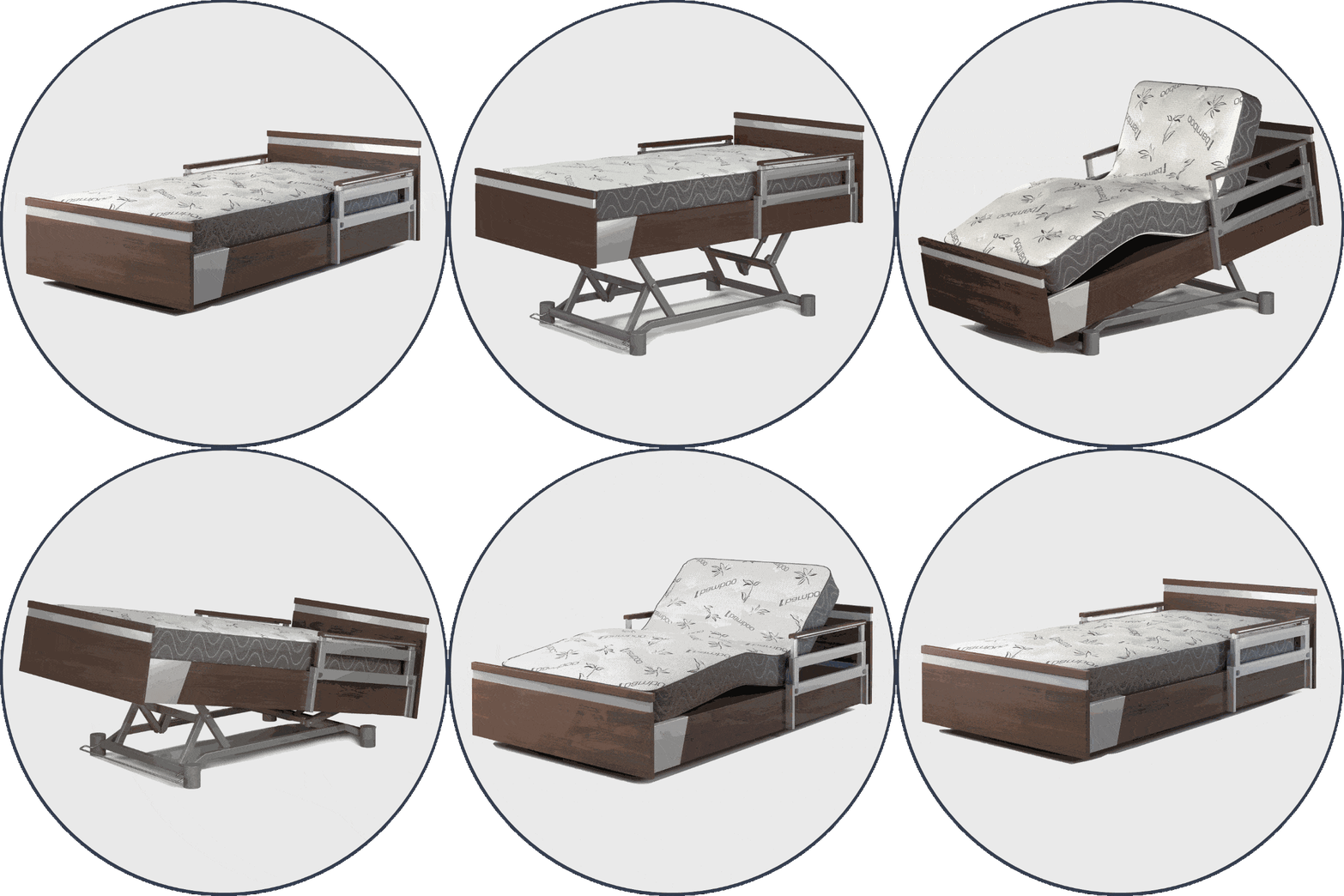
- Height adjustability protects both the caregiver and the person in the bed. The bed should raise and lower so the mattress top sits between 17 and 23 inches from the floor, matching standard wheelchair seat height for safe, level transfers.2 A bed that adjusts with a button rather than a crank means the caregiver can set the right height every time without physical strain.
- Head and knee positioning allows the person to sit up for meals, elevate their legs for circulation, and find comfortable resting positions throughout the day.
- Ultra-low height for fall prevention. If your loved one has any risk of rolling or sliding out of bed, a bed that lowers close to the floor reduces the distance and severity of a fall.
The SonderCare Aura Premium home hospital bed is designed specifically for this situation. It is certified to International Hospital Standard, carries a 500-lb weight capacity, and features FallSafe Ultra-Low height, lowering the platform to just 10 inches off the floor (17 inches to the mattress top). Its pre-programmed 21-inch transfer position sets the exact height for safe bed-to-wheelchair transfers with a single button press. Full-electric head, knee, and hi-lo adjustment means the caregiver never has to crank anything manually.
For families working within a tighter budget, the SonderCare Impulse Essential at $3,999 provides full-electric head, knee, and hi-lo adjustment in a residential design, a strong starting point that covers the core needs of a bedroom setup for someone who can’t walk.
If you are still weighing your options, our guide to setting up a hospital-grade bedroom at home covers the full decision framework.
Choosing a Mattress That Prevents Pressure Injuries
When someone can’t walk and spends extended hours in bed, pressure injuries become one of the most serious risks. These are not minor skin irritations. Approximately 2.5 million Americans are affected by pressure ulcers each year, costing the U. S. healthcare system an estimated $26.8 billion annually.3 In community and home settings, studies have found pressure injury prevalence ranging from 3.3% to 11.1%.4
The mattress is your first line of defense. The right choice depends on your loved one’s risk level:
- For moderate risk (limited mobility but can shift weight with reminders): A high-specification foam mattress with pressure redistribution properties is appropriate. The SonderCare Dream Bamboo Quilt-Top Mattress ($1,299) features Visco memory foam with cooling gel, a reversible soft/firm design, and a fluid-proof cover, built for both comfort and skin protection.
- For high risk (cannot reposition independently, history of skin breakdown, low Braden score): An alternating pressure air mattress is recommended by international wound care guidelines. The SonderCare Alternating Pressure Air Mattress ($2,999) uses 18 air bladders with a pump system to continuously cycle pressure across different body zones, reducing sustained pressure on any single area.
Regardless of the mattress, a repositioning schedule is still essential. The standard clinical recommendation is to reposition every two hours during the day and as tolerated at night. Our guide on preventing pressure injuries in elderly loved ones at home covers repositioning techniques, skin inspection routines, and when to call a wound care specialist.
Transfer Equipment: Protecting Both the Caregiver and Your Loved One
Transfers, getting in and out of bed, moving to a wheelchair, reaching the commode, are the single most physically demanding part of caring for someone who can’t walk. Roughly 41% of unpaid caregivers in the United States assist with transfers like getting in and out of beds and chairs.5 With 53 million Americans providing unpaid care and averaging 24 hours per week of care work, the physical toll is enormous.6
The biggest mistake family caregivers make with transfers is trying to do them manually for too long. Online caregiver communities are filled with stories of back injuries, shoulder injuries, and dropped loved ones, almost always from caregivers who did not get the right equipment early enough.
Patient Lifts
If your loved one cannot bear any weight on their legs, a mechanical patient lift is not optional; it is essential.
- Mobile floor lifts (commonly called Hoyer lifts) are the fastest option for urgent situations. They can be rented, delivered quickly, and moved between rooms. The drawback is that they require floor space to maneuver and a caregiver who is comfortable operating them.
- Ceiling-mounted lifts are the gold standard for long-term care. Research shows that ceiling lifts lead to more consistent use and greater reduction in caregiver back and shoulder pain compared to floor lifts.2 They require professional installation but eliminate the floor-space issue entirely.
If your loved one can bear some weight; they can stand briefly with support but cannot walk, a sit-to-stand lift may be sufficient. These are smaller, easier to operate, and less intimidating for the person being transferred.
Transfer Aids for the Bedroom Setup
- Transfer boards (slide boards): Useful for lateral transfers between bed and wheelchair when the person has good upper body strength.
- Gait belts: Worn around the waist, they give the caregiver a secure grip during assisted transfers. Every home caregiver should have one.
- Bed assist rails and trapeze bars: Allow the person to reposition themselves in bed without caregiver help, preserving independence and reducing nighttime caregiver calls.
The transfer path is just as important as the equipment. Maintain a clear, unobstructed path of at least 36 inches wide between the bed and the wheelchair parking spot, and between the bed and the bathroom or commode. No throw rugs, no cords, no furniture legs in the way.
Room Layout and Accessibility Modifications for Your Bedroom Setup
Once you have the bed, mattress, and transfer equipment, the room layout ties everything together. The goal is a space where your loved one can be cared for safely and where the caregiver can move freely without risking injury.
Clearance and Pathways
- 36 inches of clear space on both sides of the bed and at the foot. This allows a patient lift to operate and gives the caregiver room to assist with repositioning, linen changes, and personal care.
- Remove all throw rugs. Area rugs are the number one trip hazard in home care bedrooms. Replace with smooth, continuous flooring that works for both wheelchair rolling and stable footing during transfers.
- Furniture placement: A bedside table within arm’s reach (for phone, water, medications, remote controls), an overbed table for meals and activities, and a caregiver recliner if overnight monitoring is needed.
Lighting and Safety
Nighttime falls are disproportionately dangerous. Motion-activated LED lighting systems that illuminate the path from bed to bathroom have been shown to reduce nighttime falls by approximately 34% in care settings.7 Install them along the floor path between the bed and the doorway or commode.
Research on home adaptations, including grab rails, improved flooring, and stair rails, found that these modifications reduce fall-related emergency hospital admissions by approximately 3% per quarter, with the effect compounding over time.8 These are not dramatic single-day improvements. They are steady, cumulative safety gains that make a real difference over months and years of home care.
For more on creating a comprehensive safety environment, see our guide to making a bedroom safe for an elderly person.
Grab Bars and Support
Install grab bars at the toilet, inside the shower or tub, and anywhere your loved one might attempt to stand or pull themselves. Use wall-mounted bars rated for at least 250 pounds, towel bars and suction cup grab bars are not safe substitutes. If the bedroom has an attached bathroom, this is where grab bars make the most immediate impact.
Creating a Comfortable Living Space, Not Just a Medical Room
One of the hardest parts of setting up a bedroom for someone who can’t walk is the tension between clinical needs and human dignity. Multiple caregiver forums describe the same heartbreak: a bedroom that used to feel personal and warm now looks and feels like a hospital room. It does not have to be that way.
When someone’s mobility is gone, their bedroom becomes their entire world. The emotional and social elements of the bedroom setup matter just as much as the safety equipment.
- Television placement: Mount or position the TV at eye level from the bed’s seated position (head of bed elevated to 30-45 degrees). Most wall-mounted TVs are too high for someone lying in bed.
- Tablet or phone arm: A clamp-mounted adjustable arm lets your loved one video call family, browse the internet, read, or watch content without holding a device, which is exhausting for someone with limited strength.
- Personal items within reach: Photos, books, a favorite blanket, a radio or speaker. These are not luxuries. They are anchors to identity when so much else has changed.
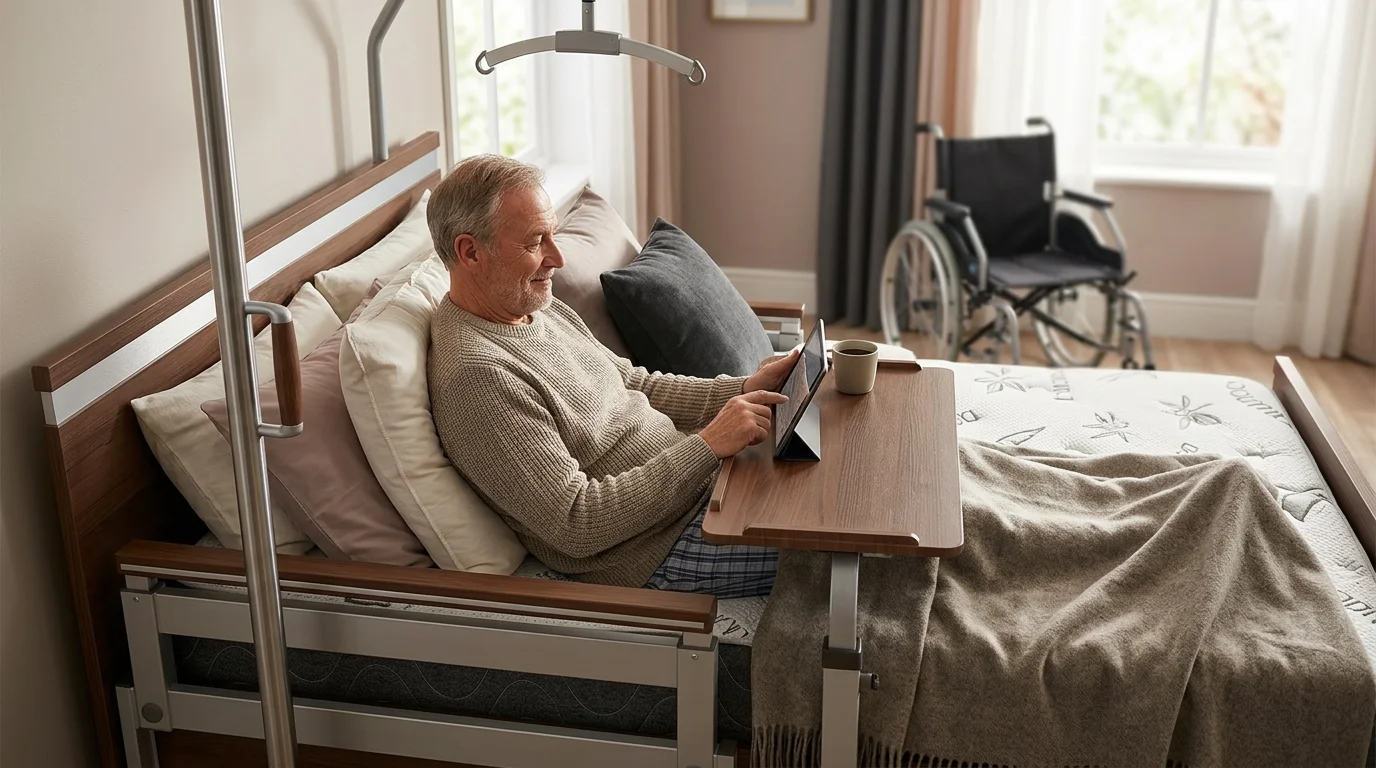
- Overbed table: An adjustable overbed table on wheels allows independent eating, writing, puzzles, and activities. It rolls out of the way during care tasks.
- Temperature and air quality: Someone who can’t adjust their own covers or open a window depends on the caregiver to manage room temperature. A small fan, a space heater with auto-shutoff, and a humidifier can make the room comfortable without constant requests.
This is where the choice of bed makes a visible difference. A standard DME rental bed, chrome rails, institutional appearance, changes the feel of the entire room. The SonderCare Aura Premium features furniture-grade headboard and footboard panels with residential finishes designed to blend into a home bedroom. The room still looks and feels like a bedroom, not a ward.
For families concerned about skin integrity in addition to comfort, our pressure sore prevention and treatment guide covers the full clinical picture.
What to Do When Time Is Short: The Urgent Discharge Bedroom Setup Checklist
If your parent or family member is coming home from the hospital in days and you need to set up a bedroom for someone who can’t walk quickly, here is the priority sequence. This is based on discharge planning best practices and what experienced caregivers wish they had known.2
Before discharge (at the hospital):
- Request an OT/PT assessment at the hospital. This professional evaluation determines what equipment your loved one needs and provides the clinical documentation for insurance coverage.
- Get written prescriptions from the doctor for all durable medical equipment (DME): hospital bed type, mattress type, patient lift. Vague orders get rejected by insurance. Be specific.
- Ask for hands-on transfer training from the hospital nursing or therapy staff. Practice the bed-to-wheelchair transfer, repositioning, and use of any lift equipment before discharge day.
At home (before they arrive):
- Contact DME suppliers immediately with prescriptions. Arrange rental or purchase and confirm delivery happens before the discharge date. A mobile floor lift is fastest for urgent situations.
- Prepare the room: Move furniture to create 36-inch clearance on all sides of where the bed will go. Remove throw rugs. Check doorway width. Verify outlet access.
- Install safety basics: Motion-activated night lights along the path to the bathroom, a bedside commode if bathroom access is difficult, and a phone within reach.
After they are home:
- Schedule a home OT/PT visit within 48-72 hours. A therapist who sees the actual room can fine-tune the setup and provide hands-on equipment training in the real environment.
- Review all insurance and rental paperwork. Understand the monthly cost, what is covered, and your out-of-pocket responsibility. Ask whether rental payments can apply toward future purchase.
The 30-day hospital readmission rate in the United States sits at 13.3%.9 A properly prepared bedroom setup significantly reduces the risk that your loved one ends up back in the hospital because of a fall, a pressure injury, or an unsafe transfer at home.
Insurance and Funding: What Medicare Covers for Your Bedroom Setup
Cost is a real concern, and the insurance landscape for home hospital beds is not intuitive. Here is the quick summary:
- Medicare Part B covers a semi-electric hospital bed as durable medical equipment when there is a doctor’s order and documented medical necessity. The patient typically pays 20% after the deductible.
- Full-electric beds are generally not covered by Medicare. However, the upgrade from semi-electric to full-electric is one of the most consistently recommended investments by experienced caregivers. The convenience of button-operated height adjustment, for every transfer, every repositioning, every linen change, pays for itself in reduced caregiver strain.
- Pressure-relief mattresses may be covered under Medicare as a Group 2 support surface with appropriate documentation.
- Patient lifts are covered with medical necessity documentation.
Beyond Medicare, look into state Medicaid Home and Community-Based Services (HCBS) waivers, VA benefits if your loved one is a veteran, and grants from condition-specific organizations like the ALS Association or MS Society. A hospital social worker can often help identify funding sources you would not find on your own.
For a detailed comparison of purchase versus rental economics, see our guide to choosing the right home hospital bed.
Bringing It All Together: Your Bedroom Setup for Someone Who Can’t Walk
Setting up a bedroom for someone who can’t walk is one of the most important things you will do as a caregiver. It is also one of the hardest, because you are making dozens of decisions in a category you never expected to learn about. Here is what matters most:
- The bed is the foundation. A full-electric home hospital bed with height adjustability and fall prevention features protects both your loved one and you.
- The mattress prevents pressure injuries. Match it to your loved one’s risk level and reposition every two hours.
- Transfer equipment eliminates the manual lifting that injures caregivers. Get it early, do not wait until someone gets hurt.
- The room layout creates safe pathways, removes hazards, and gives the caregiver space to work.
- Comfort and dignity are not afterthoughts. Personal items, natural light, entertainment access, and a bed that looks like furniture instead of medical equipment, these are what make it a home.
You do not have to figure this out alone. SonderCare’s bed experts have helped thousands of families create safe, dignified bedroom setups for loved ones with mobility challenges. If you have questions about which bed, mattress, or accessories are right for your situation, speak with a SonderCare expert for personalized guidance.
References
- Centers for Disease Control and Prevention. “Disability Impacts All of Us.” CDC Disability and Health. 2024-2025.
- Siebert C, et al. “Occupational Therapy Practice Guidelines for Home Modifications.” American Journal of Occupational Therapy. 2014;68(Suppl 1):S1-S32. DOI: 10.5014/ajot.2014.686S01
- Wound Healing Society. “Guidelines for the Treatment of Pressure Ulcers, 2023 Update.” PMC. 2023.
- Chen G. et al. “The prevalence and incidence of community-acquired pressure injury: A protocol for systematic review and meta-analysis.” BMJ Open / PMC.
- AARP and National Alliance for Caregiving. “Caregiving in the United States 2020.” Advancing States. 2020.
- Figueiro MG, et al. “Tailored lighting intervention for persons with dementia and caregivers living at home.” Sleep Health. 2020;6(3):387-391. DOI: 10.1016/j.sleh.2020.02.003
- Hollinghurst J, et al. “Do home adaptation interventions help to reduce emergency fall admissions?” Age and Ageing. 2022;51(1): afab201.
- Healthcare Cost and Utilization Project (HCUP). Nationwide Readmissions Database (NRD). AHRQ. 2022.