







If you’re caring for an aging parent at home, no room deserves your attention more than the bathroom. It’s wet, hard-surfaced, cramped, and private, the place your parent most wants to use alone, and the place most likely to cause a fall that changes everything. Most caregivers carry a quiet, constant dread about it, especially around bathing and nighttime trips.
That dread is justified, but it’s also actionable. Bathroom falls are not random bad luck; they follow predictable patterns, and the fixes are well-established, inexpensive, and proven. This guide explains why the bathroom is so dangerous, where the risks actually concentrate, and exactly what to change, prioritized by impact, to keep your parent safe while protecting their dignity.
Why the Bathroom Is the Most Dangerous Room
The bathroom punches far above its size in injury statistics. U.S. emergency departments treat roughly 234,000 nonfatal bathroom injuries every year, and 81% are caused by falls.1 Risk climbs steeply with age: adults 85 and older are injured in the bathroom at a rate over eight times that of younger adults.1
What makes these falls so consequential is what they so often cause: a hip fracture. Falls cause about 95% of hip fractures in older adults, and the aftermath is grim, roughly 25% of older hip-fracture patients die within a year, and half suffer a major, permanent loss of function.2 A single bathroom fall can be the event that ends a parent’s independence or their life. That’s why prioritizing this one room above all others isn’t an overreaction; it’s the highest-leverage safety work a caregiver can do. And there’s a compounding effect to interrupt: falling once doubles the risk of falling again, and up to 70% of people who fall develop a fear of falling that leads many to restrict activity, which weakens them and paradoxically raises long-term fall risk.3
The Nighttime Danger Zone
If you do nothing else, address the nighttime bathroom trip. Research found that 42.7% of falls among older emergency patients were toileting-related, and the risk of falling is 2.23 times higher between midnight and 6 a.m.4 The reasons are intuitive: a parent wakes groggy and disoriented, the room is dark, there’s urgency, and they’re moving alone and fast.
Several changes dramatically reduce this risk. Motion-activated night lighting along the entire path from bed to toilet removes the darkness factor. A bedside commode or a urinal can eliminate the long, risky trip altogether for a parent with significant mobility issues. Be especially cautious with sleep medications: hypnotic (sleep) drugs increase fall risk by 64%, so a medication review is itself a bathroom-safety measure.4 And because every nighttime trip begins with getting out of bed, the height and stability of the bed itself matters, more on that below.
Grab Bars: The Single Highest-Impact Fix
If there is one piece of equipment that defines bathroom safety, it’s the grab bar. University of Toronto research found that people with grab bars were 75.8% more likely to recover their balance during a bathtub exit, and in cases where they successfully grasped the bar, balance was recovered 100% of the time.5 Grab bars aren’t optional accessories, they are evidence-based medical equipment.
Yet most homes don’t have them: a national survey found 65.4% of homes have no grab bars at all, even though the overwhelming majority of people would happily use one if it were installed.6 The gap is awareness and installation, not willingness. A few rules for getting them right:
- Install real grab bars, anchored into studs or with proper heavy-duty anchors. Never rely on a towel bar or a suction-cup handle as a substitute, they fail under real weight, often at the worst moment.
- Place them where transfers happen: beside the toilet, at the tub or shower entry, and inside the shower. A vertical bar aids stepping in; a horizontal bar aids sitting and standing.
- Choose a height and length matched to your parent, and consider textured or angled bars for a more secure grip. Quality assist rails and bathroom safety accessories make this straightforward.
Making the Shower and Tub Safe
Bathing is the most dangerous bathroom activity, combining wet surfaces, slippery soap, temperature extremes, and difficult transfers. Make it safer with layered changes: a shower chair or transfer bench so your parent can bathe seated rather than standing on a slick surface; non-slip mats or adhesive strips inside and outside the tub; a handheld showerhead so they can wash without twisting and reaching; and a set water-heater temperature (around 120°F) to prevent scalding, since older skin burns faster and sensation may be reduced. For anyone with significant mobility limits, getting over a tub wall is a high-risk maneuver, a transfer bench that bridges the tub wall, or a walk-in shower, removes that hazard entirely.
Toilet Safety
The toilet is the most-used fixture and a frequent fall site, because lowering onto and rising from a standard-height toilet is hard on weak legs and balance. A raised toilet seat reduces the distance and effort of the transfer, and toilet safety rails (or a nearby grab bar) give the handhold needed to sit and stand safely. For parents who struggle most at night or have limited mobility, a bedside commode keeps toileting close and safe. These simple additions directly address toileting, which the data identify as one of the highest-risk bathroom activities.
Flooring, Lighting, and Layout
Beyond the major fixtures, the room’s surfaces and sightlines matter. Replace slippery bath mats with non-slip, low-pile options with rubber backing, and wipe up water promptly. Ensure bright, even lighting with easy-to-reach switches (or motion sensors), since shadows and glare both contribute to missteps. Keep the path clear of clutter, cords, and scatter rugs, and make sure the route from the bedroom is direct and unobstructed. Lever-style faucet handles and a clutter-free vanity reduce reaching and twisting. None of these is expensive, and together they remove the small hazards that turn a stumble into a fall.
The Bedroom-Bathroom Connection
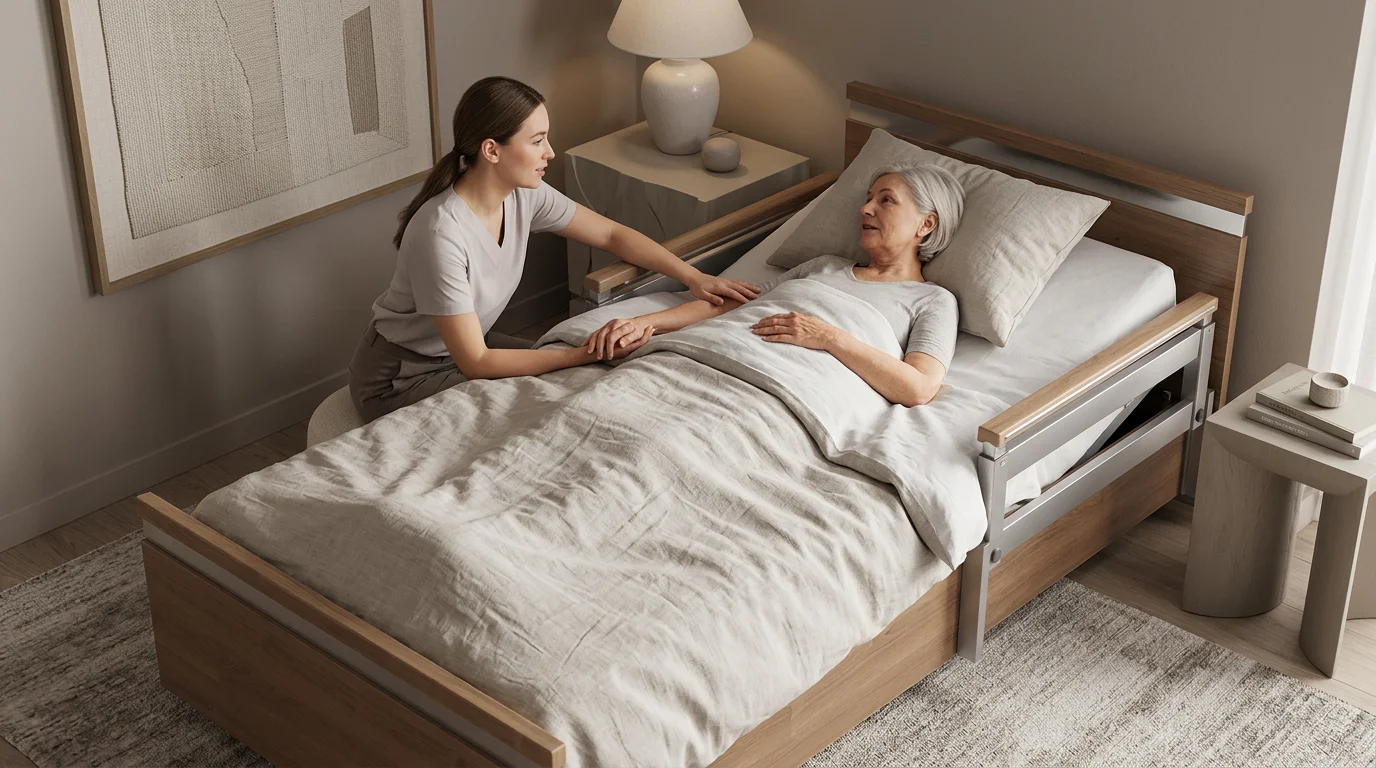
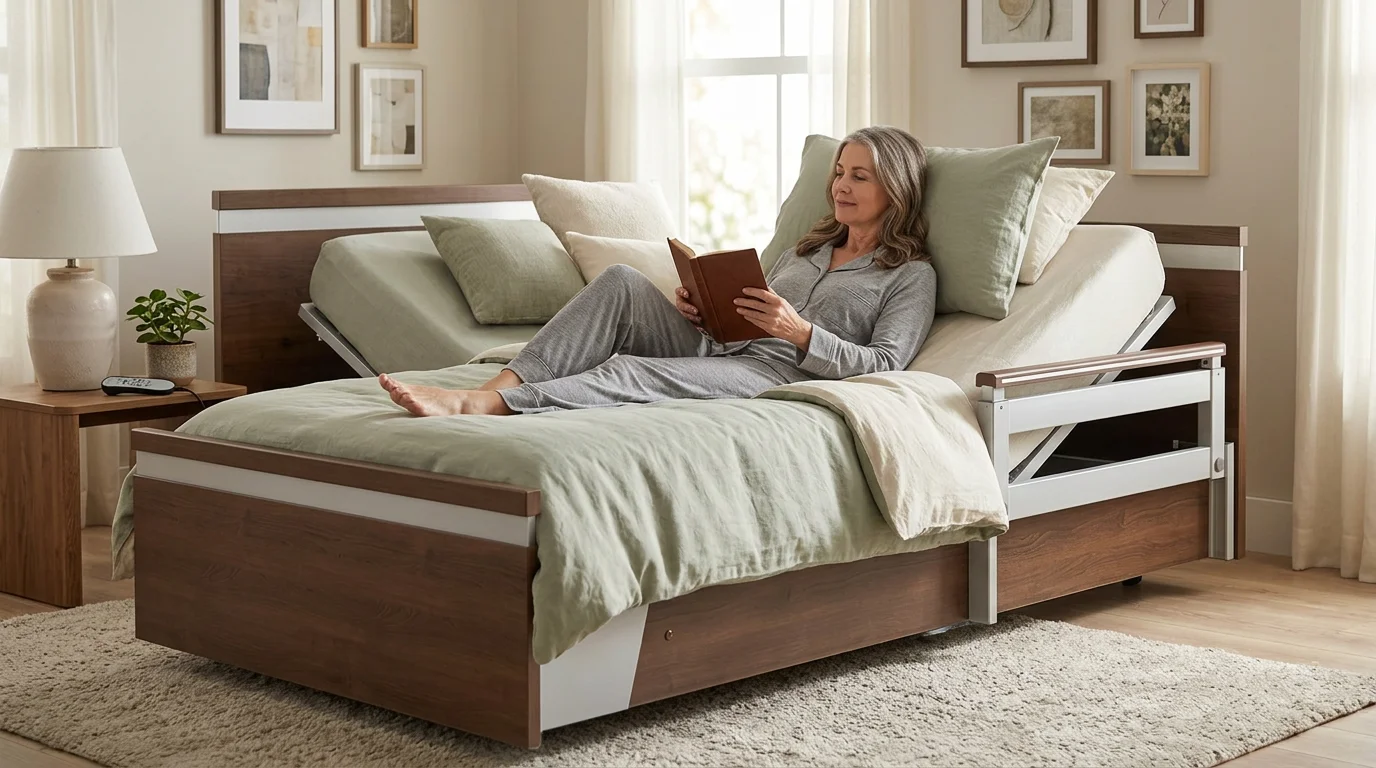
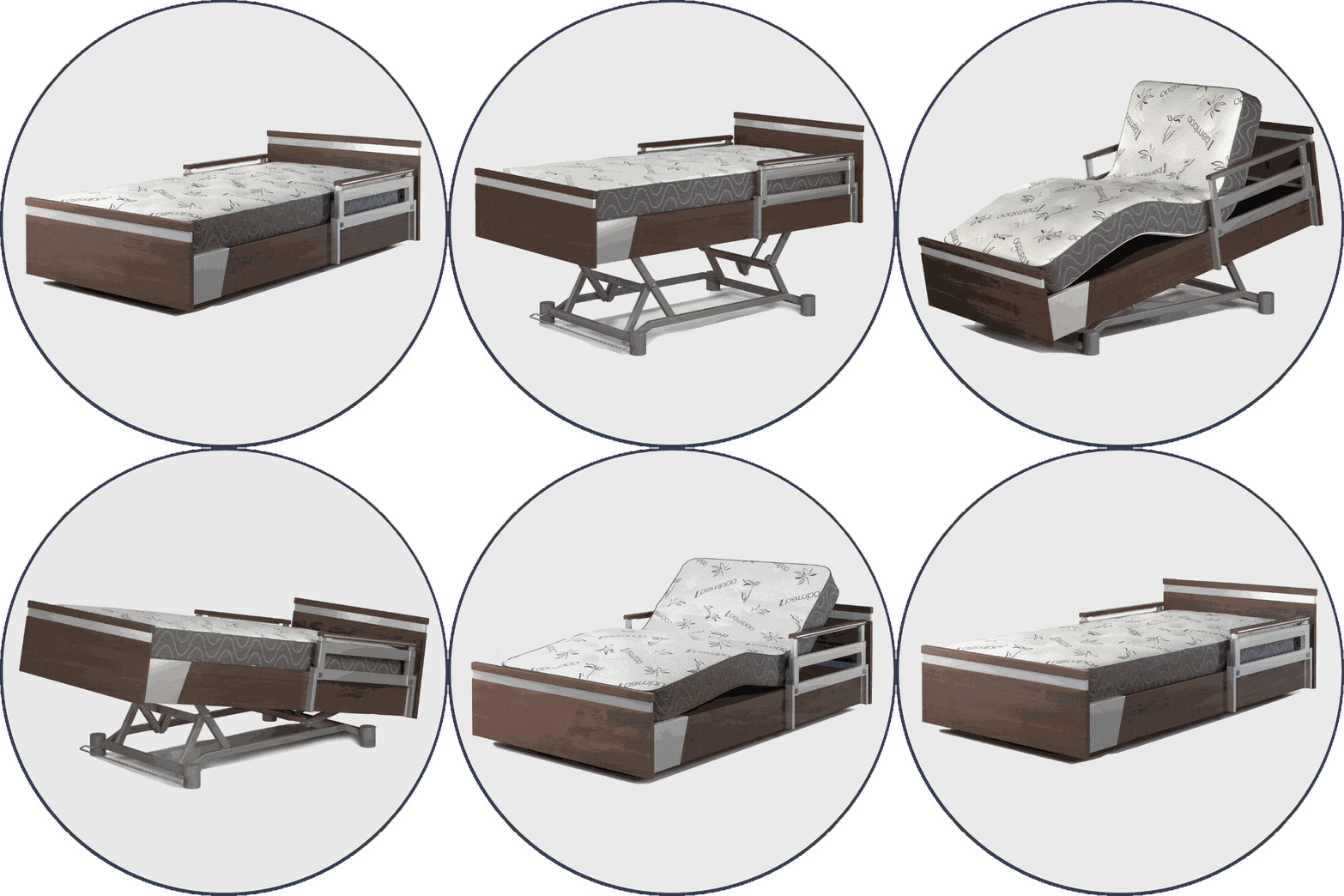
Bathroom safety doesn’t start at the bathroom door, it starts at the bed. Most nighttime bathroom falls begin with the transfer out of bed: a parent sits up groggy, stands from a bed that’s too high or too low, and is already unsteady before they take a step. Getting that first move right is half the battle. A height-adjustable home hospital bed such as the SonderCare Aura Premium lets your parent start the trip from a safe, feet-flat height, with assist rails to push up from, converting the riskiest moment of the night into a controlled one. Pair a safe bed with a lit, clear path and the bathroom fixes above, and you’ve addressed the entire nighttime fall sequence rather than just one link in it. A broader look at the bedroom environment and a structured fall risk assessment tie the whole plan together.
Beyond Equipment: Exercise and a Professional Assessment
Equipment works best alongside two other proven measures. First, balance and strength exercise: a large 2024 review found that exercise reduces fall rates by about 15%, and multifactorial interventions by 16%.7 A stronger, steadier parent is safer in every room. Second, a professional home-safety assessment: home-hazard modification programs reduce falls overall, and the most effective versions, delivered by an occupational therapist, achieve up to 31% lower fall rates than DIY efforts.8 An OT can spot risks you’ll miss and place equipment correctly the first time. Many are covered under home health benefits; it’s worth asking your parent’s care team for a referral.
A Bathroom Safety Checklist
Use this to audit your parent’s bathroom today:
- Grab bars installed (anchored) at the toilet, tub/shower entry, and inside the shower
- Shower chair or transfer bench in place; handheld showerhead installed
- Non-slip mats/strips inside and outside the tub; water heater set to ~120°F
- Raised toilet seat and/or toilet safety rails
- Motion-activated night lighting on the full bed-to-bathroom path
- Bedside commode or urinal available if nighttime trips are risky
- Clear, clutter-free floor; no loose rugs or cords
- Bed at a safe transfer height with assist rails
- Sleep-medication review completed with the doctor
- Professional/OT home-safety assessment scheduled
Common Bathroom Safety Mistakes to Avoid
Even well-meaning families undermine their own efforts. Watch for these frequent missteps:
- Relying on towel bars or suction handles for support. These are the most dangerous shortcut in the bathroom. They’re not designed to bear weight, and they pull free exactly when your parent needs them most. Only properly anchored grab bars count.
- Putting grab bars in the wrong place. A bar that isn’t where the transfer actually happens, at the toilet, at the tub entry, inside the shower, provides false reassurance. Watch how your parent moves and place bars at those points.
- Treating bath mats as non-slip. A loose, fluffy bath mat is a trip hazard, not a safety device. Use rubber-backed, low-pile mats and adhesive strips inside the tub.
- Ignoring the lighting. Many falls happen because a parent navigates a dark bathroom rather than fumble for a switch. Motion-activated lighting solves this cheaply.
- Fixing the bathroom but not the path to it. A perfectly safe bathroom doesn’t help if your parent falls getting there. Address the bedroom, the bed, and the route together.
- Letting dignity concerns stop all action. If a parent refuses help bathing, that’s a reason to make the room safer for independent use, grab bars, a shower chair, a handheld showerhead, not a reason to do nothing.
What About Cost and Insurance Coverage?
Bathroom safety is remarkably affordable relative to the harm it prevents. Grab bars typically run $25 to $100 each, and most bathroom modifications fall in the $25 to $500 range, against fall-related medical costs that exceed $50 billion nationally and an average that runs many thousands of dollars per injury.3 Even a modest investment yields enormous cost avoidance.
Coverage varies. Original Medicare generally does not pay for grab bars or home modifications (it considers them home improvements rather than durable medical equipment), though it may cover a bedside commode or certain bath safety equipment deemed medically necessary. Many Medicare Advantage plans now include supplemental benefits for bathroom safety equipment and home modifications, and Medicaid HCBS waivers, the VA, and area agencies on aging often help with the cost. It’s worth a call to your parent’s plan and your local Area Agency on Aging to ask specifically what’s covered before paying out of pocket.
The Bottom Line
The bathroom is the most dangerous room in the house for an aging parent, and a fall there is among the most likely to be life-altering. But the risks are predictable and the fixes are proven: grab bars where transfers happen, a safe shower and toilet setup, a managed nighttime routine, and a bed that makes the first step of every trip a safe one. Most of these changes are inexpensive and quick, and together they can prevent the fracture that ends independence. Start with grab bars and nighttime lighting today, and build out from there.
If you’d like help making the path from bed to bathroom safe, you can speak with a SonderCare expert for personalized guidance.
References
- Centers for Disease Control and Prevention. Nonfatal Bathroom Injuries Among Persons Aged ≥15 Years. MMWR. https://www.cdc.gov/mmwr/
- Hip Fractures Among Older Adults, falls, mortality, and functional decline. CDC / peer-reviewed orthopedic literature. https://www.cdc.gov/falls/data-research/
- National Council on Aging. Get the Facts on Falls Prevention, 2026. https://www.ncoa.org/article/get-the-facts-on-falls-prevention/
- Toileting-related falls in older emergency patients. BMJ Open, 2023. https://bmjopen.bmj.com/
- Murphy SL, et al. Grab bar use and balance recovery during bathtub transfers. University of Toronto, 2023. https://pubmed.ncbi.nlm.nih.gov/
- National survey of grab bar prevalence and acceptance, 2022. https://pubmed.ncbi.nlm.nih.gov/
- US Preventive Services Task Force. Interventions to Prevent Falls in Community-Dwelling Older Adults. JAMA, 2024. https://jamanetwork.com/journals/jama
- Home hazard modification to prevent falls: systematic review and meta-analysis, 2023. https://pubmed.ncbi.nlm.nih.gov/