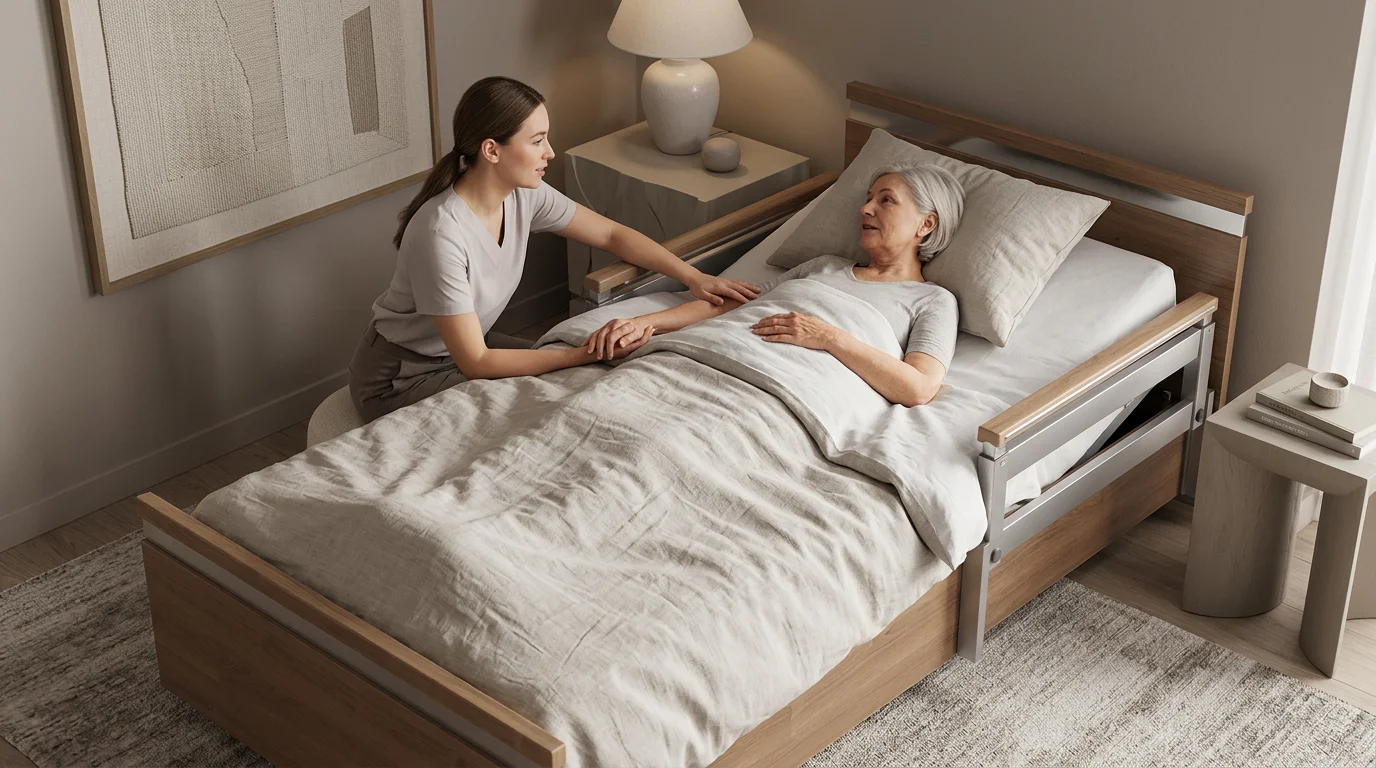
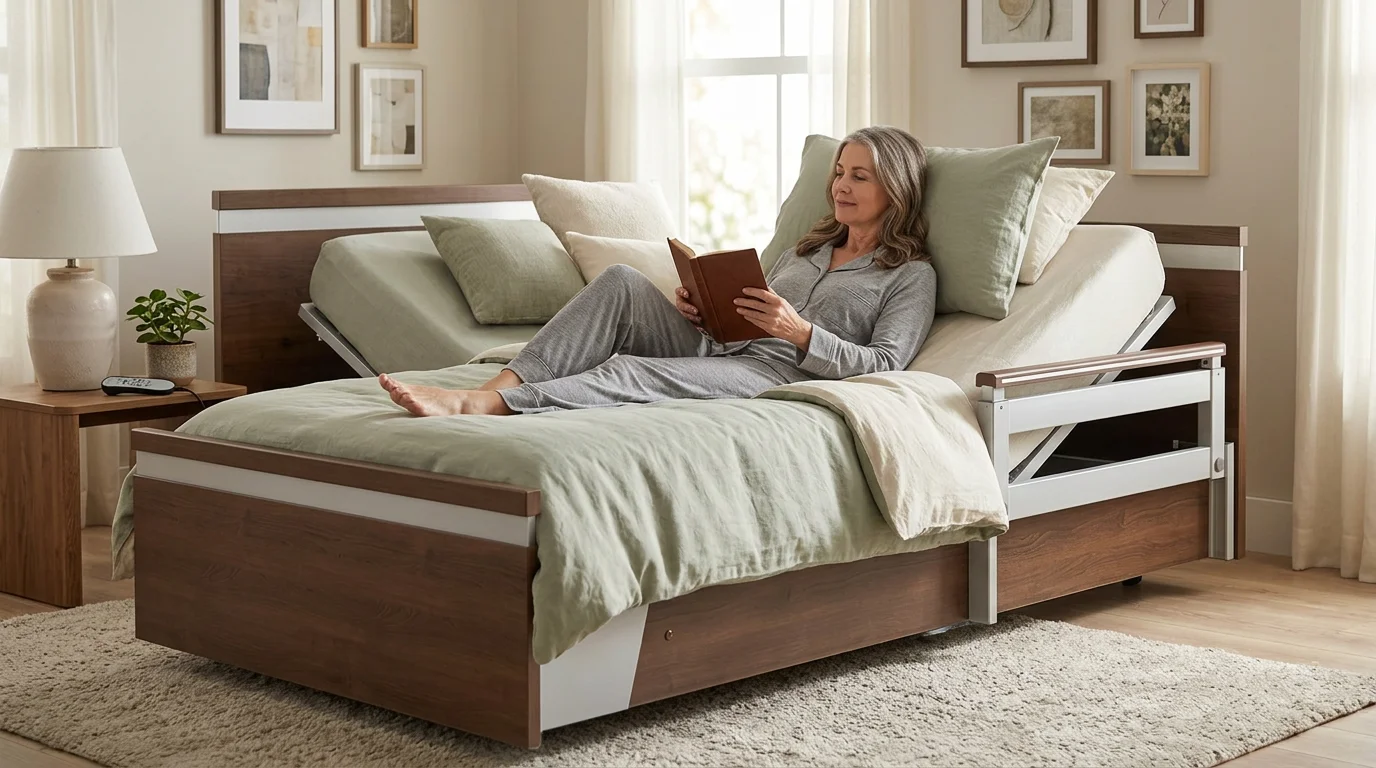
Your parent came home from the hospital two weeks ago. Every morning and every evening, you’re on your own, trying to move her up in the bed before she slides toward the footboard again. Your back hurts. She’s not comfortable. And somewhere in the back of your mind is the terrifying thought: if I hurt myself, who takes care of her?
This is not a rare situation. An estimated 63 million Americans, one in four adults, now provide unpaid care to a family member, a 45% increase since 2015.
1 Across studies, 94% of informal caregivers report musculoskeletal pain during any given four-week period.
2 The single greatest source of that pain is manual patient handling, particularly repositioning someone in bed.
3
Slide-sheet repositioning changes this equation. A slide sheet is a low-friction fabric placed under a person to allow caregivers to move them in bed using a controlled sliding motion rather than lifting. It’s been standard equipment in hospital and nursing settings for years. Many family caregivers discover it only after months of painful improvisation, sometimes after an injury.
This guide covers everything you need: what slide sheets are, why the physics work in your favor, how to place them under someone who can’t easily roll, the technique for solo repositioning, and how an adjustable hospital bed makes the whole process significantly safer.
What Is a Slide Sheet?
A slide sheet is a purpose-made fabric or film device designed to reduce friction between a person and the surface they’re lying on. The reduced friction means that sliding a person in bed, up, down, or to the side, requires dramatically less force than dragging them against standard cotton sheets. Caregivers who use them for the first time often describe the experience as startling. A person who felt immovable suddenly glides.
There are two main types:
Flat slide sheets are single-layer sheets that you position under the person’s torso and hips. They’re the most versatile option: useful for sliding someone up toward the headboard, repositioning toward one side, or assisting with repositioning in any direction. Most come in pairs that layer against each other.
Tubular slide sheets are a continuous tube of low-friction fabric, like a giant pillowcase. The tube stays in place without folding or layering, which makes them particularly useful for turning someone to one side. The person’s weight keeps the tube open.
Both types are widely available through medical supply retailers and online for $20–$60 depending on size and material. Your home health agency, occupational therapist, or hospital discharge coordinator can recommend specific products.
Why Slide Sheets Work: The Physics of Safer Caregiving
The reason caregivers hurt themselves repositioning loved ones is simple mechanics: standard cotton sheets create high friction, and moving someone against that friction requires large forces applied at awkward angles, precisely the conditions that damage spines.
Researchers at the National Institute for Occupational Safety and Health (NIOSH) set a peak spinal compression safety limit of 3,400 N at the L5/S1 joint (the junction between the lumbar spine and sacrum). Simply boosting a 77-kilogram (170 lb) person up in bed using a standard draw sheet generates 2,665 N at that joint in a single caregiver, dangerously close to the limit.
5, 6 For heavier individuals or caregivers using poor body mechanics, that limit is routinely exceeded.
Slide sheets change the numbers:
- Coefficient of friction drops by 65% with a slide sheet system compared to standard cotton.7 That single change is what makes an immovable person moveable.
- Impulse of force, the total force applied over the duration of a repositioning movement, falls by 40.6% when using a slide film versus a regular sheet.8
- Muscle activation in the upper extremities and lower back decreases by 20–40% with slide sheets, measured by electromyography (EMG).9
These are not marginal improvements. They represent the difference between a movement that protects you and one that injures you over time. Nursing assistants, the professional group most comparable to family caregivers in terms of physical caregiving tasks, have musculoskeletal disorder rates more than five times the all-worker average, costing the U.S. healthcare system an estimated $20 billion annually in injury-related expenses.
4
Slide sheets exist because the physics of manual repositioning are genuinely dangerous without them.
Getting the Sheet Under Your Loved One
The most common stumbling block for first-time users is not the repositioning itself, it’s placing the slide sheet under someone who can’t lift their hips or roll cooperatively. Here’s the technique:
The Log Roll Method
- Lower the bed to a comfortable working height. If you have a height-adjustable hospital bed, set it to elbow height for your caregiver stance. This protects your lower back before you start.
- Roll your loved one to one side. Stand at the side of the bed. Place one hand on their near shoulder and one on their near hip. Ask them to look toward you if they can. Gently roll them toward you onto their side. If they have limited mobility, use a pillow placed against their back to keep them in this position temporarily.
- Position the slide sheet behind them. With them on their side, fold the slide sheet in half lengthwise (for a flat sheet) or roll one edge. Tuck this folded edge as far under their back and hips as you can reach.
- Roll them back the other way. Help them roll onto their back and then to the other side. The slide sheet will unfold beneath them. Pull any remaining material flat so it’s centered under their hips and torso.
- Return them to their back. You’re ready to reposition.
If rolling is difficult, a hospital bed’s head elevation control can help. Raising the head of the bed slightly can make it easier to position the sheet by reducing the force needed to roll your loved one. The same controls become important during the actual repositioning move.
Moving Someone Up the Bed
This is the most common repositioning need: a person slides toward the foot of the bed during the day and needs to be moved back up. With a slide sheet in place, a single caregiver can manage this safely for most patients.
Your Body Mechanics
Stand at the head of the bed, facing your loved one’s feet. Position your feet shoulder-width apart and bend your knees slightly, never hinge at the waist. Most of your effort should come from your legs and core, not your back. If the bed is height-adjustable, raise it before you begin so you’re not bent over.
The Gravity Trick
This technique is widely used by experienced caregivers and little known by those new to home care. Before you slide your loved one,
raise the foot section of the bed. If the bed has a knee bend or foot elevation function, raising it by 15–20 degrees lets gravity assist you: the person’s lower body is slightly elevated, which reduces the friction between their back and the surface and makes the upward slide dramatically easier. This tip alone, discovered accidentally by caregivers in online forums, can transform a two-person task into a one-person one.
The Move Itself
- Reach under your loved one’s shoulders on both sides, gripping the slide sheet rather than their body directly. Keep your elbows close to your sides.
- On a count of three, shift your weight backward (from front foot to back foot) in a controlled rocking motion. Let your body weight and leg movement create the force, not your arms or back.
- The slide sheet allows your loved one to glide smoothly along its surface. Repeat as needed in small increments rather than one large effort.
Remove the Sheet After Each Move
This is the step caregivers most often miss:
always remove the slide sheet when you’re done. A person left lying on a slide sheet will continue to slide, including sideways or toward the bed’s edge. The same property that makes repositioning easy makes it dangerous if the sheet is left in place. Roll your loved one slightly to one side, extract the sheet, and return them to the center of the bed.
Turning Someone to the Side
Lateral repositioning, turning someone onto their side, is necessary for pressure injury prevention and for care tasks like changing incontinence products or inspecting the skin. It is also the move most commonly cited as requiring two people. With proper technique and a slide sheet, one caregiver can often manage this safely.
For turning, a tubular slide sheet is particularly useful because it doesn’t shift out of place. Position the tube under your loved one’s torso and hips using the log roll technique described above.
To turn them onto their right side:
1. Stand on their right. Cross their left ankle over their right.
2. Place one hand on their left shoulder and one on their left hip. The crossed ankles give you control of the lower body.
3. In a single smooth motion, roll them toward you by pulling the shoulder and hip simultaneously. The slide sheet allows the torso to rotate with much less resistance than standard bedding.
4. Position a pillow behind their back to keep them on their side, and a pillow between their knees for joint comfort.
Solo turning is more manageable than most new caregivers expect, once friction is removed from the equation.
Flat vs. Tubular: Which Should You Buy First?
| Feature |
Flat Slide Sheet |
Tubular Slide Sheet |
| Best for |
Moving up/down the bed, any direction |
Lateral turns, turning side to side |
| Setup |
Requires positioning in pairs (layered) |
Single piece; no folding required |
| Versatility |
Very high |
Moderate, primarily for turning |
| First-time buyer? |
Yes, start here |
Good second purchase |
| Typical cost |
$20–$40 per pair |
$30–$60 single |
Recommendation: If you’re buying your first slide sheet, start with a pair of flat slide sheets. They cover the most common repositioning scenarios (moving up the bed, shifting to one side) and are easier to learn with. Add a tubular sheet once you’re comfortable with the basic technique.
Both types come in small and large sizes. For most adults, a standard size (approximately 24″ × 35″ flat, or 30″ × 35″ tubular) is sufficient to cover the hips and torso. If your loved one is larger, check the manufacturer’s bariatric sizing, proper coverage matters for the technique to work.
DIY Alternatives: What Actually Works
Caregivers who don’t know about slide sheets often improvise. Trash bags, plastic grocery bags, or extra cotton sheets are common workarounds. These can reduce friction somewhat, but they have real limitations:
Trash bags can work in a pinch for a single move, but they tear unpredictably under load, don’t provide even friction reduction across the body, and create a fall risk if the person shifts unexpectedly. The crinkling noise can also startle someone with dementia.
Extra sheets layer the cotton-on-cotton friction problem, they don’t meaningfully reduce it. Moving someone on double sheets often feels no different than moving them on one.
Purpose-made slide sheets are designed to specific friction coefficients that balance ease of movement with enough resistance to stay controlled. They don’t tear. They’re washable and reusable. For a product costing $20–$60, the investment is small relative to the cost of a caregiver back injury, or a pressure injury from infrequent repositioning.
If budget is a concern, many home health agencies can loan or provide slide sheets. Ask your loved one’s home care coordinator or occupational therapist.
How Often Should You Reposition? What the Evidence Says
The instruction to reposition someone every two hours is so widely repeated that most caregivers treat it as medical law. The clinical picture is more nuanced, and more practical.
A 2025 update from the National Pressure Injury Advisory Panel (NPIAP), the international body that sets clinical guidelines for pressure injury prevention, states that either 2-hourly or 3-hourly repositioning intervals are acceptable for most individuals at risk.
11 The Cochrane Collaboration, reviewing available trial data, found no clear difference in pressure injury outcomes between 2-hourly and 3-hourly repositioning.
12
The stakes for doing this well are real. Approximately 2.5 million Americans develop pressure injuries each year, and an estimated 60,000 deaths are directly attributed to them annually.
10 The goal isn’t a specific number of minutes, it’s consistent, regular off-loading of pressure at bony prominences (heels, sacrum, hips, shoulder blades).
In practice, a realistic approach for many solo home caregivers:
– During waking hours: every 2–3 hours
– Overnight: every 4 hours may be appropriate depending on mattress type and individual risk factors, discuss this with your loved one’s care team
Mattress choice directly affects how long a person can safely remain in one position. A pressure redistribution mattress, such as SonderCare’s
Alternating Pressure Air Mattress, which uses 18 cycling air bladders to continuously shift pressure points, can extend safe repositioning intervals under appropriate clinical guidance, reducing the burden of overnight turning on solo caregivers.
The
comprehensive pressure injury prevention guide covers individual risk assessment, mattress selection, and skin inspection in more detail. For a deep look at frequency, see the guide on
how often to turn a bedridden person.
How Your Hospital Bed Makes This Safer
A hospital bed’s adjustable controls are not separate from slide-sheet technique, they’re central to it. The difference between a fixed-height bed and a height-adjustable hospital bed determines how much your back absorbs with every repositioning.
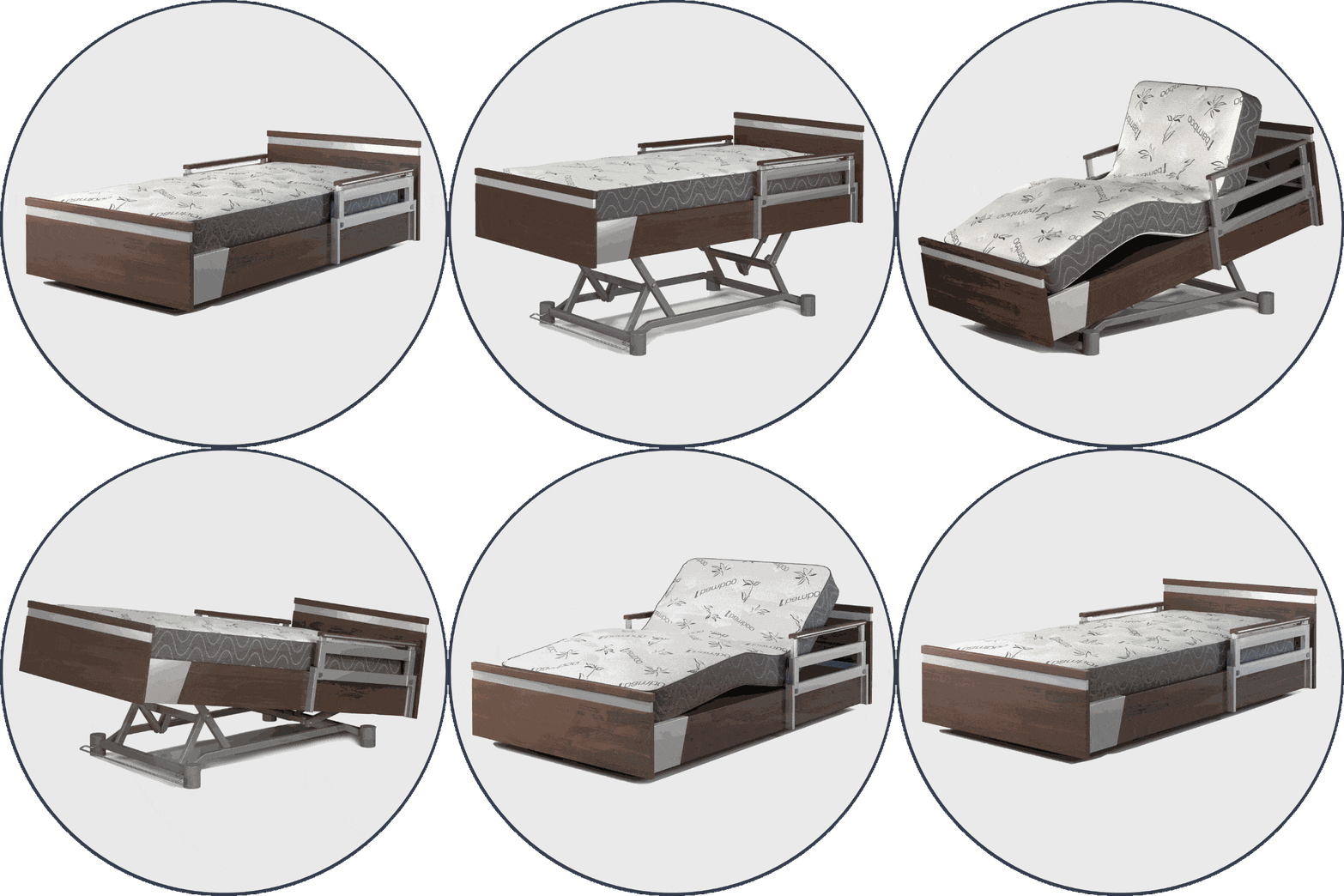
Hi-lo height adjustment lets you raise the bed to your elbow height before any repositioning move. This eliminates the hunched-over posture that loads the lumbar spine. Lowering the bed again after repositioning allows your loved one to get safely in and out of bed independently or with less assistance.
Head and foot positioning are the mechanical basis for the gravity trick described above. Raising the foot of the bed before a head-of-bed move reduces the friction load on the caregiver significantly. Adjusting the head elevation to 15–30 degrees can also reduce the tendency to slide back down during the day, reducing the number of repositioning moves required overall.
The
Aura Premium home hospital bed adjusts from a 10-inch FallSafe ultra-low position to a 39-inch high caregiver position, a 29-inch range of working height. That flexibility means you can always position the bed at the ergonomic height for repositioning, then lower it for safe transfers or fall prevention. Combined with full independent head and foot adjustments, the bed’s controls work directly alongside slide-sheet technique rather than forcing you to work around a fixed surface.
For caregivers managing repositioning alone for the first time, the bed height adjustment is the single most underused ergonomic tool available.
Understanding the Limits: When to Ask for Professional Help
Slide sheets significantly expand what a single caregiver can do safely. They do not eliminate every situation that requires two people. Some scenarios genuinely call for a second set of hands or professional support:
- Your loved one weighs more than approximately 250 lbs and repositioning consistently requires near-maximum effort even with a slide sheet
- Your loved one has significant spasticity, resistance, or unpredictable movement (common in advanced dementia) that makes controlled sliding unsafe
- You are experiencing back, shoulder, or joint pain during or after repositioning moves, even with proper technique
- The repositioning schedule required (every 2–3 hours overnight) is creating chronic sleep deprivation
Occupational therapists and physical therapists can come to your home. This is a service that many caregivers don’t know is available. A single 45-minute session with an OT or PT who observes your current technique can identify exactly what needs to change, and sometimes that one session eliminates months of pain. Ask your loved one’s physician for a home health referral.
Learning about the full range of
common mobility challenges that arise as people age can also help you plan ahead: what works today may need to be adapted as needs change, and having the right equipment in place before a crisis makes those transitions easier. The guide to
best mobility and disability aids for the bedroom covers complementary equipment that can further reduce the physical load of caregiving at home.
If you’re unsure whether your current setup supports safe repositioning, SonderCare’s bed experts are available to walk through your specific situation, including bed height, mattress selection, and how the bed’s positioning controls interact with the repositioning techniques covered here.
The Bottom Line for Slide-Sheeting
Slide-sheet repositioning is one of the most practical, lowest-cost tools in home caregiving, and one of the least known. A $30 piece of fabric changes the physics of every repositioning move you make. Combined with proper body mechanics, the gravity trick, and a height-adjustable bed, solo caregivers can reposition safely and consistently without sacrificing their own health in the process.
The two things most caregivers wish someone had told them sooner: ask an occupational therapist to show you the technique in person, and don’t wait until after an injury to invest in the right equipment.
If you’re evaluating hospital bed options that work with this approach, or want to talk through your specific situation,
speak with a SonderCare expert. There’s no pressure and no obligation. Just a straight conversation about what you actually need.
References
- AARP & National Alliance for Caregiving. Caregiving in the U.S. 2025. Released July 24, 2025. https://www.aarp.org/pri/topics/ltss/family-caregiving/caregiving-in-the-us-2025/
- Social Work Today. “Caregivers and Musculoskeletal Disorders.” August 2014. https://www.socialworktoday.com/news/dn_082014.shtml
- Minghelli B, et al. “Work-related musculoskeletal injuries in formal caregivers of Portuguese rest home of elderly.” Rev Assoc Med Bras. 2025. DOI: 10.1590/1806-9282.20241034. PMC11964325. https://pmc.ncbi.nlm.nih.gov/articles/PMC11964325/
- U.S. Occupational Safety and Health Administration (OSHA). “Safe Patient Handling.” https://www.osha.gov/healthcare/safe-patient-handling
- U.S. Centers for Disease Control and Prevention / National Institute for Occupational Safety and Health (CDC/NIOSH). “Safe Patient Handling and Mobility (SPHM).” Updated May 9, 2024. https://www.cdc.gov/niosh/healthcare/prevention/sphm.html
- Wiggermann N, et al. “Effect of Repositioning Aids and Patient Weight on Biomechanical Stresses When Repositioning Patients in Bed.” Human Factors. 2020. DOI: 10.1177/0018720819895850. PMC8114440. https://pmc.ncbi.nlm.nih.gov/articles/PMC8114440/
- Theou O, et al. “Changing the sheets: a new system to reduce strain during patient repositioning.” Gerontechnology. 2011. PMID: 21873921. https://pubmed.ncbi.nlm.nih.gov/21873921/
- Muona A, et al. “Forces required in repositioning a patient in bed using regular sheet and slide film.” International Journal of Industrial Ergonomics. 2022;90. https://www.sciencedirect.com/science/article/pii/S0169814122000439
- Higuchi D, et al. “Effects of Slide Sheet Use and Bed Position on Muscle Activities in the Low Back and Extremities.” Workplace Health & Safety. 2023. DOI: 10.1177/21650799231155626. https://journals.sagepub.com/doi/10.1177/21650799231155626
- Agency for Healthcare Research and Quality (AHRQ). “Preventing Pressure Ulcers in Hospitals: A Toolkit for Improving Quality of Care.” https://www.ahrq.gov/patient-safety/settings/hospital/resource/pressureulcer/tool/pu1.html
- National Pressure Injury Advisory Panel (NPIAP), European Pressure Ulcer Advisory Panel (EPUAP), Pan Pacific Pressure Injury Alliance (PPPIA). Prevention and Treatment of Pressure Ulcers/Injuries: International Clinical Practice Guideline. 4th Edition, published February 25, 2025. https://www.internationalguideline.com/repositioning
- Gillespie BM, et al. “Repositioning for pressure injury prevention in adults.” Cochrane Database of Systematic Reviews. 2020. DOI: 10.1002/14651858. CD009958. pub3. PMC7265629. https://pmc.ncbi.nlm.nih.gov/articles/PMC7265629/