





More than one in four older adults in the United States falls each year, generating over 3 million emergency department visits annually and costing the healthcare system an estimated $80 billion in 2020 alone.1,2 A quarter of those falls happen in the bedroom, and for adults over 85, that figure climbs to nearly one in three.3 If you are helping a parent or loved one manage limited mobility at home, the bedroom is where the risk is highest and where thoughtful equipment choices matter most.
This guide is organized the way caregivers actually need to think through this: starting with the bed itself, the single decision that shapes everything else, and working outward through transfer aids, safety rails, commodes, mattresses, and lighting. It includes honest notes on bed-rail safety risks, what caregivers commonly regret buying, and a plain-English summary of what Medicare will and won’t cover.
If you’re still building a picture of the broader challenges your loved one faces, our guide to common mobility issues in old age is a useful starting point before reading further.
Of all the equipment in this guide, adjustable home hospital beds do the heaviest lifting — literally — so we’ll start the bedroom conversation there.
The Bed Is the Anchor Decision
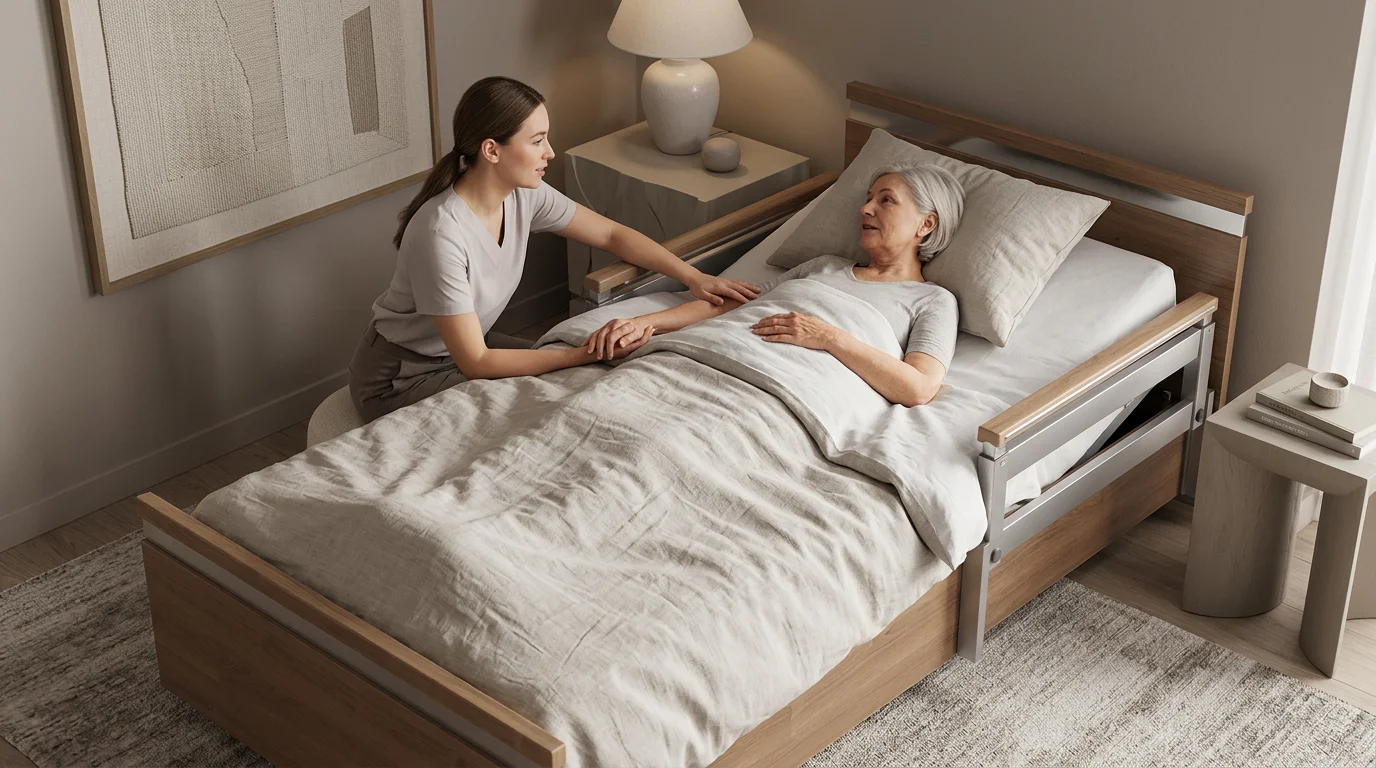
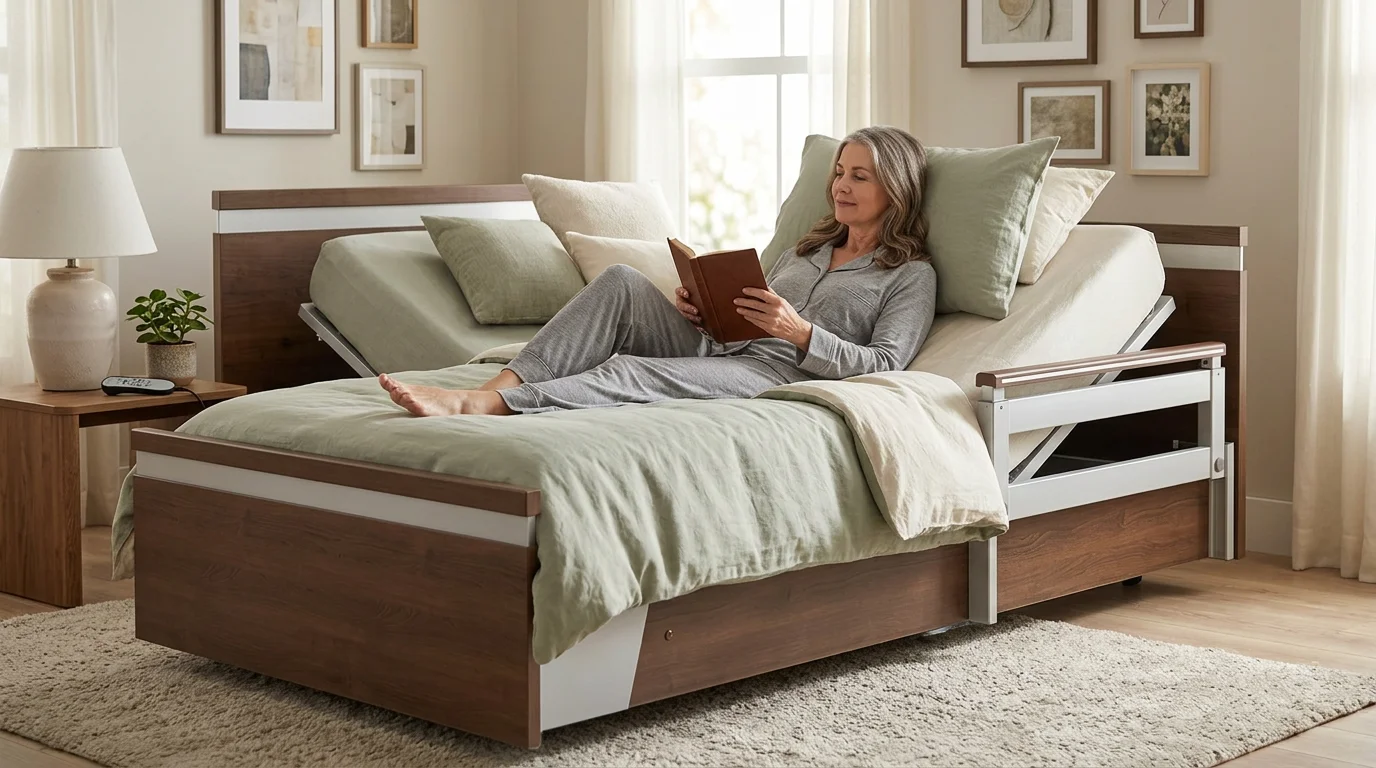
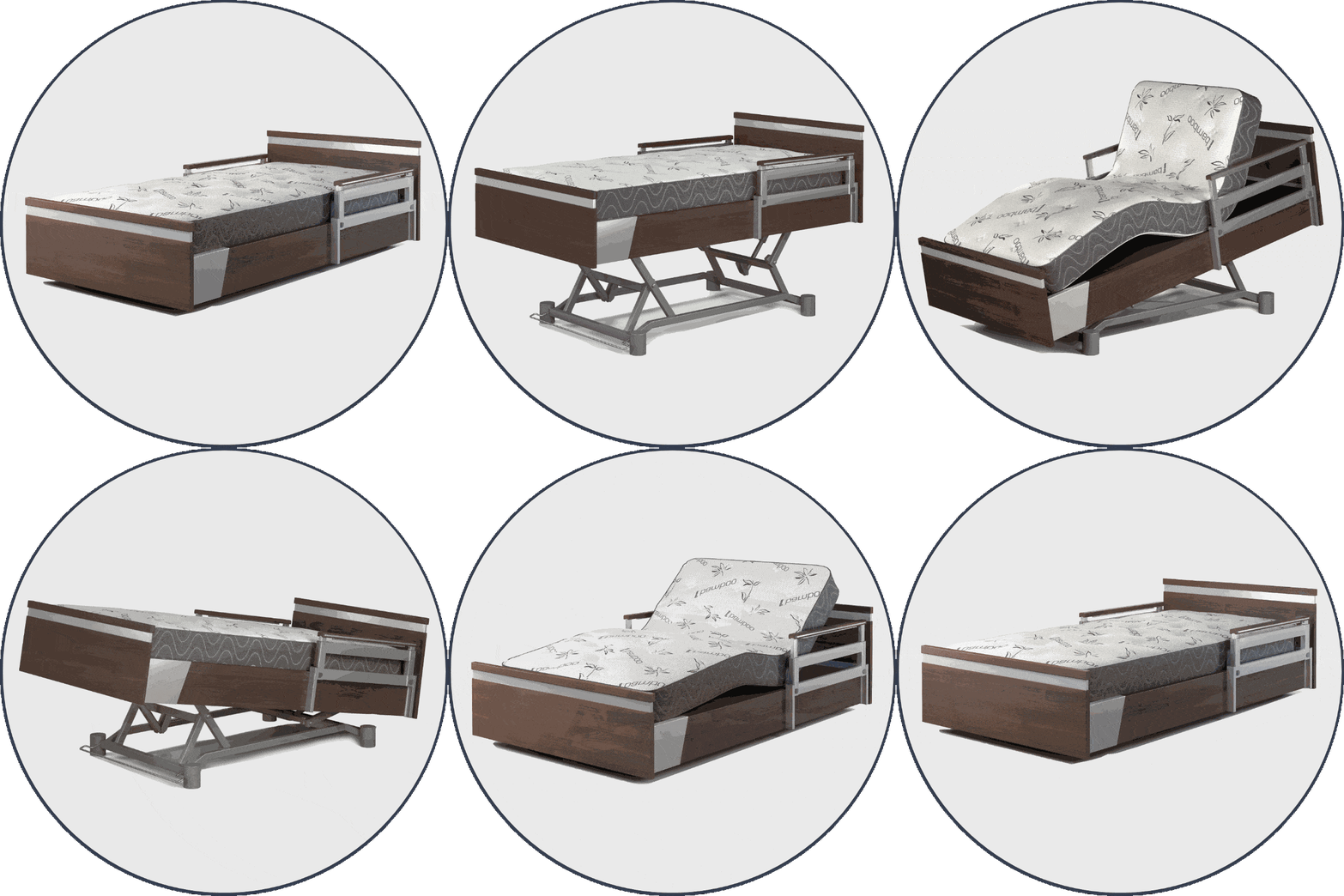
Every occupational therapist, caregiver forum, and clinical guideline converges on the same point: the bed is the most important single purchase. Not because everything else is secondary; but because every other aid is chosen around the bed. The type of bed, its height range, and whether it has articulating sections will determine which rails fit, which transfer aids work, and how your caregiving looks day to day. For someone with limited mobility, a standard fixed-height bed presents two compounding problems. If the mattress surface sits at a typical 25 inches off the floor, getting in or out requires significant leg strength and hip flexion, and many older adults simply cannot do it safely without assistance. But lower a standard bed to near-floor height, and the caregiver must bend deeply to assist, increasing lumbar load significantly.4,5,6 A hospital-style adjustable bed, sometimes called a hi-lo bed, solves both sides of this equation. It can be raised to caregiver-working height (roughly hip or elbow level) for repositioning and hygiene tasks, then lowered to a safe exit height for independent or assisted transfers. Research on transfer biomechanics identifies an optimal mattress surface height of 51–66 cm (approximately 20–26 inches) from the floor as the range that minimizes ground reaction forces and maximizes stability during bed entry and exit for older adults.4 The hi-lo function lets you dial in that exact height for each individual. For users at high fall risk, those with dementia, poor balance, or a history of rolling out of bed, some beds descend to 10–15 inches from the floor, significantly reducing injury severity if a fall does occur. Beyond height, the other features that consistently matter in caregiver discussions are: head and foot elevation via remote control (essential for reflux, respiratory positioning, sitting upright to eat), side rails that lower to allow exit, and a trapeze bar attachment point for users who need overhead grip to reposition themselves. For a detailed comparison of what distinguishes a medical-grade adjustable bed from a consumer lifestyle bed, see our guide on how to choose a home hospital bed. The Aura Premium home hospital bed from SonderCare is built specifically for this use case. Its FallSafe Ultra-Low Height feature lowers the platform to 10 inches off the floor (17 inches to the top of the mattress), while the full hi-lo range extends to 39 inches for caregiver access. Head and knee articulation, Comfort Chair positioning, and a pre-programmed 21-inch transfer height are all controlled via remote, and the bed is certified to International Hospital Standard. Unlike a rental DME bed, it’s designed to look like residential furniture, which matters for a home that is still someone’s home.Bed Rails and Assist Handles: What’s Safe and What Isn’t
Bed rails are one of the most misunderstood categories in home care. The marketing images typically show full-length rails running the length of the mattress. Many caregivers buy them. And a significant number of occupational therapists and care facilities have moved away from them, for good reason. The U. S. Food and Drug Administration tracked 803 bed rail entrapment incidents between 1985 and 2009, resulting in 480 deaths and 138 serious nonfatal injuries.7,8 The U. S. Consumer Product Safety Commission has identified 284 fatal incidents related to adult portable bed rails between 2003 and 2021.9 The highest-risk entrapment zones are: the gap between the mattress and the rail, the gap between the rail and the headboard or footboard, and the gaps between individual rail bars. People living with dementia, confusion, restlessness, or limited muscle control are at the greatest risk, because they may attempt to roll through the gap or climb over the rail rather than exit at the foot of the bed. This does not mean bed rails are always wrong. It means the type of rail matters enormously:- Full-length side rails, the ones that run from headboard to footboard, are the highest-risk configuration. Many assisted-living and memory care facilities have phased them out entirely. For a confused or restless person at home, they can create a “climbing obstacle” that increases fall height rather than preventing a fall. Clinical guidelines under ASTM F3186-17 require specific gap limitations for portable bed rails, including no gap greater than 60mm between bars and no gap greater than 120mm between the rail and the mattress platform.10
- Half-length assist rails positioned near the headboard, short rails that slide under the mattress or attach to the bed frame near the pillow zone, are the configuration endorsed by most occupational therapists for home use. They provide a grip surface for sitting up and pivoting to exit without creating an entrapment zone along the middle of the bed.
- Bedside assist handles, standalone devices that do not extend along the mattress edge, are the lowest-risk option for users who primarily need something to push against when rising from a seated position.
Transfer Aids: Following the Progression
Caregivers who have managed a loved one’s declining mobility describe the same arc: they start with hands-on assistance, then add a gait belt, then progress to a mechanical device as the person’s ability to bear weight decreases. Understanding this progression helps you buy what you need now, and plan for what you may need later. A professional bodies like AOTA and APTA consistently recommend an individualized assessment by an occupational or physical therapist before purchasing any transfer aid.11 That assessment is usually covered by Medicare Part B. If you can arrange it, do, a home visit from a therapist will identify the right device for your specific situation more reliably than any buying guide. With that caveat in place, here is the standard progression:Gait Belt (~$15–$30)
The entry point for assisted transfers. A gait belt wraps around the person’s waist and gives the caregiver a firm grip point for steadying during sit-to-stand transitions or ambulation. It is not a substitute for strength, it’s a grip aid that reduces the risk of an accidental drop and reduces awkward pulling that strains the caregiver’s back. Most caregivers who use mechanical lifts started with a gait belt years before.Floor-to-Ceiling Transfer Pole (~$80–$200)
For users who still have significant upper body strength but need a stable vertical grip to sit up and stand, a floor-to-ceiling transfer pole is one of the most underused and highly valued aids in home care. These tension-mounted poles require no drilling and can be positioned next to the bed, beside a chair, or in other transfer zones. Models with an attached horizontal grab bar (like the SuperPole with SuperBar) offer two grip heights for sit-to-stand transitions. Caregivers consistently describe these as enabling independence, the person can transfer themselves with minimal caregiver involvement, preserving dignity while reducing caregiver injury risk. The SonderCare Overhead Trapeze Helper Bar ($369) serves a related function for in-bed repositioning, an adjustable overhead handle the user pulls to reposition themselves without needing caregiver assistance. It’s particularly valuable for users who need to sit up frequently or who reposition overnight.Transfer Board / Sliding Board (~$30–$80)
A curved or straight board that bridges the gap between the bed edge and a wheelchair seat. The user slides laterally across the board rather than standing fully. Curved boards are generally easier to use than flat ones. Transfer boards require some remaining upper body strength and intact skin; they’re not appropriate when pressure injury risk is high. For caregivers who cannot safely perform a standing transfer but whose loved one is not yet fully dependent, a transfer board is often the right intermediate step, cheap, low-footprint, and effective.Sit-to-Stand Lift (~$135/month rental, or $800–$1,500 purchase)
A sit-to-stand lift uses a sling or vest that supports the person’s torso while the device mechanically lifts them to standing. The person must still be able to hold the device’s handles and bear some weight through the legs, it is not a full-body lift. This device bridges the gap between gait belt assistance and a full Hoyer lift, and many families rent one as mobility declines before investing in a Hoyer.Hoyer Lift / Full-Body Sling Lift (~$400–$800 manual, $1,500–$3,000+ battery)
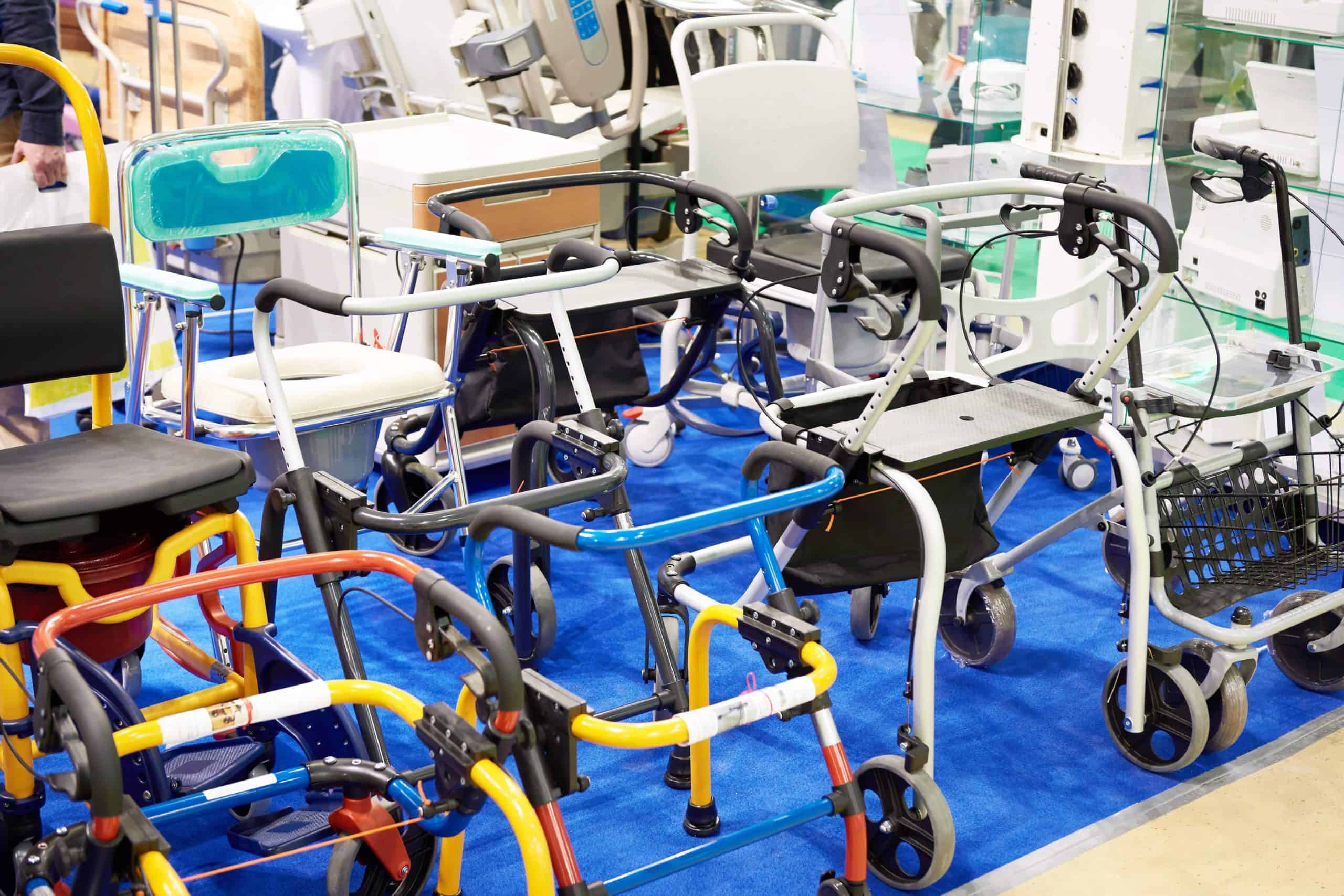
For individuals who can no longer bear any weight, a Hoyer lift is the standard of care. A fabric sling is positioned under the person; the lift then raises them completely off the bed for transfers to a chair, commode, or wheelchair. Manual hydraulic models are covered by Medicare; battery-operated versions are generally out of pocket but are strongly recommended for solo caregivers to prevent caregiver back and shoulder injury. If you have a Hoyer lift and have never been trained on the sling positioning and lift technique, request a home PT or OT visit specifically for training, equipment misuse is the primary cause of near-miss incidents. A note on walkers at bedside: Walkers are designed to be pushed, not pulled. Using a walker as a grip aid for standing up from the bed significantly increases fall risk. If your loved one’s instinct is to pull on the walker to stand, that is a signal to reassess, either with a different device or through a proper PT evaluation.Overbed Table
An overbed table on wheels is a simple but meaningful quality-of-life upgrade for anyone spending extended time in bed. It keeps meals, medications, books, tablets, and a phone within reach without requiring a full repositioning effort. The features that matter: a stable H-base frame with rolling locking casters (critical, unlocked wheels are a tipping hazard), one-touch height adjustment across a 28–39 inch range, and a tilting surface for reading or using a laptop. Critically, look for a raised edge or lip around the table surface. One of the most commonly cited complaints in product reviews is a flat surface that lets items slide off, a significant issue for someone with tremor or limited arm control. SonderCare’s Extra Large Overbed Table ($789) is sized specifically for home hospital beds, with rounded safety corners, a surface large enough for a full meal tray, and easy-clean materials that meet infection control standards. It’s worth the investment for anyone spending more than a few hours a day in bed.Bedside Commode and Urinals
Nighttime bathroom trips are one of the highest fall-risk moments for older adults, a person is groggy, the room is dark, the floor is cold, and reaction time is slower than in daylight.12 A bedside commode, a freestanding chair with a removable bucket, eliminates most of the distance and eliminates the need to navigate a hallway or bathroom in the dark. When choosing a commode, prioritize: sturdy armrests (needed for sit-to-stand transitions), a locking wheel system (commodes with wheels are easier to position, but wheels must lock before use), adequate weight capacity for your loved one, and a seat height that matches the bed height for easy lateral transfer. For men, a male urinal bottle kept within reach eliminates even the commode transfer for nighttime urination, often the highest-risk trip of all. Reaching for a bedpan while remaining flat in bed should be the last resort: getting out of bed to a commode, even briefly, is better for skin health and pressure injury prevention than sustained bedpan use.12Mattress Selection
The standard mattress that comes with many basic rental hospital beds is intentionally firm, it accommodates a wide range of users but is rarely ideal for comfort or pressure distribution. If your loved one spends significant time in bed, the mattress is worth thoughtful selection.- Pressure-redistributing foam mattress: For most home users spending up to 12–15 hours in bed. Visco memory foam or high-density therapeutic foam distributes weight across a larger surface area, reducing pressure at bony prominences. SonderCare’s Comfort Mattress ($899) and Dream Bamboo Quilt-Top ($1,299) are built for this use case.
- Alternating pressure air mattress: For users spending 15 or more hours per day in bed, or anyone with existing pressure injuries. Alternating air bladders cycle through inflation and deflation every few minutes, changing the pressure zones continuously. SonderCare’s Alternating Pressure Air mattress ($2,999) includes an 18-bladder system with pump. This is wound care–grade equipment, not a comfort upgrade.
- Bed wedge ($25–$60): A simple foam wedge under the pillow elevates the upper body for reflux relief or respiratory support. Inexpensive and effective for users who don’t yet need a full adjustable bed, or as a supplement to one.
Bedroom Lighting for Safer Nights
Motion-activated pathway lighting is one of the cheapest, most evidence-backed fall prevention measures available.13 The National Institute on Aging recommends it as a standard home modification. The logic is straightforward: most nighttime falls happen in the first seconds after getting out of bed, when the room is dark and the person is still disoriented. A motion sensor that activates as feet touch the floor eliminates that window of blind navigation. Place lights at three points: at floor level beside the bed (activates when feet land), in the hallway, and at the bathroom entrance. Use warm 3000K light, it is bright enough to navigate by without disrupting melatonin production and disrupting sleep quality. Avoid blue-spectrum lights overnight. SonderCare’s Underbed Auto-Nightlight ($219) mounts under the bed frame and activates automatically with motion in a dark room, illuminating the floor directly where feet land during a transfer. Caregivers who have used it describe it as among the most effective single safety upgrades for nighttime mobility.What Caregivers Regret Buying
Community discussions among experienced caregivers consistently surface the same purchasing mistakes. If you’re early in this process, these are worth knowing before you spend money:- Full-length bed rails for a confused or restless person: As detailed above, these increase the climbing/entrapment risk for someone who doesn’t understand why the rails are there. Many caregivers who bought them removed them within weeks.
- An overbed table without a raised edge: Items slide off immediately. Read the product description carefully, many budget tables have flat surfaces.
- Furniture risers on a wheeled bed frame: Furniture risers work only on beds with fixed, stationary legs. On a frame with wheels, risers create instability and can fail under load. If the bed needs to be higher, use the hi-lo adjustment, or replace the bed.
- Equipment purchased without an OT assessment: Multiple forum threads describe families buying the wrong transfer device, rails that don’t fit the mattress, or a lift the caregiver couldn’t operate safely, because the purchase was made from a product list, not from an individual assessment. The OT home visit is usually covered by Medicare Part B and takes 60–90 minutes. It is the single best investment before buying any mechanical transfer device.
- A manual Hoyer lift for a solo caregiver: Manual hydraulic lifts are Medicare-covered, but solo caregivers who use them regularly develop shoulder injuries over months. Battery-operated lifts are $1,500–$3,000 out of pocket, but the injury prevention argument is real, caregivers who become injured cannot provide care at all.
Cost and Medicare Coverage
Budget is a real constraint for most families, so the coverage picture matters. Here is what Medicare Part B (Durable Medical Equipment) covers and what it doesn’t: Hospital-style adjustable bed: Medicare covers 80% of the approved amount after the Part B deductible ($257 in 2025) when a physician certifies medical necessity and prescribes the bed under Local Coverage Determination LCD L33820.15 The bed must be purchased from a Medicare-enrolled supplier. Coverage typically begins with a 13-month rental; after 13 months, ownership transfers to the patient. Variable-height (hi-lo) beds have their own qualifying criteria, the person must need height adjustment specifically to permit safe transfers, not just general positioning. Consumer adjustable beds are explicitly excluded from coverage, as is the “total electric” height-adjustment feature on some models, which is considered a convenience feature.15 A face-to-face physician visit within six months before the equipment order is required for documentation. Work with your parent’s primary care physician to confirm that the prescription and documentation address the medical necessity criteria, the improper payment rate for this category is 27.3%, meaning documentation errors are common and claims are frequently denied.15 For a complete breakdown of what qualifies and what doesn’t, see our guide to what kind of hospital bed Medicare will pay for. Manual Hoyer lift: Covered by Medicare when medically necessary. Battery-operated versions are typically out of pocket. Bedside commode: Covered by Medicare Part B as DME when medically necessary.14 OT home assessment: Covered by Medicare Part B when ordered by a physician. Hospice patients: If your loved one is enrolled in a hospice program, the hospice typically provides a hospital bed, commode, and some transfer equipment at no cost to the family. This is a significant financial relief that many families are unaware of until they ask.| Item | Approximate Out-of-Pocket Cost |
|---|---|
| Full-electric hospital bed (purchase) | $3,999–$10,999+ |
| Hospital bed rental | ~$200/month |
| Gait belt | $15–$30 |
| Transfer board | $30–$80 |
| Half-length assist rail | $40–$100 |
| Floor-to-ceiling transfer pole | $80–$200 |
| Overbed table | $40–$789 |
| Bed wedge | $25–$60 |
| Bedside commode | $50–$150 |
| Sit-to-stand lift (rental) | ~$135/month |
| Hoyer lift (manual, purchase) | $400–$800 |
| Hoyer lift (battery, purchase) | $1,500–$3,000+ |
| Motion-sensor nightlight | $10–$25 |
Frequently Asked Questions
Are bed rails safe for elderly people?
It depends on the type and the individual. Half-length assist rails positioned near the headboard, used as a grip surface for sitting up and transferring, are generally safe. Full-length rails running the length of the mattress carry documented entrapment and fall risks and are no longer recommended for people with dementia, confusion, or restlessness. The FDA has tracked 480 deaths from bed rail entrapment incidents since 1985. If you are uncertain, consult an occupational therapist before installing rails.What is the difference between a hospital bed and a regular adjustable bed?
A consumer adjustable bed (like a Sleep Number or Tempur-Pedic) adjusts the head and sometimes the foot for comfort. A home hospital bed adds: hi-lo height adjustment of the entire frame (critical for transfers and caregiver safety), medical-grade certifications, higher weight capacity, and accessories compatibility (rails, trapeze bars, alternating pressure mattresses). Consumer adjustable beds do not qualify for Medicare coverage; hospital-grade beds do when medically prescribed.What does Medicare cover for bedroom mobility equipment?
Medicare Part B covers 80% of approved costs for a hospital bed, manual Hoyer lift, and bedside commode when a physician prescribes them as medically necessary and the supplier accepts Medicare assignment. Consumer-grade adjustable beds, battery-operated lifts, and overbed tables typically do not qualify. The OT home assessment to choose your equipment is also usually covered when ordered by a physician.What is the cheapest way to help someone sit up in bed on their own?
A bed ladder (a rope ladder secured to the foot of the bed frame, ~$13) is one of the most affordable options. The person “climbs” the rungs from lying to sitting without caregiver assistance. It’s particularly effective for people with core weakness, back pain, or post-surgical recovery. A foam bed wedge behind the pillow is another low-cost option that reduces the effort needed to transition from lying to sitting.What is a floor-to-ceiling transfer pole and do I need to drill into the ceiling?
A floor-to-ceiling transfer pole is a vertical pole tensioned between the floor and ceiling, no drilling required. The user grips it to stand from a seated position. It works in most rooms with standard 7–9 foot ceilings; drop ceilings and uneven surfaces may not support adequate tensioning. Do not use a tension-mounted pole for users who exceed the manufacturer’s stated weight limit.When does a Hoyer lift become necessary?
When the person can no longer bear any weight through their legs, even briefly, even with assistance, a Hoyer lift becomes the standard of care. Signs include: slipping to the floor during assisted transfers, inability to push up from sitting, or both parties experiencing pain or near-falls during transfers. At that point, manual transfers become unsafe for both the person and the caregiver. A PT or OT can assess this and make the recommendation formally, which supports Medicare coverage for the device.How do I prevent my parent from rolling out of bed without using bed rails?
Several options are commonly used: lower the bed to its minimum height and place a fall mat or dense foam pad on the floor beside it, use foam wedges tucked inside the fitted sheet at the mattress edges, or use a concave or cupped mattress design that creates a natural central depression. A pool noodle tucked under the fitted sheet at the mattress edge is a caregiver-discovered alternative that many report as effective. These approaches are widely used in memory care settings where entrapment risk from rails is too high.What bedroom equipment does hospice provide for free?
Enrolled hospice programs typically provide a hospital bed, bedside commode, and some basic transfer equipment at no cost to the family as part of the hospice benefit. The specific items vary by provider. Ask the hospice care coordinator directly, many families do not realize this and pay out of pocket unnecessarily.The Right Equipment Starts with the Right Assessment
The most common mistake in outfitting a bedroom for limited mobility is buying equipment before someone has evaluated the specific person in the specific room. A licensed occupational therapist, whose home assessment is usually covered by Medicare Part B when ordered by a physician, will assess transfer ability, fall risk, bed height, room layout, and caregiver capacity and match those to specific equipment recommendations. It takes 60–90 minutes and routinely saves families from expensive wrong purchases. If you’re ready to explore the bed options that anchor the whole setup, SonderCare’s bed experts can walk you through the Aura Premium line, help you understand the Medicare documentation process, and arrange white-glove delivery and installation. Speak with a SonderCare expert to get started.References
- CDC. Older Adult Falls Data. Centers for Disease Control and Prevention. https://www.cdc.gov/falls/data-research/index.html
- Haddad YK, et al. Healthcare spending for non-fatal falls among older adults, USA. Injury Prevention / BMJ. 2024. PMC11445707.
- Ang GC, et al. A Descriptive Analysis of Location of Older Adult Falls That Resulted in Emergency Department Visits in the United States, 2015. BMC Geriatrics. PMC8669898.
- Usmani AR, et al. Biomechanical analysis of patient transfers: effects of bed height. Human Factors in Healthcare. 2023.
- Merryweather AS, et al. Effect of bed height on patient egress: implications for older adults. Work. 2015.
- Tsuji S, et al. Effect of bed height on caregiver lumbar load during manual tasks. Industrial Health. 2023.
- U. S. Food & Drug Administration. Clinical Guidance for the Assessment and Implementation of Bed Rails in Hospitals, Long Term Care Facilities, and Home Care Settings. FDA / Hospital Bed Safety Workgroup.
- U. S. Food & Drug Administration. Bed Rail Entrapment Incident Data, 1985–2009. FDA Safety Communications.
- U. S. Consumer Product Safety Commission. Safety standards and recall data for Adult Portable Bed Rails (APBRs), 2003–2021.
- ASTM F3186-17. Standard Performance Specification for Adult Portable Bed Rails. ASTM International.
- American Occupational Therapy Association (AOTA) / American Physical Therapy Association (APTA). Clinical guidance on individualized assessment for transfer aids. Professional standards documents.
- Zou Y, et al. Toileting-related falls among older adults: an observational study. 2023.
- National Institute on Aging. Home Safety for Older Adults. U. S. Department of Health and Human Services.
- Centers for Medicare & Medicaid Services (CMS). DME Coverage Policy, Bedside Commodes. General DME Coverage Policies and Home Care Equipment Guidance.
- Medicare Administrative Contractors. Local Coverage Determination L33820: Hospital Beds and Accessories. HCPCS codes E0255, E0256, E0292, E0293.
- Szanton SL, et al. CAPABLE program evaluation: Medicaid savings and functional outcomes. Journal of the American Geriatrics Society. 2018.
- Lektip C, et al. Effectiveness of home hazard modification programs on fall prevention: systematic review and meta-analysis. PeerJ. 2023.