Janet bought the rail at 2 a.m. It was a Tuesday in January, her mother had nearly rolled off the edge of the bed twice that week, and the next-day delivery promise felt like the only certain thing in an uncertain situation. Three days later, after the rail was installed, she was reading a Consumer Product Safety Commission advisory about entrapment zones.
You might be in the same research spiral right now: trying to understand whether your parent needs a bed rail, an assist bar, or both, while also discovering that the category is more complicated than any product listing makes it sound. The key thing most product descriptions won’t tell you:
bed rails and assist bars are designed to solve completely different problems. Choosing the wrong one won’t just fail to help, in some situations, it can introduce risks the original concern never posed.
This guide explains what each type of support actually does, when each is appropriate, what independent federal safety data reveals about portable rail products, and how to arrive at a confident, evidence-grounded choice. We’ll also cover the scenarios, including dementia care, where standard recommendations can break down.
There are two separate jobs. That’s where every other decision starts.
Two Products, Two Different Jobs
Before comparing bed rails vs. assist bars by price, height, or installation method, it helps to understand that they’re built for different functional goals.
Bed rails are side barriers installed along the length of the mattress. Their primary function is
containment, keeping someone from rolling out of bed during sleep or involuntary movement. They’re passive devices: they work regardless of whether the person using the bed is awake, aware, or directing their own movement.
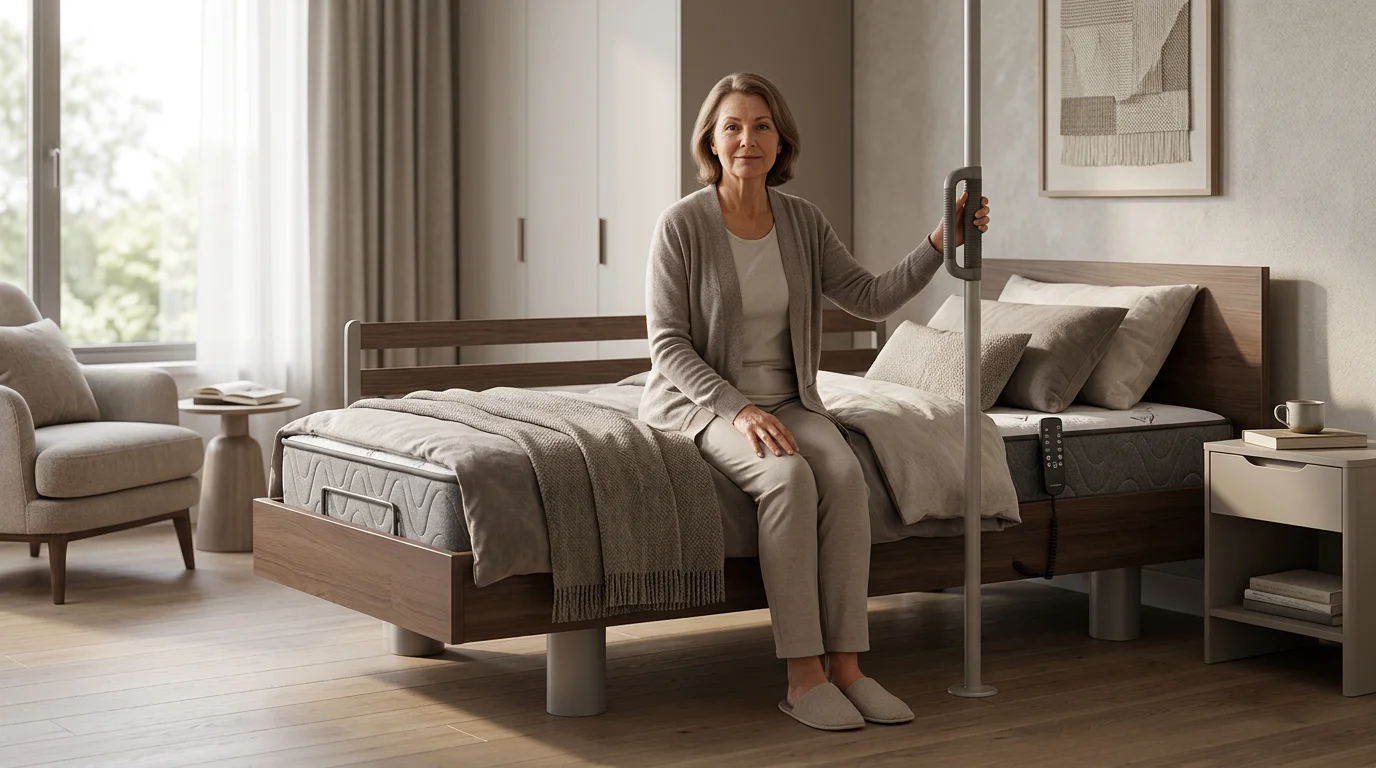
Assist bars (also called assist handles, bed handles, or bed canes) are grip supports positioned near the point where a person sits up and transitions to standing. Their primary function is
transfer support, giving someone a firm surface to push against or pull toward during a deliberate bed-to-standing movement. They’re active devices: they’re only useful to someone capable of directing their own movement.
A person who needs containment overnight is not necessarily the same person as someone who needs a push-off point in the morning. In many households, someone uses both a rail and an assist bar. But in many others, a caregiver purchases a full-length rail when what the situation actually calls for is a handhold. Getting this distinction right is the foundation of everything else in this guide.
What Is a Bed Rail?
A bed rail is a barrier device that attaches to or slides under a mattress, extending upward along the length or partial length of the sleeping surface. The most common types include:
- Full-length rails: Run the full length of the mattress, used when there is significant risk of rolling or unintended movement during sleep
- Half-length rails: Cover roughly half the bed length, often positioned at the upper body; they balance containment with ease of entry and exit
- Quarter-length rails: Short rails that function more like assist bars, they offer a grip point near the transfer position without creating a full barrier along the side
Full-length and half-length bed rails are most closely associated with fall prevention
from the bed during sleep, not with helping someone get out of bed safely. This is a critical distinction that gets lost in both product listings and caregiver research.
Home hospital beds include rails that are engineered as part of the bed frame system, designed to align precisely with the specific mattress dimensions the bed accommodates. These are structurally and functionally different from the
portable bed rails sold at pharmacies and online, products that attach via straps or slide under the mattress and are designed to fit a wide range of existing beds. That difference carries safety implications discussed below.
What Is an Assist Bar (or Assist Handle)?
An assist bar is a rigid handle or short rail positioned near the side of the bed to give a person something firm to grip or push against during the transition from lying to sitting, or from sitting to standing. Unlike a full bed rail, an assist bar is not designed to create a physical barrier, it’s designed to function as a leverage point for someone who is doing the work of moving themselves.
You’ll see assist bars sold under several names:
– Bed assist handles
– Bed canes
– Bedside grab handles
– Transfer assist bars
– Bed poles
The key design feature is that they’re positioned at the point where a person sits up, at the edge of the mattress, near the hip, rather than running the full length of the sleeping surface.
An assist bar serves the person who
can transfer independently but needs a stable grip to do it safely. This is a meaningful distinction: it supports and preserves autonomy rather than managing risk through containment.
Consider Robert, a 78-year-old who moved back into his own home after a short rehabilitation stay following knee replacement surgery. His physical therapist told him to be careful getting up from bed while he was still on pain medication. Robert doesn’t roll out of bed at night, his concern is the unsteady moment when he swings his legs to the floor and pushes himself upright. A bedside assist bar gives him the grip he needs, lets him get up on his own schedule without calling for help, and doesn’t change how his room looks. A full-length bed rail would address a problem he doesn’t have, and would require him to navigate past a barrier every time he wanted to get up.
Ready to talk through which option fits your parent’s situation? Speak with a SonderCare bed specialist, no pressure, just practical guidance from people who’ve helped thousands of families make this decision.
Bed Rails vs. Assist Bars: At a Glance
| Feature |
Bed Rail |
Assist Bar |
| Primary function |
Containment, prevents rolling out of bed |
Transfer support, provides a grip/leverage point |
| Works when user is |
Asleep, unaware, moving involuntarily |
Awake and directing their own movement |
| Best for |
High fall risk overnight, involuntary movement, spasticity |
Ambulatory users who struggle with the sit-to-stand transition |
| User must direct movement |
No |
Yes |
| Dementia / cognitive impairment |
Requires careful individual assessment |
Not appropriate if person cannot self-direct |
| Portable version entrapment risk |
Yes, four defined zones (see below) |
Minimal, no mattress gap issue |
| Aesthetic / bedroom feel |
More clinical (especially full-length) |
Lower profile, more bedroom-appropriate |
Reading this table is the core of the bed rails vs. assist bars decision. If your parent walks independently and their challenge is getting up, not staying in bed, an assist bar deserves to be the first product you evaluate.
What Federal Safety Data Shows About Portable Bed Rail Safety
Choosing bed safety equipment for an aging parent means navigating a product category that federal safety agencies have actively monitored for decades. The data is worth knowing, not to generate alarm, but to support genuinely informed decisions.
In November 2024, the
U.S. Consumer Product Safety Commission issued an urgent consumer warning noting that nine adult portable bed rail recalls had occurred in just three years, with 18 deaths reported since 2021.
1 In a 2022 federal rulemaking that finalized a mandatory safety standard for the category, the CPSC estimated that approximately 79,500 emergency-department-treated injuries were associated with adult portable bed rails between 2003 and 2021, at an average treatment cost of about $28,849 per injury.
2
The U.S. Food and Drug Administration has defined four specific
entrapment hazard zones for adult portable bed rails: within the rail itself, beneath the rail between its support structures, between the rail and the mattress edge, and beneath the rail at its ends.
3 These are the areas where a person’s head, neck, or chest can become trapped, with asphyxiation as the outcome in the most serious cases.
A foundational analysis of 74 reported adult deaths associated with bed rails found that approximately 70% involved entrapment between the mattress and the side rail, with the face pressed against the mattress surface.
4 This is not a rare product-defect scenario, it’s the predictable outcome of the gap that forms between a portable rail and a mattress when weight shifts, when the mattress compresses differently than the rail’s strap tension anticipated, or when the user rolls toward the rail during sleep.
The mattress compatibility issue is significant and often overlooked at the point of purchase. Many portable rail designs were calibrated for standard innerspring mattresses with a predictable height and compression profile. Modern memory foam and hybrid mattresses, taller, softer, with more variable compression under load, can create larger gaps than the rail manufacturer assumed when designing the strap geometry. A rail that fits safely on one mattress may leave an unsafe gap on another.
This does not mean bed rails have no appropriate use. It means that portable bed rails in particular warrant careful assessment, of product type, mattress compatibility, installation, and user characteristics, and that the “quick Amazon purchase” approach carries risks that most product listings do not disclose.
The FDA’s consumer guidance on adult portable bed rail safety explicitly recommends that caregivers consider alternatives, including adjustable-height beds, bed canes, and bed poles, particularly for older adults, and for anyone with altered mental status, physical limitations, or certain medical conditions.
5
Which one you need starts with the person’s actual risk level — our free fall risk screening tool helps establish that before you buy either.
When a Bed Rail Is the Right Choice
A bed rail, properly selected, appropriate to the mattress, and correctly installed, is the right choice in these situations:
Overnight rolling and involuntary movement. If your parent tends to shift toward the edge of the bed during sleep, experiences muscle spasticity, or moves involuntarily due to neurological conditions, a bed rail provides the physical barrier that an assist bar cannot.
Severe mobility limitations. When someone has very limited upper body strength and cannot self-direct a handhold, a rail can support repositioning within the bed by providing something to grip while lying down, a function that is different from standing transfer support.
Post-surgical or acute recovery. During recovery from surgery or acute illness, when medication may affect awareness and coordination, a bed rail provides passive protection for periods when the person cannot reliably direct their own movements.
Medical recommendation with mattress compatibility verified. When a physician, physical therapist, or occupational therapist specifically recommends a bed rail after assessing the individual’s needs, the home environment, and the specific mattress in use.
In all these cases, the rail should be assessed against the mattress on the actual bed to confirm that no gap exists at the mattress edge, and that all entrapment zones are clear.
When an Assist Bar Is the Right Choice for Independent Transfers
For a substantial group of aging adults, an assist bar is the appropriate solution; not a rail. These are people who:
- Walk independently and do not require overnight containment
- Can direct their own movement but need a stable grip at the moment of sitting up or standing
- Face a specific transition challenge: the bed-to-standing movement is biomechanically demanding, and a fixed grip point at the right height makes it dramatically safer without changing anything else about the sleeping environment
- Value independence, an assist bar supports autonomous transfer rather than signaling that the person needs to be managed
The “just needs something to hold onto” scenario is genuinely underserved in most discussions of bed safety equipment. Many caregivers default to full-length rails because they’re more visible and seem more protective. But for an ambulatory, cognitively intact older adult, an assist bar preserves the ability to transfer independently, and independence itself is a safety goal. Maintaining the physical activity of self-directed getting-up keeps strength and balance engaged in a way that passive containment does not.
For caregivers exploring bedroom safety options, our guide to the
best bedroom mobility aids for older adults covers the full range of transfer support tools, from assist bars to floor lamps to bedside step pads, that support independence without making a bedroom feel clinical.
A Critical Consideration for Dementia Caregivers
If your loved one is living with dementia or another form of cognitive impairment, the standard guidance on bed rails calls for a separate, direct conversation.
One of the most common and distressing situations in dementia caregiver communities is this:
“My parent keeps trying to climb over the rail. What do I do?”
Full-length bed rails can be genuinely contraindicated in dementia care. A person living with dementia who encounters a physical barrier at the side of the bed may not perceive it as a safety feature. They may experience it as an obstacle to navigate around, leading them to attempt to climb over the top. A fall from over a rail, from a partially standing position at rail height, is typically more serious than a roll from mattress level. The height difference matters.
This is not a rare outcome. Occupational therapists, geriatricians, and caregiver forums document rail-climbing as a recurring hazard in dementia care, and reducing routine bed rail use in memory care settings has been an active clinical and regulatory priority.
For someone living with dementia, alternatives most often recommended include:
- Ultra-low platform beds that reduce the height of any potential fall to near-floor level, meaning a roll from bed becomes a short drop to the floor rather than a fall from rail height or higher
- Floor pads or fall mats positioned alongside the bed
- Bed enclosure systems designed specifically for dementia care (a different product category entirely from standard bed rails)
- Bed exit alarms paired with caregiver availability for nighttime response
If your loved one has dementia and you’re considering a bed rail for overnight safety, an occupational therapist assessment before any purchase is strongly recommended. The risk calculus is meaningfully different from the standard fall-prevention scenario.
Why Integrated Hospital Bed Rails Are Different
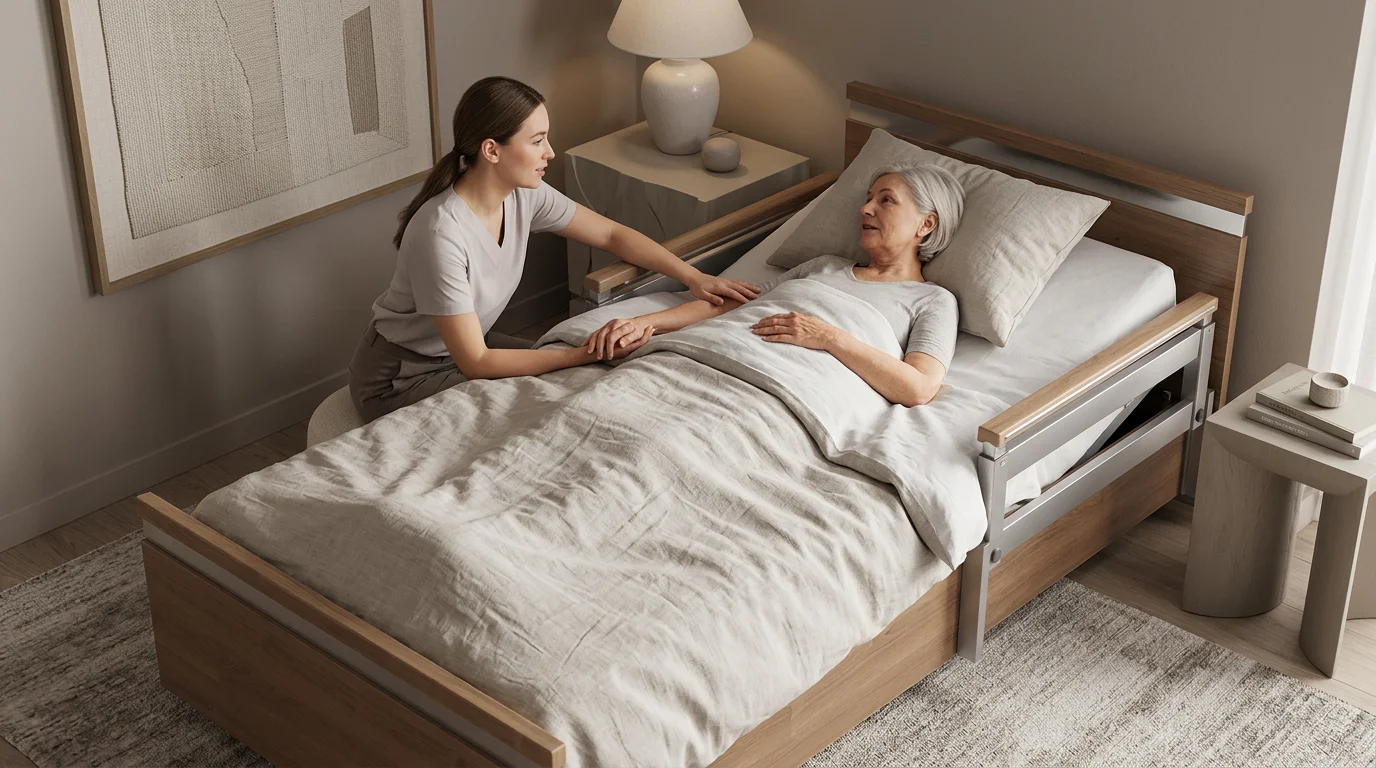
If a bed rail is appropriate for your parent’s situation, there is an important functional distinction between aftermarket portable rails and the integrated assist rails that come standard on a home hospital bed.
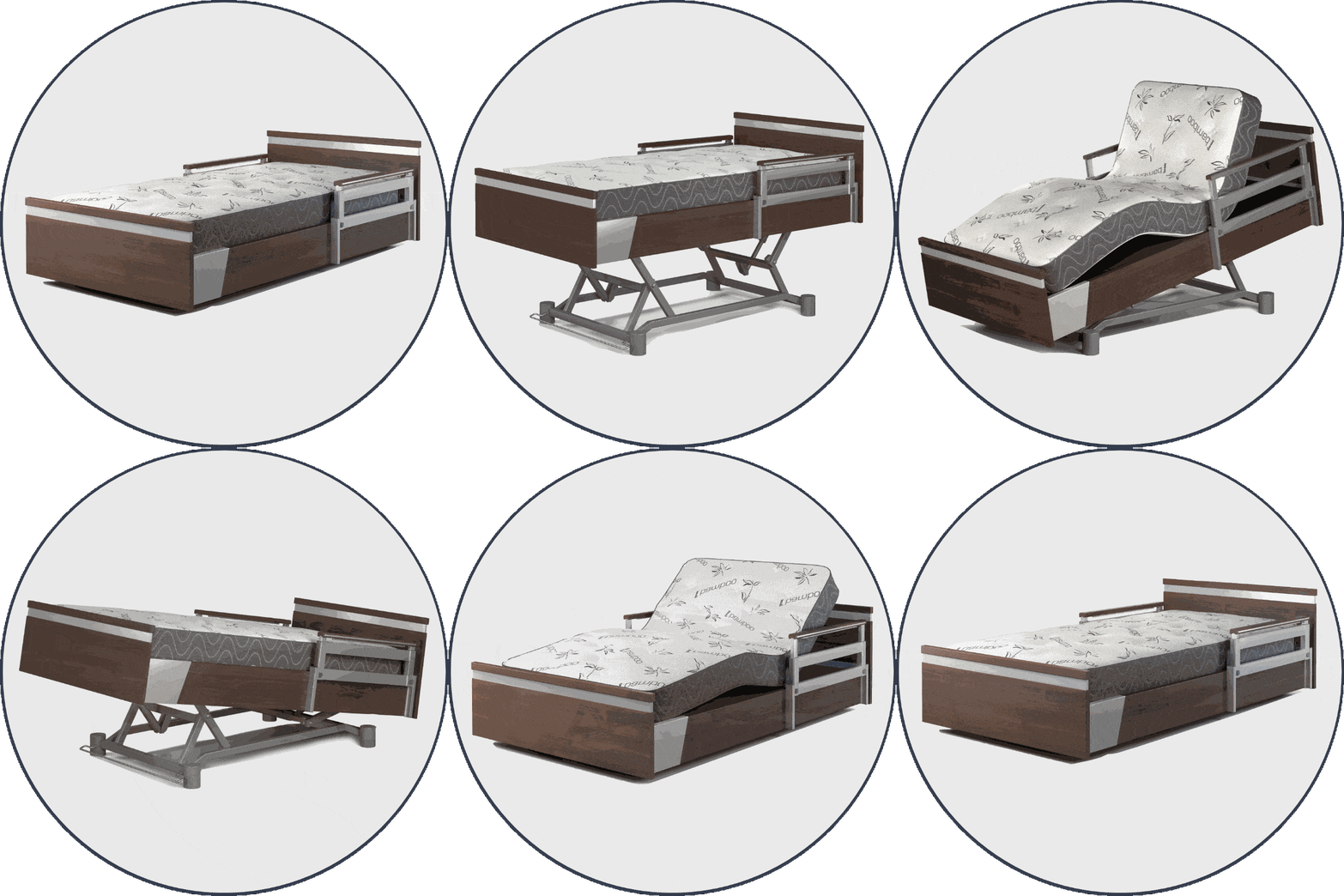
The Multi-Height Assist Rails included with the
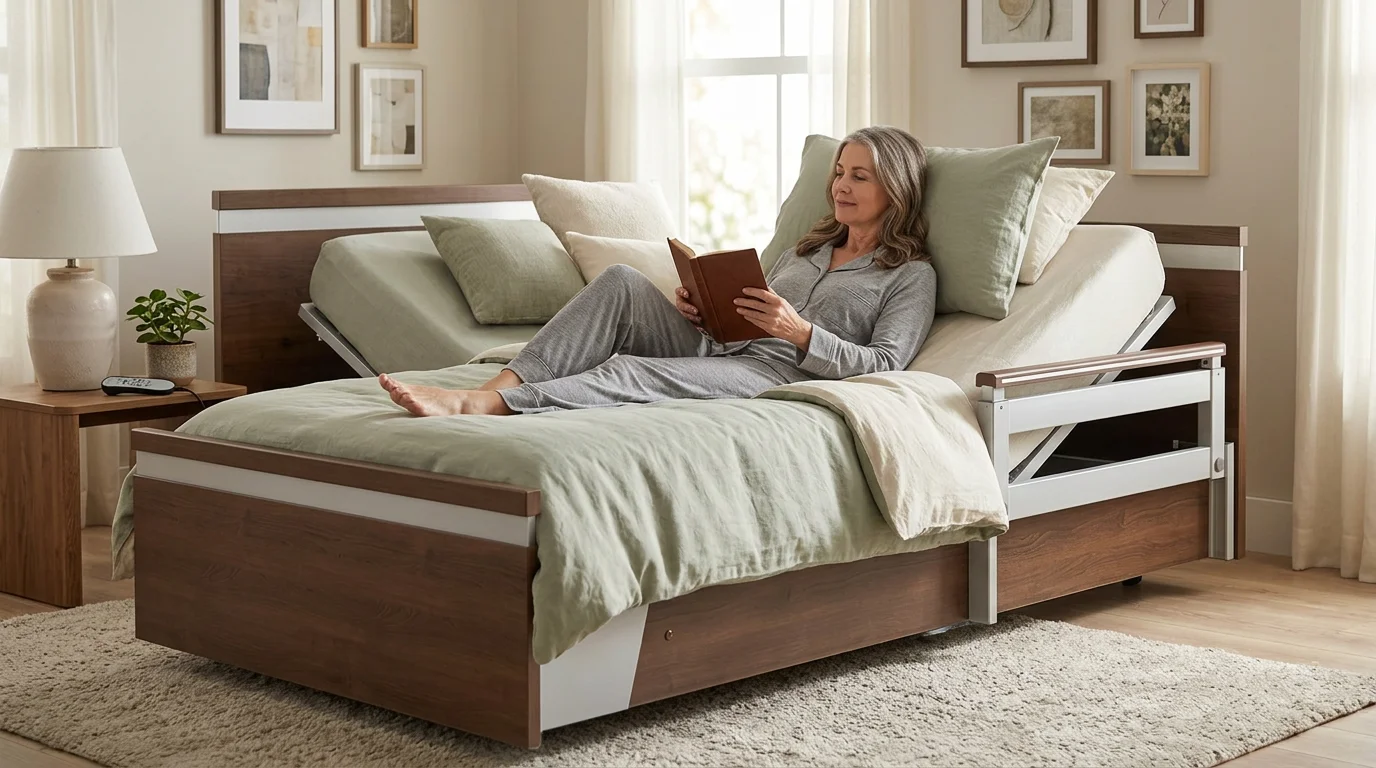
SonderCare Aura Premium home hospital bed are engineered as part of the same system as the bed frame and mattress deck. They’re designed to maintain consistent, predictable geometry with the specific mattress dimensions the Aura accommodates, eliminating the gap variability that creates entrapment risk in portable aftermarket products. Because the rails are part of the system rather than additions to it, there are no straps to shift under load, no strap-tension geometry to miscalibrate against a non-standard mattress, and no aftermarket fitting process.
The Aura Premium is also certified to International Hospital Standard, a certification that applies to the complete sleeping system, not individual components. A portable rail slid under a consumer mattress is not part of a certified system. The Aura’s rails are.
For families who need integrated, hospital-grade bed safety and want a result that doesn’t transform a bedroom into a clinical space, the Aura Premium’s furniture-grade finish, upholstered headboard, and residential aesthetics address both concerns simultaneously. And for situations where a very low bed height, rather than a side rail, is the right primary safety intervention, the Aura’s FallSafe Ultra-Low height lowers the platform to just 10 inches off the floor (17 inches to the top of the mattress), meaning that if someone does roll, the distance is dramatically reduced.
To explore the complete range of SonderCare bed safety accessories, including the Overhead Trapeze Helper Bar, Protective Rail Pads, and Underbed Auto-Nightlight for safer transfers, visit the
SonderCare bed accessories page.
When to Involve an Occupational Therapist
An occupational therapist (OT) is the appropriate professional to assess whether a bed rail, an assist bar, or a different approach is right when you’re uncertain. OTs are trained specifically in functional mobility evaluation, what a person can actually do safely, not just what their diagnosis suggests, and they assess the full home environment as part of that picture.
Consider involving an OT when:
- You’ve received conflicting recommendations across care settings (hospital discharge team vs. home health nurse vs. what you’re reading online)
- Your parent has cognitive impairment that complicates standard recommendations
- You’re unsure whether the transfer challenge is primarily a strength issue or a balance issue, the appropriate equipment differs
- A fall has already occurred and you want a systematic home safety assessment
- Your parent is resistant to anything that looks or feels clinical, and you want professional guidance on less conspicuous options
Many OTs conduct home visits and can evaluate the actual bedroom, mattress height, bed position relative to walls, flooring, lighting, and clearance, all of which contribute to transfer safety in ways no single piece of equipment fully addresses.
Sandra, a 52-year-old whose father moved in with her after a stroke, spent nearly three weeks researching bed rails online before the discharge coordinator from her father’s rehabilitation facility recommended requesting a home OT visit. “She spent 45 minutes with Dad,” Sandra said. “She watched how he moved, where he hesitated, what he reached for without thinking. She recommended a half-rail on his right side and a bed cane on his left. I never would have figured that out from a product page, and neither combination was what I’d been about to order.”
For a broader review of fall prevention strategies and home safety modifications, our
complete fall prevention guide for seniors at home covers interventions from bed height to lighting to flooring, the full picture that any single piece of equipment can only partially address.
Choosing the Right Support: A Decision Framework
| If your parent… |
Consider first… |
| Rolls toward the edge of the bed during sleep |
Bed rail, half or full, verified against mattress for gap |
| Can walk and transfer but needs a grip point |
Assist bar positioned at mattress edge |
| Has dementia and might attempt to climb over a rail |
Ultra-low bed + floor pad; consult OT before installing any rail |
| Is recovering from surgery and taking medication at night |
Short-term bed rail; reassess when recovery is complete |
| Wants to get up independently without calling for help |
Assist bar, supports autonomy, preserves strength |
| Has a rail recommendation but the mattress has visible gaps |
Reassess mattress compatibility; consider an integrated bed system |
| Situation is complex or you’re getting conflicting advice |
Occupational therapist home assessment before purchasing anything |
Conclusion
The bed rails vs. assist bars question looks like a product comparison. It’s actually a functional assessment: what does your parent need to do, and what specifically is preventing them from doing it safely?
If the goal is keeping someone safely in bed during sleep, a bed rail may be appropriate, with careful attention to mattress compatibility and the federal safety data that applies specifically to portable aftermarket rail products. If the goal is helping someone get out of bed on their own terms, an assist bar preserves independence without the entrapment concerns associated with portable rails.
For families navigating cognitive impairment, complex mobility profiles, or conflicting advice, an occupational therapist assessment is worth arranging before any equipment purchase. And for situations where integrated, hospital-grade bed safety is needed alongside a residential aesthetic, a home hospital bed with engineered rails is a fundamentally different solution from a strap-mounted aftermarket product.
The right support exists. Getting there means understanding the actual problem first.
Questions about what’s right for your parent’s specific situation? The team at
SonderCare has helped thousands of families work through exactly these decisions, with no pressure and no scripts, just practical guidance.
For more on the topics covered here, see our
fall risk assessment guide for older adults at home and our guide to
how to use bed rails safely for elderly.
References
- U.S. Consumer Product Safety Commission. “Consumer Safety Alert: CPSC Issues Urgent Warning About Adult Portable Bed Rails; 9 Recalls in 3 Years; 18 Deaths Reported Since 2021.” November 14, 2024. https://www.cpsc.gov/Newsroom/News-Releases/2025/Consumer-Safety-Alert-CPSC-Issues-Urgent-Warning-About-Adult-Portable-Bed-Rails-9-Recalls-in-3-Years-18-Deaths-Reported-Since-2021
- U.S. Consumer Product Safety Commission. “Safety Standard for Adult Portable Bed Rails; Final Rule.” 87 Fed. Reg. 67586. November 9, 2022. https://www.federalregister.gov/documents/2022/11/09/2022-22692/safety-standard-for-adult-portable-bed-rails
- U.S. Food and Drug Administration. “Safety Concerns about Adult Portable Bed Rails.” February 27, 2023. https://www.fda.gov/medical-devices/adult-portable-bed-rail-safety/safety-concerns-about-adult-portable-bed-rails
- Parker K, Miles SH. “Deaths caused by bedrails.” Journal of the American Geriatrics Society. 1997;45(7):797–802. PMID: 9215328. https://pubmed.ncbi.nlm.nih.gov/9215328/
- U.S. Food and Drug Administration. “Adult Portable Bed Rail Safety.” February 27, 2023. https://www.fda.gov/medical-devices/consumer-products/adult-portable-bed-rail-safety