





Your Free Reference Manual to Home Hospital Beds for Post-Stroke Paraplegia: Clinical, Safety & Reimbursement Data
For a loved one recovering at home after a stroke, their bed becomes so much more than a place to sleep—it’s the heart of their daily life, their safe haven for healing, and the centerpiece of their independence. We understand how overwhelming this journey can feel, especially when facing the complex challenges of post-stroke paraplegia: profound immobility, the ever-present risk of complications, and the physical and emotional strain on you, the caregiver. Selecting the right home hospital bed for stroke recovery is a critical decision that impacts clinical outcomes, caregiver strain, and safety.
While generic advice is easy to find, specific, actionable data is not. This guide is designed to change that. We’ve transformed complex research into a clear, compassionate blueprint that bridges clinical need, safety imperatives, and practical reality, including Medicare hospital bed coverage details. Our goal is to empower you and the clinical team with the exact information needed to make confident, informed decisions that prioritize dignity, safety, and hope.
Beyond Comfort: The Clinical Case for Specialized Home Hospital Beds
The Unmet Trial Gap and Supportive Indirect Proof
We believe in full transparency: there is a complete absence of Randomized Controlled Trials (RCTs) that directly compare adjustable home hospital beds to standard beds for this specific situation. Sometimes, this gap in research is used to question the need for this equipment. However, the clinical justification is built on strong, logical medical reasoning and supportive evidence from similar conditions. Positive observations from caring for those with Spinal Cord Injury (SCI)—who face comparable risks—provide meaningful support for the potential benefits of adjustable frames and therapeutic surfaces.
Pressure Ulcer Prevention – The Primary Justification
Pressure injuries (bed sores) are a painful, costly, and often preventable complication. For a loved one who is spending more time in bed, every point of contact with the surface is a potential risk. With the right setup, you can create a powerful defense. Manufacturers of advanced support surfaces claim that proper positioning and pressure redistribution may reduce pressure ulcer incidence by up to 60%.
Choosing the right pressure relief mattress for bedridden patients is as crucial as choosing the bed frame. It’s a key decision in protecting your loved one’s skin. The following table, based on systematic reviews of the evidence, provides clear guidance:
| Surface Type | Prevention Effectiveness (vs. Foam) | Healing Effectiveness | Cost-Effectiveness (vs. Foam) | Evidence Certainty |
|---|---|---|---|---|
| Alternating Pressure (Active) Air | May reduce new ulcers (RR 0.63) | Evidence not detailed | Probably more cost-effective in community/acute care | Low to Moderate |
| Reactive Air (Static) | May reduce ulcer risk | May increase complete ulcer healing | Not specified | Low |
| High-Specification Foam | Reduces incidence compared to standard foam | Not specified | Not specified | Low to Moderate |
The SonderCare Standard: Where Safety Meets Dignity
While clinical data drives the need for a specialized bed, the reality of living with post-stroke paraplegia requires a solution that feels like home, not a hospital. This is where SonderCare bridges the gap.
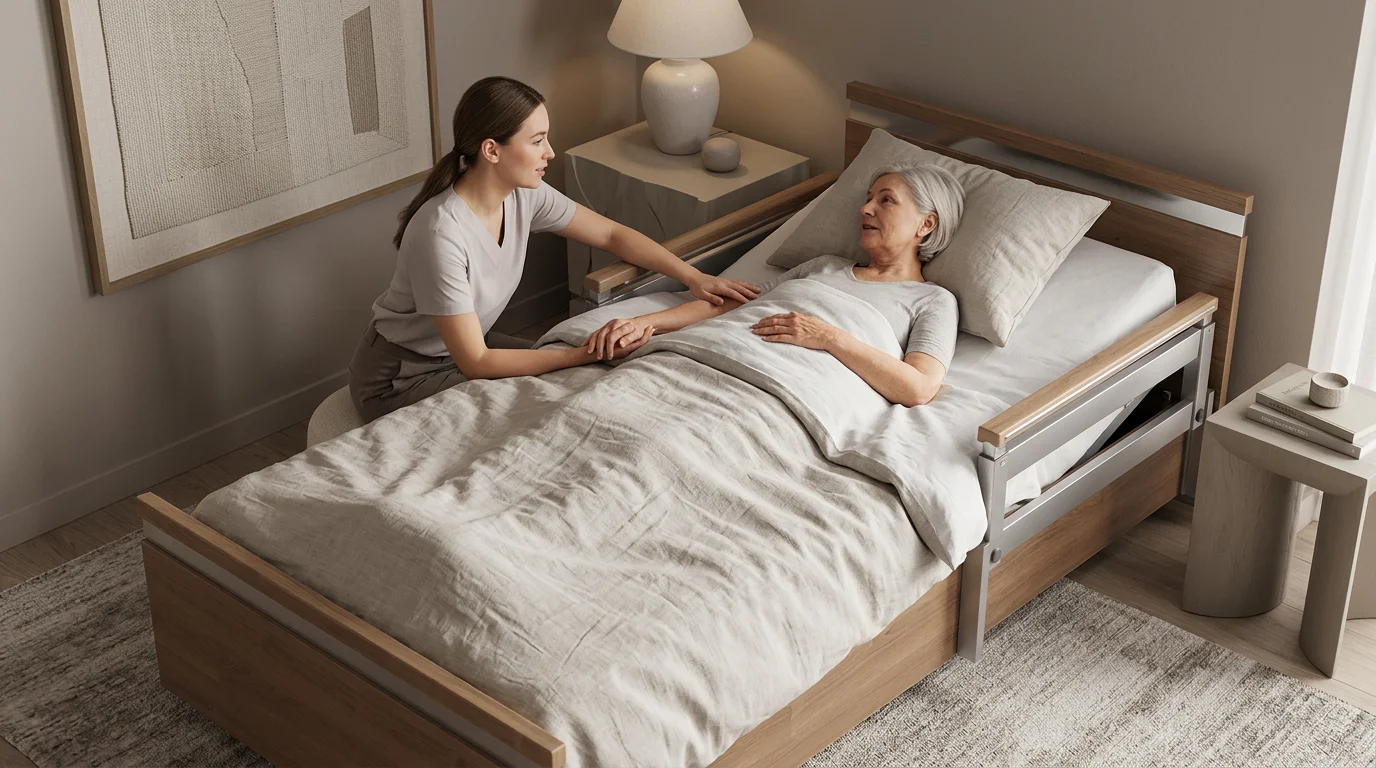
SonderCare beds, particularly the Aura Premium and Aura Platinum series, are engineered specifically to address the “unmet trial gap” mentioned earlier. They provide the high-acuity features of a medical device—critical for managing pressure distribution and transfer safety—hidden within a luxury, residential design. For stroke survivors, this preservation of dignity is a vital component of holistic recovery.
Why the “Aura” Series is Optimized for Stroke Recovery:
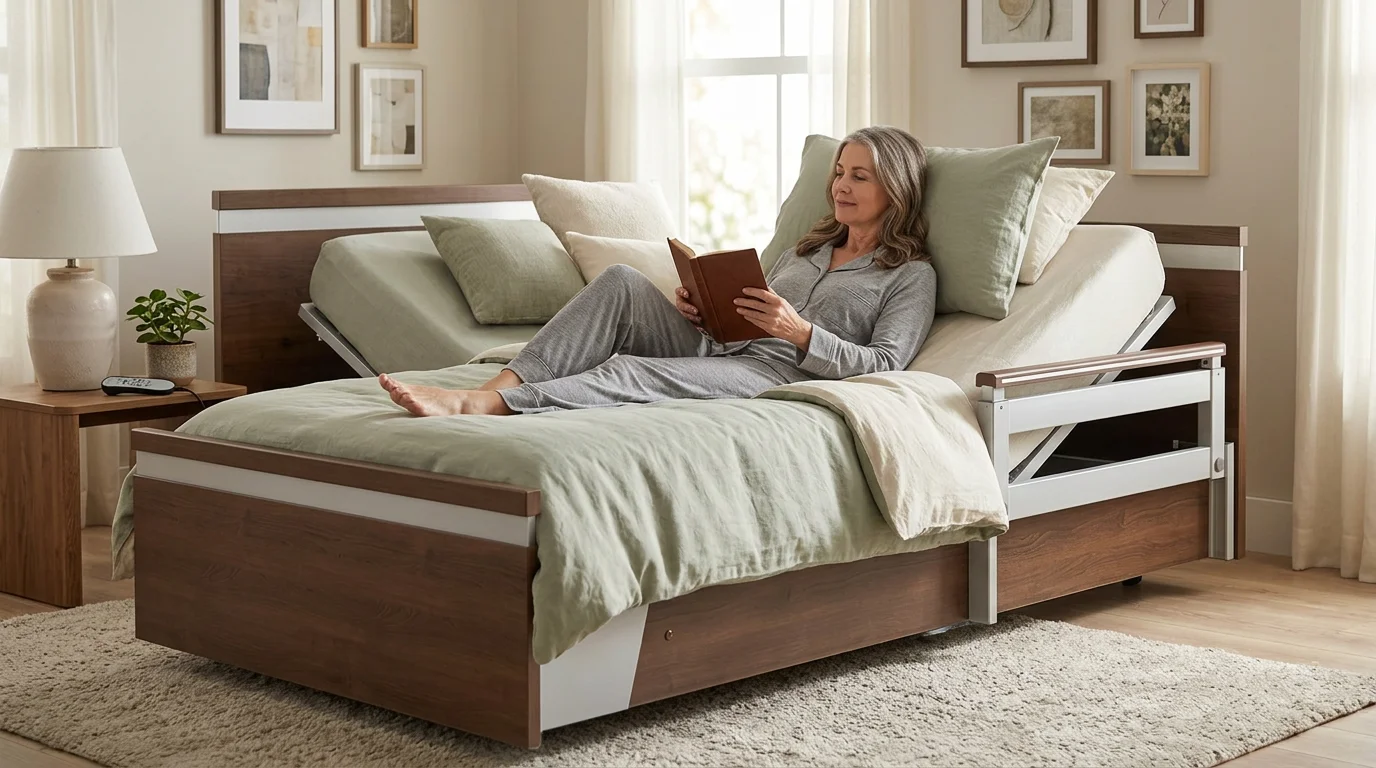
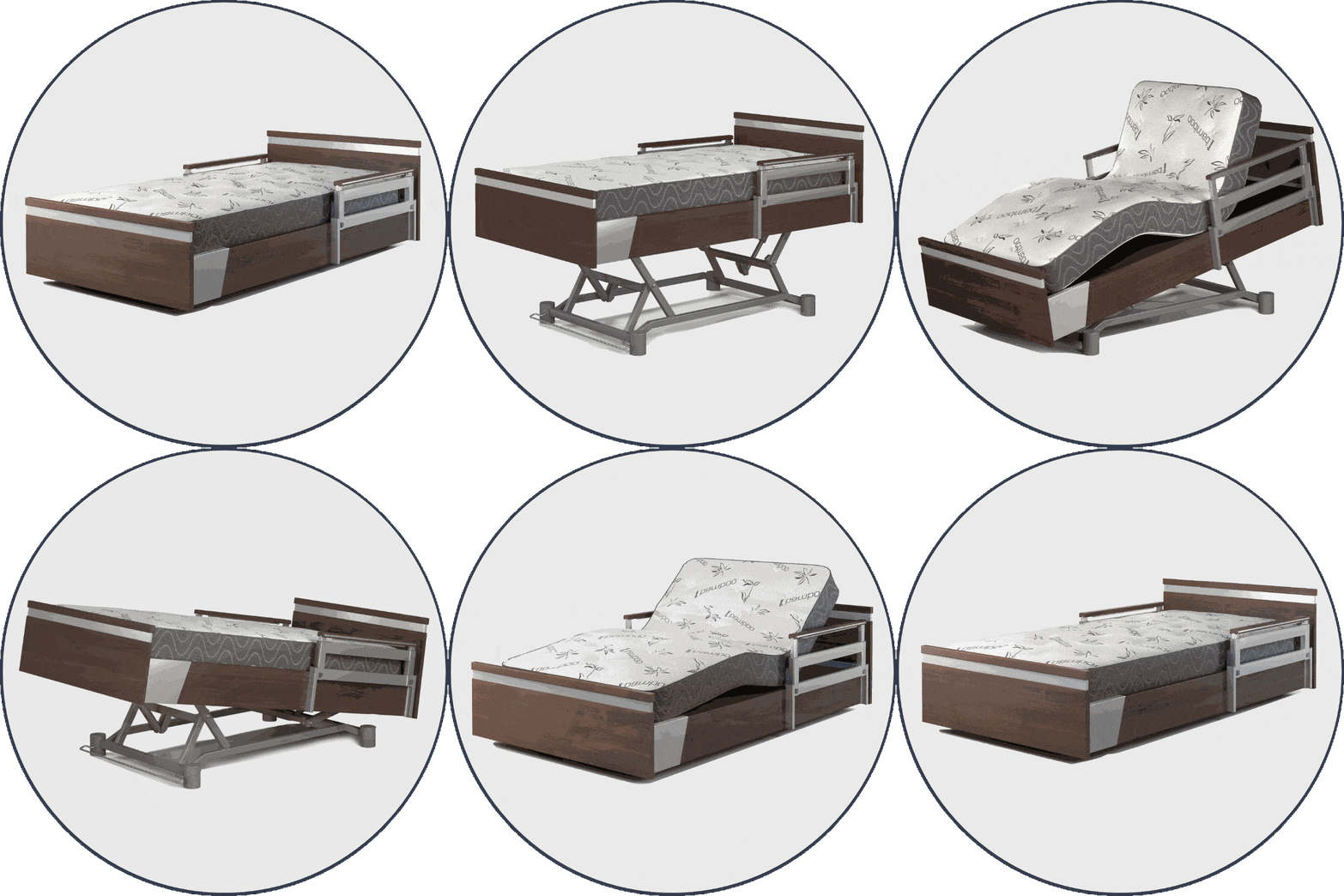
- The Chair Position (Cardiac Chair): Available in the Aura models, this allows the user to transition from flat to a seated position with a single button. For stroke survivors with limited trunk control, this facilitates safer eating, better socialization, and easier egress (exiting the bed) without the physical strain of manual repositioning.
- Hi-Lo Elevation & Fall Safety: The Aura lowers significantly to reduce the impact of potential falls—a common fear in post-stroke care—while raising high enough to protect the caregiver’s back during hygiene tasks.
- Assist Rails: Unlike standard bed rails, SonderCare’s multi-height assist rails are designed to provide leverage for the survivor to pull themselves up, promoting the re-learning of motor skills and independence.
Procurement Pathway: The Private Pay Advantage
Navigating insurance for high-end durable medical equipment (DME) can be a maze of denials and delays. Medicare often restricts coverage to semi-electric beds that lack the “Chair Position” or “Luxury Design” elements, categorizing them as convenience rather than necessity. For families who require immediate delivery and refuse to compromise on aesthetics or advanced functionality, the Private Pay Procurement Workflow offers a streamlined alternative.
The SonderCare “White Glove” Workflow:
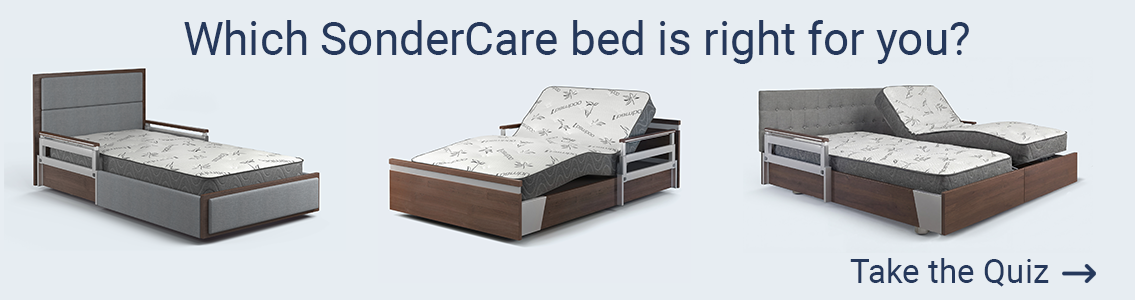
You consult with a SonderCare specialist to determine the specific needs of the stroke survivor. Do they require the extra width of the Aura Premium Wide (48″) for turning protocols? Is the Aura Companion needed for a spouse to sleep alongside?
Based on the pressure ulcer risk assessment (see table above), we pair the chosen frame with the correct therapeutic surface—whether that is high-specification foam or an alternating pressure system—ensuring clinical compliance.
Unlike standard freight delivery, SonderCare utilizes a technician team to deliver, assemble, and test the bed in the room of your choice. They demonstrate the hand controller functions (including the Chair and Zero Gravity presets) to the caregiver, ensuring you are confident in operating the equipment before they leave.
Investing in a SonderCare bed is an investment in the long-term trajectory of stroke recovery at home. It shifts the focus from “managing illness” to “living well,” providing a secure foundation for rehabilitation and rest.
Functional Independence and Stroke-Specific Management
Adjustability is about more than comfort—it’s about enabling specific, therapeutic care.
- Electric Height Adjustment: This feature is often medically necessary for safe, dignified transfers. For a loved one with hemiparesis, lowering the bed to a near-chair height can minimize fall distance and facilitate a safer, more independent pivot from a wheelchair. Raising it to a caregiver’s hip level can eliminate back-straining bending, helping to protect your health as you provide care.
- Head-of-Bed (HOB) Elevation: Gently elevating the head to 30 degrees is a standard, caring intervention to decrease intracranial pressure (ICP). Sitting fully upright to 90 degrees is critical for reducing aspiration risk during meals, turning a necessary task into a safer, more enjoyable moment.
Protecting the Caregiver: How Adjustable Beds Mitigate Physical Strain
Your physical and emotional well-being is the foundation of your loved one’s ability to thrive at home. The data highlights a real need for support: 24% of family caregivers for stroke survivors sustain injuries. Furthermore, 30% experience accidents like muscle strains, and among those with the highest burden, 28% report high physical strain.
A specialized bed is an investment in your health, transforming physically demanding tasks into controlled, manageable routines. It’s about preserving your strength so you can focus on connection, not just care tasks.
References & Sources
-
- Do Doctors Recommend Adjustable Beds For Homecare?https://www.sondercare.com/learn/home-healthcare/doctors-recommend-adjustable-beds-home-healthcare-patients/
- The experience of using a hospital bed alternative at homehttps://pmc.ncbi.nlm.nih.gov/articles/PMC9987729/
- Research Proposal: NCT04932668https://cdn.clinicaltrials.gov/large-docs/68/NCT04932668/Prot_000.pdf
- How Can Hospital Beds Help Stroke Recovery? – SonderCarehttps://www.sondercare.com/learn/hospital-beds/how-hospital-beds-help-stroke-recovery/
- Beds, overlays and mattresses for preventing and treating pressure ulcershttps://pmc.ncbi.nlm.nih.gov/articles/PMC8407250/
- Alternating pressure (active) air surfaces for preventing pressure ulcershttps://pmc.ncbi.nlm.nih.gov/articles/PMC8108044/
- Musculoskeletal Discomfort, Physical Demand and Caregiver Strainhttps://pmc.ncbi.nlm.nih.gov/articles/PMC3964150/
- Interventions designed to prevent healthcare bed-related entrapmentshttps://pubmed.ncbi.nlm.nih.gov/22258994/
- Bed rails: management and safe usehttps://www.gov.uk/guidance/bed-rails-management-and-safe-use
- Top Conditions That Benefit From A Home Hospital Bed – SonderCarehttps://www.sondercare.com/learn/hospital-beds/conditions-benefit-home-hospital-bed/
- Interventions for preventing falls in people after stroke – PMChttps://pmc.ncbi.nlm.nih.gov/articles/PMC6770464/
- Recognized Consensus Standards: Medical Devices – FDAhttps://www.accessdata.fda.gov/scripts/cdrh/cfdocs/cfStandards/detail.cfm?standard__identification_no=44373
- Can a prolonged healing pressure injury be benefited by specialized surfaces?https://pmc.ncbi.nlm.nih.gov/articles/PMC10986049/
- Home or Hospital for Stroke Rehabilitation? Results of a Randomized Controlled Trialhttps://pubmed.ncbi.nlm.nih.gov/10797162/
- Hospital Bed System Dimensional and Assessment Guidance – FDAhttps://www.fda.gov/regulatory-information/search-fda-guidance-documents/hospital-bed-system-dimensional-and-assessment-guidance-reduce-entrapment
- Preventing pressure injuries in individuals with impaired mobilityhttps://pmc.ncbi.nlm.nih.gov/articles/PMC12330434/
- Effectiveness of a pressure-relieving mattress in an acute care settinghttps://www.magonlinelibrary.com/doi/abs/10.12968/bjon.2016.25.20.S34
- Reactive air surfaces for preventing pressure ulcers – Cochranehttps://www.cochranelibrary.com/cdsr/doi/10.1002/14651858.CD013622.pub2/full
- Beds, overlays and mattresses for preventing and treating pressure ulcershttps://pubmed.ncbi.nlm.nih.gov/34398473/
- Support surfaces for pressure ulcer prevention – PMChttps://pmc.ncbi.nlm.nih.gov/articles/PMC7075275/
- Head Positioning in Acute Strokehttps://www.ahajournals.org/doi/10.1161/STROKEAHA.118.020087
- Impact of Head-of-Bed Posture on Brain Oxygenationhttps://pmc.ncbi.nlm.nih.gov/articles/PMC8312355/
- Mitigating Direct Care Workforce Injuries in Homecarehttps://aspe.hhs.gov/sites/default/files/documents/c379795044a66f974f9d7b63c3318490/MitDCW.pdf
- Practice Hospital Bed Safetyhttps://uvrc.com/wp-content/uploads/Practice-Hospital-Bed-Safety.pdf
- Medicare Durable Medical Equipment (DME) coveragehttps://www.medicare.gov/coverage/durable-medical-equipment-dme-coverage
- Medicare Coverage: Hospital bedshttps://www.medicare.gov/coverage/hospital-beds
- Medicare DME Coverage: What’s Covered and How to Qualifyhttps://www.solace.health/articles/medicare-dme-durable-medical-equipment-coverage-whats-covered-and-how-to-qualify
- Current, future and avoidable costs of stroke in the UKhttps://www.stroke.org.uk/sites/default/files/economic_impact_of_stroke_report_final_feb_2020_0.pdf
- Stroke rehabilitation in adults: Evidence review (NICE)https://www.nice.org.uk/guidance/ng236/evidence/e5-intensity-of-rehabilitation-health-economics-report-pdf-474910116375
- Remote Monitoring Programs for Cardiac Conditionshttps://www.cda-amc.ca/sites/default/files/attachments/2021-12/OP0549-RM%20for%20Cardiac%20Conditions%20Final-meta_0.pdf
- Home or Hospital for Stroke Rehabilitation? Cost Minimization Analysishttps://www.researchgate.net/publication/12520557_Home_or_Hospital_for_Stroke_Rehabilitation_Results_of_a_Randomized_Controlled_Trial_II_Cost_Minimization_Analysis_at_6_Months
- Modify the Bedroom to Match Your Abilitieshttps://www.stroke.org/en/life-after-stroke/recovery/home-modifications/modify-the-bedroom-to-match-your-abilities
- Bed ordering risk assessment form – Trafford LCOhttps://traffordlco.org/app/uploads/2023/08/Bed-ordering-risk-Assessment.docx
- Hospital Bed Maintenance: Avoid Costly Repairs!https://medshopdirect.com/blogs/hospital-beds/hospital-bed-maintenance-avoid-costly-repairs
- IEC 60601-2-52:2009 Medical electrical equipmenthttps://www.iso.org/obp/ui/en/#!iso:std:36067:en
- Understanding IEC 60601-2-52https://www.medstrom.com/wp-content/uploads/2021/02/SM614-Understanding-2-52-Brochure-Rev2-Feb2021.pdf
- Economic Evaluation of Home Care for Stroke Patientshttps://brieflands.com/articles/healthscope-112833
- “Hospital at Home” Programs Improve Outcomes, Lower Costshttps://www.commonwealthfund.org/publications/newsletter-article/hospital-home-programs-improve-outcomes-lower-costs-face-resistance
- Quality improvement study on early recognition of strokehttps://pmc.ncbi.nlm.nih.gov/articles/PMC7406019