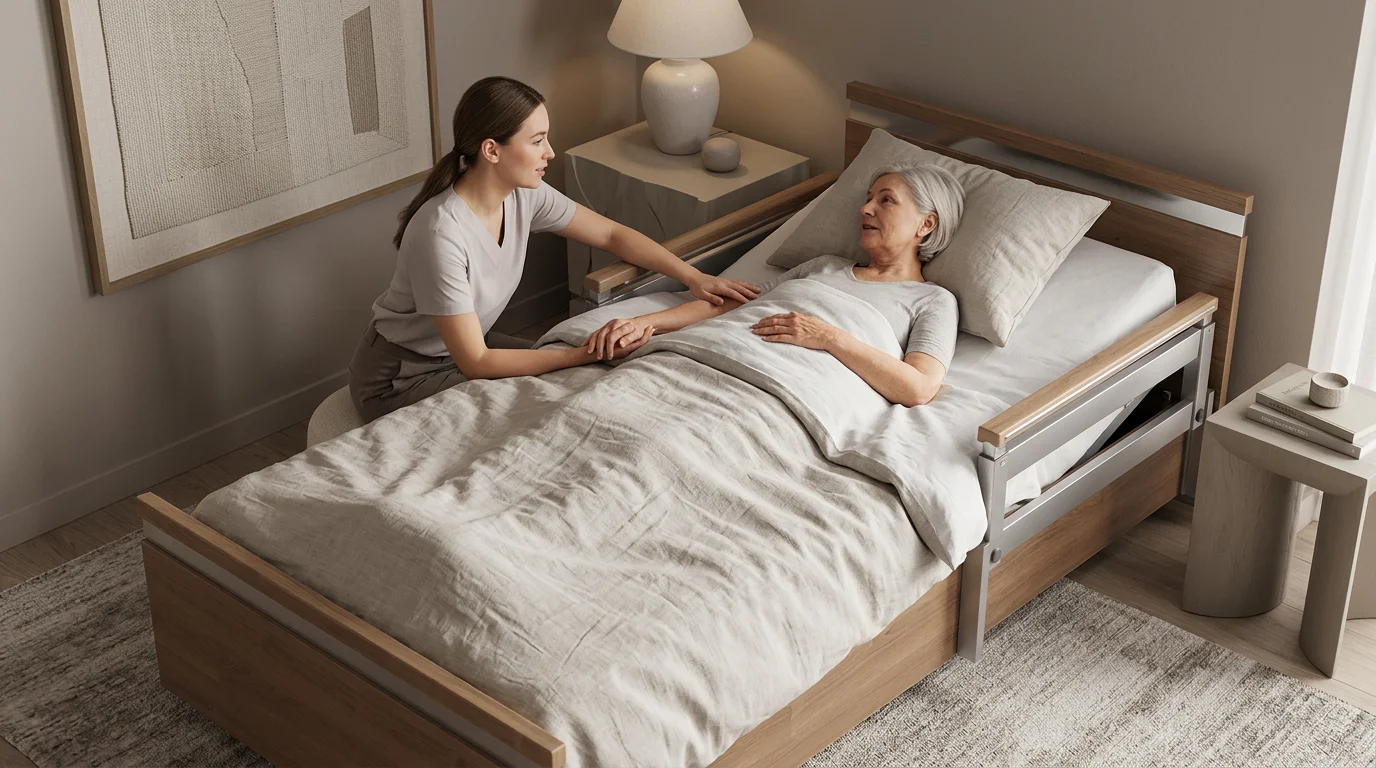









Two years into caring for her mother at home, Carol realized she had never once cleaned the mattress itself. She washed the sheets every other day. She wiped down the bed rails weekly. But the foam mattress beneath the cover had never been touched.
When she finally removed the mattress cover during a routine sheet change, the foam inside had yellowed deeply at the center and carried a smell that didn’t belong in any home. The mattress was ruined.
If you’re caring for a family member in a home hospital bed, nobody warns you that the mattress needs its own cleaning routine. The hospital doesn’t mention it during discharge. The rental company doesn’t include a schedule. Most caregivers discover the situation the same way Carol did: reactively, and often too late to recover.
It doesn’t have to go that way.
This guide answers the question directly: how often should hospital bed mattresses be cleaned, what each cleaning tier actually involves, and how to make the whole process realistic when caregiving already fills your day. For broader guidance on setting up a safe home care environment, see our home hospice care guide.
Why Hospital Bed Mattress Hygiene Matters More Than You Think
Mattress hygiene home care routines are easy to overlook; yet the mattress is the highest-contact surface in a home hospital bed. Your loved one rests on it for 16 or more hours a day. Without a proper cleaning routine, it becomes one of the primary contributors to the bacterial accumulation, moisture buildup, and skin breakdown risk that caregivers are working to prevent.
Research published in Antimicrobial Resistance and Infection Control found that after a single patient occupancy, mattress surfaces carried an average of 79.1 colony-forming units of bacteria per 30 cm², a tenfold increase from the pre-use baseline.1 A single round of terminal cleaning after occupancy was insufficient to eliminate this bioburden. Standard quaternary ammonium compound disinfectants produced only about a 90% reduction, and bacteria re-colonized the surface to approximately 42% of pre-cleaning levels within 6.5 hours.1
The long-term consequences are significant. A retrospective study of more than 25,000 hospital encounters found that people whose bed had previously been used by a patient with Clostridioides difficile (C. diff) had a 50% greater risk of developing the infection themselves, with contamination persisting for up to 90 days after the prior occupant.2 In a home setting, your loved one may be the only person in that bed, but the biology is the same. A mattress that isn’t regularly cleaned accumulates pathogenic bacteria over time.
The connection to skin integrity is direct. A loved one who requires extended bed rest already has compromised skin at risk for pressure injuries. A damp, soiled mattress surface accelerates that risk considerably. Preventing pressure sores at home begins with the surface your loved one rests on, and a clean, dry mattress is one of the most actionable interventions available.
There’s also the matter of the mattress cover itself. The U.S. Food and Drug Administration issued a safety communication noting that covers damaged by repeated cleaning, small tears, or faulty zippers allow body fluids to penetrate into the foam interior.3 Once that happens, no surface cleaning can reach the contamination inside. A 2019 survey found that 52% of healthcare facilities reported mattress cover failures with fluid ingress within the prior year, and fewer than 15% followed manufacturer cleaning instructions correctly.4
These risks don’t disappear at home. They become a caregiving responsibility.
How Often Should Hospital Bed Mattresses Be Cleaned? The Three-Tier Schedule
There isn’t a single hospital bed mattress cleaning schedule that fits every situation. There are three tiers, depending on what has happened and how recently.
Tier 1, After every soiling event. Spot-clean the affected area immediately. Do not wait until sheet-change time.
Tier 2, Weekly surface disinfection. Wipe the entire accessible mattress surface with an appropriate disinfectant, regardless of whether visible soiling occurred. This is the routine that prevents bacterial accumulation.
Tier 3, Deep clean monthly, or immediately after any illness. Remove the cover, clean the mattress interior, inspect the cover for damage, and assess whether the mattress still meets its purpose.
The German S2k Guideline on hygienic requirements for patient beds, the most recent international consensus guideline on this subject, recommends daily disinfection of all bed contact surfaces and weekly linen changes as the minimum standard for occupied hospital beds.5 For a home setting, the weekly surface disinfection is realistic and sufficient for most situations. Tier 1 spot cleaning after any soiling event is non-negotiable.
After Every Incontinence Episode: Spot Cleaning That Actually Works
When an accident happens, timing matters. Urine that penetrates through an absorbent pad, through the mattress cover, and into the foam core of a hospital bed mattress is nearly impossible to fully eliminate once the odor has set in. The enzyme proteins responsible for persistent smell bind to foam fibers and resist most standard cleaning agents. The most effective intervention is an immediate one.
Step-by-step spot-cleaning protocol:
-
Remove soiled linens immediately. Strip the sheet, absorbent pad, and any underlayers as quickly as possible after the episode.
-
Blot, don’t rub. If liquid has reached the mattress cover surface, absorb it with a dry cloth by blotting firmly. Rubbing pushes the fluid further into the material.
-
Apply an enzyme-based cleaner. Enzyme cleaners break down the organic compounds in urine, feces, and other body fluids far more effectively than bleach or vinegar, which can damage the mattress cover’s fluid-resistant barrier over time. Confirm compatibility with your cover material, most manufacturer instructions specify pH-neutral products in the pH 5-9 range.6
-
Allow proper contact time. Follow the product’s dwell-time instructions, typically five to ten minutes. Most home caregivers rush this step and undercut the cleaning effectiveness significantly.
-
Wipe clean and allow the cover to fully dry before remaking the bed. Never place sheets or pads over a damp mattress surface. Moisture trapped beneath a cover creates precisely the warm, wet conditions in which bacterial populations grow fastest.
What to avoid:
– Bleach applied directly to the mattress cover. It degrades the fluid-resistant barrier and increases the risk of fluid penetration into the foam over time.
– Saturating the mattress with liquid. Over-wetting foam interiors causes structural breakdown and creates persistent internal moisture that resists drying.
– Lysol spray or Febreze as a disinfectant substitute. Surface sprays that don’t achieve adequate wet contact time with pathogens do not disinfect, they mask odor temporarily.
Pairing spot cleaning with a quality protective layer reduces how often this step is needed at all. SonderCare’s Fluid-Proof Mattress Cover ($169 for 39″ twin XL, $199 for 48″ extra wide) is a full-zip breathable stretch encasement that seals completely around the mattress, providing a durable first barrier against fluid penetration.
Mini-story: Marcus was eight months into caring for his father when a visiting hospice nurse asked how he cleaned the mattress after accidents. “I spray it with disinfectant and wipe it down,” he said.
She walked him through the proper technique: enzyme cleaner, five-minute contact time, full air-dry before remaking the bed. “I had no idea that what I was doing wasn’t actually disinfecting anything,” he said afterward. “Nobody told me.”
Weekly: The Routine Surface Disinfection
Even without visible soiling, hospital bed mattresses accumulate bacteria from skin contact, perspiration, respiratory droplets, and environmental sources. A review in the Journal of Hospital Infection specifically recommended weekly decontamination intervals for occupied patient beds based on the documented rate of bacterial colonization over time.7
How to clean hospital bed mattress surfaces on a weekly schedule:
-
Remove all bedding, sheets, absorbent pads, and the waterproof mattress cover.
-
Visually inspect the cover. Run your fingers along every seam, the full zipper length, and the surface. Look for cracks, pinholes, or areas where the fabric has stiffened or pulled away. This inspection step is what most families skip, and what the FDA identified as the primary source of undetected mattress contamination.3
-
Wipe the entire mattress cover surface with an appropriate hospital-grade disinfectant. The UK’s Norfolk and Norwich University Hospitals NHS Trust protocol specifies an approved disinfectant product with a minimum five-minute contact time for routine decontamination of occupied-bed mattresses.6
-
While the mattress is uncovered, clean the bed frame, side rails, and headboard. These surfaces accumulate the same bacterial load as the mattress and are often overlooked entirely.
-
Allow the cover to fully dry before remaking the bed.
Many caregivers make this a Sunday routine, strip everything, wipe everything down, air it out, then remake the bed fresh for the week. The consistency matters more than the day.
The weekly inspection is also a natural moment to pair with a skin check. The two routines belong together: you’re assessing the sleeping surface and the person resting on it at the same time. For a comprehensive framework on connecting these tasks, see the pressure sore prevention guide.
Not sure which cleaning products are compatible with your specific mattress cover? Speak with a SonderCare expert, we can walk you through the right care protocol for whichever mattress you’re using, at no cost.
Deep Cleaning: Monthly or After Any Illness
A monthly deep clean goes beyond surface disinfection. It’s especially important after your loved one has had a respiratory illness, a urinary tract infection, a gastrointestinal episode, or any condition that increases microbial shedding significantly.
Monthly deep-cleaning protocol:
-
Remove and machine-wash the mattress cover according to manufacturer instructions. Most zippered mattress encasements are designed to be washed at 60°C (140°F), which achieves adequate thermal disinfection for most pathogens.
-
Clean the bare mattress surface. Use a damp (not wet) cloth with a pH-neutral cleaner. Work in sections across the surface. Allow each section to partially air-dry before moving to the next to avoid saturating the foam interior.
-
Allow the mattress to air out completely, ideally for several hours with ventilation. Foam materials require full air-drying before being re-covered; trapped moisture inside a closed cover creates the exact conditions where odor-producing and pathogenic bacteria thrive.
-
Inspect the foam itself. When the cover is off, look for yellowing or staining that has penetrated through the cover material, depressions or soft spots that don’t recover, or any structural changes to the foam surface. These are signs that the mattress is compromised.
-
Replace the cover if it shows any signs of damage. A damaged mattress cover cannot be repaired reliably. Once it has failed, the foam underneath cannot be effectively cleaned from the surface.
Note on alternating pressure air mattresses: If your loved one uses an Alternating Pressure Air mattress for wound care or active pressure injury management, the cleaning protocol for that hospital bed mattress differs from standard foam. Each bladder section must be individually wiped and allowed to dry before inflation is restored. Check the specific care instructions for your unit, this protocol is distinct enough that generalizing from foam-mattress guidance can cause problems.
Cleaning When Your Loved One Can’t Get Out of the Bed
This is the question most clinical resources skip entirely. It’s also the question most family caregivers are actually asking.
If your loved one cannot be transferred to a chair, a recliner, or another surface while you clean the hospital bed mattress, you are working with what healthcare professionals call an “occupied bed” technique. Learning this technique is one of the highest-impact skills a home caregiver can develop.
The side-roll method:
- Position your loved one on their side, supported with a pillow placed behind their back to maintain the position safely.
- Roll the soiled sheet and underpad toward the center of the bed.
- Spot-clean or wipe the now-exposed mattress cover surface on the near side.
- Place the clean sheet and fresh underpad on the cleaned side, folded lengthwise toward the center.
- Gently reposition your loved one to the cleaned side.
- Remove the soiled materials from the vacated side.
- Clean the remaining side of the mattress surface.
- Unfurl the clean sheet and underpad across the full bed and tuck in.
This technique takes practice. The first few attempts will feel awkward. It becomes routine.
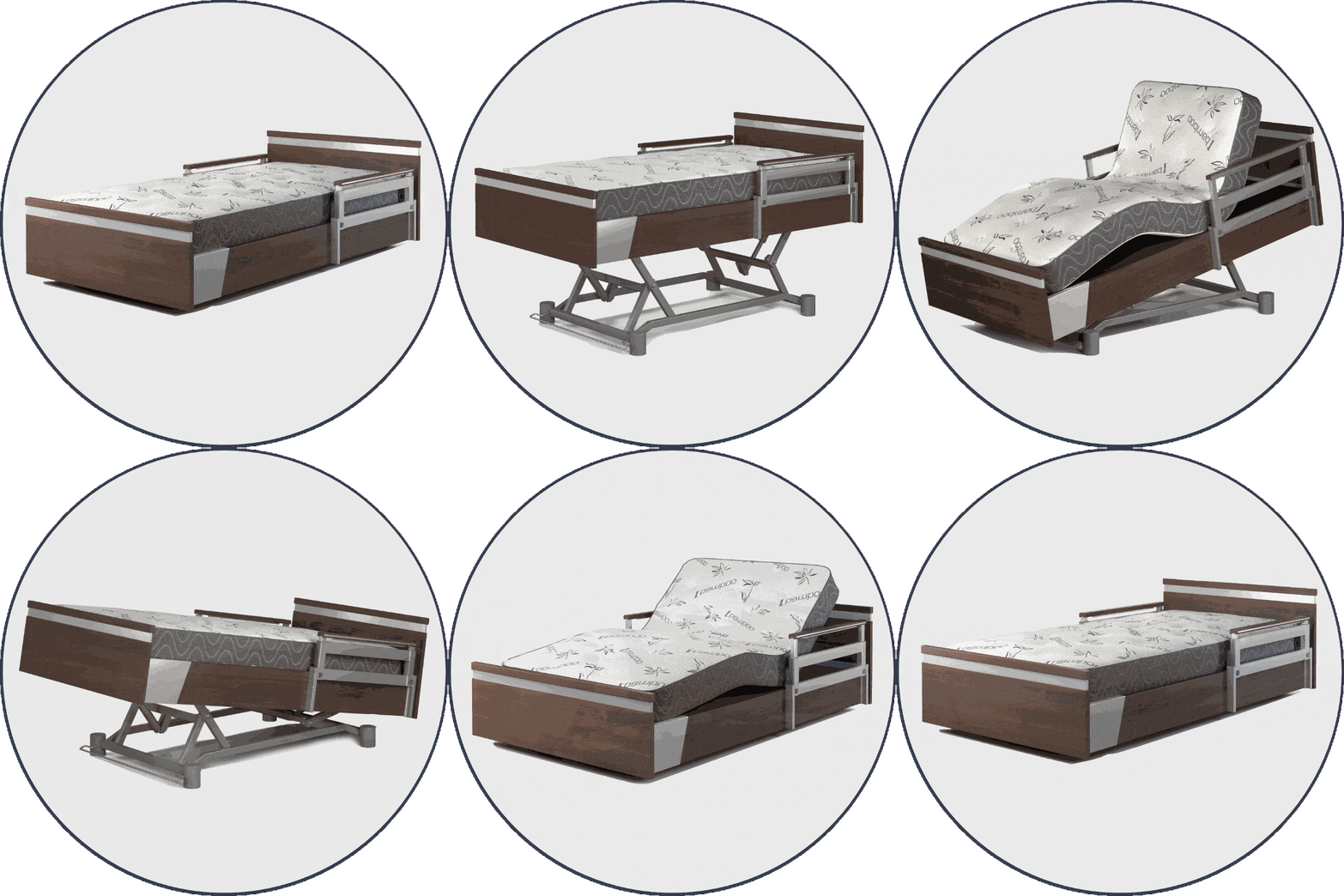
It’s significantly more manageable when the hospital bed itself can be raised to a comfortable working height. The SonderCare Aura Premium home hospital bed adjusts from 10 inches to 39 inches in platform height. Working at 39 inches, rather than reaching down to a standard bed height, eliminates most of the back strain that makes occupied-bed cleaning so physically difficult. For caregivers who are managing this work alone or who have their own physical limitations, that hi-lo adjustment is one of the most meaningful ergonomic differences between a home hospital bed and a standard mattress.
If you are doing this alone: Stage everything before you start, clean linens, cleaning supplies, gloves, and anything else you’ll need. Interrupting the process mid-change to retrieve something is when both caregiver and care recipient are most vulnerable to injury.
Mini-story: Diane cared for her husband, who had a stroke 18 months ago and can’t transfer independently. For the first year, she managed sheet changes by pulling materials under him while he lay flat, a process that took 40 minutes and left her back aching every time.
A physical therapist demonstrated the side-roll technique during a home visit. The same change now takes 12 minutes. “I genuinely can’t believe I did it the other way for an entire year,” she said. “No one ever showed me there was a better way.”
The Layering System That Makes Everything More Manageable
Every experienced family caregiver eventually discovers the same thing: the right layering system changes everything.
A properly layered bed for someone managing incontinence works like this, from the mattress up:
- Fluid-proof zippered mattress encasement, a full encasement that seals around the entire mattress, not just a fitted pad
- Fitted sheet over the encasement
- Disposable or washable absorbent underpad (also called a chux or bed pad) positioned beneath the hips and lower back
- Top sheet or light blanket
When this system is in place, most incontinence episodes are fully captured by the absorbent underpad. The mattress encasement beneath catches anything that passes through. In most cases, you remove the soiled pad, wipe the encasement surface, and replace the pad.
The hospital bed mattress stays clean. The weekly disinfection becomes routine rather than crisis response.
Caregivers who discover this approach consistently describe it as a turning point. The majority find it themselves through forums, peer caregivers, and trial-and-error, rarely from a healthcare provider or equipment supplier.
For guidance on best mattress for bedridden patients, including which mattress types pair most effectively with fluid-protection layers, the SonderCare team can walk you through the options based on your specific care situation.
Mini-story: The Reyes family spent the first six months of caring for their mother doing emergency laundry at 2 a.m., stripping and rewashing sheets, pads, and the mattress cover every time there was a nighttime accident.
A neighbor who’d been through the same situation suggested the layered underpad system. “The first night we used it, the mattress cover didn’t even need to come off,” says Danielle, her daughter. “We just replaced the pad. That was it. I couldn’t believe something so simple made such a difference.”
Mattress Cover Inspection: The Step Most Families Miss
The FDA safety communication on hospital bed mattresses identified cover failure as a widespread and underreported source of contamination, in both healthcare facilities and home settings.3 When a cover develops a pinhole, a torn seam, or a faulty zipper closure, body fluids reach the foam core. Once that happens, no surface cleaning can address the contamination inside.
During every monthly deep-clean cycle, inspect the cover thoroughly:
- Run your fingers along every seam. Seams are the highest-failure zone. You’re looking for separation, fraying, or any gap in the stitching.
- Check the full zipper length. Confirm it seals completely when closed. A zipper that doesn’t lie flat or leaves any gap is a failed zipper.
- Hold the cover up to a light source and look for any light passing through the fabric. A single pinhole is enough to allow fluid ingress.
- Check for stiffening or brittleness in the material. This is a sign of chemical damage from repeated cleaning with incompatible products, most commonly bleach.
- Look for discoloration along seams or low points. A brownish or yellowish line often indicates that fluid has been wicking through without obvious visible failure.
If any of these signs are present, replace the cover before the next use. Do not attempt to repair a damaged mattress cover with tape or sealant, these fixes are temporary and unpredictable, and the consequence of failure is a contaminated mattress interior that cannot be remediated.
A 2019 survey of healthcare facilities found that 52% had experienced mattress cover failure with fluid ingress in the prior 12 months.4 Most of those failures were discovered after the fact. Regular inspection at the monthly deep-clean is the only way to catch cover damage before it becomes a problem.
When to Replace the Hospital Bed Mattress Entirely
No mattress lasts forever. Proper hospital bed mattress care extends its usable life, but a mattress used for extended home care reaches its limits sooner than a standard sleep mattress under typical conditions.
Replace the mattress when you observe:
- Persistent odor that doesn’t resolve after deep cleaning. This indicates that odor-producing compounds have saturated the foam beyond surface-level intervention.
- Visible staining on the foam interior itself when the cover is removed. Fluid has penetrated through the cover, and the foam is contaminated in a way that cannot be reversed by cleaning.
- Structural depressions or soft spots that don’t recover after the person gets up. These create uneven pressure distribution and elevate the risk of pressure injuries.
- Cover failure that recurs despite replacement covers. If a second or third replacement cover develops the same staining in the same location, the foam itself may be damaged in a way that causes moisture migration toward the cover surface.
SonderCare’s mattress line is designed for the cleaning demands of extended home care. The Dream Bamboo Quilt-Top ($1,299) and Signature Hybrid ($1,799) both include fluid-proof covers as standard and are built to withstand the repeated cleaning cycles that long-term home caregiving requires. For persons with active pressure injuries or wound care needs, the Alternating Pressure Air mattress ($2,999) provides 18-bladder alternating pressure support that reduces static skin loading, and it comes with a specific care protocol designed for its cleaning and maintenance requirements. You can explore the full range of options on the SonderCare hospital bed mattress page.
Quick Reference: How Often Should Hospital Bed Mattresses Be Cleaned
| Situation | Action | What You Need |
|---|---|---|
| After every soiling event | Spot clean with enzyme cleaner; dry fully before remaking | Enzyme cleaner, clean cloths, gloves |
| Weekly (every 7 days) | Remove bedding; wipe full cover surface with disinfectant; allow contact time; clean bed frame; inspect cover | Hospital-grade disinfectant, timer |
| Monthly (or after any illness) | Machine-wash cover; clean foam surface; full air-dry; comprehensive cover inspection | Washing machine, pH-neutral cleaner |
| Cover shows any damage | Replace immediately, do not repair | Replacement fluid-proof mattress encasement |
| Persistent odor or visible foam staining | Replace the mattress | New hospital bed mattress |
Nobody tells home caregivers how often hospital bed mattresses should be cleaned. The answer is a three-tier approach: spot cleaning immediately after every soiling event, weekly surface disinfection as the baseline routine, and monthly deep cleaning to address bacterial accumulation and catch cover damage before it causes problems. Getting the layering system right first, waterproof encasement, absorbent underpad, fitted sheet, dramatically reduces how often the emergency tier is needed.
The mattress your loved one rests on is the foundation for skin integrity, comfort, and infection control at home. A consistent cleaning routine isn’t optional care, it’s part of what makes long-term home care safe and sustainable for both of you.
If you have questions about which mattress, cover, or protection system is right for your specific situation, speak with a SonderCare expert. We help families set up home care environments every day and are happy to give you an honest recommendation based on your needs, no pressure, just guidance.
References
-
Hooker EA, Banzouzi B, Brouder H, et al. “A randomized trial to evaluate a launderable bed protection system for hospital beds.” Antimicrobial Resistance and Infection Control, 2012. DOI: 10.1186/2047-2994-1-27. https://pmc.ncbi.nlm.nih.gov/articles/PMC3441859/
-
Witt LS, Howard-Anderson J, Prakash-Asrani R, Overton E, Jacob JT. “The role of the hospital bed in hospital-onset Clostridioides difficile: A retrospective study with mediation analysis.” Infection Control & Hospital Epidemiology, 2023/2024. DOI: 10.1017/ice.2023.254. https://pmc.ncbi.nlm.nih.gov/articles/PMC11027076/
-
U.S. Food and Drug Administration. “Damaged or Worn Covers Pose Risk of Contamination and Infection.” FDA Safety Communication, April 25, 2013. https://www.nwcemss.org/assets/1/continuing_education_materials/Medical_Bed_Mattresses.pdf
-
Association for Professionals in Infection Control and Epidemiology (APIC). Survey on mattress cover failure rates, 2019. Cited in: “The Enemy Within: How Mattresses Act as a Hidden 5th Column Undermining Patient Safety.” The Leapfrog Group / Trinity Guardion Webinar, 2024. https://www.leapfroggroup.org/sites/default/files/Files/Trinity%20Guardion%20Webinar%20Slides-combined.pdf
-
Kramer A, Seifert J, Gruber B, et al. “S2k Guideline: Hygienic requirements for patient beds, bed linen, bed accessories and personal protection when handling beds.” GMS Hygiene and Infection Control, 2025. DOI: 10.3205/dgkh000549. https://pmc.ncbi.nlm.nih.gov/articles/PMC12172067/
-
Norfolk and Norwich University Hospitals NHS Foundation Trust, Infection Prevention and Control Team. “Cleaning and Disinfection Guidelines for Mattresses, Dynamic Pressure Relieving Systems, Pillows and Bedframes.” Version 6.1, August 2024. https://www.nnuh.nhs.uk/publication/download/cleaning-and-disinfection-guidelines-for-mattresses-dynamic-pressure-relieving-systems-pillows-and-bedframes-v6-1/
-
Creamer E, Humphreys H. “The contribution of beds to healthcare-associated infection: the importance of adequate decontamination.” Journal of Hospital Infection, Volume 69, Issue 1, May 2008. https://www.sciencedirect.com/science/article/abs/pii/S0195670108000352