


Alternatives to Online Hospital Bed Retailers (US/Canada)
If you’re researching a hospital bed from an online retailer and something feels off — the price gap, the vague specs, the drop-ship delivery, or the warranty fine print — you’re asking the right questions. This guide explains the category difference between marketplace resellers and medical-grade manufacturers, and links to individual comparisons for each retailer we’ve reviewed.
Quick answer
Most online hospital bed retailers are resellers or drop-shippers, not manufacturers. They source the same pool of OEM beds and rarely handle delivery, assembly, or warranty claims directly. Medical-grade manufacturers design proprietary beds, certify them to International Hospital Standard, deliver and assemble in-home, and hold the warranty themselves. These are different product categories — not different price points for the same thing.
Two different things are being sold
When you search for a hospital bed online, you’re looking at two structurally different kinds of seller — and confusing them is the most common buying mistake we see. The product names overlap. The price ranges overlap. But the business model, the supply chain, and the post-purchase experience are different.
What most online retailers are
- Sources beds from third-party OEM factories (typically Chinese manufacturers supplying dozens of brands)
- Does not design or certify the bed — passes through existing models under a store label or generic brand
- Delivery is typically curbside drop-ship; in-home assembly is optional or unavailable
- Warranty claims route through the retailer, not a manufacturer support team — response times and replacement parts vary
- Certification documentation (FDA 510(k), side-rail standards) requires retailer to provide per-model — not a store-wide guarantee
- Pricing reflects sourcing and margin, not design, engineering, or clinical testing investment
What a manufacturer is
- Designs, engineers, and manufactures its own beds — no shared OEM supply with competitors
- Certifies each model to International Hospital Standard; holds the certification documentation directly
- White-glove in-home delivery and assembly standard — not an add-on
- First-party warranty and support: the company that built the bed handles the warranty
- Proprietary clinical features (fall-safe ultra-low height, positioning suite, hi-lo range) built into design spec, not added as options
- Residential aesthetics designed as a primary requirement, not an afterthought
This distinction matters before you buy, not after. The questions in the framework below are the ones to ask any retailer — and the answers will tell you which category you’re actually dealing with.
The five structural questions
These five questions cut through the spec-sheet noise. Every reputable retailer or manufacturer should be able to answer them clearly. If the answer is vague — “check the listing,” “contact support,” “depends on your location” — that’s information too.
| Axis | Typical online retailer pattern | Medical-grade manufacturer (SonderCare) |
|---|---|---|
| Powered operation | Mix of full-electric and semi-electric (hand-crank foot section) within the same store; must confirm per SKU. Hand-crank height adjustment common at lower price points. | Full-electric across all Aura-series configurations — height, head, and knee all motor-driven. One-button hi-lo pre-programmed to transfer height and FallSafe positions. |
| Side-rail certification | FDA 510(k) clearance varies by model and changes as inventory rotates. Ask for the specific 510(k) number for the exact SKU — not a store-level claim. IHS side-rail standards rarely referenced. | International Hospital Standard certified on every Aura-series bed. Certification documentation available on request. Half-rails tested to the same standard as the bed frame. |
| Delivery & assembly | Drop-ship to curb or door is standard; in-home assembly is often an extra-cost add-on or unavailable by zip code. Hospital-weight beds (200–400 lb) require in-home assembly to be set up safely. | White-glove in-home delivery and assembly standard — included in purchase price, no zip-code lottery. Technician confirms proper function before leaving. |
| Warranty & support | 1-year parts typical; support often routes through the retailer rather than a manufacturer team. Replacement parts availability depends on whether the OEM still produces that model. | 5-year parts warranty. Direct manufacturer support line. Replacement parts sourced from the same production run as the original bed. |
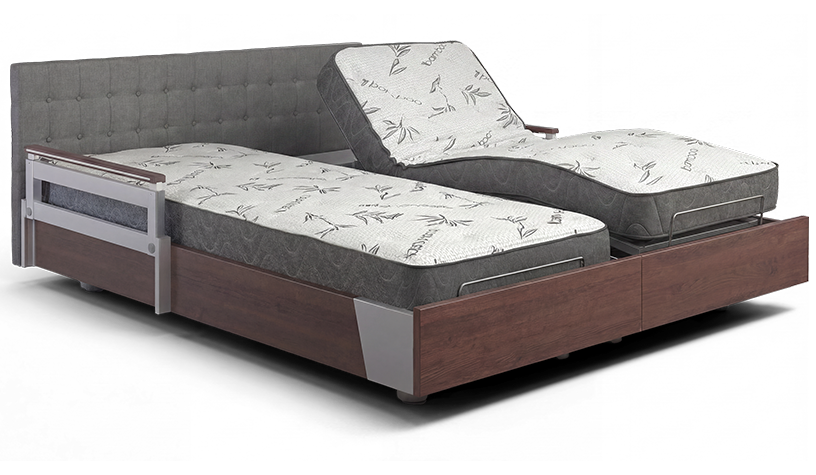
| Residential appearance | Hospital-chrome or painted tubular steel is the dominant aesthetic — designed for clinical settings, adapted for home use. Residential-look finishes are rare and typically add-on. | Residential design is a primary engineering requirement, not a finish option. Aura Platinum adds upholstered Slate Gray Crypton furniture-grade panels. Aura Premium uses architectural matte-black panels. |
What’s actually driving your search?
Most people searching for hospital bed retailer alternatives are in one of three situations. Pick the path that matches where you are — each one routes to the most useful part of this guide.
You’re looking at a specific retailer
You’ve found a bed on a retailer’s site and want to know what you’re actually buying — the supply chain, the certification, the delivery model, and what happens if something goes wrong. Use the spoke index below to find that retailer’s dedicated comparison page.
You need to understand the quality tiers
You’re seeing a wide price range — $800 to $15,000 — and can’t figure out what the difference actually is. The category reframe and the five structural questions above are your starting point. The tiers aren’t about features; they’re about supply chain and who’s accountable after the sale.
You’re weighing cost against clinical risk
Someone in the home has fall risk, daily transfer needs, or is in hospice or palliative care, and you’re trying to decide whether a premium bed is justified vs. a lower-cost online option. Talk to a SonderCare bed expert — this is the conversation we have most often, and the answer depends on the specific situation.
Retailer-by-retailer comparisons
Each link below is a dedicated page comparing SonderCare to that retailer using the same framework: category-class position, verifiable structural facts sourced from the retailer’s live site, and an honest concession for when that retailer is genuinely the right call.
Online hospital-bed retailers
Mobility & rehab superstores
Rental & DME providers
Local medical-equipment stores
Go deeper
If you want broader context on what to look for in a home hospital bed before comparing retailers, these guides cover the questions that matter most.
Not sure which bed is right for your situation?
Our bed experts have helped thousands of families through this decision. We’ll listen to your situation first — care needs, home layout, caregiver setup — and recommend the configuration that fits, honestly.
Talk to a bed expert