


SonderCare vs SlumberSource: which bed is right for care at home?
If you’ve been comparing beds on SlumberSource and something is making you pause — the catalog is huge, the price range is wide, and you’re not entirely sure which bed was actually built for a bedroom versus a hospital floor — that pause is worth listening to. A home hospital bed is usually a one-time purchase you’ll live with for years, and many of these beds are final once they’re made. This page lays out the real differences, using facts published on SlumberSource’s own site, so you can decide with clear eyes.
Quick answer
SlumberSource is a multi-brand specialty retailer: it selects, sells, and installs hospital beds made by more than a dozen other manufacturers — brands like Transfer Master, Med-Mizer, Accora, and Flex-A-Bed — across home and facility categories. SonderCare is the manufacturer of its own residential home hospital bed, which it designs, certifies, delivers, assembles, and warranties as a single product. These aren’t better and worse versions of the same bed; they’re two different kinds of purchase. The right choice comes down to whether you want the breadth of a catalog, or one company standing behind one bed for the long run.
Key takeaways
- SlumberSource carries beds built by 14+ other manufacturers; SonderCare designs and builds its own. That’s a difference in category, not just a difference in price for the same bed.
- On their own site, SlumberSource’s catalog spans facility-grade categories — acute care, med-surg, long-term care — alongside home beds, and many of the home models are made to order and final once production begins.
- Both companies deliver and install in your home rather than dropping a box in the driveway — a genuine point of similarity. SlumberSource’s home beds are also full-electric, as every SonderCare Aura bed is.
- Where the need is short-term or tied to a specific third-party model, a multi-brand catalog can be the practical fit. SonderCare earns its place for long-term, lived-in care, where one company designs, delivers, and stands behind a bedroom-first bed for years.
A retailer that carries dozens of beds from many makers and a manufacturer that builds one bed of its own can both deliver and install in your home — and still be two different purchases. The question underneath the price isn’t really “which bed,” it’s “which kind of relationship do I want for the years this bed has to last?” That’s why it’s worth slowing down before you click “add to cart,” even when the situation feels urgent.
Most people who land on a SlumberSource review or comparison are mid-decision. A parent is coming home from the hospital, a partner’s mobility has changed, or a recovery is going to take longer than anyone hoped. You’re not loyal to any retailer — you’re trying to make one good choice under pressure, and you want to know whether the breadth of a big catalog is an advantage or just more to sort through. That’s the right instinct, and it deserves a real answer rather than a sales pitch.
So this comparison does two things, and it tries to be fair about both. First, it reframes the question: SlumberSource and SonderCare aren’t two points on the same shelf — they’re two categories of seller, and the questions you’d ask are different for each. Second, it puts the structural facts side by side, drawn from SlumberSource’s own published pages, with a plain-language note on what each one means for you. Where the two are genuinely similar — in-home installation, full-electric operation — we’ll say so plainly, because the point isn’t to win an argument; it’s to help you make a decision you won’t second-guess.
Two different things are being sold
When you compare SonderCare with SlumberSource as if they were rival versions of one product, you’re already asking the wrong question. The most useful first step is to notice that they sit in different categories of business — and that the category, more than any single feature, shapes what you experience after the sale.
SlumberSource is a retailer. By its own description it carries “over 39 hospital bed models from 14+ manufacturers” — brands like Transfer Master, Med-Mizer, Accora, and Flex-A-Bed — rather than a bed it designs and builds itself. SonderCare is a manufacturer: it engineers, certifies, delivers, and warranties its own Aura and Impulse beds as one continuous product and relationship. Neither model is dishonest. A wide multi-brand catalog and a single focused line are simply built to do different jobs.
Multi-brand specialty retailer
Selects, sells, and installs clinical and home beds made by 14+ other manufacturers, across categories from acute care to home. A fit when you want breadth, or already know the exact third-party model you need.
Residential bed manufacturer
Designs and builds its own beds, certifies the Aura line to International Hospital Standard, and stands behind each one with white-glove delivery and a 5-year warranty. Built for long-term, lived-in care at home.
Breadth, or one bed for the long run?
A short, specific, or feature-driven need points one way; years of daily care in a bedroom that should still feel like home points the other. The category you need follows from the kind of relationship you want, not the logo.
Read that way, “Is SonderCare better than SlumberSource?” dissolves into a clearer question: which category fits the care you’re actually providing? The facts below help you answer it — including the places where the two genuinely overlap.
What the facts show
Everything in the table below is drawn from SlumberSource’s own live pages — their About page, their delivery-and-policy page, and their bed collections — checked on June 25, 2026. We’ve deliberately left out anything we couldn’t source, including warranty terms (which their site doesn’t state in one clear place) and any claim about side-rail certification.
The point isn’t to score points. It’s to show you the structural differences that don’t appear in a price comparison — and to be honest about one row where the two are not different at all.
| What to check | SlumberSource | SonderCare | Verified |
|---|---|---|---|
| Who makes the bed | Retailer of 14+ third-party brands; “over 39 hospital bed models from 14+ manufacturers” | Manufacturer of its own Aura and Impulse beds | Verified 2026-06-25 |
| Design intent | Catalog spans facility categories — acute care, med-surg, long-term care — “built for both facility and home use” | Residential design as a primary requirement; Aura Platinum upholstered Slate Gray Crypton panels | Verified 2026-06-25 |
| Delivery & installation | In-home setup by their own technicians, “not a third-party freight company”; optional white-glove install in 4–11 business days | White Glove Standard ($599): full in-home setup, installation, walkthrough, and debris removal | Verified 2026-06-25 |
| Made-to-order returns | Custom, hi-low, sleep-to-stand, rehab, medical, bariatric & therapy beds “not eligible for return refund or exchange” once in production | Pre-purchase consultation with a bed expert to confirm size and fit before anything is built | Verified 2026-06-25 |
| Returns & restocking | Where allowed: 30 days, new/unopened in original box, 20% restocking fee, customer ships back to factory docks | Fit confirmed before the order, so the decision is settled before the bed is made | Verified 2026-06-25 |
| Price position | Home-care beds from $1,647 to $12,787 across many brands and bed types | $3,999 (Impulse) to $12,999 (Aura Companion); Aura Premium $6,999, Aura Platinum $8,499 | Verified 2026-06-25 |
What these facts mean for you
Because the bed is built by one of many other companies, you’re choosing a catalog item rather than a product its seller designed. The breadth is real and useful — but it also means the bed you sleep in and the company you bought it from are two different businesses. SonderCare engineers, builds, delivers, and warranties one bed as a single relationship.
Some of these frames were engineered first for hospitals and care units, then offered for home use too. In a bedroom, a bed built for an acute-care floor can read as clinical equipment rather than furniture — the opposite of what most families want for a parent or partner. SonderCare designs for the bedroom first; residential appearance is a primary requirement, not a finish added later.
This is a genuine point of similarity, not a difference: both companies bring the bed in, assemble it, and walk you through it rather than leaving a box in the driveway. If white-glove setup was your worry, you can treat it as settled on both sides and focus on the factors that do differ — who built the bed, how returnable it is, and how it looks in the room. SonderCare’s White Glove Standard service is $599.
Many of the home hospital beds people choose here are made to order, which means the decision is final the moment it enters production — before the bed is ever in your room. You usually can’t judge height, width, and look until the bed is in place, so it’s worth being certain about fit first. SonderCare confirms size and configuration with a bed expert before you order, so the choice is settled before anything is built.
Even on the items that can be returned, the bed has to be unopened in its original box — so once it’s assembled to see whether it works, the window effectively closes — and a return costs a fifth of the price plus freight back to the dock. For a decision made under stress, that’s a narrow margin for changing your mind, which is why a fit conversation before ordering is worth the few minutes it takes.
The price band is wide because it spans many brands and bed types, from a basic frame to a rotating clinical bed — so a low entry price and a five-figure clinical model sit in the same catalog. SonderCare’s line reflects one design standard across every bed, rather than a span across many makers. Where budget is the deciding factor, a multi-brand catalog can start lower; where a single, consistent standard matters, that’s a different purchase.
Three questions worth asking before you decide
You don’t need anyone to tell you what to think — you need the right questions to think with. These are the three we’d quietly ask ourselves before buying any home hospital bed, each tied to a fact above.
If the bed is made to order and final once production begins, how sure do you want to be before you order?
It’s worth knowing before you buy. SlumberSource’s policy states that made-to-order beds — custom, hi-low, sleep-to-stand, rehab, medical, bariatric, and therapy beds — are “not eligible for return, refund or exchange” once the order enters production, and even returnable items carry a 30-day window, a 20% restocking fee, and return freight you pay. Since you usually can’t judge height, width, and look until the bed is set up, the real question is how to be certain of fit before anything is built — which is exactly what a pre-purchase consultation is for.
In a catalog that spans facility and home, which beds were designed first for a bedroom?
That’s harder to tell than it looks. SlumberSource carries acute-care, med-surg, and long-term-care frames “built for both facility and home use” alongside its home beds. Some of those were engineered first for a care unit, where appearance isn’t the priority. If the bed will live in a bedroom for years, it’s fair to ask which models were designed for that room from the start — and to weigh how a frame will look to the family every morning, not just how it functions.
Does it matter to you whether the seller is also the maker?
Only you can answer that, and for some situations it genuinely doesn’t matter. But when the bed is one of dozens of models from more than a dozen manufacturers, the company you buy from and the company that engineered the frame are two different businesses. For a one-time purchase you’ll rely on for years, it’s worth deciding up front how much you value having a single company that designed the bed, delivers it, and stands behind it — which is the relationship SonderCare is built around.
Which SonderCare bed fits the situation
If you’ve decided this is long-term, lived-in care, the next question is simply which configuration answers your specific worry. You don’t need the most expensive bed — you need the one matched to the concern that’s actually keeping you up at night.
Two worries come up most often among families who start out comparing multi-brand retailer catalogs: “I don’t want a bed that was designed for a hospital floor sitting in our bedroom,” and “the daily lifting and transfers are wearing me out.” Here are the SonderCare configurations built for each, with current prices.
The bedroom that still looks like a bedroom
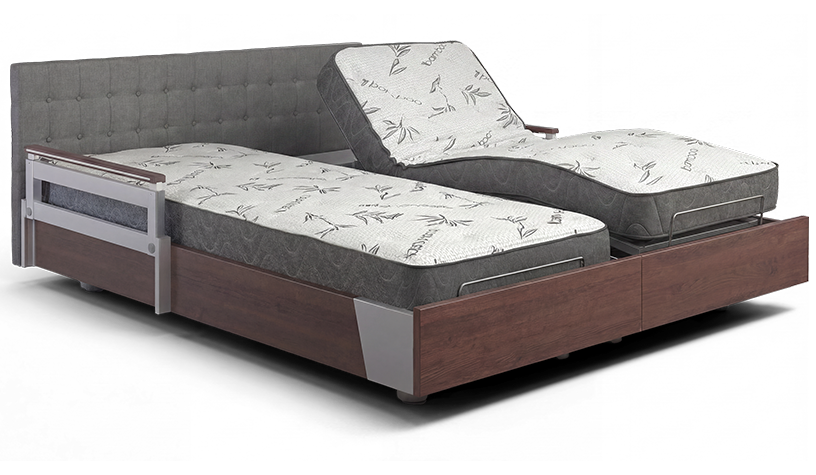
For families worried about a clinical look- Appearance: Upholstered Slate Gray Crypton side panels, furniture-grade finish
- Height range: Full-electric hi-lo, 10″ to 39″
- Fall prevention: FallSafe ultra-low 10″ platform (17″ to mattress top)
- Certification: Certified to International Hospital Standard
- Operation: 54 dB(A) — quieter than typical conversation
- Warranty: 5-year comprehensive parts, included
The bed that does the lifting for you
For caregivers doing daily transfers- Operation: Full-electric — height, head, and knee; no hand crank
- Transfers: 21″ pre-programmed bed-to-wheelchair transfer height
- Positioning: Zero Gravity, Cardiac Chair, Trendelenburg tilt
- Fall prevention: FallSafe ultra-low 10″ platform
- Capacity: 500 lbs weight capacity
- Warranty: 5-year parts; +$199 for parts & labor
If the budget needs to start lower, the Impulse Residential Bed ($3,999) brings full-electric head, knee, and hi-lo adjustment in a residential design — an entry point into the manufacturer category, designed for the bedroom from the start. And for couples who want to keep sleeping side by side, the Aura Companion Bed ($12,999) is a split-king with each side independently adjustable and an upholstered headboard.
When SlumberSource is genuinely the right call
If the need is short-term, or you already know the exact third-party model and clinical feature set the situation calls for — a specific rotating, bariatric, or acute-care frame for a defined medical need — then a multi-brand retailer that carries that breadth across many makers may be all the situation requires, and a single manufacturer’s focused residential line would be a narrower fit than the moment needs. SonderCare is built for the opposite case: long-term, lived-in care at home, where one company designing, delivering, and standing behind a bedroom-first bed for years is what matters most.
Frequently asked questions
Is SlumberSource a good place to buy a hospital bed?
SlumberSource is a multi-brand retailer that carries and installs hospital beds from more than a dozen other manufacturers across home and facility categories. If you already know the specific third-party model you need, or the need is short-term, the breadth of its catalog can be useful. For long-term, lived-in care at home — where you want one company that designed the bed, looks after a bedroom-first appearance, and stands behind the frame for years — a manufacturer like SonderCare is built for a different job.
Does SlumberSource make its own hospital beds?
No. SlumberSource states on its About page that it carries “over 39 hospital bed models from 14+ manufacturers,” including brands such as Transfer Master, Med-Mizer, Accora, and Flex-A-Bed. That means it selects and resells beds built by other companies. SonderCare designs and manufactures its own Aura and Impulse beds, so the company you buy from is the same company that engineered, delivers, and warranties the bed.
Are SlumberSource beds full-electric, or do they need a hand crank?
The home hospital beds shown on SlumberSource’s collection are described as full-electric, with powered head, knee, and hi-lo adjustment — so on this point it and SonderCare are comparable. Every SonderCare Aura-series bed is also full-electric, with height, head, and knee motor-driven, a one-button hi-lo, and pre-set positions. This is a point of similarity, so the decision really comes down to who builds the bed, how returnable it is, and how it looks in your room.
Can I return a hospital bed to SlumberSource if it doesn’t work out?
Often, no. SlumberSource’s policy states that made-to-order beds — including custom, hi-low, sleep-to-stand, rehab, medical, bariatric, and therapy beds — are “not eligible for return, refund or exchange” once the order enters production. Where a return is allowed for specific products, it’s within 30 days, the item must be new and unopened in its original box, there is a 20% restocking fee, and you pay to ship it back. Because you usually can’t judge fit until a bed is set up, it’s worth confirming size and configuration before you order.
Does SlumberSource deliver and set up the bed in my home?
Yes. SlumberSource states that its own installation technicians — “not a third-party freight company” — bring the bed in, assemble it, and test every function, with optional white-glove installation in 4 to 11 business days. This is a genuine point of similarity with SonderCare, whose White Glove Standard service ($599) includes full setup, installation, a feature walkthrough, and debris removal, with a rush option available in 1 to 3 business days.
How does SonderCare’s price compare with SlumberSource?
The ranges overlap. SlumberSource’s home-care collection lists beds from $1,647 to $12,787 across many brands and bed types, from a basic frame to a rotating clinical bed. SonderCare’s own line runs from $3,999 for the Impulse Residential Bed to $12,999 for the Aura Companion split-king, with the Aura Premium at $6,999 and the Aura Platinum at $8,499 — figures that reflect one design standard across every bed, in-house manufacturing, International Hospital Standard certification, white-glove delivery, and a 5-year warranty. If the lowest entry price is the priority, a multi-brand catalog can start lower; if a single consistent standard across years of care matters more, SonderCare is built for that.
Not sure which bed your situation calls for?
Tell us what’s happening at home — the care needs, the room, who’s doing the lifting — and we’ll recommend the right fit honestly, even if that means a smaller bed than you expected. No pressure, ever.
Related SonderCare reading
If you want broader context before deciding, these guides cover the questions that come up most often.