


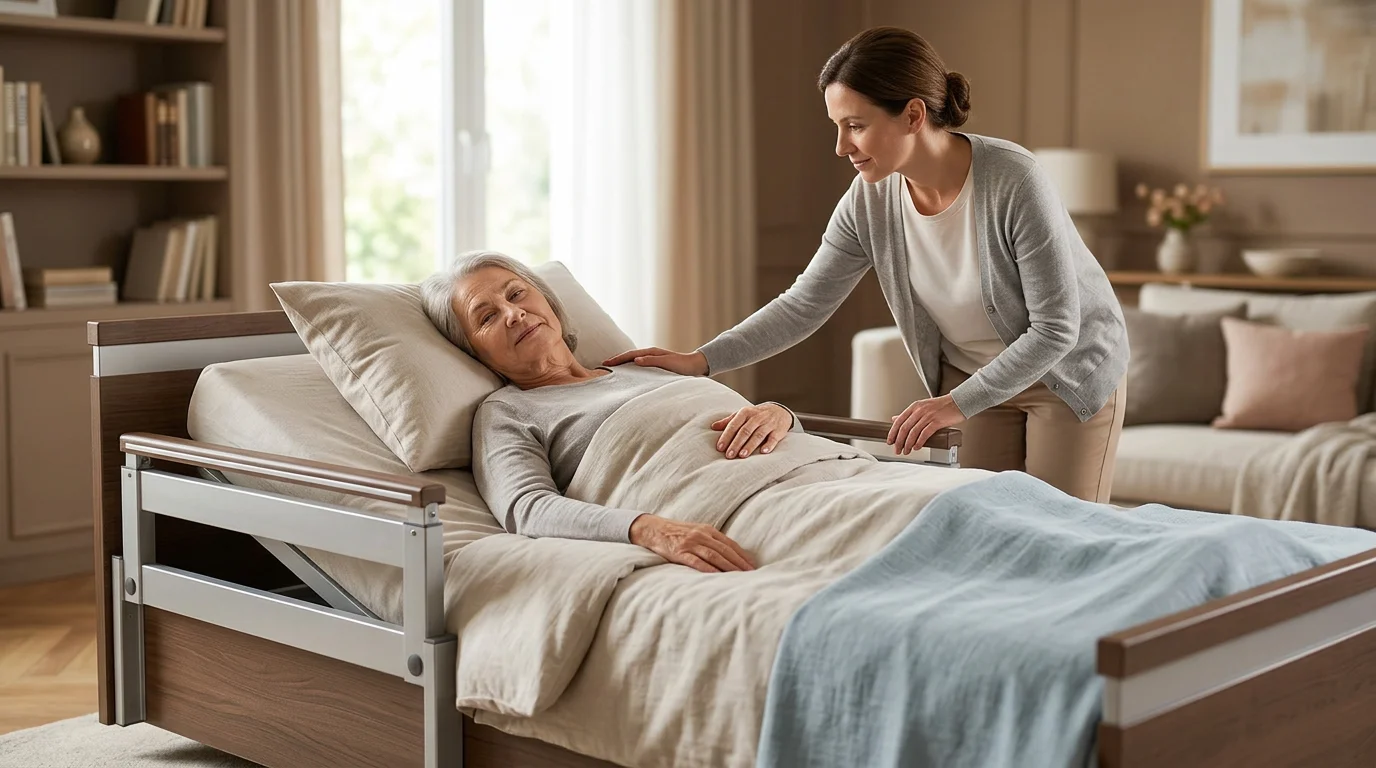



She’d been repositioning her mother every few hours, keeping the skin clean, watching for redness. Then a wound appeared anyway, near the tailbone, in a spot that seemed impossible given how careful she’d been.
What she didn’t know was that she had been protecting against the wrong force.
Most family caregivers know about pressure sores. Fewer have ever heard the word “shear.” And almost none have had anyone explain that shear, the force that occurs when someone slides down in bed while their skin stays behind, is a distinct mechanism with its own prevention requirements. An air mattress helps with pressure. It doesn’t automatically address shear.
This guide explains what shear and friction actually do to skin, why older skin is uniquely vulnerable to both, how moisture silently amplifies the risk, and what a bed surface system needs to include to protect fragile skin at every layer. For the broader context of preventing skin breakdown at home, start with the complete guide to pressure sore prevention.
Shear is the force that most family caregivers have never heard of until they’re already looking at a wound that shouldn’t have been there. It happens when someone slides down the bed, when they’re repositioned with dragging instead of lifting, and when a moist cotton sheet adds twice the friction to every movement. Understanding it doesn’t require a nursing degree, but it does require knowing it exists. The good news is that shear and friction reduction don’t require complicated interventions. They require a system: a mattress that redistributes pressure, a low-friction cover that doesn’t grab at fragile skin, linens that allow the body to move smoothly during turns, moisture management that prevents friction amplification, and repositioning technique that lifts rather than drags. The bed surface is the foundation of that system. Getting it right matters more than getting it perfect on the first try. If you’d like guidance on which surface combination fits your loved one’s situation, speak with a SonderCare expert at no cost. We help families work through these decisions every day.
Shear vs. Friction, Two Forces That Damage Skin Differently
Most caregivers conflate shear and friction because both can result in skin injury. They operate through entirely different mechanisms, and that distinction determines what you need to prevent each one. Friction acts on the skin’s surface. When someone is dragged across a bed sheet, during a repositioning turn, when they slip down toward the foot of the bed, or when a caregiver pulls them up by the arms, the outermost layer of skin catches on the fabric. The result is a top-down injury: abrasion, blistering, or skin tears affecting the epidermis.1 Shear is what happens deeper in the body during that same slide. When the skeleton and deep tissue move in one direction and the skin stays anchored to the surface below it, the tissue layers shift against each other internally. The blood vessels, fascia, and soft tissue at the bone-skin interface get stretched, compressed, and torn in a bottom-up mechanism that the skin’s surface may not reveal until damage is already advanced.1,2 Here’s the critical relationship: friction and shear are coupled. Clinical researchers describe it plainly, if friction increases, shear likely increases too.1 A rough sheet that catches on fragile skin isn’t just causing a surface abrasion; it’s generating the internal shear force that damages deep tissue at bony prominences. That coupling is why reducing friction at the skin-surface interface is a shear-reduction strategy, not just a comfort measure. A friction-only injury typically presents as a serum-filled blister or skin tear, the kind of wound that looks like a bad scrape. A deep tissue injury from shear may appear as a maroon or purple discoloration that feels firm or boggy underneath, with the surface seemingly intact until the injury has progressed significantly.2 Knowing the difference matters for both treatment and prevention. Plain-language translation of clinical terms:| Clinical Term | What Caregivers Call It |
|---|---|
| Shear force | Skin dragging as the body slides down |
| Friction | The sheet rubbing against her skin |
| Pressure injury | Bed sore, pressure sore |
| Repositioning | Turning, flipping, rolling him over |
| Low-friction surface | Silky sheets, smooth covers |
| Sacral wound | The sore on her tailbone or lower back |
| Incontinence-associated dermatitis | Rash from being wet, skin breakdown |
Why Older Skin Breaks Down Faster
The same repositioning forces that a younger person’s skin absorbs without injury can cause lasting damage to an older adult’s skin. This is not a reflection of careful vs. careless caregiving, it’s biology, and understanding it changes what interventions actually make a difference. As skin ages, several structural changes make it more vulnerable to both friction and shear:- The epidermis thins, offering less mechanical protection against surface forces
- Collagen and elastin production decline, reducing elasticity and tensile strength
- The rete ridges at the dermal-epidermal junction flatten, weakening the structural bond between skin layers
- Subcutaneous fat, which naturally cushions bony prominences, diminishes
- Muscle mass decreases, reducing the natural padding at pressure points like the sacrum and heels
Moisture Is Friction’s Amplifier
One of the most consistently underestimated contributors to skin breakdown in bedridden older adults is moisture, specifically, how dramatically it increases the friction between skin and fabric during every contact and repositioning turn. Research comparing skin-textile friction across conditions found that a standard 100% cotton hospital bed sheet produces a friction coefficient of approximately 0.33 against dry skin. Against wet or moist skin, that same sheet reaches a friction coefficient of roughly 0.80, more than double.3 For a person dealing with incontinence, perspiration, or wound exudate, every repositioning turn is happening against a surface with dramatically increased resistance. The result is more skin drag, more shear force generation, and more injury risk, even when the caregiver’s technique is careful and intentional. Moisture also creates a parallel breakdown pathway. When skin is chronically exposed to urine or stool, the pH of the skin surface rises, the permeability barrier breaks down, and the stratum corneum softens. Compromised, softened skin is significantly more vulnerable to friction forces during repositioning, a condition clinically known as incontinence-associated dermatitis.4 Caregivers often manage moisture and repositioning as separate concerns; clinically, they’re part of the same injury pathway. Practical moisture management steps:- Use a vapor-permeable mattress cover that allows moisture vapor to escape rather than trapping it against the skin
- Apply a film-forming skin protectant or zinc-based barrier cream to incontinence-exposed areas before each reposition
- Change incontinence briefs at the first sign of saturation rather than waiting for scheduled changes
- Prioritize smooth, moisture-wicking fabrics for sheets that contact the skin directly
What Your Bed Surface Is, and Isn’t, Doing
When a family caregiver purchases an alternating pressure air mattress, they often believe they’ve solved the skin protection problem. They’ve addressed one mechanism. But shear and friction can still occur on an alternating pressure surface, and understanding why is essential for building an effective system. What alternating pressure mattresses do: They cycle air through internal chambers on a timed schedule, periodically relieving pressure from different points under the body. This addresses ischemia, the compression of capillaries that starves tissue of oxygen and causes cell death over time. By interrupting sustained pressure at bony prominences, alternating pressure surfaces reduce one of the three primary mechanisms of pressure injury formation.5 What they don’t do, on their own: They don’t change the friction coefficient of the cover material the person’s skin is in contact with. They don’t prevent shear from occurring during active repositioning. A person pulled up toward the head of the bed while lying on an air mattress still experiences the same skin-on-fabric drag. The mattress’s cycling function doesn’t protect against the horizontal forces applied during turning and positioning.5 Evidence from the PRESSURE 2 trial, a randomized evaluation of 2,030 high-risk patients, found no statistically significant difference in pressure injury incidence for the primary outcome between alternating pressure mattresses and high-specification reactive foam.6 A broader Cochrane systematic review of 32 randomized trials involving 9,058 participants found alternating pressure active surfaces may reduce pressure ulcer risk compared to standard foam (risk ratio 0.63), but rated the evidence as low certainty.5 The lesson is not that alternating pressure mattresses don’t work, it’s that mattress type alone is not sufficient. No single surface addresses the complete injury picture. Choosing the right mattress for a bedridden person requires matching the surface to the individual’s risk profile, mobility level, moisture exposure, and care environment.Low-Friction Linens and Covers, The Most Overlooked Intervention
The fabric that directly contacts the skin is where friction actually occurs. It is also the least expensive component of a skin protection system to change, and the one most caregivers never consider. Research comparing skin-textile friction coefficients across material types found a clear hierarchy. Polyamide-based (nylon-type) and silk-like fabrics have the lowest friction coefficient against human skin. Wool has the highest. Cotton, the default for most home bedding, sits in the middle when dry, and climbs dramatically when wet.3 The practical implication: caregivers who default to soft flannel sheets or thick cotton for a bedridden person may be using the highest-friction option available. A 2020 evidence summary found that low-friction bedding received a Grade B clinical recommendation for individuals with moderate to high pressure injury risk, meaning there is good published evidence supporting its use, even if large randomized trials are still limited in number.7 What to look for in sheets and mattress covers:- Smooth weave over pile or flannel, textured surfaces catch and drag on fragile skin
- Silk-like, microfiber, or polyamide-blend sheets, lower friction coefficient than standard cotton
- Vapor-permeable mattress covers rather than solid waterproof plastic, trapping moisture under the cover defeats moisture management
- Taut, unwrinkled linens, bunched fabric creates localized pressure points and dramatically increases drag during repositioning
- Replace worn or pilled covers, surface degradation increases friction over time
Friction Wound vs. Pressure Injury: How to Tell the Difference A friction or shear wound tends to appear as a serum-filled blister, skin tear, or superficial abrasion near a bony prominence. The surrounding skin may look intact. A pressure injury, by contrast, usually begins as non-blanchable redness that deepens over time. A deep tissue pressure injury may present as a maroon or purple patch that feels firm, mushy, or boggy underneath, the surface looks relatively undisturbed while significant internal damage has already occurred. Both require wound care attention, but their prevention strategies differ: friction reduction protects the surface, while pressure redistribution protects deep tissue.1,2
Safer Repositioning, Reducing Shear During Every Turn
Repositioning changes which bony prominences bear the body’s weight, reducing sustained pressure. But if done incorrectly, repositioning also generates shear, making the very intervention meant to protect the skin into an injury source. The most common mistake is pulling someone up toward the head of the bed by grasping the arms or shoulders. This drags the skin across the mattress surface while the underlying tissue moves with the skeleton, exactly the opposing-direction displacement that shear describes.1 When the mattress cover has high friction (as wet cotton does), the drag force is even greater. Repositioning techniques that reduce shear:- Use a draw sheet or slide sheet placed under the person, allowing caregivers to lift and slide the entire body without skin-on-mattress contact
- Log-roll for lateral position changes, maintain spinal alignment and roll as a unit, never dragging the trunk while legs stay stationary
- Lift rather than drag, position yourself so you can lift the body briefly clear of the surface before lateral movement, even if only a few inches
- Raise the head of the bed slightly before turning, sliding someone on a tilted surface requires more drag force than repositioning flat
Building a Complete Skin Protection System at Home
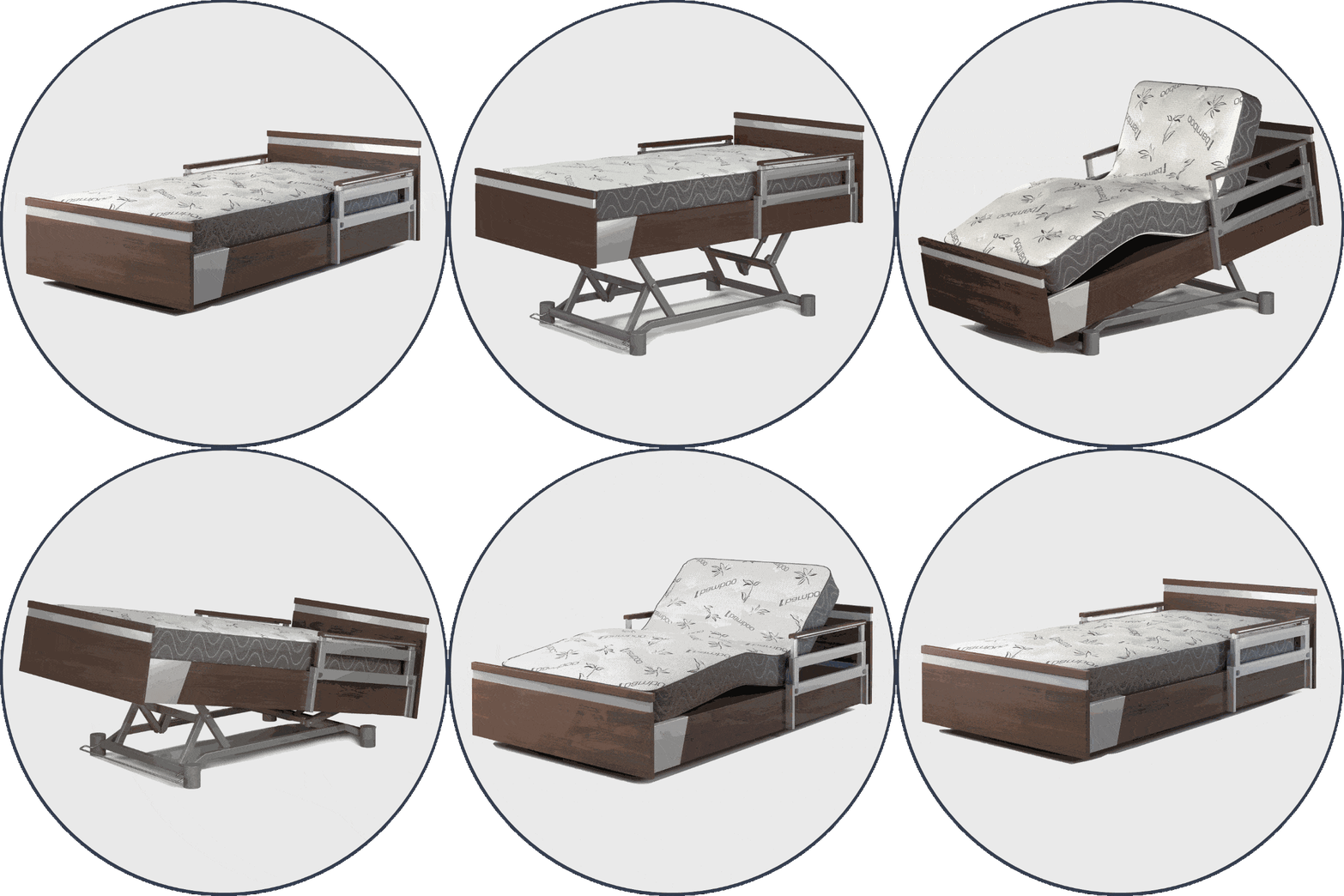
No single product prevents shear and friction injuries. The approach that works combines elements that address each layer of the problem. Understanding how the layers interact helps caregivers make better choices at every point. The four-layer skin protection system: 1. The mattress should redistribute pressure across the widest possible surface area. A high-density foam mattress with an appropriate support profile reduces localized pressure at bony prominences. For the highest-risk individuals, those who are fully immobile, severely malnourished, or have existing stage 1 or 2 injuries, an alternating pressure mattress for home use may be appropriate based on clinical guidance. 2. The mattress cover sits between the mattress and the person’s skin and directly determines interface friction. It should be vapor-permeable, low-friction, and cleanable. A non-breathable waterproof cover that traps moisture defeats moisture management, regardless of how good the mattress underneath is. 3. The linen should be smooth, moisture-wicking, and taut. No mattress system compensates for a high-friction, bunched, or wet sheet in direct contact with fragile skin. 4. Moisture management prevents the doubling of friction that occurs when skin is wet, and interrupts the IAD pathway that further compromises skin’s mechanical integrity.4 SonderCare mattress options for skin protection: The SonderCare Comfort Mattress provides standard pressure redistribution with a fluid-proof cover, a practical choice for individuals who are partially mobile and at moderate skin risk. The SonderCare Signature Hybrid combines individually wrapped pocket coils with multiple layers of high-density orthopedic foam and a copper-infused cover with natural antimicrobial properties, delivering more responsive pressure distribution for individuals with moderate-to-high repositioning needs. For individuals with existing pressure injuries or the highest skin breakdown risk, the SonderCare Alternating Pressure Air Mattress provides 18 independently cycling air bladders specifically designed for wound care and advanced pressure injury prevention. All SonderCare mattresses are designed for use on the Aura bed platform’s fully electric frame, which includes the hi-lo adjustment range that makes ergonomic, low-shear repositioning possible for family caregivers working with limited help. Questions to help match the system to the person:- Is the person currently fully immobile, or able to shift position independently? Immobile individuals generate more sustained pressure and more shear during every repositioning; they need higher-specification support.
- Is incontinence a factor? If yes, a vapor-permeable cover and active moisture management are non-negotiable components, not optional additions.
- Are there existing wounds? Stage 1 and 2 injuries may be manageable with a high-specification foam surface and technique improvement; stage 3 and 4 typically require alternating pressure.
- What is the caregiver’s physical capacity? A bed that adjusts to working height reduces shear risk during every single turn.
Shear is the force that most family caregivers have never heard of until they’re already looking at a wound that shouldn’t have been there. It happens when someone slides down the bed, when they’re repositioned with dragging instead of lifting, and when a moist cotton sheet adds twice the friction to every movement. Understanding it doesn’t require a nursing degree, but it does require knowing it exists. The good news is that shear and friction reduction don’t require complicated interventions. They require a system: a mattress that redistributes pressure, a low-friction cover that doesn’t grab at fragile skin, linens that allow the body to move smoothly during turns, moisture management that prevents friction amplification, and repositioning technique that lifts rather than drags. The bed surface is the foundation of that system. Getting it right matters more than getting it perfect on the first try. If you’d like guidance on which surface combination fits your loved one’s situation, speak with a SonderCare expert at no cost. We help families work through these decisions every day.
References
- Broderick VV, Cowan LJ. “Pressure Injury Related to Friction and Shearing Forces in Older Adults.” Dermatology Reports. 2021;13(1):9056. Available at: dermatoljournal.com
- Antokal S, Brienza D, Herbe L, Kirk J, Kohler B, Linden M, Mann W. “Friction Induced Skin Injuries, Are They Pressure Ulcers? An Updated NPUAP White Paper.” National Pressure Injury Advisory Panel. 2013.
- Vilhena L, Ramalho A. “Friction of Human Skin Against Different Fabrics for Medical Use.” Lubricants. 2016;4(1):6. DOI: 10.3390/lubricants4010006.
- Kottner J, Dissemond J. “Incontinence-Associated Dermatitis: Consensus Statement.” British Journal of Nursing. 2012.
- Shi C, Dumville JC, Cullum N, et al. “Beds, overlays and mattresses for preventing and treating pressure ulcers: a systematic review and network meta-analysis.” Cochrane Database of Systematic Reviews. 2021;(7): CD013623. Available at: Cochrane Library
- Nixon J, Nelson EA, Rutherford C, et al. “Pressure relieving support surfaces: a randomised evaluation (PRESSURE 2).” Health Technology Assessment. 2019;23(52).
- Haesler E. “Low-friction bedding for prevention of pressure injuries: a summary of evidence.” Wound Practice & Research. 2020;28(2).
- National Institute for Health and Care Excellence (NICE). Pressure Ulcers: Prevention and Management. Clinical Guideline CG179. London: NICE; 2014. Available at: nice.org. uk
- European Pressure Ulcer Advisory Panel, National Pressure Injury Advisory Panel, Pan Pacific Pressure Injury Alliance. Prevention and Treatment of Pressure Ulcers/Injuries: Clinical Practice Guideline. Third Edition. EPUAP/NPIAP/PPPIA; 2019.