






Two people. One bed. Completely different bodies feeling different every single night.
Your partner needs their head elevated for acid reflux. Or they’ve stopped being able to roll over on their own. Or they snore when they fall onto their back, and every nudge only lasts twenty minutes. Meanwhile, you just need to sleep, really sleep, so you can show up again tomorrow.
This is the positioning problem that nobody talks about clearly. Clinical guides for caregivers assume a solo patient. Couples’ sleep content assumes two healthy people who are simply uncomfortable. Neither addresses what it actually feels like to share a bed when one person has a medical positioning need and the other just wants a flat mattress and a full night.
This guide is for that second scenario. You’ll find concrete techniques, angles, pillow sequences, repositioning methods, organized by the specific condition driving your partner’s need. You’ll also find the emotional layer named directly, because guilt and exhaustion are part of this equation too.
Why Your Partner’s Positioning Need Affects Both of You
Before the techniques: a number that matters. According to a CDC analysis of national survey data, 39.5% of caregivers report short sleep duration, compared to 34.2% of non-caregivers, a 12% higher likelihood after adjusting for other factors.1 A meta-analysis published in JAMA Network Open found that caregivers average 2.4 to 3.5 fewer hours of sleep per week than non-caregiving peers.2
That sleep gap doesn’t happen in isolation. It happens in a shared bed, one positioning problem at a time.
The deeper issue is what researchers call partner disturbance in co-sleeping adults. Studies show that between 18.9% and 46% of nocturnal movements in a shared bed are transmitted between partners.3 When one person can’t hold a therapeutic position, or needs to be turned repeatedly through the night, both people pay the cost.
Clinical positioning guides assume a single patient in a single bed. Couples’ sleep content assumes two people who are just uncomfortable. What’s missing is the guide that names and solves the dual-person problem explicitly: every positioning technique has a hidden variable, what does it do to the person sharing the mattress?
That’s what you’ll find below.
Head Elevation for Acid Reflux, Snoring, Sleep Apnea, and Trouble Breathing
Head elevation is the most common therapeutic positioning need in a shared bed. It covers a wider range of conditions than most people realize: acid reflux (GERD), snoring, positional sleep apnea, COPD and other breathing conditions, post-cardiac surgery recovery, and congestive heart failure.
The Evidence for Elevation
For acid reflux, the evidence is strong. A 2021 systematic review published in BMJ Open found that head-of-bed elevation consistently produced clinically meaningful symptom improvement across multiple trials, with one high-quality crossover study reporting that patients using a 20 cm (approximately 8 inch) elevation were more than twice as likely to achieve symptom relief compared to controls.4
For snoring and positional sleep apnea, even a modest elevation helps. A 2017 study in Sleep & Breathing found that elevating the head by just 7.5 degrees reduced the Apnea-Hypopnea Index, the standard measure of sleep apnea severity, by a median of 31.8%.5 That’s a meaningful improvement from a relatively small angle.
The Angles That Work
Different conditions call for different elevations:
– Snoring and mild sleep apnea: 20–30 degrees (roughly 6–8 inches at the head)
– Acid reflux and GERD: 35–45 degrees (some relief at 20 degrees; more for severe cases)
– COPD and breathing difficulty: 30–45 degrees (Cardiac Chair or Fowler’s position when sitting upright is needed)
– Post-cardiac or reflux surgery: follow your surgeon’s specific guidance; typically 30–45 degrees
For GERD specifically: sleeping on the left side also reduces acid exposure because the stomach sits lower than the esophagus in that position. If your partner prefers left-side sleep and you do too, you’ll both be facing each other or competing for the same edge of the bed, see the side-lying support section below for how to handle this.
Wedge Pillow Technique
A wedge pillow is the lowest-barrier starting point. Place the wedge with the wide, flat base against the mattress and the angled surface supporting your partner’s back and head. The thin end points toward the foot of the bed. Do not stack a regular pillow on top, this creates instability, reduces the effective angle, and means your partner’s neck is unsupported at a different angle than their torso.
The wedge should support the whole torso, not just the head. A pillow that only elevates the head actually bends the neck forward, which can worsen snoring and creates its own discomfort.
What this does to you: On a firm mattress, a wedge placed on one side creates a noticeable height difference but transmits minimal incline to the other side. On a softer mattress, the shape can create a tilt-by-association effect that disrupts your sleep. An under-mattress incline wedge, which slides between the mattress and the foundation, elevates your partner’s side of the sleeping surface with a gentler slope that’s less noticeable to you.
When Wedge Pillows Reach Their Limit
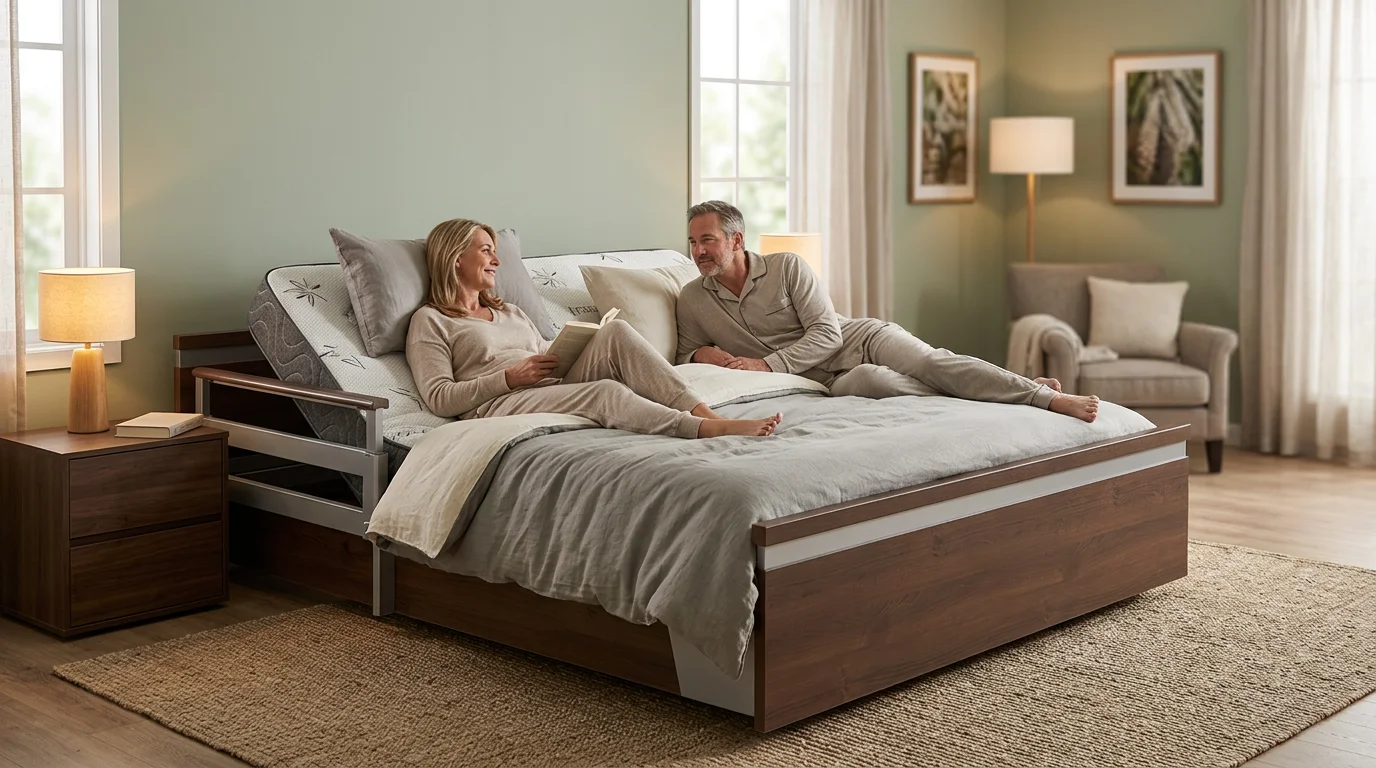
Wedges shift during sleep, particularly for active sleepers. When one partner needs sustained head elevation above 30–35 degrees every night, and the other needs to lie flat, a split adjustable base is the mechanical solution that pillow arrangements can only approximate. The SonderCare Aura Companion Bed operates as a split king, each side has independent backrest articulation up to 71 degrees, so your partner’s head can be elevated while your side remains completely flat. For a full discussion of adjustable bed options for couples, see our guide on Spousal Caregiving at Night: Adjustable Bed for Couples.
Side-Lying Support: Keeping Your Partner on Their Side Without Waking Them
Side sleeping is prescribed for snoring, positional sleep apnea, acid reflux (left side preferred), and many post-surgical recovery protocols. The problem is that people roll off their side the moment they fall deeply asleep.
“They roll onto their back the minute they fall asleep.” If you’ve said this, you know the cycle: nudge, twenty minutes of side sleep, roll back, nudge again.
The Pillow Between the Knees
The simplest, most evidence-supported side-lying tool is a pillow placed between the knees. An ergonomic review in Healthcare (2021) notes that in lateral sleep posture testing, a pillow between the knees keeps the hips stacked and the spine horizontal, minimizing biomechanical stress and reducing the discomfort that causes people to shift position.6 Clinical practice guidelines for pressure injury prevention from the National Pressure Injury Advisory Panel (NPIAP) also recommend it: placing the upper leg forward of the lower leg with pillow support promotes stability in the side-lying position.7
A pillow between the knees doesn’t prevent rolling on its own, but it makes the side position comfortable enough to stay in longer.
What this does to you: Nothing. A pillow between your partner’s knees is entirely contained on their side of the bed.
The Body Pillow Wall
For partners who actively roll supine, a full-length body pillow or firm bolster placed behind their back creates a physical barrier. When they shift toward their back, they hit the pillow and stop. This works best on a firm mattress, on a soft mattress, the pillow sinks with the person.
This is the solution most commonly recommended in snoring and sleep apnea forums, where partners describe it as the difference between 40 minutes of quiet sleep and four hours.
The 30-Degree Tilt Position
For partners who need to be on their side but keep migrating back toward supine, a pillow or rolled blanket placed behind the lower back provides a stable 30-degree tilt, not a full 90-degree side position, but a meaningful lean that reduces pressure on the sacrum and keeps the airway open.
This matters for pressure injury prevention too. Research comparing interface pressures found that a 90-degree lateral position creates peak pressure on the hip bone of 69–79 mmHg, while a 30-degree tilt keeps that pressure at 47–51 mmHg.8 That’s the clinical reason wound care nurses and occupational therapists teach the 30-degree tilt rather than full lateral positioning for patients at skin risk.
Pillow Under the Upper Arm
When someone is side-lying, the upper arm tends to fall forward and rotate the shoulder inward, which pulls the whole body toward rolling forward. A thin pillow under the upper arm prevents this and is particularly important after shoulder surgery or for stroke survivors whose affected arm needs supported positioning.
What this does to you: Pillows and body pillow barriers occupy real estate on the bed, but they don’t transfer motion. The main practical impact is bed width, factor this in if you’re already working with a queen-size mattress.
Leg and Foot Elevation for Edema, Varicose Veins, and Post-Surgery Recovery
One partner needs legs elevated above heart level, the other just wants a flat bed. Leg elevation is prescribed for peripheral edema, lymphedema, varicose veins, post-surgical recovery (hip, knee, vascular), and heart failure.
The Leg Wedge Technique
A dedicated foam leg-elevation wedge placed under the calves and heels holds position better than stacked pillows, which migrate during the night. The heels should extend slightly beyond the wedge’s edge so they aren’t bearing point pressure against the foam. This is called “floating the heels” and it’s the technique wound care nurses teach to prevent heel pressure sores in people who spend significant time in bed.
For back sleepers with edema, this setup affects only their side of the bed when placed correctly. The wedge sits under their legs from approximately mid-calf to heel; your side of the mattress remains flat.
For Side Sleepers With Edema
Elevating the feet while side-sleeping is trickier. A foot-elevation wedge works when someone is flat on their back; it doesn’t translate naturally to lateral positions. The combination that works for side-sleeping edema is a long bolster pillow between the knees (which raises the upper leg) paired with a separate pillow supporting the foot of the upper leg. This doesn’t achieve the same venous return angle as back-lying elevation, but it reduces dependent pooling in the lower leg.
Ask your partner’s physician or physical therapist what elevation angle their specific condition requires, the guidance differs for lymphedema, DVT prevention, and post-surgical swelling.
Nighttime Repositioning When Your Partner Can’t Move Themselves
This is the high-stakes end of the spectrum. Parkinson’s disease, stroke, advanced dementia, ALS, and neuromuscular conditions can all limit or eliminate a person’s ability to reposition independently. Research from Parkinson’s Foundation resources indicates that up to 80% of people with Parkinson’s report difficulty turning over or repositioning during sleep. The caregiver partner must physically assist, sometimes multiple times per night.
“Two people suffer sleep deprivation, the one being turned and the one doing the turning.” That description, from resources supporting families managing neuromuscular disease, names the problem exactly.
The Draw Sheet Technique
A draw sheet is a regular bed sheet folded to half-width, or a purpose-made slide sheet, placed under your partner’s torso from shoulders to hips. To reposition using a draw sheet:
- Stand at the side of the bed you want to roll your partner toward.
- Reach across them and grasp the far side of the draw sheet.
- Shift your body weight backward, lean back from your hips, rather than pulling with your arms.
- The sheet slides your partner toward you across the mattress surface.
This body-mechanics approach dramatically reduces caregiver back strain. Research consistently documents that 76% of informal caregivers report low back discomfort, and nearly one in three sustains a physical injury from caregiving activities. Nighttime repositioning by bending over a flat mattress and pulling is one of the primary injury mechanisms.
A satin or silk fabric layer placed under your partner from shoulders to hips reduces friction further and makes small position shifts much easier, particularly relevant for Parkinson’s, where small adjustments are needed frequently.
The Log Roll Technique
For repositioning from back to side-lying position:
- Place one hand on your partner’s far shoulder, one hand on their far hip.
- Gently roll them toward you as a single unit, shoulders and hips moving together, no twisting at the spine.
- Before releasing, place pillows to support the new position.
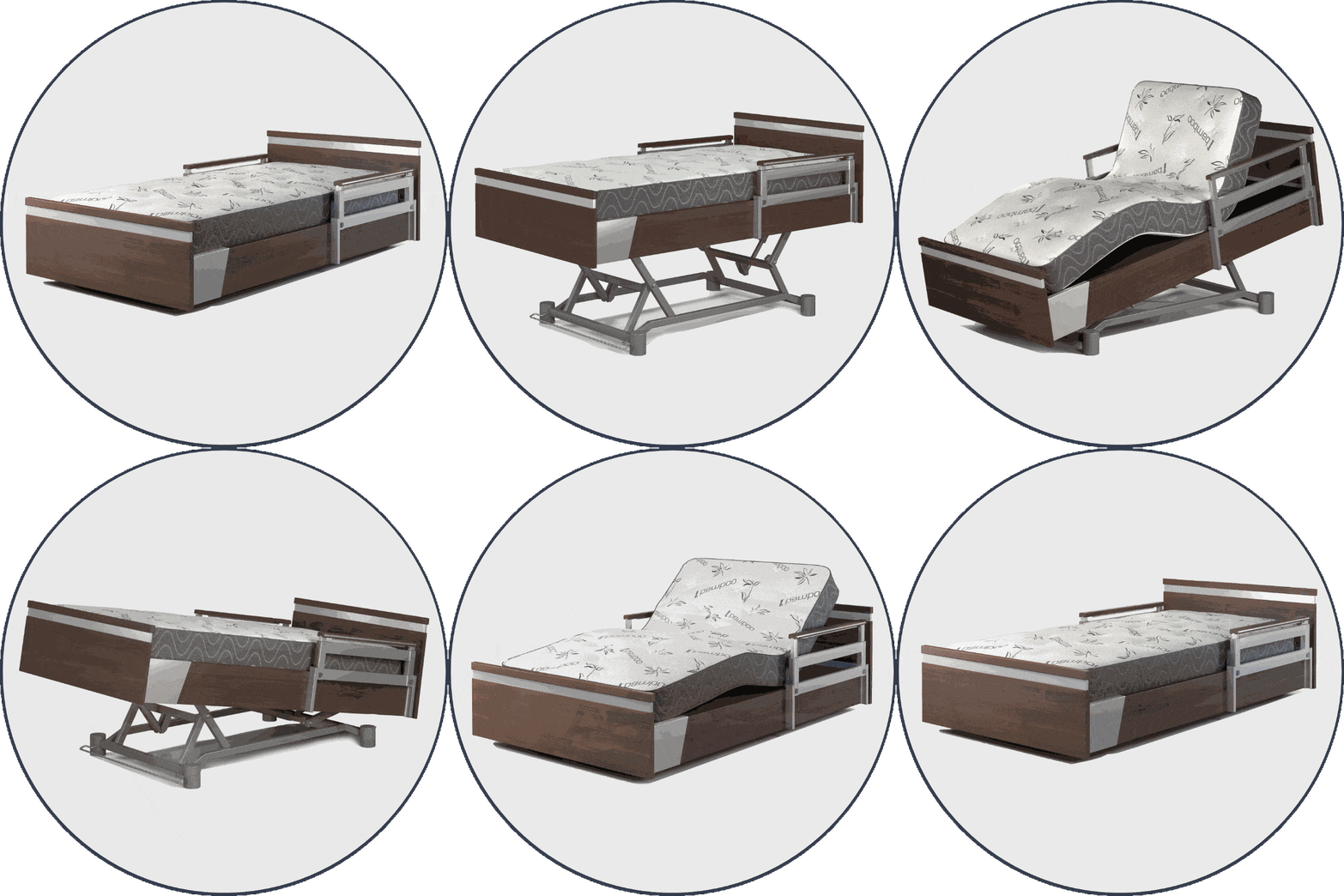
The log roll avoids spinal twisting and is suitable for one-person repositioning at a standard bed height. For the SonderCare Aura Premium Bed, the hi-lo height adjustment (10″ to 39″ working height) means you can raise the bed to a height that lets you work with a straight back rather than bending over from standing, a significant ergonomic protection for caregiver spines during nighttime repositioning.
The 4-Pillow Support Sequence After Turning
After rolling your partner onto their side, use this sequence before letting go:
- Pillow behind the back, tuck firmly from shoulder to sacrum to maintain the 30-degree tilt and prevent rolling back
- Pillow between the knees, prevents the top knee from falling forward and rotating the hip
- Thin pillow under the upper arm, supports the shoulder and prevents forward roll
- Pillow under the calf to float the heel, takes pressure off the heel bone for anyone at risk of pressure sores
This four-pillow sequence is what occupational therapists and wound care nurses teach as standard preventive positioning for immobile adults. Research found that standard pillows used to maintain a 30-degree tilt lost effectiveness over time, average angle decreasing from about 27° to 17° in two hours, which is why re-checking the position and re-tucking is part of the routine, not evidence of failure.9
How Often Do You Actually Need to Turn Someone?
The answer is less rigid than the classic “every two hours” guidance suggests. A Cochrane Review concluded there is no strong evidence that a specific two-hour frequency is universally optimal. Current guidelines from the NPIAP have moved toward individualized schedules based on the person’s mobility level, skin condition, and the type of mattress they’re on. For a complete guide to repositioning schedules, see how often should you turn a bedbound person.
An alternating pressure mattress overlay changes the calculation significantly, air cells inflate and deflate on a programmed cycle, reducing or eliminating the need for manual repositioning every two hours for some people. Multiple caregivers in online forums describe this as the single intervention that finally let them sleep through the night.
The Emotional Reality: What Nobody Says Out Loud
“I can’t sleep next to them anymore” and “I love them but I’m exhausted” aren’t problems that more pillow options solve. The physical techniques above are real and they help. But the positioning problem in a shared bed is also a relationship problem, and it deserves to be named.
Caregiver forums are full of the specific grief that comes with this: sleeping beside someone whose needs have changed so fundamentally that the bed itself has become a care environment. From the Alzheimer’s Society UK forum, one caregiver described the discomfort of sleeping beside “someone whose personality I hardly recognise” after nearly 39 years together. That’s not a wedge pillow problem.
The Guilt Around Wanting Your Own Sleep
Caregivers consistently describe guilt about wanting uninterrupted sleep when their partner has a medical need. This is worth saying directly: wanting to sleep is not selfish. It is how you stay capable of giving care. A CDC analysis of caregiver health outcomes documents a high co-prevalence of depressive symptoms and elevated cardiometabolic risk associated with caregiver sleep deprivation.1 Your sleep is not a luxury. It is a prerequisite for the care your partner is counting on.
The Sleep Separation Question
A 2024 survey by the American Academy of Sleep Medicine found that 29% of Americans have chosen to sleep separately to accommodate a partner.10 Sleeping in separate beds or rooms is not a measure of how much you love someone. In many caregiver communities, it’s reframed this way: sleep apart so you can be more present when you’re together.
If you’re weighing this decision, whether to continue sharing a bed or to create a sleeping arrangement that gives both of you more rest, our Spousal Caregiver’s Guide to Sleeping Separately walks through the full conversation, including how to approach it with your partner and how other couples have maintained closeness while sleeping in different spaces.
The spectrum of solutions is wider than same bed versus separate rooms. Some couples sleep in the same room in adjacent beds. Some share a bed that allows one side to elevate independently. Some maintain a specific ritual, a goodnight moment, a morning check-in, that anchors the relationship across the physical distance. The goal is rest for both of you, in whatever arrangement makes that possible.
When Positioning Technique Isn’t Enough: Independent Side-by-Side Solutions
Some nights, the mismatch between partners’ needs is too large for wedges and pillow architectures to bridge. One partner needs sustained head elevation above 35 degrees for acid reflux every night. The other sleeps flat. One partner needs frequent position changes. The other needs uninterrupted sleep. A wedge on one side of a shared mattress can’t solve that, it creates incline for both people.
A split adjustable base solves it mechanically. Two independent frames placed side by side, each with its own motor and controls, means one side can be elevated while the other stays completely flat. Because the frames are mechanically separate (not a single continuous platform), movements and adjustments on one side don’t transfer structurally to the other. Consumer lab reviews consistently report that split king setups provide effective motion isolation, with separate mattresses preventing surface-level movement transfer between sides.11
The SonderCare Aura Companion Bed offers this in a residential design: operating in Split King mode, each partner controls their own head and knee elevation independently while synchronized hi-lo adjustment allows the couple to raise and lower the bed height together. It’s available with furniture-grade upholstered headboards that don’t read as medical equipment in a bedroom.
For the full decision guide on adjustable beds for couples, including what to evaluate, how different configurations work, and how to approach the conversation with your partner, see Spousal Caregiving at Night: Adjustable Bed for Couples.
Frequently Asked Questions
How do I keep my partner on their side without waking them up?
Use a combination of a pillow between the knees (for comfort and hip stability) and a body pillow or firm bolster tucked behind their back. The body pillow acts as a physical barrier, when your partner’s body shifts toward supine, they encounter the pillow rather than rolling fully over. On a firm mattress, this works reliably. The key is placing the pillow before they fall asleep, not after.
If I use a wedge pillow on my partner’s side, will it tilt my side too?
On a firm mattress with a quality foam wedge placed only under your partner’s torso, the effect on your side is minimal. On a softer mattress, the wedge shape can transmit a slight incline through the mattress surface. An under-mattress incline wedge (which elevates the mattress itself on one side) is often less noticeable to the flat-sleeping partner than a surface wedge.
What angle should the head be elevated for acid reflux vs. snoring vs. COPD?
- Acid reflux (GERD): 35–45 degrees, or 6–8 inches of vertical lift at the head. Left-side sleeping also reduces acid exposure.
- Snoring and mild sleep apnea: 20–30 degrees is sufficient for many people; a 7.5-degree elevation has been shown to reduce sleep apnea severity by roughly 30%.5
- COPD and breathing difficulty: 30–45 degrees. Severe breathing episodes may require sitting more upright (Cardiac Chair position).
- When in doubt, start lower and increase based on symptom relief. A physician or respiratory therapist can guide the target elevation for your partner’s specific condition.
What is a draw sheet and how do I use it alone?
A draw sheet is a standard bed sheet folded to half its width and placed under your partner’s torso from shoulder blades to hips. To use it: stand beside the bed, reach across your partner, and grasp the far edge of the sheet firmly. Then lean back from your hips, shift your whole body weight backward, rather than pulling with your arms and back. Your partner slides toward you across the mattress. This technique protects your lower back by converting the effort from an arm-and-back pull to a body-weight shift.
How often do I really need to reposition my partner at night?
The “every two hours” guideline is a starting point, not a universal rule. Current clinical guidelines recommend individualizing the schedule based on your partner’s mobility level, skin condition, the mattress type, and their risk factors for pressure injuries. Someone on an alternating pressure mattress overlay may need manual repositioning far less frequently. Someone at high risk with normal mattress and limited mobility may need it every two hours. A home health nurse or occupational therapist can help you establish the right schedule for your specific situation.
What pillow goes where when my partner is lying on their side?
Four placements:
1. Behind the back (shoulder to sacrum), maintains the side position and prevents rolling supine
2. Between the knees, keeps hips stacked and spine aligned, reduces hip and back discomfort
3. Under the upper arm, supports the shoulder and prevents the upper body from rolling forward
4. Under the calf (if pressure sore risk), floats the heel above the mattress surface
Is sleeping separately a failure if positioning in the same bed doesn’t work?
No. A 2024 American Academy of Sleep Medicine survey found that 29% of Americans have chosen to sleep separately to accommodate a partner’s needs. In caregiver communities, this is widely understood as a practical act of care, both partners getting rest, rather than a measure of relational failure. Many couples maintain the same room, different beds. Others sleep separately but maintain specific rituals. If you’re navigating this question, see our Spousal Caregiver’s Guide to Sleeping Separately for a fuller discussion.
Positioning Is the Starting Point, Rest Is the Goal
Every technique in this guide, the wedge angle, the draw sheet sequence, the 4-pillow setup, exists to serve one purpose: both of you getting enough sleep to function tomorrow.
Positioning technique is the first tool. Equipment is the amplifier. For couples whose positioning needs exceed what pillow arrangements can deliver, an adjustable setup with independent sides changes what’s possible without requiring separate bedrooms. Our complete hospital-grade bedroom setup guide covers the full picture of equipment, layout, and care environment decisions for families managing care at home.
If you’re at the point of evaluating adjustable bed options for your specific situation, our bed experts are available for a consultation with no pressure attached. What works is a setup that lets both of you rest, and that looks like your bedroom, not a hospital room.
References
- Lu H, et al. “Short self-reported sleep duration among caregivers and non-caregivers in 2016.” PMC. 2021. https://www.ncbi.nlm.nih.gov/pmc/articles/PMC8630996/
- Gao C, Scullin MK, et al. “Sleep Duration and Sleep Quality in Caregivers of Patients With Dementia and Other Conditions: A Systematic Review and Meta-analysis.” JAMA Network Open. 2019. https://jamanetwork.com/journals/jamanetworkopen/fullarticle/2748661
- Walters AS, Pankhurst T, & Meadows R. “Partner disturbance in co-sleeping: A systematic review.” Sleep Medicine Reviews. 2026. https://www.sciencedirect.com/science/article/pii/S2352721826000045
- Albarqouni L, et al. “Head of bed elevation to relieve gastroesophageal reflux symptoms: a systematic review.” BMJ Open. 2021. https://pmc.ncbi.nlm.nih.gov/articles/PMC7816499/
- de Barros Souza FJF, et al. “The influence of head-of-bed elevation in patients with obstructive sleep apnea.” Sleep & Breathing. 2017. https://pmc.ncbi.nlm.nih.gov/articles/PMC5700252/
- Lei JX, et al. “Ergonomic Consideration in Pillow Height Determinants and Evaluation.” Healthcare (Basel). 2021. https://pmc.ncbi.nlm.nih.gov/articles/PMC8544534/
- European Pressure Ulcer Advisory Panel, National Pressure Injury Advisory Panel and Pan Pacific Pressure Injury Alliance. “Prevention and Treatment of Pressure Ulcers/Injuries: Clinical Practice Guideline. The International Guideline.” 2019. https://www.internationalguideline.com/repositioning
- Ghezeljeh TN, et al. “A Comparative Study of 2-Hour Interface Pressure in Different Angles of Laterally Inclined, Supine, and Fowler’s Positions in Healthy Adults.” International Journal of Environmental Research and Public Health. 2021. https://www.ncbi.nlm.nih.gov/pmc/articles/PMC8507824/
- Kapp S, Gerdtz M, Gefen A, et al. “An observational study of the maintenance of the 30° side-lying lateral tilt position, using a standard pillow and a fluidised positioner.” International Wound Journal. 2019. https://pmc.ncbi.nlm.nih.gov/articles/PMC7949259/
- American Academy of Sleep Medicine. “Americans opting for ‘sleep divorce’ to accommodate bed partner.” 2024. https://aasm.org/americans-opting-sleep-divorce-accommodate-bed-partner/
- National Council on Aging. “Best Split King Adjustable Beds of 2026.” https://www.ncoa.org/product-resources/sleep/best-split-king-adjustable-beds/