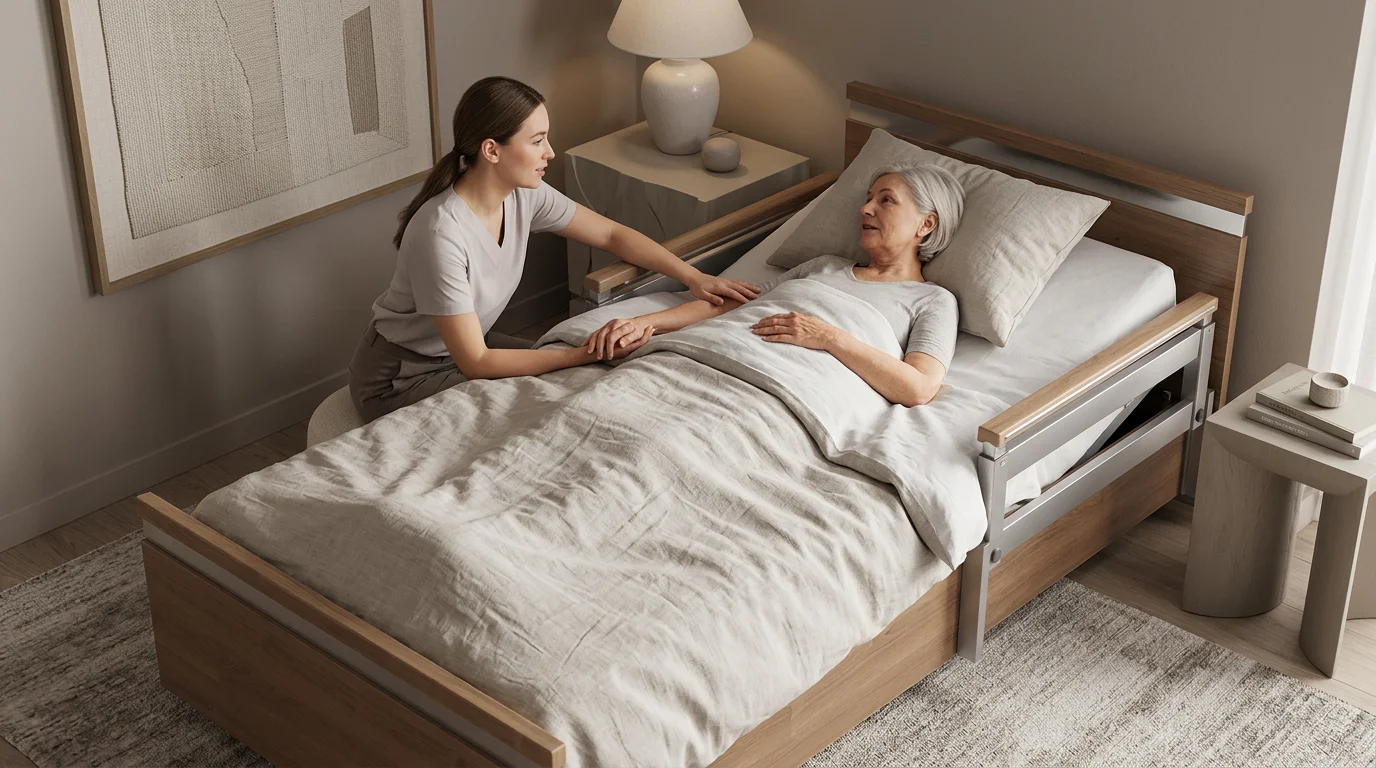






Picture the morning routine. Your mother is awake, but the process of getting her upright and to the bathroom is already a small crisis. The standard bed sits at knee height. She can’t push herself up anymore. You lean over, again, bracing your lower back against the familiar strain. She grabs your arm. For a moment, neither of you is stable.
If this sounds familiar, you’re not alone. More than one in four older adults falls each year in the United States, and roughly 3 million require emergency department treatment for fall-related injuries annually.1 The age-adjusted fall death rate has been rising, with recent data showing a 21% increase among older adults, a trend that has prompted renewed urgency around home safety equipment.2 And yet the most common fall scenario is not a dramatic accident. It’s a bed exit. It’s the pivot moment when someone is partially sitting, partially standing, and neither position is stable.
Up-and-down bed solutions, beds that can raise the head, elevate the body to sitting, and adjust the entire frame’s height, are designed specifically for this problem. This guide explains what these beds actually do, why both features matter, and how to choose the right configuration for your situation.
What “Up-and-Down” Actually Means: Two Distinct Features
The phrase “up-and-down bed” gets used loosely, but there are two mechanically different functions at play, and understanding both is essential before comparing any products.
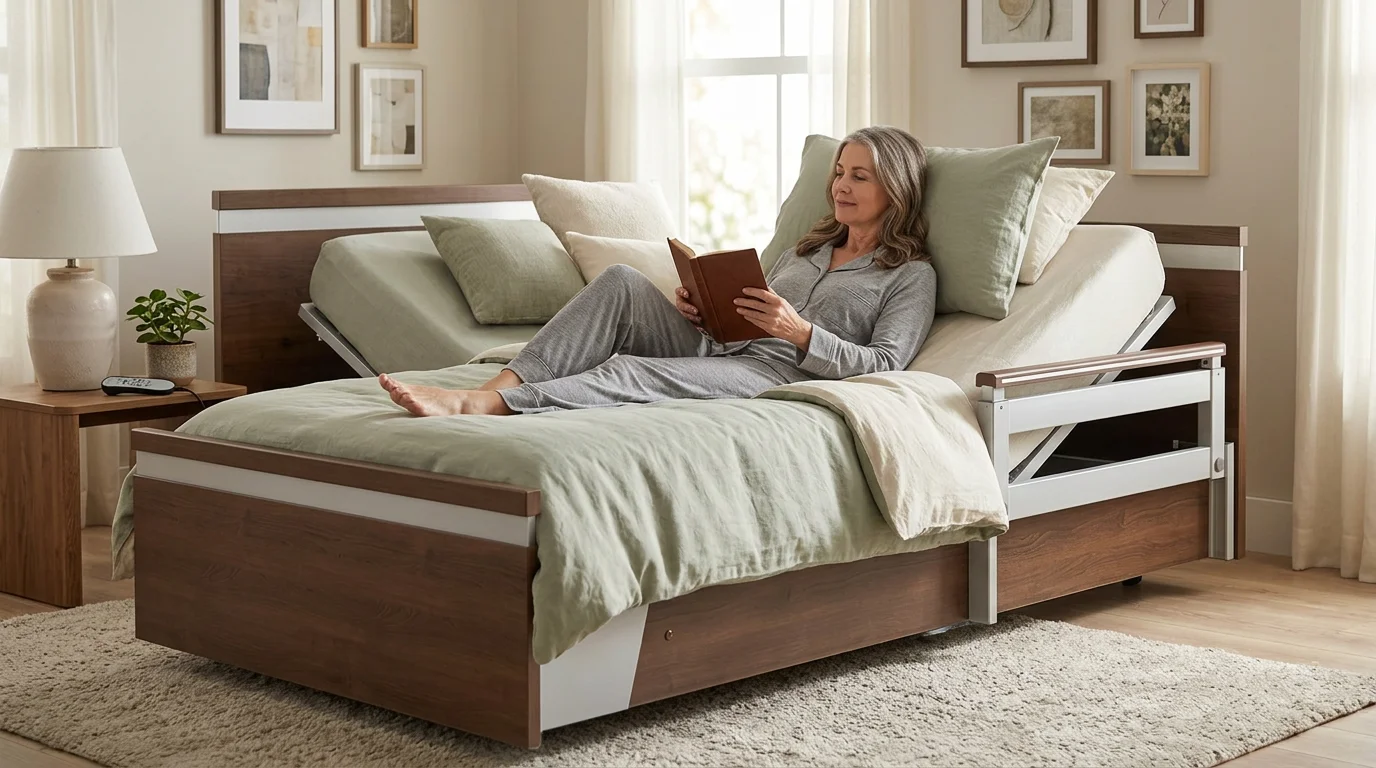
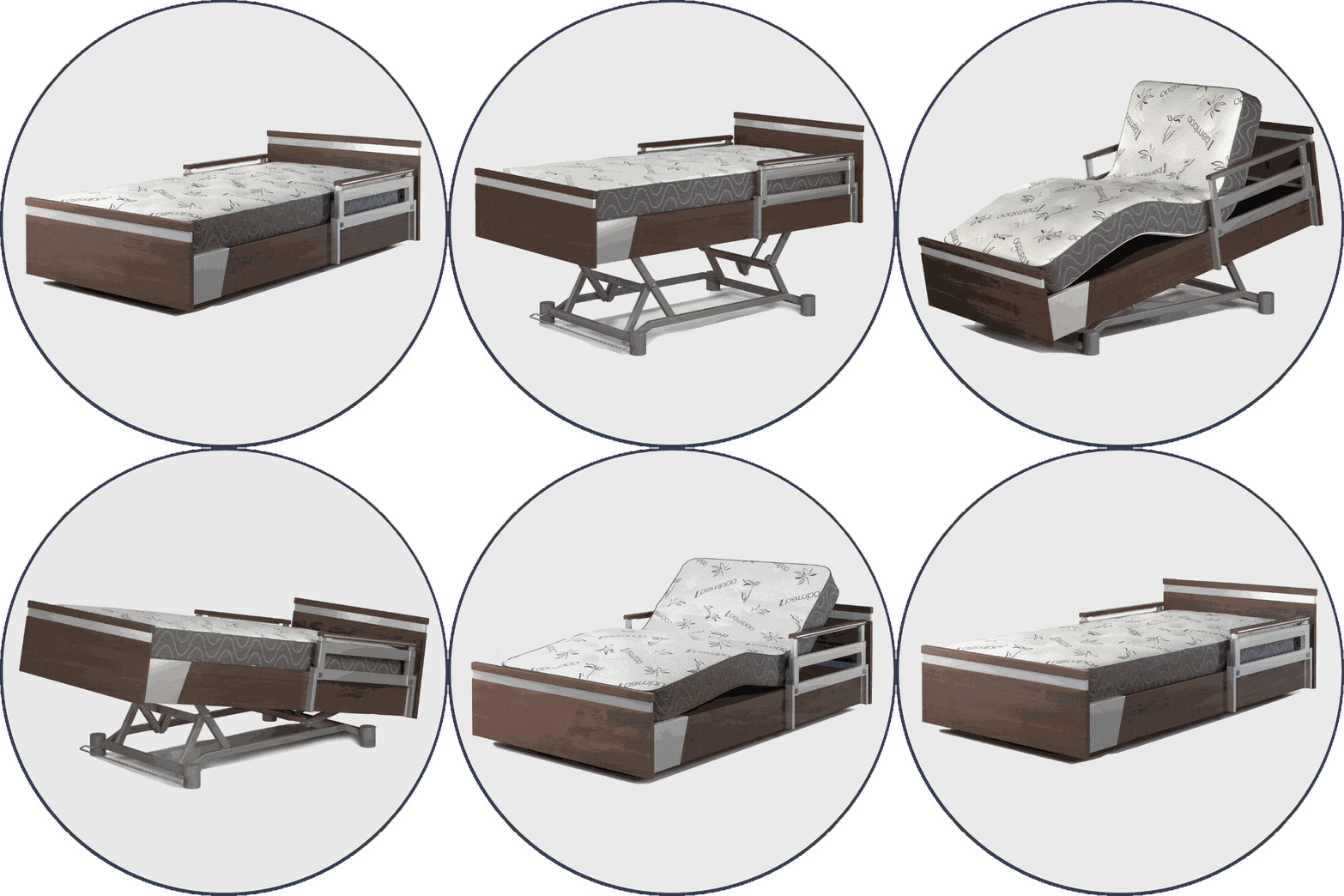
Feature 1: Head and backrest elevation. This is the tilting motion that raises the upper body from flat to a semi-upright position. Most people picture this when they hear “adjustable bed.” It’s useful for reading, watching television, eating in bed, or managing conditions like COPD and acid reflux where lying flat is uncomfortable. The head raises; the rest of the frame stays put.
Feature 2: Full-frame height adjustment (hi-lo). This is an entirely separate motor system that raises or lowers the entire bed platform, from floor level (sometimes as low as 10 inches) up to hip or counter height (typically 28 to 39 inches). The person in the bed doesn’t move up or tilt. The whole frame shifts vertically.
Most consumer adjustable beds, including well-known brands designed primarily for comfort, offer Feature 1 only. A true home hospital bed with hi-lo capability offers both. That distinction matters enormously, because the two features solve two different problems for two different people.
The head raise helps the person in the bed. The height adjustment helps the caregiver, and the person getting out of bed.
How Full-Height Adjustment Protects the Caregiver
Manual patient handling is, by federal health authority assessment, the single greatest risk factor for work-related musculoskeletal disorders in healthcare settings.3 That finding applies equally to paid nursing assistants and family caregivers performing the same physical tasks at home.
The math is straightforward. A caregiver performing six to ten bed-to-chair or bed-to-commode transfers per day, year after year, is accumulating compressive force on the lumbar spine in an amount that structural tissue cannot sustain indefinitely. Direct and indirect costs associated with back injuries in the healthcare industry are estimated at $20 billion annually.4 As many as 20% of nurses who leave direct patient care positions report that physical risk was a contributing factor.4 Family caregivers absorb the same physical risk, without workers’ compensation, without occupational health resources, and often without even recognizing it as a clinical problem until surgery is the only option.
The biomechanics are clear: bed height is one of the most significant variables in transfer safety. A study examining biomechanical stress during patient transfers found that lower bed heights involve greater ground reaction forces, reduced stability, and increased physical difficulty for the person performing the transfer.5 A separate study on slide boards and vertical-assist devices during transfers confirmed that even partial mechanical assistance, providing 18 to 36% of the patient’s body weight in vertical support, meaningfully reduces caregiver physical load.6
What this means practically: a bed that raises to hip height for a transfer puts the caregiver in a neutral mechanical posture. Their spine is straight. Their knees are not bent. They are assisting, not lifting. The same bed lowered back to 10 or 12 inches during the day, or at night, keeps the person in the bed safer in the event of an unassisted roll or exit.
One insight from caregiver communities captures this well: the high position is for the caregiver; the low position is for the person in the bed. It is not one setting. It is two different jobs performed by the same machine.
How the Same Adjustment Restores Independence
There is a second story inside the same feature, and it’s equally important.
When a bed is at the right height for the person in it, feet flat on the floor when sitting on the edge, a senior with limited strength can often stand with minimal help, or none. They push up from a stable seated position at the correct ergonomic angle, rather than trying to launch themselves from a mattress that is 6 inches lower than their center of gravity can manage.
The relevance to fall prevention is direct. Research on the origin of falls in care settings consistently points to bed-exit transitions as among the most common fall scenarios, with some studies finding that 51% of falls occurred specifically while getting into or out of bed.7 Bed exit alarms, rails, and grab bars address the symptom. Adjustable height addresses the underlying mechanical problem: the bed is the wrong height for the person’s body.
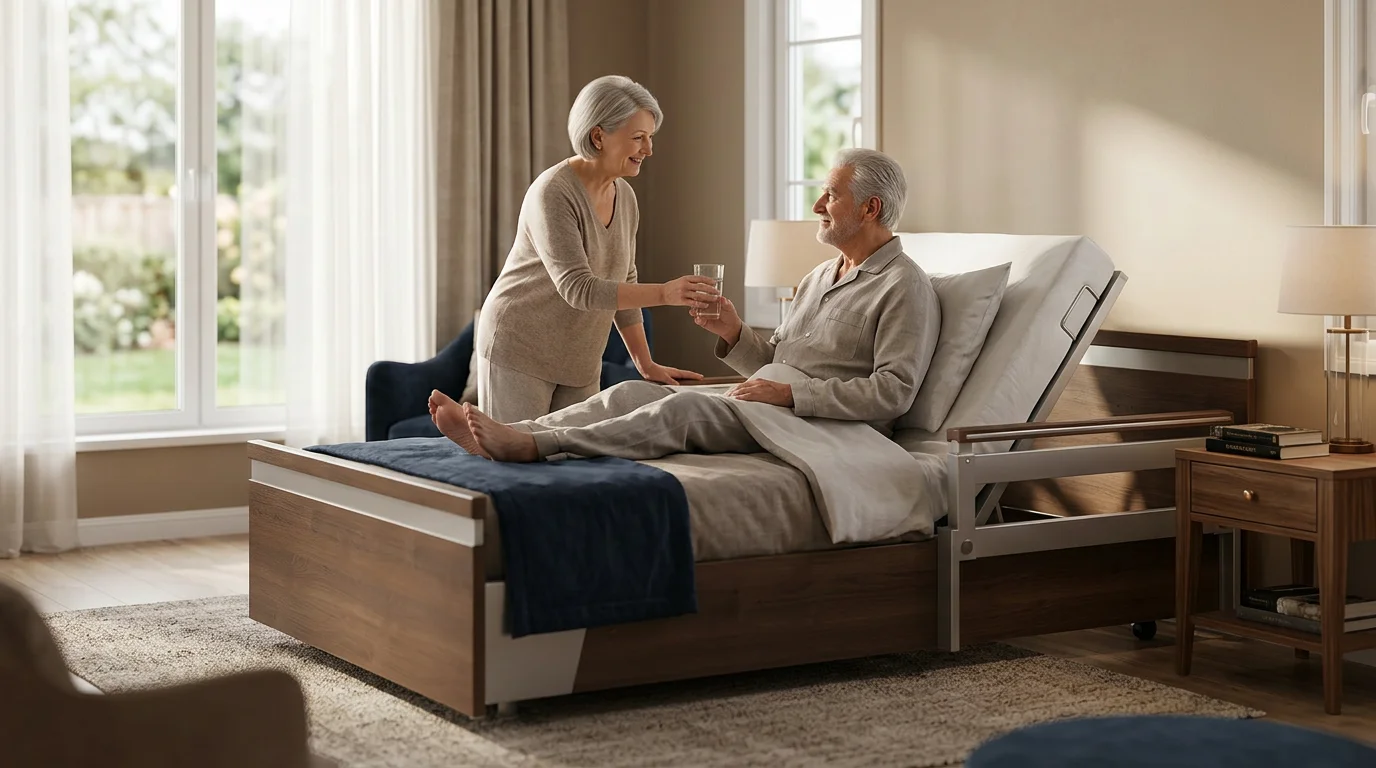
When a senior can adjust the head angle to help them rock forward, then lower the frame so their feet touch the floor, then push to stand with the bed at the right height, they are doing the work themselves. The caregiver is standing by, not doing the deadlift. The family’s account of this shift, drawn from real caregiver communities, is consistent: “I felt guilty it took us this long. My husband goes from lying flat to sitting upright with the head raised, then I lower the whole bed until his feet touch the floor. He can stand with almost no help from me. It’s like I got my back, and my morning, back.”
This is the emotional win. Not the elimination of caregiving, but the restoration of shared agency in a daily routine that had become a source of fear for both people.
Fall Prevention by Design: What the Evidence Says
Falls among older adults are not random. The CDC tracks them as a leading cause of injury death, and the data on where falls happen points specifically to the bed-exit scenario as a high-risk moment.1 The combination of features in a full-function home hospital bed, low platform height, height adjustment, head elevation, and bed rails, represents an engineering approach to fall prevention that addresses the root cause rather than adding detection equipment after a fall has already begun.
A systematic review of hospital bed-related injuries found that standard bed heights are simply too high for safe egress for many patients, and that bed rails alone do not produce statistically significant reductions in fall rates when controlling for other variables.7 The implication is that the height of the platform at the moment of exit, not the presence of a rail, is the more important variable.
In practical terms, this supports two separate configurations for an adjustable-height bed:
- Daytime and transfer height: raised to allow stable, assisted, or unassisted transfer
- Sleeping height (FallSafe low): platform as close to the floor as possible, reducing the distance and severity of any unassisted exit
The fall prevention guide for seniors at home covers the full range of bedroom safety measures, including floor mats, nightlights, and grab rails. An adjustable-height bed works best as part of this complete safety environment.
Rotating Beds: An Advanced Solution for Specific Needs
For most caregivers, the combination of head-raise and full height adjustment is sufficient. But there is a category of need, particularly relevant for individuals living with Parkinson’s disease, severe spasticity, or significant loss of trunk control, where even a fully adjusted upright position is not enough to initiate standing.
Rotating or profiling beds address this by adding lateral rotation to the height and head adjustment functions. The person can be moved to their side, knees bent, and the bed itself rotates toward the edge, essentially assisting the user into a seated, dangling position from which standing is much more manageable. For a solo caregiver managing a partner with Parkinson’s rigidity or post-stroke hemiplegia, this can be the difference between managing at home and transitioning to facility care.
These products are more specialized, typically more expensive, and require a clear clinical indication. If you are caring for someone with one of these specific conditions, your occupational therapist or physical therapist can assess whether a rotating mechanism is warranted and help you trial appropriate products before purchase.
The “Nursing Home Look” Problem, and Why It Has a Real Solution
One of the most consistent findings across caregiver communities is that standard home hospital beds, metal frames, removable plastic headboards, visible motor assemblies, create an immediate psychological shift in how a bedroom feels. One caregiver summarized it plainly: “She took one look at it and said, ‘that’s a hospital bed, I’m not dying.'”
This is not irrational. A bedroom is a deeply personal space. The visual cue of clinical equipment in that space signals loss of independence in a way that other adaptive equipment does not. It is also, fortunately, not the only option.
The home hospital bed market has evolved significantly. At one end are standard durable medical equipment beds, functional, covered by Medicare with a physician’s order, but unmistakably clinical in appearance. At the other end are residential-aesthetic home hospital beds that retain every safety and positioning feature while using upholstered panels, premium headboards, and furniture-grade finishes that blend into a normal bedroom.
For families where aesthetics are a meaningful barrier to adoption, options like the Aura Platinum, which features fully upholstered side panels in Slate Gray Crypton fabric, offer a genuine middle path. The positioning capabilities, FallSafe ultra-low height, and full-electric operation are all identical to the clinical version. What changes is the visual presentation of the bed in the room.
Our separate guide on hospital beds that don’t look clinical covers this spectrum in more detail, including questions to ask about finishes, headboard profiles, and side panel options before you purchase.
A Realistic Word About Medicare Coverage
Medicare coverage for hospital beds at home is one of the most misunderstood topics in this category. Here is what you actually need to know.
Medicare Part B covers standard home hospital beds, meaning a basic full-electric or semi-electric model with head and foot adjustment, when a physician certifies medical necessity and the equipment supplier is Medicare-enrolled. Coverage generally applies to basic hospital beds with side rails, hospital-grade mattress, and safety rails. The government’s reimbursement is for a functional standard, not a premium aesthetic.
Medicare does not cover luxury or residential-aesthetic models with upholstered panels, furniture-grade finishes, or features beyond the medically necessary standard. Families choosing a premium home hospital bed for aesthetic or long-term quality reasons are generally purchasing out-of-pocket, financing the difference, or supplementing a basic Medicare-covered rental with a private purchase.
This does not mean premium beds represent poor value, the home care vs. nursing home cost comparison shows that even a $7,000–$9,000 bed purchase can represent significant savings over facility care costs within a relatively short period. But transparency about what insurance covers is essential for realistic planning.
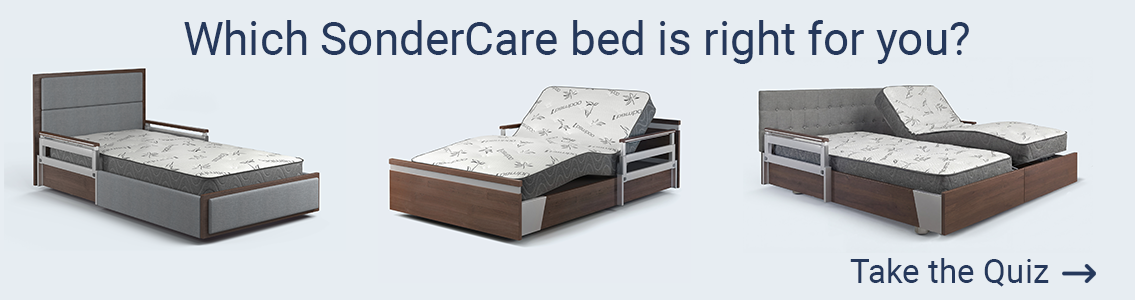
If you are in a hospital discharge situation with a narrow window, your discharge planner can help establish medical necessity documentation for basic Medicare coverage. If you are planning ahead, a consultation with a SonderCare bed expert can help you understand your options across the full price range and what configuration best matches your specific needs and budget.
What to Look for in a Home Up-and-Down Bed
Not all beds marketed as “hi-lo” or “adjustable” deliver the same functional range. When evaluating a home hospital bed for lift, sit, and assist capabilities, look for these specific specifications:
Height range: The most important number is the low height. A platform that only lowers to 16 or 18 inches does not provide the same fall-risk reduction as one that reaches 10 inches. Full hi-lo beds span from approximately 10 inches (FallSafe) to 39 inches (standing-caregiver working height). Consumer adjustable beds and some homecare models do not offer this range.
Head angle: Backrest elevation to at least 60–70 degrees allows the person in the bed to reach a fully upright seated position from which standing is biomechanically practical. Beds with a 30–45 degree maximum backrest limit are useful for comfort but not for sit-to-stand assistance.
Pre-programmed transfer position: Some beds include a memory-programmed height, typically around 21 inches, for wheelchair-to-bed or bed-to-wheelchair transfers. This standardization matters for consistent, safe technique.
Weight capacity: The published “total system load” typically includes user weight, mattress weight, and accessories. For a 250-pound user, confirm the actual user weight maximum (not the marketing headline) and verify the rail load limits independently. Research in home use of adjustable bed systems found clinically acceptable pressure mapping and no skin breakdown events when the bed was appropriately specified for the user’s needs.8
Certifications: For clinical reassurance, look for beds certified to an international hospital standard (IEC 60601-2-52) and manufactured under an ISO 13485-certified quality management system. These certifications confirm that the bed has been designed and tested to the same safety standards used in clinical settings, not just the comfort standards of a consumer adjustable bed.
For a comprehensive overview of evaluation criteria including full-electric vs. semi-electric function, weight capacity guides, and delivery considerations, see our complete guide to setting up a hospital-grade bedroom at home.
How SonderCare’s Aura Line Approaches Lift, Sit, and Assist
The Aura Premium is SonderCare’s full-featured home hospital bed built specifically around the lift, sit, and assist functions described in this guide. The platform lowers to 10 inches (17 inches to the top of the mattress) via the FallSafe Ultra-Low Height system, and raises to 39 inches for caregiver access. A pre-programmed transfer position at 21 inches is stored in the hand controller for wheelchair users and consistent transfer routines.
The backrest adjusts to 71 degrees with integrated mattress-length compensation so the sleeping surface adjusts proportionally as the head section rises, preventing the person in the bed from sliding down. The knee section raises independently to prevent forward migration and support Zero Gravity or Cardiac Chair positions for comfort and clinical needs.
The hand controller locks are available in key-switch or magnetic-chip configurations, important for households where the person in the bed has cognitive limitations and should not have unsupervised access to the adjustment controls.
The Aura Platinum offers identical positioning, FallSafe height, and weight capacity (500 lbs) in a design with fully upholstered Slate Gray Crypton side panels and a furniture-grade headboard, addressing the aesthetic resistance that is a genuine purchase barrier for many families. For users who require additional width, the Aura Extra Wide Premium provides a 48-inch sleeping surface with the same full positioning suite.
All Aura beds are certified to International Hospital Standard and manufactured under an ISO 13485-certified quality management system. A 5-year comprehensive parts warranty is included with every bed.
Understanding How the Bed Protects Both People
The physical strain of caregiving, particularly the daily transfers from bed, is one of the most underreported causes of caregiver health decline. For a deeper look at how bed height adjustment, positioning, and caregiver ergonomics work together to reduce injury risk, the caregiver physical strain and hospital bed positioning guide covers the mechanics in detail, including how to work with an occupational therapist to identify the right bed height for your specific transfer technique.
For most families, the decision point is not whether an up-and-down bed would help. The evidence, from falls data to caregiver injury research, is clear that it would. The decision is which configuration, at which price point, is right for your specific situation. A bed expert consultation is the fastest way to work through that question. SonderCare’s team can assess your setup, discuss Medicare options, and help you understand the full configuration, bed, mattress, accessories, before any commitment.
Choosing the Right Up-and-Down Bed Solution
The morning routine does not have to stay dangerous. A bed that lifts, sits, and assists is not a concession to decline; it is a tool for extending the period during which daily life at home remains possible and safe for both the person in the bed and the person caring for them.
When evaluating your options, use these three questions as your decision framework:
- What does the caregiver need? If back strain from bending is the primary issue, full-frame height adjustment is the non-negotiable feature. Verify the full range (low to high), not just the marketing headline.
- What does the person in the bed need? If independent sitting and standing assist is the goal, look for head elevation angle and a pre-programmed transfer height that enables a stable sit-to-stand without requiring the caregiver to provide upward force.
- What does the bedroom need? If aesthetics are a barrier to acceptance; and they often are, a residential-design bed with upholstered panels is a genuine solution, not a compromise.
For a comprehensive overview of how to evaluate all of these factors together, the guide on how to choose a home hospital bed walks through the full decision process including certifications, weight capacity, mattress compatibility, and delivery options.
The right bed does not transform the caregiving relationship. But it changes the morning, and when you start the day without injury, without fear, and without a daily argument about who is in charge of whom, everything else is more manageable.
References
-
Centers for Disease Control and Prevention. “Facts About Falls.” Older Adult Fall Prevention. Updated January 27, 2026. https://www.cdc.gov/falls/data-research/facts-stats/index.html
-
Centers for Disease Control and Prevention. “Older Adult Falls Data.” Updated February 26, 2026. https://www.cdc.gov/falls/data-research/index.html; McKnight’s Long-Term Care News. “New CDC data: Older adults face rising fall death rates.” June 18, 2025. https://www.mcknights.com/news/new-cdc-data-older-adults-face-rising-fall-death-rates/
-
CDC/NIOSH. “About Safe Patient Handling and Mobility.” Updated May 9, 2024. https://www.cdc.gov/niosh/healthcare/prevention/sphm.html
-
U.S. Department of Labor, OSHA. “Healthcare, Safe Patient Handling.” https://www.osha.gov/healthcare/safe-patient-handling
-
Usmani, A.R., et al. “Biomechanical investigation of optimal bed height for patient transfer.” Applied Ergonomics (ScienceDirect), 2023. https://www.sciencedirect.com/science/article/pii/S2772501423000209
-
Banks, J.J., et al. “Biomechanical stresses on healthcare workers during patient transfer tasks: the impact of slide boards and vertical assistance.” International Journal of Industrial Ergonomics, 2024. https://www.sciencedirect.com/science/article/pii/S0169814124000404
-
Bloswick, D.S., et al. “The Safety of Hospital Beds: A Systematic Review of Reports of Hospital Bed-Associated Injuries, Entrapments, and Entrapment-Related Deaths.” Global Qualitative Nursing Research, 2015. CDC Stacks. https://stacks.cdc.gov/view/cdc/230904/cdc_230904_DS1.pdf
-
Levinson, R., Salas, L., & Zanca, J.M. “The experience of using a hospital bed alternative at home among individuals with spinal cord injury: A case series.” Journal of Spinal Cord Medicine, 2023. https://pubmed.ncbi.nlm.nih.gov/34139138/