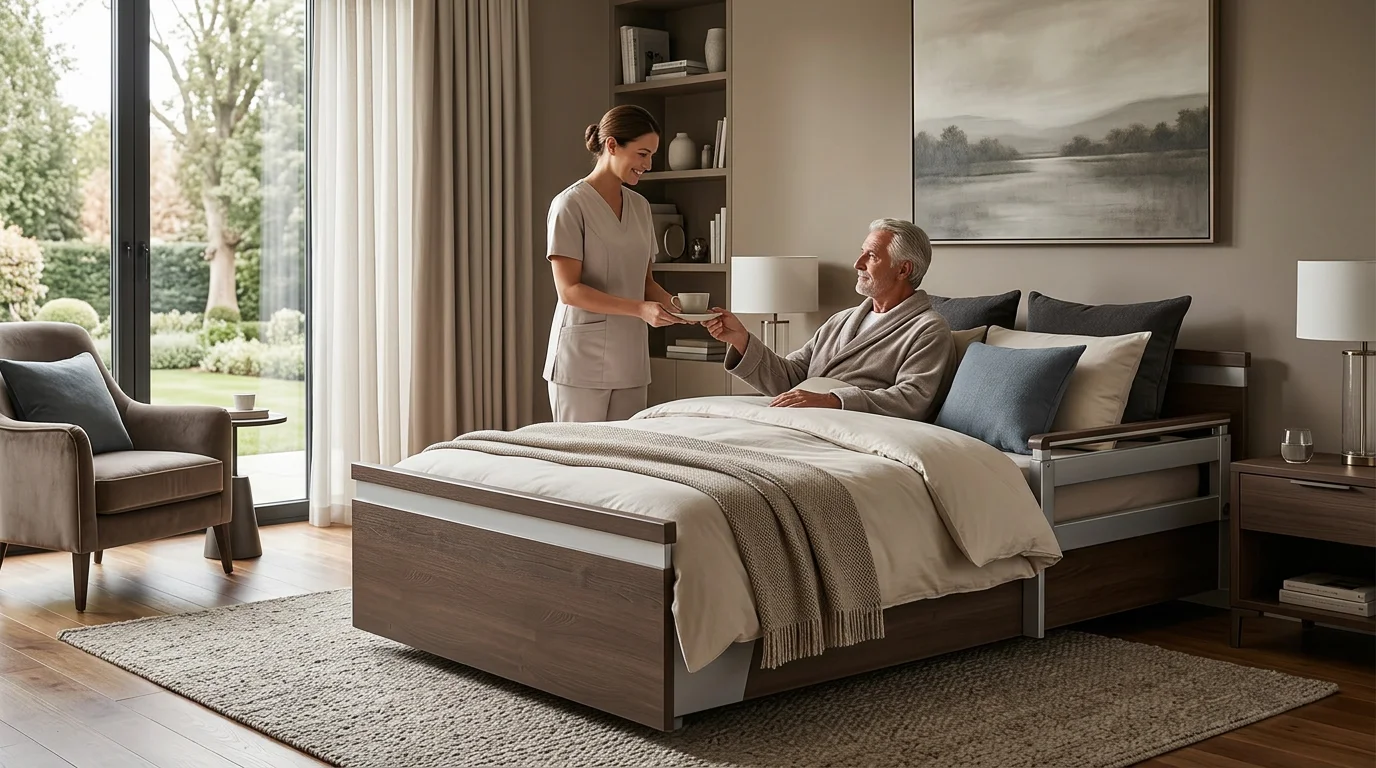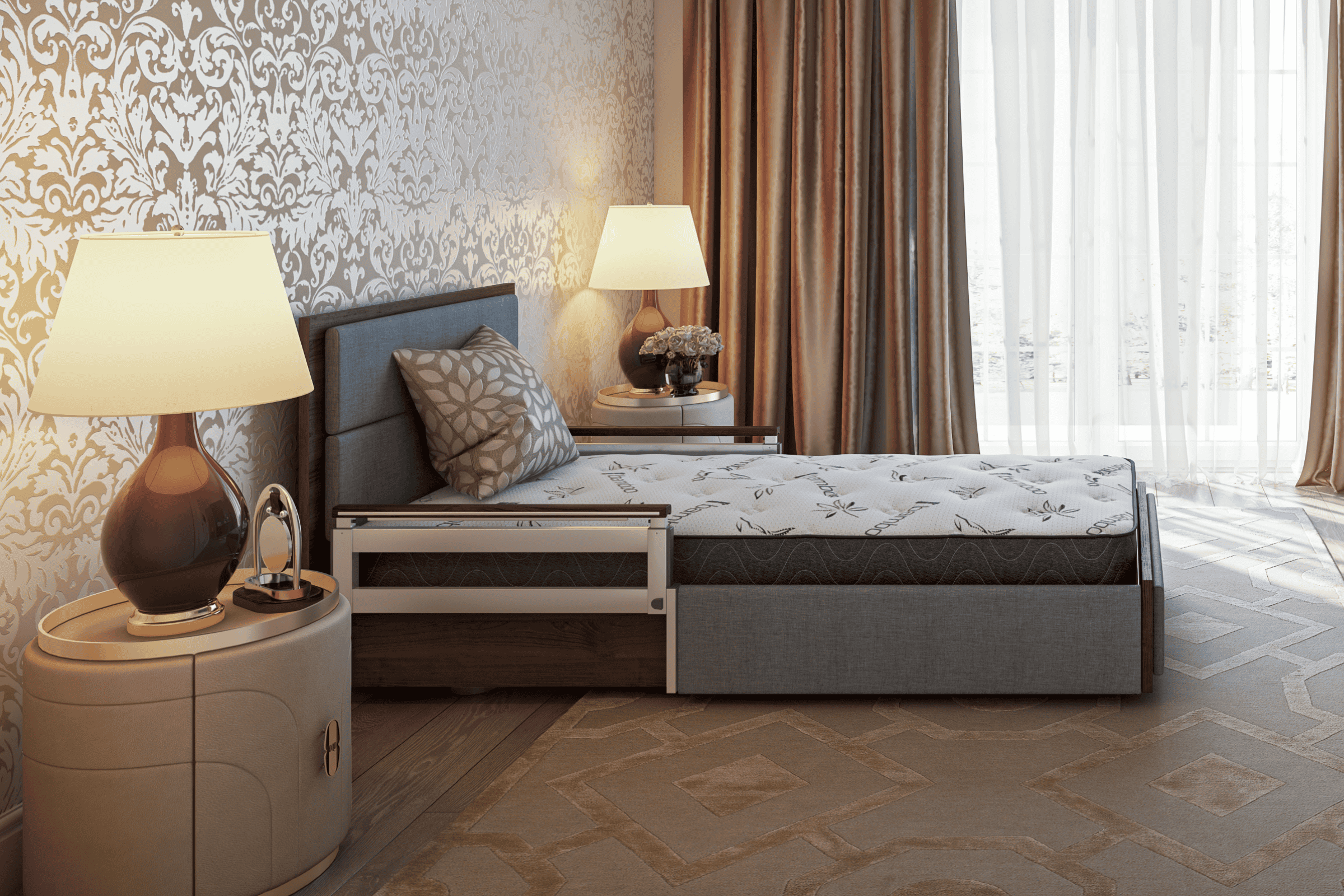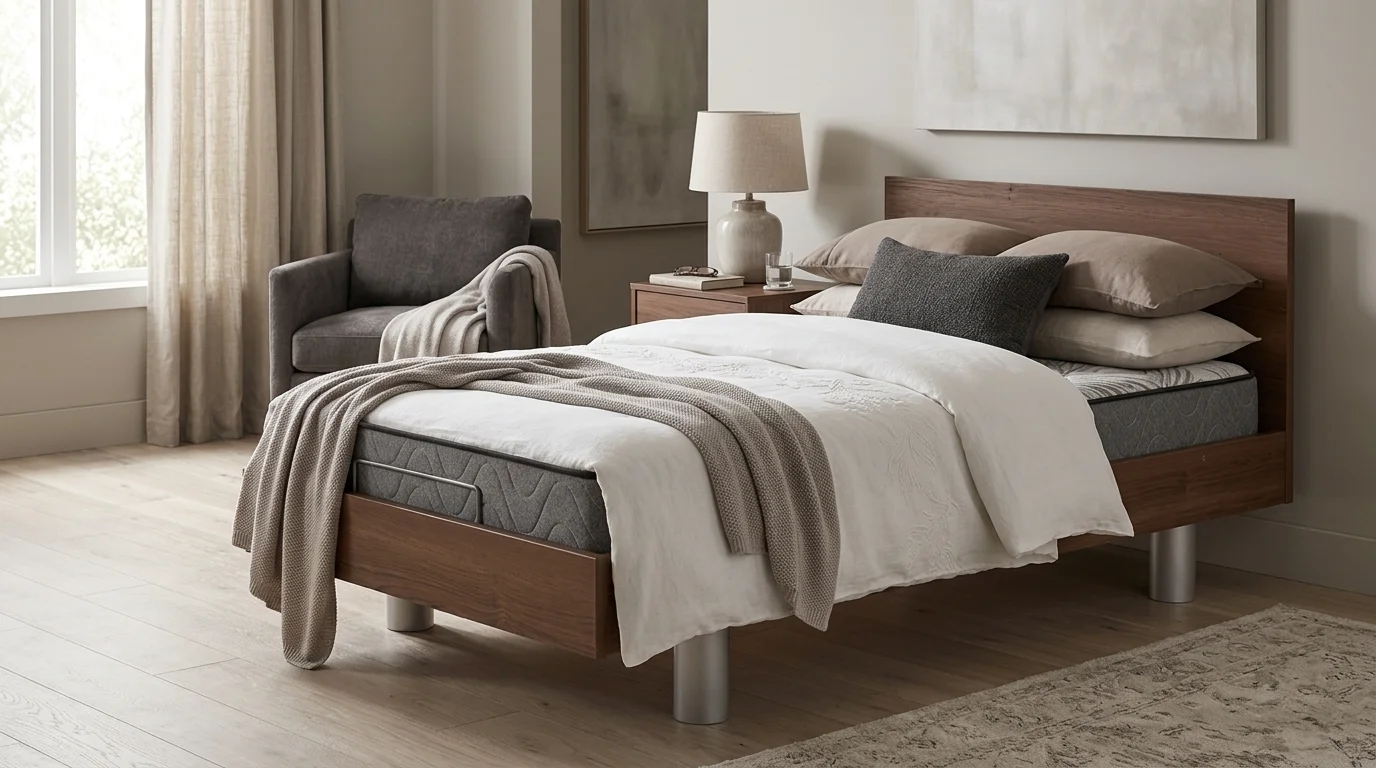







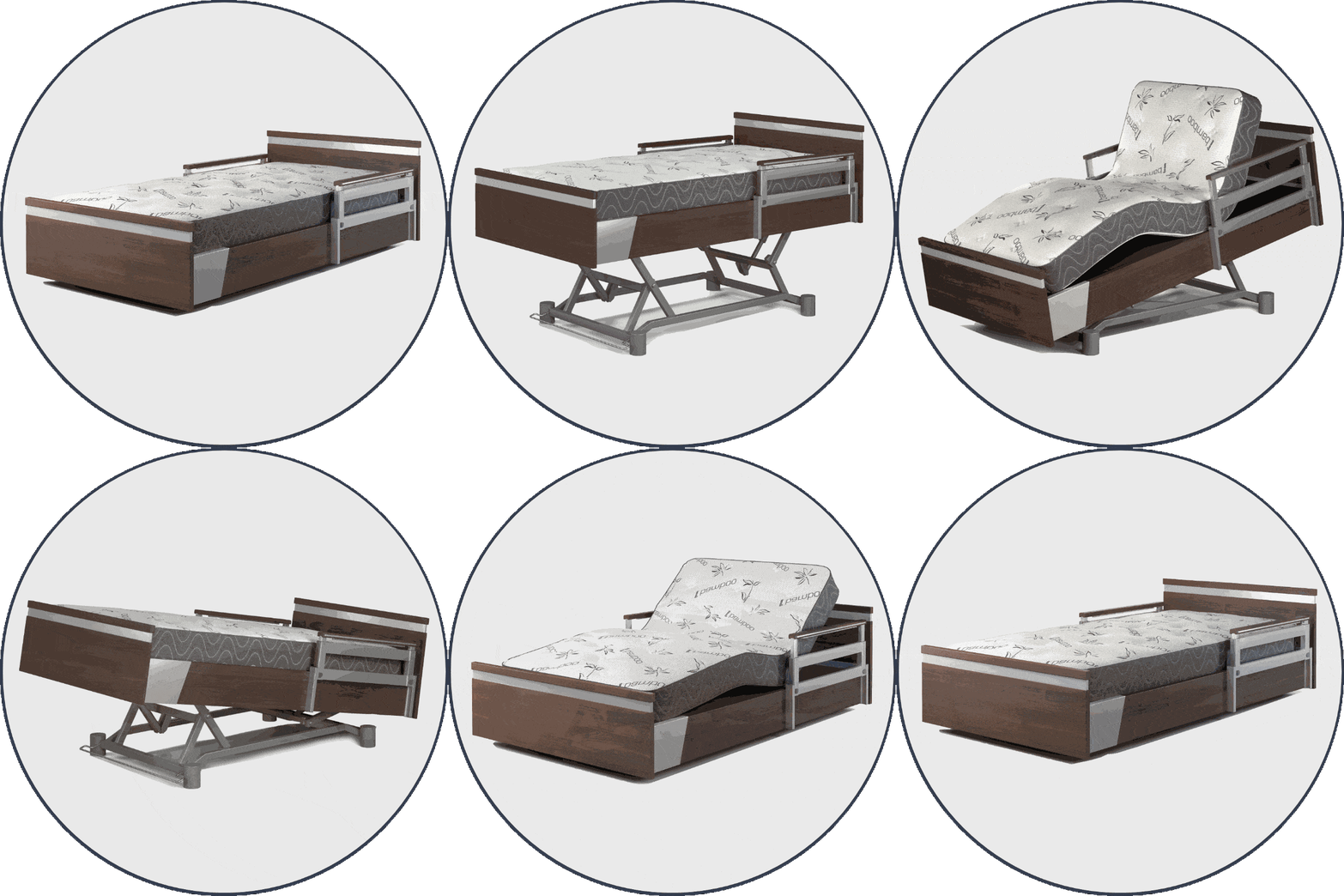
The short answer: the best bed for an elderly person with mobility issues is a full-electric adjustable bed with a hi-lo lift that hits the user’s individual knee-height transfer band (typically 20 to 23 inches), coordinated head and knee positioning, half-length assist rails sized to FDA limits, and a trapeze bar where indicated. The SonderCare Aura Premium ($6,999) meets every one of those – it drops to a 10-inch platform, raises to a pre-programmed 21-inch transfer height, and to 39 inches so caregivers can help without bending. Add the Overhead Trapeze Helper Bar ($369) for self-repositioning. Shop SonderCare beds for seniors or call 833-649-7772.
Why Mobility Issues Change the Bed Decision
When an elderly person starts having trouble getting in and out of bed, the bed itself becomes the most important piece of equipment in the house. Falls are the leading cause of injury for adults 65 and older – the CDC reports that about 1 in 4 older adults (over 14 million annually) report a fall each year1. Mobility loss from arthritis, Parkinson’s disease, post-stroke weakness, hip or knee replacement, or age-related strength loss turns three movements into hazardous ones: sitting up from lying flat, swinging legs to the floor, and standing from a seated position. The right bed makes each of those three movements achievable and safe.
For background on how mobility loss progresses with age, see SonderCare’s hub article on common mobility issues in old age. The rest of this guide focuses on the bed.
Five Bed Features That Matter Most for Limited Mobility
Most consumer adjustable beds get one or two of these right. A bed built for elderly users with mobility issues needs all five, and the evidence behind each is stronger than mass-market senior-bed reviews suggest.
1. Hi-Lo Height Adjustment – The Caregiver’s Back Depends on It
This is the single most important feature, with the most evidence behind it. A 2023 experimental study in Industrial Health of 33 clinicians performing in-bed care tasks found that placing the bed at an individually adjusted working height (versus a low height) cut estimated lumbar disc compression by 109% to 67% depending on the task, and reduced trunk flexion from 73-81 degrees down to 17-25 degrees2. In plain terms: when the bed raises to the caregiver’s hip, the strain on the caregiver’s lower spine drops dramatically. The Aura Premium raises to 39 inches for this exact reason. No consumer adjustable bed for an elderly person with mobility issues offers this kind of caregiver-protective range.
2. Transfer Height Near the User’s Individual Knee Height
The 21-inch “magic number” you see in senior-bed marketing is a useful starting point – and an oversimplification. The right transfer height is the user’s individual knee height, typically 20 to 23 inches from floor to mattress top3. Going much above 120% of the user’s lower-leg length is linked to unsafe transfers and bed-related falls4, and beds set far below knee height significantly raise the effort required to stand. The Aura’s pre-programmed 21-inch transfer height sits inside the safe band for most adults of average height, and the full hi-lo range lets a clinician or family caregiver fine-tune it for each user.
3. Coordinated Head and Knee Positioning Reduces Shear
An elderly person with limited core or arm strength cannot push themselves up to a seated position from lying flat. An adjustable bed does that work electrically. Equally important: the bed should elevate the head AND slightly flex the knees in a coordinated motion, which reduces downhill migration and skin shear as the backrest rises to 30-45 degrees5. The Aura’s profiling-bed articulation does both in one motion. From a propped-up position, swinging the legs to the floor is a much smaller, safer movement.
4. Half-Length Assist Rails (Not Full-Length Cages)
The FDA has documented 803 reported entrapment incidents linked to bed rails and defines seven hazard zones for measurement6. Guidance favors half-length assist rails or fixed grab bars over full-length cages where rails are clinically indicated. SonderCare Aura beds include Multi-Height Assist Rails on each side – half-rails sized for hand support during transfers, not full-length cages – and the bed system is engineered so every gap stays below the FDA’s 4.75-inch Zone 1-3 limit and 2.36-inch Zone 4 limit. The user grips them while standing, sitting, or repositioning, with no entrapment risk.
5. A Trapeze Bar (and Medicare Covers It)
For seniors whose mobility issue affects standing but not arm strength, an overhead Trapeze Helper Bar is the single highest-leverage accessory. Medicare’s coverage policy LCD L33820 explicitly covers trapeze equipment when it is needed to sit up in bed, change body position, or get in and out of bed – the federal coverage signal alone tells you how clinically established this is7. The SonderCare Overhead Trapeze Helper Bar ($369) is rated to 75 kg (165 lbs) of pull, which is far more than most users will ever apply. Browse the full SonderCare accessories for trapeze bars, nightlights, additional rails, and helper bars.
What Doesn’t Work: Bed Exit Alarms
One thing the evidence is unusually clear on. Bed exit alarms – the sensor pads under the mattress that beep when a senior tries to get up – sound like a useful fall-prevention tool, but they do not reduce falls. A hospital cluster-randomized trial of 16 nursing units enrolling 27,672 patients found that intensified bed-alarm use produced no statistically significant reduction in falls (rate ratio 1.09, 95% CI 0.85-1.53)8. A 2021 meta-analysis was worse: bed and chair sensors increased first-fall risk by about 20% (RR 1.20, 95% CI 1.04-1.37)9. Why? Likely because alarms create alarm fatigue without changing the underlying risk factors. The better strategy is environmental: a bed sized to the user’s body, transfer training, half-rails or grab bars, supervision when needed, and impact-absorbing floor mats for very high-risk users.
Best SonderCare Bed Picks for Elderly with Mobility Issues
Aura Premium – Best Overall for Mobility Issues
The SonderCare Aura Premium at $6,999 is the right bed for almost every elderly user with mobility issues. Every feature above is built in: a 10-inch FallSafe platform for supervised low-mode use, a 21-inch pre-programmed transfer height inside the ADA safe band, a 39-inch caregiver-friendly height, coordinated head and knee positioning, half-rails included, Trendelenburg and Zero Gravity positions, quiet motors, and a 9-volt battery backup for power outages. Rated for 500 lbs.
Aura Extra Wide – When the Senior Shifts Position Often
The Aura Extra Wide at $8,999 widens the sleeping surface to 48 inches. For elderly users who shift position often, have difficulty staying centered, or rely on a caregiver who needs room to sit on the edge during a transfer, the extra nine inches of width matters. Same safety features, same 500-lb capacity, same hi-lo range.
Aura Platinum – When the Bedroom Should Not Look Clinical
The Aura Platinum at $8,499 adds fully upholstered side panels in Slate Gray Crypton fabric and a furniture-grade headboard. Same mobility-issue features as the Aura Premium. Often the difference between “we bought the bed” and “we bought the bed and Mom uses it.”
Condition-Specific Notes
Parkinson’s Disease and Bed Mobility
Bed mobility is one of the most commonly impaired functions in people with Parkinson’s disease – getting in, getting out, and rolling over all become disproportionately difficult10. An adjustable bed addresses this in three concrete ways: a coordinated head-and-knee gatch helps the user sit up without bracing on a weak side, a 20-23 inch transfer height lets the legs swing safely to the floor, and a trapeze gives a confident grip if a freezing episode hits mid-transfer. Quiet motors matter too – sudden noise can worsen tremor in some PD patients.
Post-Stroke Recovery
Stroke patients find lateral (slide) transfers easier than “get-up” transfers from the bed11, which is one reason hi-lo beds aligned to wheelchair seat height matter so much in post-stroke care. Physiatrists and neurologists prescribe adjustable beds as part of rehabilitation to support safe transfers as the patient rebuilds strength and coordination. The Aura’s 21-inch pre-programmed transfer height matches most wheelchair seat heights closely.
Arthritis
Arthritic hands cannot operate manual or semi-electric beds reliably – the hand crank that engineers love and caregiver communities universally regret. Full-electric only, with a backlit remote, large buttons, and clear preset positions. The Aura’s controller is built around this.
Hip and Knee Replacement Recovery
Surgeons typically recommend a bed at about 21 inches post-operatively for the first 6-12 weeks of recovery. The Aura’s pre-programmed 21-inch transfer height matches this exactly. For longer-term mobility loss after a hip fracture, ownership is the right call (see the rent-vs-buy section in our companion best beds for elderly at home article).
Recommended Accessories for Limited Mobility
- Overhead Trapeze Helper Bar ($369) – the highest-leverage add-on for users who can grip and pull. Covered by Medicare when medically indicated7.
- Additional Rails ($594 / set of 2) – extra rail coverage for users who reposition often or need a handhold at the foot of the bed.
- Underbed Auto-Nightlight ($219) – motion-activated floor illumination so nighttime exits are not made in the dark.
- Protective Rail Pad ($99) – cushions the rails for users who shift in their sleep or have fragile skin.
- Portable Battery Backup ($149) – a 4-outlet power backup that keeps the bed operational through a short outage.
The Mattress Matters, Especially for Limited Mobility
An elderly user with mobility issues spends more time in bed and applies more pressure to the same body points. A mattress that flexes with the adjustable base and supports the edges for sitting matters more here than for any other senior user. The SonderCare Dream Bamboo Quilt-Top ($1,299) is the go-to pairing: reversible soft and firm sides, cooling gel, a fluid-proof cover, and a firm perimeter for safe sitting at the edge. For users at high risk of pressure injuries, the Alternating Pressure Air mattress ($2,999) adds clinical-grade pressure redistribution. See our full mattress lineup.
Fall Prevention Goes Beyond the Bed
Even the best bed for an elderly person with mobility issues is only one piece of fall-safe aging in place. Bedroom modifications – night lighting, clear pathways, non-slip flooring, a phone within reach, a reachable bedside table – all reduce the chance and the consequence of a fall. For a complete picture, read SonderCare’s fall prevention guide for seniors at home.
Frequently Asked Questions
What is the best bed for an elderly person with mobility issues?
A full-electric adjustable bed with a hi-lo lift, a transfer height near the user’s individual knee height (typically 20 to 23 inches), coordinated head and knee positioning, half-length assist rails, and a trapeze where indicated. The SonderCare Aura Premium ($6,999) is the most-recommended choice.
Do bed alarms help an elderly person with mobility issues avoid falls?
No. The strongest evidence shows bed and chair sensor alarms do not reduce falls and may increase first-fall risk by about 20% (RR 1.20)9. Focus on bed sizing, transfer training, half-rails, and supervision instead.
What is the right transfer height for an elderly person with limited mobility?
Near the user’s individual knee height – typically 20 to 23 inches. Heights above 120% of lower-leg length are unsafe4. The Aura’s 21-inch pre-programmed transfer height sits in the safe band for most adults.
Are half-rails safer than full-length rails for an elderly person with mobility issues?
Yes. The FDA’s bed-safety guidance favors half-length assist rails or grab bars over full-length cages, citing 803 reported entrapment incidents6. SonderCare Aura beds include Multi-Height Assist Rails sized to FDA limits.
Does Medicare cover a trapeze bar for an elderly person?
Yes, when medically indicated. Medicare LCD L33820 explicitly covers trapeze equipment for sitting up, changing position, or getting in and out of bed7.
Talk to a Senior Bed Expert
Buying a bed for an elderly family member with mobility issues is a decision worth a phone call. SonderCare experts have helped thousands of families pair the right Aura model + the right mattress + the right accessories for the specific mobility picture – whether the elderly user is recovering from a hip replacement, managing Parkinson’s, or living with progressive mobility loss. Every consultation is guidance, not a sales pitch.
Shop SonderCare adjustable beds for seniors or call 833-649-7772. For the broader buyer’s guide, see our complete guide to the best beds for seniors, or the best beds for elderly at home for the broader buying picture.
References
- Centers for Disease Control and Prevention. Older Adult Falls Data and Facts. About 1 in 4 older adults (over 14 million annually) report a fall; over 3 million emergency-department visits annually. Available at: cdc.gov/falls/data-research
- Authors. “Effects of different bed heights on physical burden during in-bed care.” Industrial Health, 2023. Lumbar disc compression reduced 109%-67% with adjusted working height vs low height. DOI: 10.2486/indhealth.2022-0038
- ADA National Network. “Accessible Lodging” fact sheet. 2017. Recommended bed height 20 to 23 inches from floor to mattress top. adata.org/factsheet/accessible-lodging
- Tzeng HM. “Hospital bed-related falls and the role of bed height adjustability.” Applied Nursing Research, 2012. Bed heights above 120% of lower-leg length linked to unsafe transfers. See also Capezuti E et al., J Am Geriatr Soc, 2008.
- Davis K, et al. “The effect of supine head-of-bed elevation on tissue shear forces.” 2015. Coordinated head + knee gatch reduces downhill migration and skin shear during sit-up.
- U.S. Food and Drug Administration. “Hospital Bed Safety: Reported Entrapment Incidents and Bed Safety Group Guidance.” 803 reported entrapment incidents; 7 hazard zones defined; FDA Hospital Bed System Dimensional and Assessment Guidance, 2006 (current). fda.gov hospital bed guidance
- Centers for Medicare & Medicaid Services. Local Coverage Determination L33820 – Hospital Beds and Accessories. Trapeze equipment covered when needed to sit up in bed, change position, or get in and out of bed. cms.gov
- Shorr RI, et al. “Effects of an intervention to increase bed alarm use to prevent falls in hospitalized patients: a cluster randomized trial.” Annals of Internal Medicine, 2012. 27,672 patients across 16 units; rate ratio 1.09 (95% CI 0.85-1.53). PMID: 22250144
- Cortes OL, et al. “Effectiveness of bed and chair alarms for the prevention of inpatient falls: a systematic review and meta-analysis.” 2021. Bed and chair sensors increased first-fall risk RR 1.20 (95% CI 1.04-1.37).
- Taniguchi K, et al. “Bed mobility impairments in patients with Parkinson disease: a study of clinical correlates and bed-design implications.” 2022.
- Kitamura S, et al. “Comparative ease of transfer types in stroke patients: lateral slide transfers vs sit-to-stand bed-to-wheelchair transfers.” 2022.