





If your loved one is a fall risk, someone has almost certainly told you to lower the bed. But what does “lower” actually mean, and how low does a bed need to be to make a real difference?
That question has a specific answer, and getting it right matters. A standard home bed sits 24 to 28 inches off the floor at the mattress surface. A hospital bed adjusted to its “lowest” setting often stops at 18 to 20 inches. A true ultra-low home hospital bed reaches 17 inches or below. A floor-level bed can drop to 3 to 6 inches. Each measurement represents a fundamentally different level of fall risk, not just in whether your loved one falls, but in how badly they’re hurt when they do.
This guide gives you the clinical numbers, explains the research behind the ultra-low approach, addresses the trade-offs most caregivers aren’t told about, and provides the operational protocol that turns a low bed into an effective safety tool.
Our fall prevention guide for seniors at home covers the full range of home safety strategies. This article focuses specifically on what the evidence says about bed height, including where the research is strong, where it’s more nuanced, and what that means for the decisions you’re making right now.
Bed height should follow risk level — if you haven’t gauged it yet, our fall risk screening tool is a two-minute starting point.
Why Standard Bed Height Is a Fall Risk in Itself
Most people don’t think about bed height until a fall has already happened. That’s when they discover that the standard mattress setup they’ve had for years, or the adjustable bed on its “low” setting, may have been dangerously high the entire time. Researchers who audited bed heights in four U.S. nursing homes found that 93.9% of residents had beds set above 120% of their individual lower-leg length, the clinical threshold above which foot placement becomes unstable during transfers.1 More than three-quarters had beds set above 140% of their lower-leg length. Nearly every bed measured was too high for safe transfer, not by a small margin, but significantly. Falls in care settings are not a rare edge case. Between 700,000 and one million U.S. patients experience a fall while hospitalized each year, with up to one-third causing some form of injury and roughly 10% resulting in serious harm.2 Falls are the single most frequently reported sentinel event tracked by The Joint Commission, accounting for 49% of all serious adverse events reported in 2024, a 15% increase from the prior year.3 The long-term trend is moving in the wrong direction: the age-adjusted fall death rate among adults 65 and older rose 21% between 2018 and 2024.4 Where falls happen is revealing. 85% occur in the patient’s room and 59% occur in the evening or overnight hours, the window when no caregiver is actively present at the bedside.5 That overlap, bedroom, nighttime, unassisted, is exactly the situation that bed height is positioned to address.What “Ultra-Low” Actually Means: The Numbers
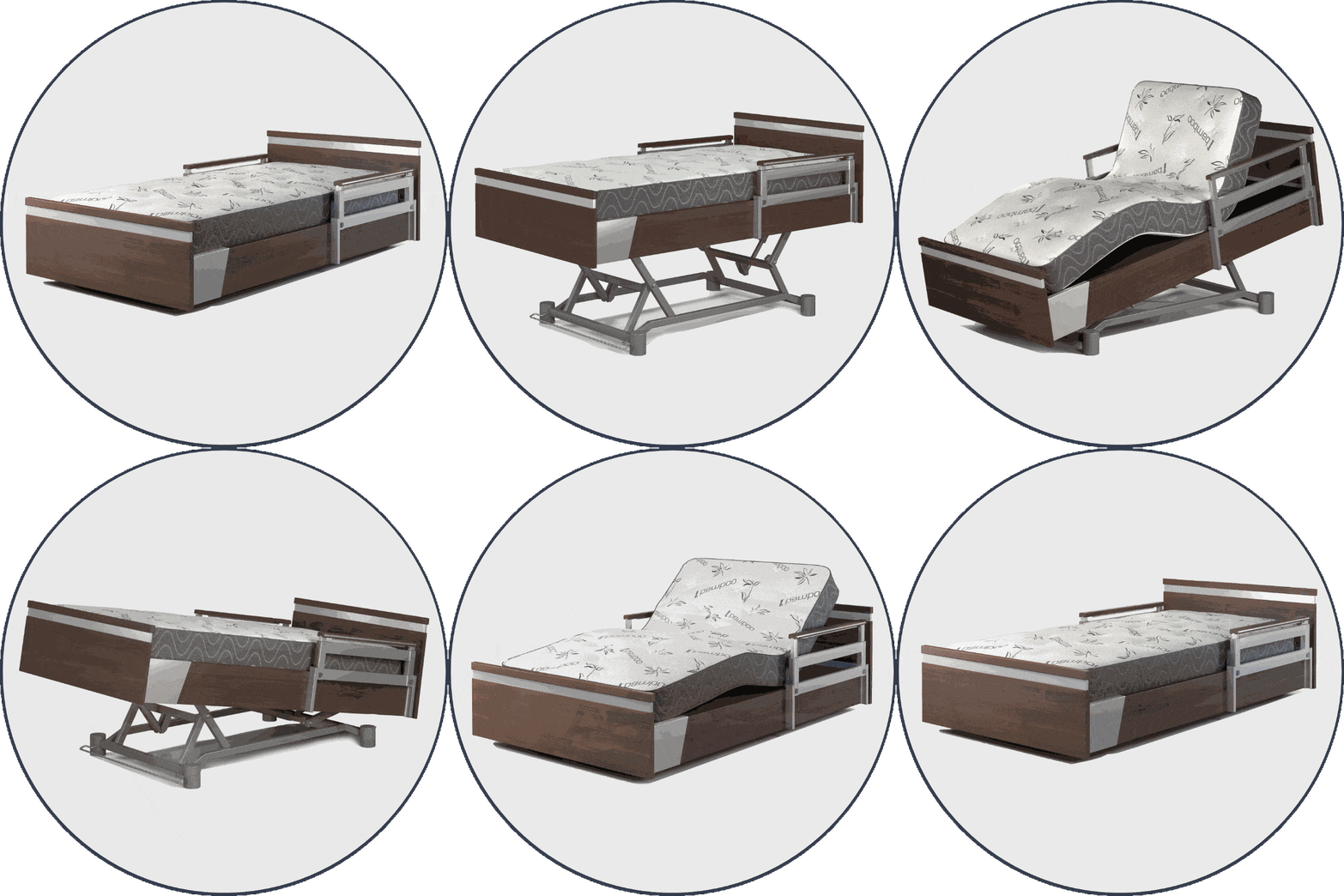
The term “low bed” is used loosely by manufacturers and caregivers alike, which creates real confusion when shopping or evaluating your current setup. Here are the categories defined by their actual measurements: Standard height (most consumer beds and non-adjustable hospital beds): – Platform height: 20–22 inches – Mattress surface: approximately 26–30 inches Low beds (entry-level hospital beds at their lowest setting): – Platform height: 12–17 inches – Mattress surface: approximately 18–23 inches Ultra-low beds: – Platform height: 7.5–10 inches – Mattress surface: approximately 14–17 inches Floor-level beds: – Platform height: 2.8–4 inches – Mattress surface: approximately 9–11 inches The distinction between “low” and “ultra-low” is clinically meaningful. A bed that advertises itself as low but stops at 14 to 16 inches at the platform, leaving the mattress surface at 20 to 22 inches, is not delivering the same protective effect as a bed that genuinely reaches 10 inches at the platform. The Aura Premium home hospital bed from SonderCare reaches a FallSafe Ultra-Low platform height of 10 inches, placing the mattress surface at 17 inches. That’s at the upper edge of the ultra-low category, closer to what long-term care facilities use for their highest-risk residents than what most adjustable beds sold for home use can achieve.How Lower Height Reduces Fall Injury, Even When It Doesn’t Prevent the Fall
Here’s the distinction that most “lower the bed” advice skips over: ultra-low bed height works primarily by reducing the severity of falls rather than by preventing them from occurring. When someone falls from a bed set at 28 inches, the impact force is substantially higher than a fall from a bed at 17 inches. That’s physics, fall energy scales with height. What that translates to clinically is that a fall from an ultra-low position onto a bedside crash mat looks fundamentally different from a fall from a standard-height bed onto a hardwood floor. Long-term care settings that have implemented floor-level and ultra-low beds for high-risk residents report striking results. A six-month evaluation at a U.S. nursing home using floor-level beds with their highest fall-risk residents found a 100% reduction in falls directly from bed and an 80% reduction in total bedroom falls during the evaluation period.6 A 2022 clinical study at a continuing-care retirement community using beds adjustable between 3.9 and 29.5 inches found a 55% overall reduction in falls and a 100% reduction in injurious bed falls during the study phase, zero injuries when falls did occur.7 These are studies conducted in partnership with manufacturers and their generalizability to all settings has limits. But the underlying mechanism is straightforward: lowering the bed doesn’t prevent a confused or restless person from rolling or attempting to exit, it reduces how far they fall and how hard they land. That distinction matters for how you frame this decision. If you’re trying to eliminate falls entirely, ultra-low bed height is a partial answer. If you’re trying to ensure that when a fall happens, it doesn’t cause a hip fracture, the evidence is more compelling.But Is Lowest Always Safest? The Trade-Off You Need to Know
This is where it gets counterintuitive, and where most “just lower the bed” advice stops short. Biomechanical research consistently finds that the optimal height for safely getting in and out of bed is 51 to 66 centimeters, roughly 20 to 26 inches at the mattress surface.8 A separate study confirmed that bed entry and egress become measurably more difficult as heights drop below this range, particularly for adults with reduced knee strength or limited range of motion.9 The clinical trial evidence for low beds in acute care settings is sobering. A pragmatic cluster-randomized trial that introduced low-low beds across hospital wards found no significant reduction in falls or fall-related injuries.10 A comprehensive 2019 state-of-the-science review reached the same conclusion: there was no evidence that low-low beds reduced fall rates in hospitalized patients.11 A 2022 systematic review and meta-analysis of 43 studies actually found that fall rates trended higher with low beds, not lower.12 The explanation isn’t complicated. A bed set at 10 inches requires significantly more leg strength and balance to rise from than a bed at 22 inches. For someone with intact cognition and reasonable mobility, that’s manageable. For someone with Parkinson’s disease, significant hip weakness, or moderate dementia, it creates a different fall risk, one that happens during the exit attempt, not during sleep. This is why one major hospital bed manufacturer has explicitly stated that mandating the “lowest possible bed frame” is “inaccurate and unsafe” and is not grounded in individual patient performance assessment.13 The correct approach isn’t a single height, it’s a protocol tied to what the person is doing at any given moment.The Protocol Most Caregivers Don’t Know: Lower for Sleep, Raise for Care
The research points toward a dual-height protocol that is both well-supported and almost universally absent from the advice caregivers receive at discharge. During sleep and rest: position the bed at ultra-low height, 10 to 17 inches at the mattress surface. If your loved one rolls, attempts to exit, or falls during the night, the distance and impact are minimized. This is the protective function that the long-term care research supports. During transfers (getting in or out of bed): raise the bed to a height appropriate for safe exit. The clinical standard is approximately 120% of the person’s lower-leg length, measured from the floor to mid-kneecap.13 For most adults, this lands in the 20 to 24 inch range at the mattress surface. At this height, the sit-to-stand movement is biomechanically achievable without excessive demand on leg strength. During caregiving tasks (repositioning, bathing, wound care, applying compression stockings): raise the bed to approximately waist height, 30 to 40 inches, so the caregiver can work upright. Sustained bending over a bed kept permanently low is a significant contributor to caregiver back injury, and it’s a problem that makes the entire care situation unsustainable. Most families don’t know about this protocol. The ones who discover it often do so after months of back pain from keeping the bed at one low position all day. The ability to adjust height quickly, quietly, and repeatedly throughout the day is precisely why a fully electric hi-lo home hospital bed, with a range from ultra-low to 39 inches or higher, is a different tool from a consumer adjustable base that offers only head and foot movement. If a formal assessment of your loved one’s fall risk has not been done, our guide to fall risk assessment for elderly at home walks through the clinical tools occupational therapists and physicians use to stratify who is at highest risk and which interventions are most appropriate for that profile.The Dementia and Sundowning Exception
For people living with moderate to advanced dementia, the calculus shifts in ways that make a consistently ultra-low or floor-level position more defensible. The challenge with dementia-related bed falls is not primarily biomechanical. People with significant cognitive impairment often don’t remember they cannot walk. They may attempt to get out of bed at 2 a.m. with complete confidence in a mobility they no longer have. No bed height will prompt a reasoned decision to stay in place, the neurological impairment removes that option. What bed height does is determine what happens when that attempt occurs. Sundowning, the increased agitation, confusion, and restlessness that many people with dementia experience in the late afternoon and evening, concentrates fall risk in exactly the window when caregivers cannot be continuously present. The pattern that emerges from caregiver communities is consistent: nighttime is when the most serious falls happen, because it combines maximum cognitive impairment with minimum supervision. For dementia caregivers, the approach used in long-term care settings is instructive. High fall-risk residents with cognitive impairment are typically placed in floor-level beds during sleep hours, with floor mats on both sides and a bed-exit alarm. At home, a bed that genuinely reaches 10 to 17 inches at the mattress surface is a practical approximation, more protective than a standard bed on its lowest setting, without the access challenges of a true floor bed for morning care tasks. Our dedicated guide on how to prevent falls in elderly with dementia covers the behavioral and environmental picture beyond bed height, including how to manage sundowning, bed alarms, and wandering risk at home.Building a Complete Fall-Safety System
Ultra-low bed height is the most important single variable, but falls research supports a layered approach. No intervention eliminates risk, the goal is to reduce frequency and severity at each layer. Layer 1: Ultra-low bed position during sleep The primary intervention. A bed that reaches 10 to 17 inches at the mattress surface reduces fall impact force significantly compared to a standard-height bed. This is the layer most directly supported by the long-term care outcome data. Layer 2: Bedside crash mat A 3- to 4-inch foam mat placed directly against the bed on both sides creates a forgiving landing surface when a person does roll or fall. Caregiver experience across multiple forums is consistent: the difference between falling onto hardwood and falling onto a properly positioned mat is the difference between a bruise and a fracture. The mat completes what ultra-low bed height starts. Layer 3: Bed-exit alarm A pressure-sensitive pad placed under the mattress pad that triggers an audible alert when the person shifts or begins to rise. Alarms are imperfect, they provide 15 to 30 seconds of warning at best, but they allow a caregiver who is nearby to respond before a fall completes. For people with dementia, the alarm is often more valuable than any single piece of equipment because it extends the caregiver’s effective presence through the overnight hours. Layer 4: Ambient floor lighting Motion-activated floor lighting that illuminates the path between the bed and the bathroom eliminates the disorientation of waking in complete darkness. Many falls happen not in bed but in the first few steps after exit, unsteady feet, low blood pressure on standing, a rug edge that wasn’t visible. A low light level triggered by movement addresses this without disrupting sleep. For the full range of hospital bed accessories that support this system, including assist rails, underbed nightlights, and protective rail pads, our accessories overview covers current options. For a detailed guide to which bed design works best for someone who has already experienced a fall, see our guide to the best bed for someone who falls out of bed.What to Look for in a Home Ultra-Low Bed
If you’ve concluded that your current bed isn’t reaching a protective height, here are the criteria that matter most when evaluating a replacement. Verified ultra-low height. The platform should reach 10 inches or below. Many beds marketed as “low” stop at 14 to 16 inches at the platform, putting the mattress surface at 20 to 22 inches. Verify the manufacturer’s published low-position specification, not the selling headline. Full hi-lo range for the dual-height protocol. A bed that only goes low isn’t useful if a caregiver cannot raise it comfortably for care tasks. Look for a bed that reaches 30 inches or higher at the platform for seated caregiving work and 39 inches or higher for standing tasks. The full range is what enables the sleep-low, care-high protocol to work in practice. Quiet motor operation. If height is being adjusted during overnight hours, a motor that operates at approximately 54 dB(A), roughly the volume of a quiet conversation, avoids startling a person with light sleep or dementia, or waking others in the household. Residential design. A bed that visually announces itself as medical equipment affects dignity in ways that matter to both the care recipient and their family. The Aura Platinum home hospital bed features fully upholstered side panels in Crypton fabric and a residential upholstered headboard, the same hospital-grade positioning capability as the Aura Premium, in a form designed to coexist with a home bedroom rather than transform it into a clinical space. Assist rail compatibility. Side rails that provide grip points for repositioning without creating entrapment risk are worth specifying. Current residential-use rails designed to international medical bed standards (IEC 60601-2-52) address the entrapment concerns associated with older institutional rail designs. The Aura Premium home hospital bed, with a FallSafe Ultra-Low platform at 10 inches (17 inches to the mattress surface), a high position of 39 inches, and a quiet 54 dB(A) motor, is certified to International Hospital Standard and built specifically for home use. For caregivers who need the low-position protection during sleep and the ergonomic range to give care without back strain, the hi-lo spread is as important as the low setting itself.How Low Is Low Enough? A Practical Summary
The direct answer: a mattress surface at or below 17 inches during sleep represents a meaningful reduction in fall injury risk compared to a standard bed at 24 to 28 inches. The protective mechanism is primarily about fall severity, reducing the distance traveled and the impact force when a fall occurs, rather than preventing falls from happening. “Lowest possible” is not the right target. A bed so low that the person cannot rise from it safely, or that keeps a caregiver bent over it for every care task, creates different problems. The goal is ultra-low during rest, appropriately raised for transfers and care tasks, and layered with a crash mat and exit alarm to cover the residual risk. If a formal fall risk assessment hasn’t been completed, that’s the right place to start. An occupational therapist can evaluate your loved one’s specific mobility, transfer ability, and environment, and identify which interventions will have the most impact for their profile. From there, a bed with a genuine ultra-low position and a full hi-lo range gives you the tools to implement the correct protocol rather than simply lowering the bed and hoping for the best. Our team offers free consultations with SonderCare bed experts who can help match the right bed and configuration to your specific situation. No purchase required. Reach us at sondercare.com/contact/.References
- Tzeng H.M., Yin C.Y., Anderson A., Prakash A., “Nursing staff’s awareness of keeping beds in the lowest position to prevent falls and fall injuries in an adult acute surgical inpatient care setting,” Journal of Nursing Care Quality, 2012. https://pmc.ncbi.nlm.nih.gov/articles/PMC3639136/
- Locklear T. et al., “Inpatient Falls: Epidemiology, Risk Assessment, and Prevention Measures. A Narrative Review,” HCA Healthcare Journal of Medicine, 2024. https://pmc.ncbi.nlm.nih.gov/articles/PMC11547277/
- The Joint Commission, “Sentinel Event Data 2024 Annual Review,” 2025. https://digitalassets.jointcommission.org/api/public/content/eac7511986c0442a9c1ae04b1aa02cc0
- CDC, “Older Adult Falls Data,” updated February 26, 2026. https://www.cdc.gov/falls/data-research/index.html
- Hitcho E.B. et al., “Characteristics and Circumstances of Falls in a Hospital Setting: A Prospective Analysis,” Journal of General Internal Medicine, 2004. https://pmc.ncbi.nlm.nih.gov/articles/PMC1492485/
- Accora, “Case Study: Implementing the Accora FloorBed Technology in Lutheran Nursing Home,” 2021. https://us.accora.care/case-study/implementing-the-accora-floorbed-technology-in-lutheran-nursing-home
- Kwalu, “Floor-Level Beds: A Proven Solution for Fall Prevention,” referencing a 2022 clinical study at Masonic Villages of Pennsylvania. https://www.kwalu.com/senior-living/floor-level-beds-a-proven-solution-for-fall-prevention/
- Davis K.G. et al., “Biomechanical Investigation of Optimal Bed Height for Egressing and Ingressing Hospital Beds,” Human Factors in Healthcare, 2023. https://www.sciencedirect.com/science/article/pii/S2772501423000209
- Merryweather A.S. et al., “Effects of bed height on the biomechanics of hospital bed entry and egress,” Work, 2015. https://stacks.cdc.gov/view/cdc/231426/cdc_231426_DS1.pdf
- Haines T.P. et al., “Pragmatic, cluster randomized trial of a policy to introduce low-low beds to hospital wards for the prevention of falls and fall injuries,” Journal of the American Geriatrics Society, 2010. https://pubmed.ncbi.nlm.nih.gov/20398120/
- LeLaurin J.H. & Shorr R.I., “Preventing Falls in Hospitalized Patients: State of the Science,” Clinics in Geriatric Medicine, 2019. https://pmc.ncbi.nlm.nih.gov/articles/PMC6446937/
- Morris M.E. et al., “Interventions to reduce falls in hospitals: a systematic review and meta-analysis,” Age and Ageing, 2022. https://academic.oup.com/ageing/article/51/5/afac077/6581612
- Hillrom, “Preventing Falls: Optimal Bed Height,” Whitepaper, 2016. https://www.hillrom.com/content/dam/hillrom-aem/us/en/marketing/knowledge/content-marketing/articles/191351-EN-r3_Optimal-Bed-Height_Whitepaper-HR.pdf