





You know the sound. A thud, then silence, then a second of held breath before you’re already moving. By the time you reach the room, your parent or spouse is on the floor, sometimes shaken but unharmed, sometimes not.
Falls from beds are among the most common and most costly injuries in home care. More than one in four adults over 65 falls each year in the United States,1 and those falls produce roughly 3 million emergency department visits, approximately 1 million hospitalizations, and around 319,000 hip-fracture hospitalizations annually.2 In hospital settings alone, an estimated 700,000 to 1,000,000 inpatient falls occur every year, and 30 to 50 percent of them result in some form of injury.3 A single injurious fall adds an average of 6.3 days to a hospital stay and approximately $14,000 in direct costs.4
The instinct after a fall, or after the tenth near-miss, is to add more barriers. A bedrail. A body pillow. A vest restraint. Something that keeps them in. That instinct is understandable. It is also, as the evidence shows, largely counterproductive.
There are two interventions that actually work: lowering the bed height and placing a padded floor mat. Neither is complicated. Neither is expensive relative to the cost of a hip fracture. And neither requires anyone to be tied, netted, or caged.
This guide explains the mechanics of why these two interventions work, how to implement them correctly at home, and why combining them into a layered approach is more effective than any single solution.
These interventions work best when they’re ordered by risk level, so screen for fall risk first, then match the response to what it flags.
Why Physical Restraints Make Falls More Dangerous
Physical restraints, bedrails that fully enclose the sleeping surface, vest or belt restraints, tuck-in sheets used as barriers, have been used in hospitals and homes for decades. The logic seems sound: if you can’t get out, you can’t fall. The reality is more complicated. A 2022 Cochrane systematic review by Abraham and colleagues examined restraint-reduction programs in general hospitals and found that removing physical restraints did not increase fall rates. The programs they studied were not associated with more falls, and physical restraints were not shown to reduce them.5 They also carry independent harms: skin injuries from prolonged pressure, respiratory compromise from vest restraints, severe agitation and psychological distress, and the particular danger of full bedrails, which someone with dementia or restlessness will attempt to climb, creating a fall from a greater height, not a smaller one. CMS policy has tracked this evidence. The 2008 CMS no-pay rule for hospital-acquired conditions shifted practice patterns measurably, and the 2025 update to the State Operations Manual Appendix PP (Transmittal 229) strengthened the right to be free from physical restraints under 42 CFR 483.12(a)(2), specifically requiring documented evidence that alternatives were attempted before any restraint use.12 The clinically sanctioned alternatives? Low bed positioning and bedside mats are consistently listed first. For a deeper look at how to use partial bedrails as positioning aids, rather than entrapment barriers, see how to use bed rails safely for elderly in the SonderCare Learning Center.The Physics No One Explains: Why Fall Height Is the Variable That Matters
Most family caregivers don’t instinctively think of bed height as a safety variable. A standard home bed sits between 24 and 30 inches off the floor. A hospital bed in functional position sits in a similar range. When someone rolls, slides, or climbs out of either, they fall that entire distance. That distance matters enormously. Impact force increases with the square of fall velocity, and velocity increases with height. A fall from 8 inches is not merely “shorter” than a fall from 28 inches, it is categorically different in terms of the kinetic energy transferred to bone and tissue at landing. Research by Usmani and colleagues tested a range of bed heights from approximately 17 inches down to lower positions and documented that lower heights increase a patient’s ability to place their feet on the floor and reduce fall impact energy significantly.7 The World Health Organization reports that 28 to 35 percent of community-dwelling adults aged 65 and older fall each year, rising to 32 to 42 percent in those over 70,6 and a substantial share of the most serious injuries, hip fractures above all, result directly from the height of the fall rather than from the exit behavior itself. The implication is practical: you may not be able to stop someone determined to get out of bed. But you can radically reduce the consequences of that exit by reducing how far they fall.What a Hi-Lo Low Bed Actually Does
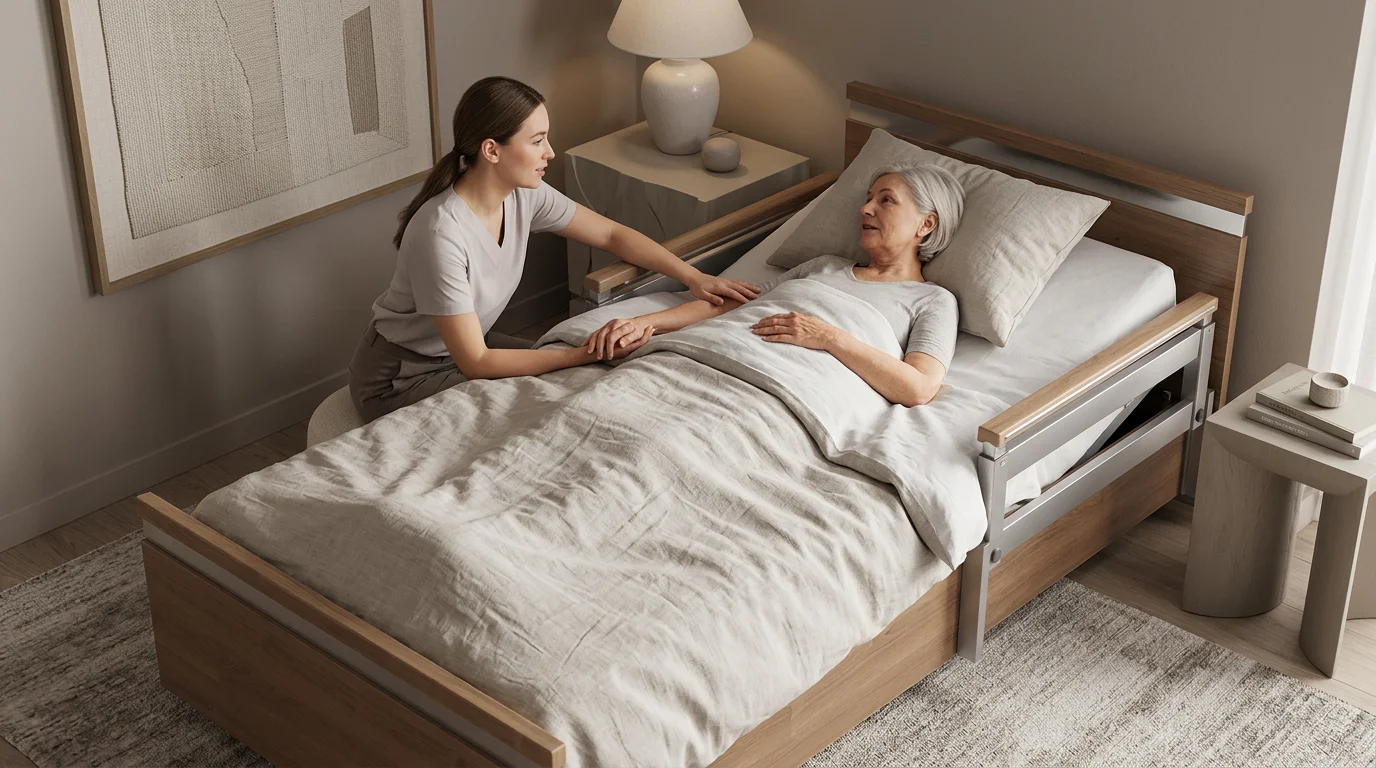
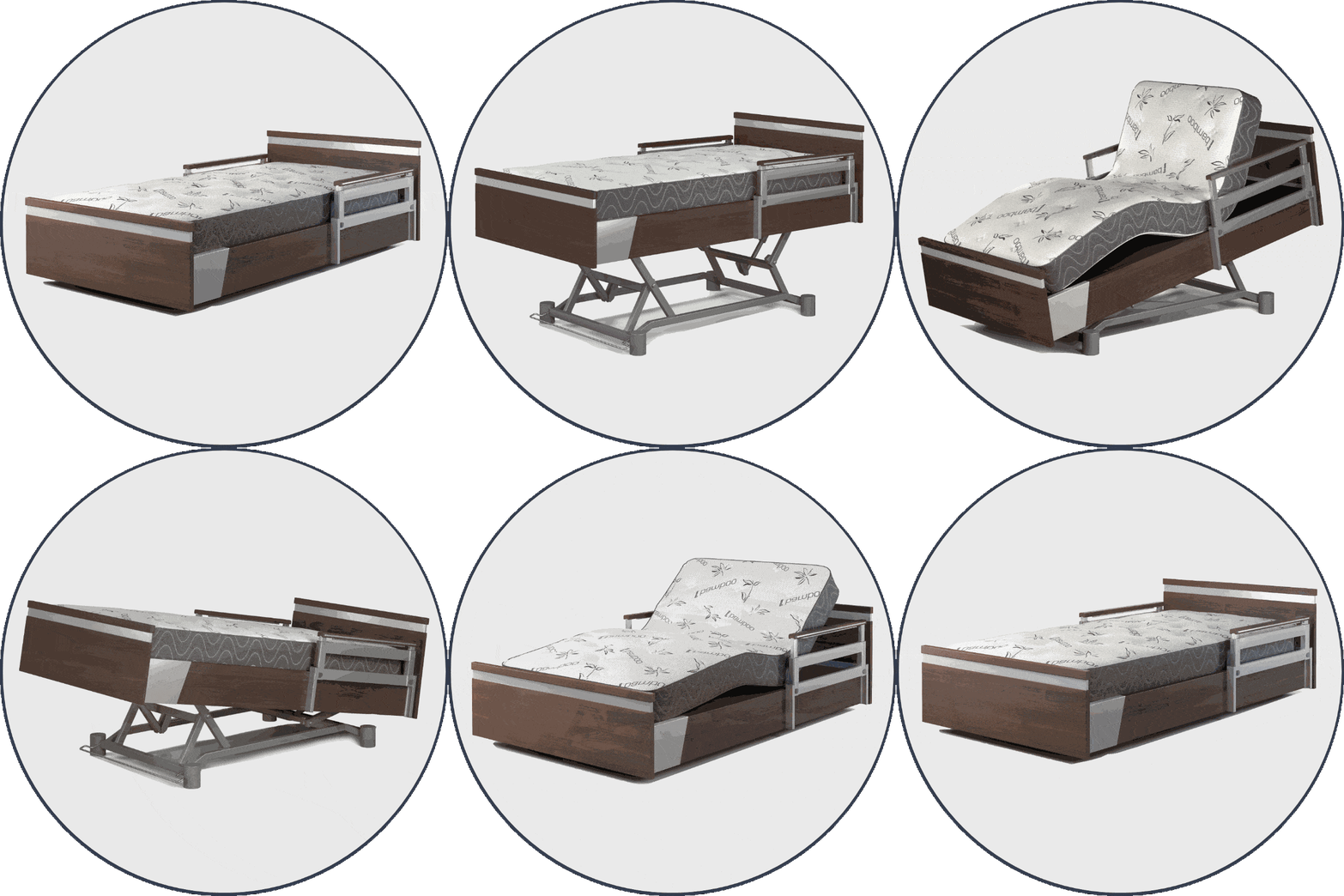
A hi-lo hospital bed is an adjustable bed frame that raises and lowers the entire sleeping surface, independent of head and knee positioning. Most quality hi-lo frames have a range from roughly 10 to 32 inches (platform height). The goal for a high fall-risk person at home is to set the bed as low as possible during sleep and overnight hours, typically 7 to 15 inches from floor to mattress top. Why this height range? At 7 to 15 inches, a person who exits the bed typically steps down rather than falling. Even if they slide or roll out, the contact height is low enough that impact energy is substantially reduced compared to a standard bed, making fracture-level injury far less likely. A 2010 cluster randomized trial by Haines and colleagues across 18 hospital wards studied the effect of low-low beds (one per 12 standard beds) on fall rates. They found no statistically significant effect on total fall rates, an important caution against overclaiming, but falls with serious injury trended lower, and the design had a meaningful limitation: low beds were deployed for only a fraction of at-risk patients per ward rather than universally for the highest-risk individuals.8 Quasi-experimental deployments at individual institutions have shown more encouraging numbers: one multi-site study reported a 55 percent reduction in total falls and a 27 percent reduction in injurious falls; another reported a 58 percent reduction in moderate-to-major-injury falls at four years. These are non-randomized figures, but they align with the biomechanical prediction. The mattress-on-the-floor problem. Many family caregivers, facing repeated falls from a standard bed, place the mattress directly on the floor. This intuition is correct, the goal is to reduce fall height, but the execution creates its own problems. Floor-level mattresses make it nearly impossible to provide care without severe caregiver back strain, they offer no ability to raise the bed for transfers, and they can feel deeply undignified to the person using them. A purpose-built hi-lo bed solves all three: it lowers to a protective height for sleep, raises to a comfortable transfer height (typically 21 inches, pre-programmed) for getting in and out, and rises further to a full caregiving height (up to 39 inches) so that a caregiver or home health aide never has to work bent double. If you’re comparing specific options, the guide to the best bed for someone who falls out of bed walks through the key features to evaluate.Floor Mats: Injury Mitigation When Exits Still Happen
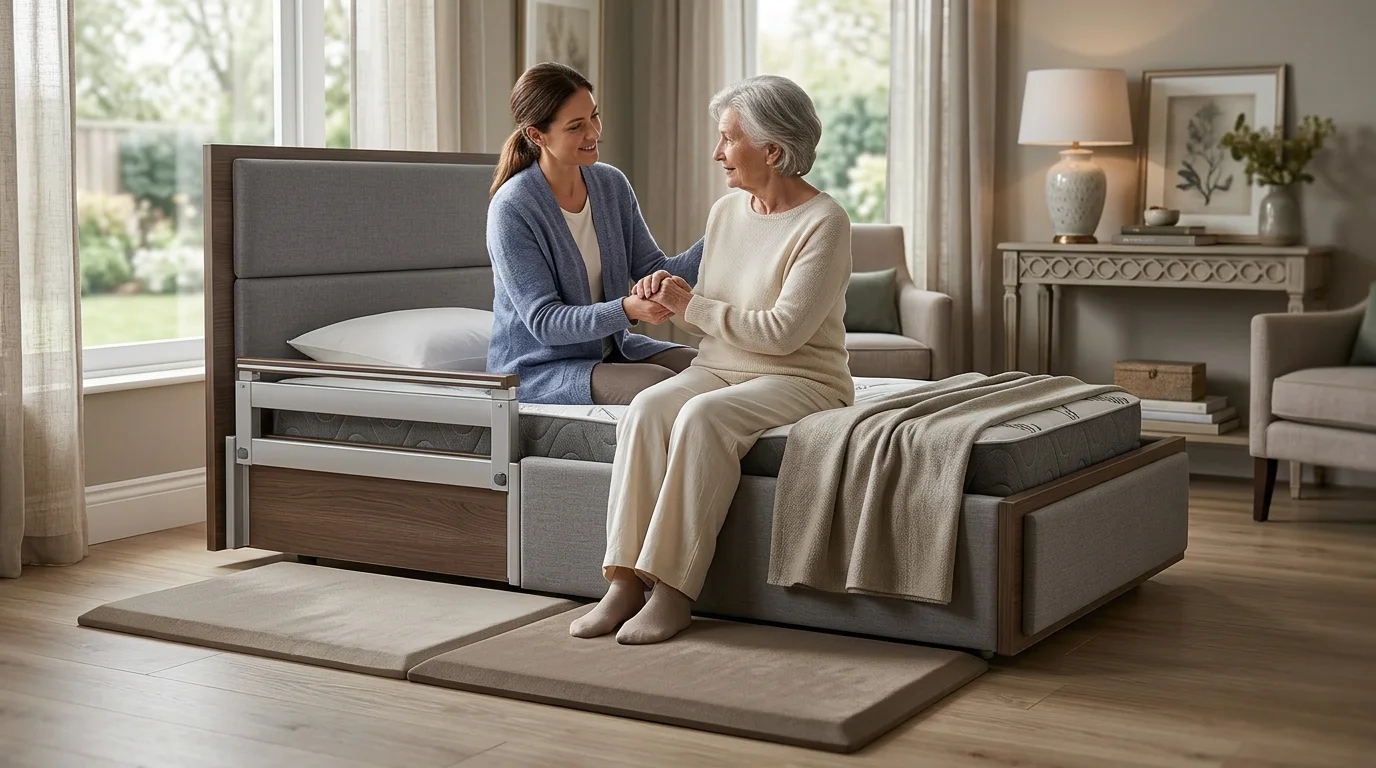
No matter how low a bed sits, some people will still exit it, and floor mats address what the low bed cannot: the possibility of injury when a fall does occur. A padded floor mat placed alongside the bed absorbs impact at the point of contact, reducing the kinetic energy transferred to the hip, shoulder, or head. Research by Capezuti and colleagues (published in Nursing Research) examined bed-exit alarm effectiveness in a clinical setting and documented that positioning the bed in its lowest position and placing a bedside mat were the primary safety precautions used alongside alarms to reduce the risk of injury, the mats functioning as the injury-mitigation layer while the bed height functioned as the primary prevention layer.10 However, floor mats introduce their own risk if deployed incorrectly: a raised edge or bunched mat can become a tripping hazard for a person who stands on it to walk to the bathroom. The VA National Center for Patient Safety has formalized a decision algorithm specifically for this reason: a patient who stands on a floor mat to ambulate faces elevated fall risk from the mat itself. Correct mat deployment:- Choose a mat with beveled (tapered) edges, not squared corners, so that a foot sliding off the edge does not catch.
- Position the mat flush against the bed frame on the side most likely to see exit attempts, typically the unrailed side or the side closest to the bathroom.
- The mat should be thick enough to absorb impact (2–3 inches is typical for clinical-grade crash mats) but not so thick that it elevates the standing surface by an amount that could cause a step-off fall.
- Remove and stow the mat before any assisted transfer, ambulation with a walker, or physical therapy. Replace it after the person is settled in bed.
- If the person regularly exits independently and ambulates, coordinate with their occupational therapist about whether a floor mat is appropriate for their specific gait and mobility profile.
Why Bed Exit Alarms Alone Are Not Enough
Bed exit alarms, pressure-sensitive pads placed on the mattress or under the sheet that trigger an alert when the person shifts or rises, have become the most common fall-prevention tool in both hospitals and homes. They are also the tool that most experienced caregivers eventually become skeptical of. The skepticism is evidence-based. A 2018 Cochrane Review by Cameron and colleagues analyzed bed sensor alarms across 28,649 participants in two trials and found uncertainty about whether they have any effect on fall rates in hospitals.9 A separate cluster randomized trial by Shorr and colleagues across 16 nursing units found no significant effect on injurious falls from a multicomponent intervention that included bed alarms. The finding that caregivers report anecdotally is the same finding in the research: bed exit alarms notify after exit begins. They do not prevent the exit, and they cannot prevent the fall that may occur in the seconds between the alarm sounding and a caregiver arriving. Alarms are useful as an adjunct, as an early-warning signal that helps a caregiver respond quickly, but they are not a substitute for the physical injury-mitigation provided by a low bed and floor mat. The goal of the layered approach is to ensure that by the time the alarm sounds, the physical environment is already set up to minimize harm if the caregiver doesn’t arrive in time.Having the Dignity Conversation
One of the most consistent things caregivers report when they first consider a low bed is that the person they’re caring for resists it. “This is a floor bed. I’m not a dog.” The concern is real: being placed in a bed that sits close to the floor can feel like a demotion, a signal that you are no longer trusted to navigate the world at a normal height. This conversation is worth having directly, and with honesty. The goal of a low bed is not to confine, it’s to change what a fall means. The person in the bed still gets out when they want to. They are not prevented from exiting. The low position simply means that if they do exit unexpectedly in the night, the landing is survivable. Framing that tends to land well: “I’m not trying to keep you in. I’m trying to make sure that the times you do get out on your own terms are safe.” For someone with dementia, whose sundowning drives purposeful nightly exit attempts, this framing acknowledges their agency while explaining the engineering rationale. The residential design of a quality hi-lo bed also helps. A bed that looks like furniture, with an upholstered headboard, residential finishes, and no institutional metal frame, reads as a room-appropriate choice rather than medical intervention. For those for whom aesthetics matter most, preventing falls in someone with dementia covers the full behavioral and environmental picture.Building a Layered Bed-Exit Safety System
The strongest evidence for fall-injury reduction comes not from any single intervention but from multifactorial bundles, combinations of environmental modification, risk assessment, and monitoring. A 2025 integrative review by AlGhareeb and colleagues analyzing nurse-led acute-care fall prevention programs found an overall 15 percent reduction in total falls and a 34 percent reduction in injurious falls across programs that consistently included environmental modification, low beds and mats among them, as one component of a coordinated bundle.11 Here is a practical sequence for home implementation: Step 1: Assess the exit pattern. When does the person exit, overnight, early morning, when sundowning peaks? Does the exit happen from a specific side? Is it impulsive or purposeful? Understanding the pattern tells you where to focus the mat and whether a bed exit alarm will give useful advance warning. Step 2: Lower the bed. Set the sleeping position as low as the bed frame allows during sleep hours. For a hi-lo adjustable bed, this means the lowest platform height, ideally under 15 inches from floor to mattress top for high-risk individuals. Step 3: Place the floor mat. Position a beveled-edge crash mat on the exit side, flush with the bed frame. Confirm it lies flat and does not create a tripping edge for early-morning ambulation. Step 4: Add a bed exit alarm as an early-warning layer. Even knowing that alarms don’t prevent falls, an early alert gives you a few seconds to respond before a fall occurs. This is meaningful. Configure the alarm for the lightest possible trigger so that it sounds during the initial shift rather than after the person is already standing. Step 5: Raise the bed for care tasks. One of the underappreciated benefits of a hi-lo bed is that a caregiver never has to work hunched over. Raise the bed to a comfortable working height for bathing, repositioning, or wound care, then lower it again before leaving. This protects caregiver backs as well as the person in the bed. Your complete reference for the full safety picture is the fall prevention at home guide, which covers risk assessment tools, medication review, and environmental checklists alongside equipment-based interventions.Choosing the Right Adjustable Bed for Fall Prevention at Home
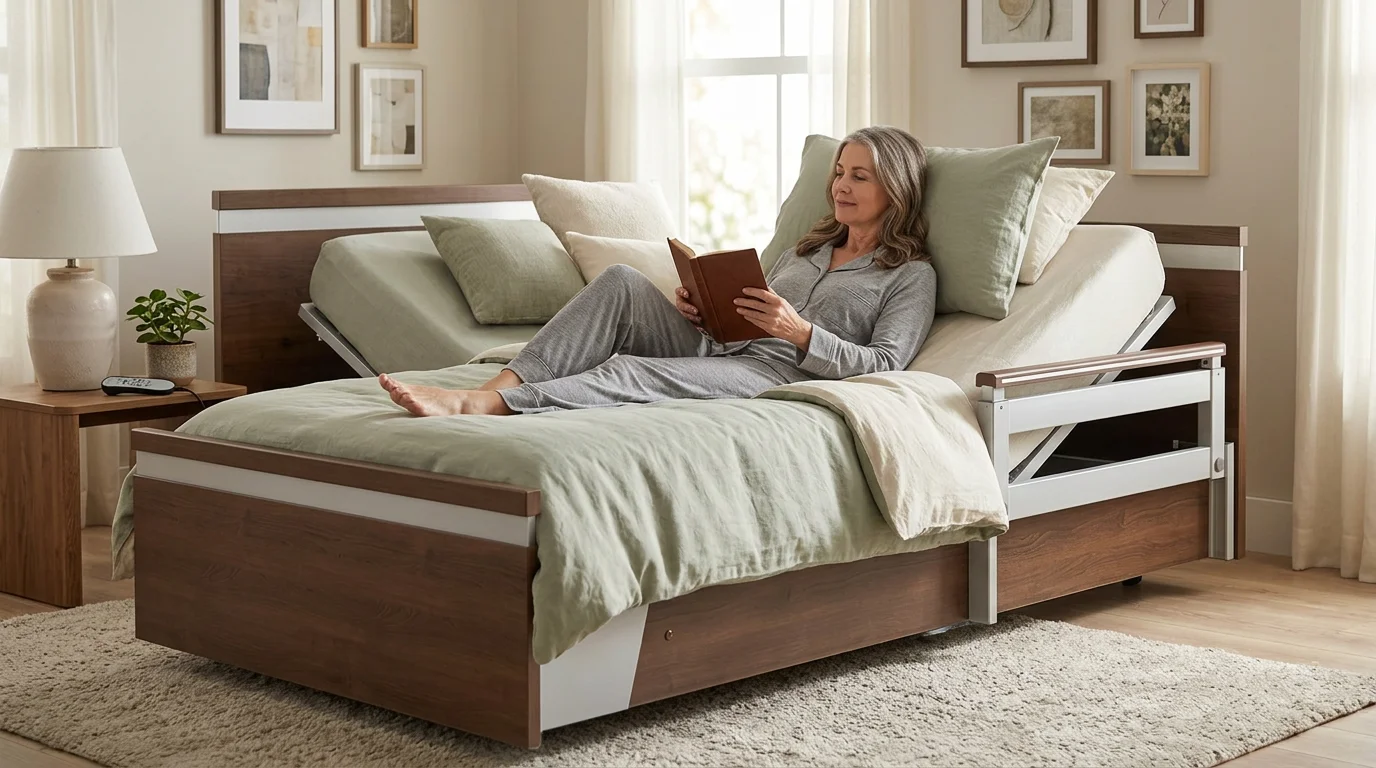
Not all adjustable beds deliver a low enough platform height to be meaningful for fall prevention. Consumer adjustable beds, split kings, Sleep Number beds, and similar products, adjust head and knee angle but typically do not lower the platform height below 16 to 20 inches, and many sit fixed at 24 inches or higher. The hi-lo mechanism is a hospital-grade feature, not a consumer-bed feature. The SonderCare Aura Premium home hospital bed includes the FallSafe Ultra-Low Height system, which lowers the platform to 10 inches (17 inches to the top of the mattress), well within the protective range for high-risk individuals. The full hi-lo range runs from 10 inches to 39 inches, meaning the same bed that protects during sleep raises to a full standing-assist height for caregivers during care tasks. The Aura Premium also includes the full SonderCare positioning suite, head articulation, knee articulation, Zero Gravity, and Cardiac Chair positioning, which addresses other safety concerns alongside the fall-height problem. It is certified to the International Hospital Standard, so families who need documentation for home health aides or insurance purposes have a verifiable clinical baseline to reference. For families prioritizing aesthetics alongside safety, particularly those who want the bedroom to remain a bedroom rather than a clinical space, the Aura Platinum adds fully upholstered side panels in Slate Gray Crypton fabric over the same functional platform. Safety features do not require sacrificing the look of the room. If a hip fracture has already occurred, the recovery setup requirements change. The hip fracture recovery bedroom setup guide covers the specific height, transfer, and equipment considerations for the post-surgical period.The Goal Was Never Confinement
The instinct to use restraints comes from a good place: you’re watching someone you love, and you want to protect them. But the research consistently shows that restraints don’t achieve that goal, and the alternatives that do work are available, practical, and already in use in hospitals and skilled nursing facilities that have moved past the restraint era. A low bed that someone can safely step out of, or safely fall from, combined with a padded landing zone if they don’t make a controlled exit, addresses the injury problem without addressing the person as the problem. They still have their freedom. They still get out when they need to. The environment has simply been engineered to make their exits survivable. That engineering is available for home use. If you’d like guidance on the right setup for your specific situation, speak with a SonderCare expert, we’ve helped thousands of families configure bedroom safety without compromising comfort, dignity, or independence.References
- Centers for Disease Control and Prevention. “Older Adult Falls Data.” National Center for Injury Prevention and Control. Last reviewed February 26, 2026. https://www.cdc.gov/falls/data/index.html
- Centers for Disease Control and Prevention. “Facts About Falls.” National Center for Injury Prevention and Control. Last reviewed January 27, 2026. https://www.cdc.gov/falls/data/falls-older-adults.html
- LeLaurin JH, Shorr RI. “Preventing Falls in Hospitalized Patients: State of the Science.” Clinics in Geriatric Medicine. 2019;35(2):273–283. https://doi.org/10.1016/j.cger.2019.01.007
- The Joint Commission. “Sentinel Event Alert 55: Preventing Falls and Fall-Related Injuries in Health Care Facilities.” September 28, 2015. https://www.jointcommission.org/resources/sentinel-event/sentinel-event-alert-newsletters/sentinel-event-alert-issue-55-preventing-falls-and-fall-related-injuries-in-health-care-facilities/
- Abraham J, et al. “Interventions to reduce physical restraints in general hospital settings.” Cochrane Database of Systematic Reviews. 2022;(3): CD015287. https://doi.org/10.1002/14651858.CD015287
- World Health Organization. WHO Global Report on Falls Prevention in Older Age. Geneva: WHO; 2007. https://www.who.int/ageing/publications/Falls_prevention7March.pdf
- Usmani MT, et al. “Effect of hospital bed height on fall biomechanics and patient egress.” Clinical Biomechanics. 2024. https://doi.org/10.1016/j.clinbiomech.2024.106272
- Haines TP, et al. “Patient education to prevent falls among older hospital inpatients: a randomized controlled trial.” Archives of Internal Medicine. 2010;170(6):516–524. https://doi.org/10.1001/archinternmed.2010.5
- Cameron ID, et al. “Interventions for preventing falls in older people in care facilities and hospitals.” Cochrane Database of Systematic Reviews. 2018;(9): CD005465. https://doi.org/10.1002/14651858.CD005465.pub4
- Capezuti E, et al. “Bed-exit alarm effectiveness.” Research in Gerontological Nursing. 2008;1(1):16–23. https://pmc.ncbi.nlm.nih.gov/articles/PMC2744312/
- AlGhareeb SM, et al. “Nurse-led multifactorial fall prevention programs in acute care: an integrative review.” Journal of Nursing Management. 2025. [Advance publication.]
- Fehlberg EA, et al. “Inpatient falls in US hospitals following the CMS no-pay policy.” JAMA Internal Medicine. 2018;178(12):1629–1636. https://doi.org/10.1001/jamainternmed.2018.4748