









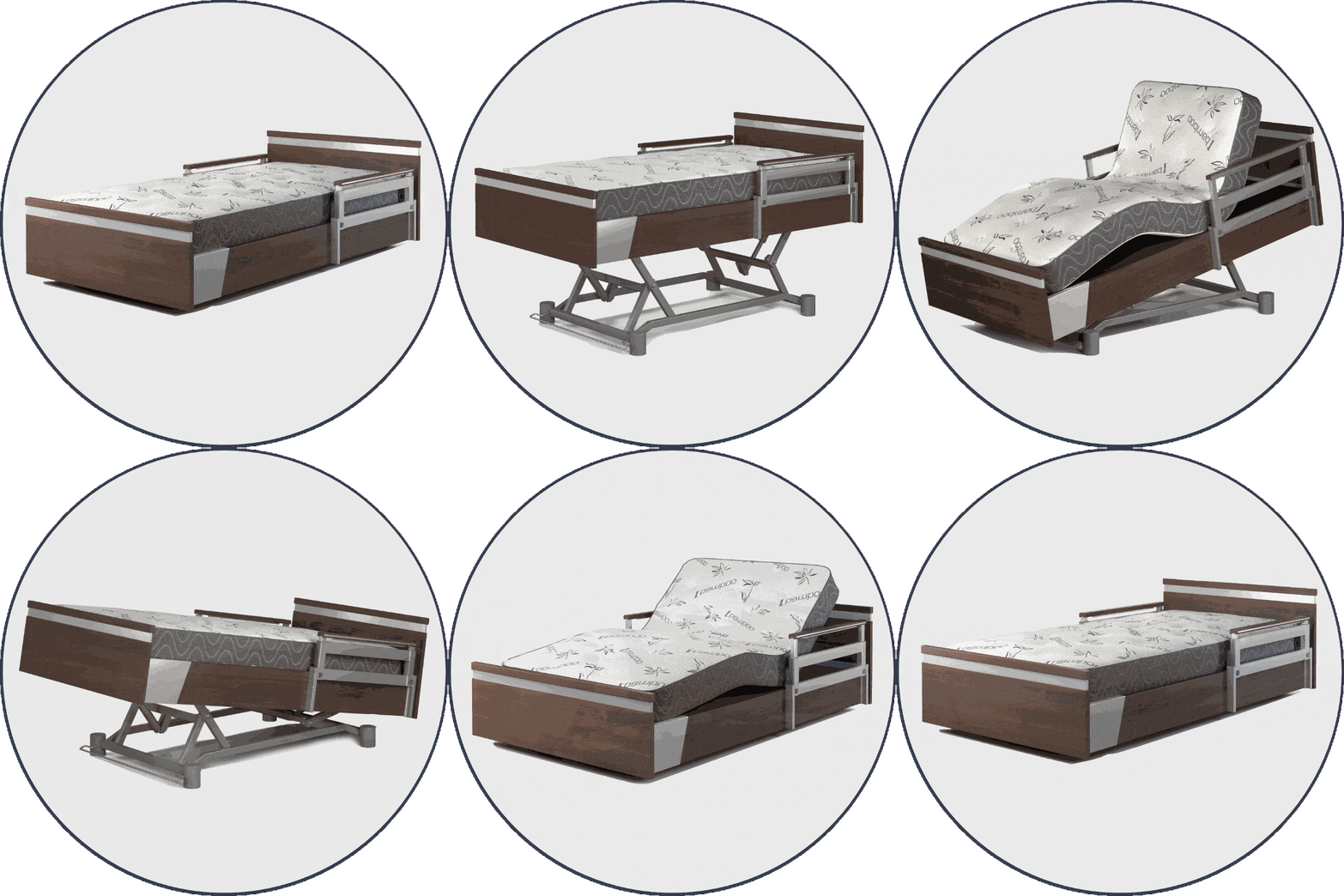
Your parent’s doctor just recommended a hospital bed for home use, and someone at the office said “Medicare covers those.” That’s true, but it’s about 20% of the story. What Medicare covers, which bed types qualify, what you’ll actually pay, and what paperwork must happen before the bed arrives are all details that trip up families every single day.
This guide answers the core question, what kind of hospital bed will Medicare pay for, and covers the details you won’t find in most places: the difference between semi-electric and fully-electric beds (and why it matters for your back), a 2024 documentation requirement that most caregivers don’t know about, and the math that shows some families end up paying $0 out of pocket while others pay thousands.
The Short Answer: What Medicare Covers in 5 Points
- Medicare Part B covers semi-electric hospital beds (HCPCS E0260) as Durable Medical Equipment when a physician documents a qualifying medical condition under LCD L33820.
- Fully-electric beds are not covered. Powered height adjustment is classified as a convenience feature; “semi-electric” means electric head/foot but a manual hand crank for bed height.
- You pay 20% coinsurance after the $283 Part B deductible (2026), and Medicare pays 80%. Medigap Plan F or G can bring your out-of-pocket cost to $0.
- It’s a 13-month capped rental, then the bed becomes your parent’s property. The supplier handles repairs during the rental period.
- A 2024 face-to-face physician visit and Written Order Prior to Delivery are required. Missing this paperwork is the #1 reason claims get denied.
The rest of this guide explains each point in detail.
What Types of Hospital Beds Does Medicare Cover?
Medicare Part B covers hospital beds as Durable Medical Equipment (DME), equipment prescribed by a doctor for use in the home. Not every type of hospital bed qualifies, and coverage depends on which specific features your parent’s medical condition requires.2
Here is how each bed type maps to Medicare coverage under Local Coverage Determination L33820:
| Bed Type | HCPCS Codes | How Bed Height Adjusts | Medicare Coverage |
|---|---|---|---|
| Fixed-height | E0250, E0251, E0290, E0291, E0328 | Does not adjust | Covered with documented medical necessity |
| Variable-height (manual) | E0255, E0256, E0292, E0293 | Manual crank adjusts height | Covered if transfer need is documented |
| Semi-electric | E0260, E0261, E0294, E0295, E0329 | Manual crank for height; electric for head/foot | Covered if frequent repositioning is needed |
| Fully-electric | E0265, E0266, E0296, E0297 | Electric for height AND head/foot | Not covered, height control deemed a convenience feature |
The most commonly approved bed for home use is the semi-electric model (E0260). The key point that surprises most caregivers: even though a semi-electric bed has electric controls, the height of the entire bed frame must still be cranked manually. That distinction matters more than it first appears, and it’s the reason many families eventually upgrade out of pocket.
If you’re not sure which bed type your parent’s condition qualifies for, our companion guide explains what diagnosis qualifies for a Medicare hospital bed in detail.
The Semi-Electric vs. Fully-Electric Difference, and Why It Matters for Your Back
This is the single most important distinction in Medicare hospital bed coverage, and it’s the one caregivers most often discover only after the bed is already in the bedroom.
What a Semi-Electric Bed Actually Does
A semi-electric bed gives the person using it electric control over two positions: the angle of the head (backrest) and the position of the knees and feet. Both can be adjusted at the press of a button, useful for elevating the head to ease breathing, or raising the knees to relieve lower back pressure.
What the electric controls do not adjust is the height of the entire bed frame, how high off the floor the mattress sits. That adjustment requires a manual hand crank. A full range-of-height adjustment on a standard semi-electric bed requires approximately 30 to 50 complete revolutions of that crank. When a caregiver is raising the bed to change linens, lowering it for a safer transfer to a wheelchair, raising it again for wound care, and then returning it to sleeping height, those crank revolutions add up to hundreds per day.2
Caregiver reports from forums consistently describe shoulder strain, wrist fatigue, and the practical impossibility of one-handed cranking while simultaneously steadying the person in the bed. Applied ergonomics literature confirms that powered height adjustment significantly reduces the peak forces and awkward postures associated with patient handling tasks, but Medicare classifies powered height adjustment as a “convenience feature,” not a medical necessity.2
Why Medicare Doesn’t Cover Full-Electric Beds
CMS’s position, stated in Medicare policy documents and the CGS Medicare Dear Physician guidance, is that a caregiver can manually crank the bed height. Therefore, powered height adjustment is a comfort upgrade rather than a clinical requirement. Fully-electric hospital bed codes (E0265, E0266, E0296, E0297) are explicitly listed as not covered under LCD L33820 as “not reasonable and necessary.”2
There are documented exceptions. A physician can make the case for a fully-electric bed, and Medicare will consider it, when:
- The person has a severe cardiac or pulmonary condition where emergency repositioning speed is clinically essential
- The person is bariatric and requires a heavy-duty fully-electric model
- The caregiver has their own documented physical limitations that make manual cranking medically unsafe
These exceptions require detailed physician documentation describing why a semi-electric alternative is medically insufficient for this specific patient, not just a general preference for electric controls. Most primary care physicians are not familiar with this level of documentation specificity, so caregivers need to ask directly and persistently.
Upgrading to a Fully-Electric Bed: How It Works
If Medicare will not cover a fully-electric bed for your parent’s situation and you want one anyway, there is a defined upgrade process. The DME supplier issues an Advance Beneficiary Notice of Noncoverage (ABN), a form stating that Medicare is not expected to pay for the powered height feature. Once you sign the ABN, the supplier bills Medicare for the covered semi-electric portion (E0260) using a two-line billing approach with specific modifiers. Medicare pays its share of the covered item. You pay the difference between the fully-electric bed’s price and what Medicare approved for the semi-electric equivalent.4
For more detail on how semi-electric and fully-electric models compare on features, our full electric vs. semi-electric hospital bed comparison breaks down every difference with use-case examples.
Does Your Parent Qualify? Medical Conditions Medicare Accepts
Medicare does not cover hospital beds based on age or general frailty. Coverage requires that a physician document a specific medical reason why a standard flat bed is insufficient for your parent’s condition. LCD L33820 defines the qualifying criteria for each bed type.2
Criteria for a Fixed-Height or Semi-Electric Bed
Any of the following, documented in the medical record, can justify a fixed-height hospital bed. A semi-electric bed requires the same plus a documented need for frequent position changes:
- Positioning that a standard bed cannot achieve. The person’s condition requires the body to be positioned (head elevated, legs raised, specific angle) in a way that a flat bed physically cannot accomplish. Simple head elevation under 30 degrees typically does not qualify.
- Pain management through positioning. The person requires specific body positioning to alleviate documented pain, for example, keeping the head elevated to reduce acid reflux pressure on a surgical repair site.
- Head-of-bed elevation more than 30 degrees for most of the night. Congestive heart failure, chronic obstructive pulmonary disease (COPD), aspiration risk, or severe GERD, conditions where lying flat creates immediate physiological harm, are the most common drivers of this criterion.
- Traction equipment that requires a hospital bed frame. Certain orthopedic traction setups attach only to a hospital-style bed frame.
Variable-height beds add one criterion: a documented medical need for the bed to be at a specific height to allow safe transfers to a chair, wheelchair, or standing position. This applies to stroke patients, those with severe arthritis limiting joint mobility, and spinal cord injury patients who can transfer with assistance.
What About Dementia?
Dementia alone is generally not sufficient to qualify for a Medicare hospital bed. The diagnosis must be paired with one of the above criteria, for example, severe aspiration risk due to swallowing difficulties, complete immobility requiring frequent caregiver repositioning, or total incontinence requiring the bed to be raised for hygiene care. A physician responding to caregivers in forum discussions consistently confirmed: “She has to have a listed condition for Medicare to pay, difficulty breathing, positioning requirements, that kind of thing.”
Common diagnoses that successfully support approval, when paired with appropriate clinical documentation, include congestive heart failure, COPD, severe arthritis, Parkinson’s disease with positioning challenges, post-stroke mobility impairment, and ALS. The diagnosis is the starting point; the documented functional limitation is what actually drives the coverage decision.
The 2024 Face-to-Face Requirement, Don’t Skip This Step
If your parent has not had an in-person physician appointment recently, this 2024 rule change could delay the process by weeks or longer. As of August 12, 2024, CMS added three specific hospital bed HCPCS codes, E0290, E0301, and E0304, to the “Face-to-Face Encounter and Written Order Prior to Delivery” (WOPD) requirement list.2
Here is what this means in practice:
- An in-person doctor visit is required. The treating physician, physician assistant, nurse practitioner, or clinical nurse specialist must have seen your parent in person within the six months before the hospital bed is ordered. The visit must be documented as evaluating or treating the condition that necessitates the bed.
- Telemedicine may not qualify. Video visits may not satisfy this requirement for the affected codes, depending on the Medicare Administrative Contractor (MAC) in your region.
- The written order must reach the supplier before delivery. A Written Order Prior to Delivery (WOPD) must be in the DME supplier’s hands before the bed is brought to the house. If the supplier delivers the bed before receiving the WOPD, the claim will be denied, and receiving the paperwork afterward will not fix it.
This documentation requirement matters because it has real consequences. The 2024 Medicare Fee-for-Service Supplemental Improper Payment Data reported a 27.3% improper payment rate for hospital beds and accessories, translating to approximately $16 million in projected improper payments.1 The vast majority of these errors are documentation failures, missing face-to-face visits, incomplete written orders, or medical records that don’t connect the dots clearly enough between the diagnosis and the need for the bed.2
Real-world timelines from caregiver forums consistently report 6 weeks to 3 months from the initial physician conversation to actual bed delivery. Building in time for the face-to-face appointment, documentation preparation, supplier identification, and WOPD processing is essential, especially after a hospitalization when time pressure is highest.
Our guide on what to know before getting a Medicare hospital bed covers the documentation process in full detail, including a template conversation to have with the ordering physician.
What Will You Actually Pay? The 2026 Cost Breakdown
Understanding the cost structure removes the biggest source of caregiver anxiety about this process. The numbers are more manageable than most people expect, and for some families, they’re genuinely close to zero.
Original Medicare (Part A/B) Out-of-Pocket Costs
Hospital beds are covered under Medicare Part B and are provided as capped rentals, not purchases. Here is what the payment structure looks like in 2026:4, 5
- Annual Part B deductible: $283. You pay this once per year. Once it’s met, Medicare pays its share for all covered Part B services for the rest of the year.
- Medicare pays 80% of the Medicare-approved monthly rental amount. You pay the remaining 20% coinsurance.
- Rental period: 13 months. Medicare pays the supplier monthly for up to 13 continuous months. After the 13th payment, Medicare stops making rental payments, and the bed legally becomes your parent’s property.
- During the 13-month rental: The supplier is responsible for all maintenance and repairs. If the bed breaks, the supplier fixes it at no cost to you.
- After ownership transfers: Medicare may still cover the cost of reasonable and necessary maintenance and repairs, paying 80% of approved amounts.
If you want to understand the full cost of rental vs. buying a premium bed, our hospital bed cost guide runs the numbers both ways.
The Medigap Factor: How Some Families Pay $0
This is the detail that DME suppliers rarely mention, and it can dramatically change the financial picture. If your parent has a Medigap supplemental insurance plan, specifically Plan F or Plan G, that plan covers the 20% Part B coinsurance that Medicare doesn’t pay. Plan G also covers the Part B deductible after the first year. This means that for a beneficiary with Plan G, the effective out-of-pocket cost of a Medicare-approved semi-electric hospital bed can be $0 per month.
Compare that to the private purchase price range for a fully-electric home hospital bed: $2,500 to $8,000 or more. One caregiver in an AgingCare forum thread reported spending approximately $3,500 on a used Hill-Rom fully-electric bed, plus $1,000 in delivery costs, roughly $4,500 total, with no Medicare contribution. For a family with a Medigap plan, the Medicare-covered semi-electric bed over 13 months may cost less than $500 total, depending on the Part B deductible status.
Always check your parent’s supplemental insurance coverage before committing to out-of-pocket alternatives.
The “Accepts Assignment” Question You Must Ask
Before you select any DME supplier, ask this exact question: “Do you accept Medicare assignment?” A supplier that accepts assignment has agreed to accept the Medicare-approved amount as full payment. You will only owe the deductible and 20% coinsurance, nothing more. A supplier that does not accept assignment can bill above the Medicare-approved amount, and you may be responsible for the full difference. This single question can significantly impact your total cost.4
If Your Parent Has Medicare Advantage, Read This First
Medicare Advantage (Part C) plans are legally required to cover at least the same benefits as Original Medicare, including hospital beds, under federal regulation 42 CFR 422.101.5 However, the path to getting the bed approved through an MA plan is different, and often longer.
Prior Authorization: The Extra Step
Most Medicare Advantage plans require prior authorization for DME, including hospital beds. This means the plan must approve the bed as medically necessary before it will be covered. The DME supplier typically handles the submission, but the process requires the physician’s documentation to be in order first.
Under 2024 CMS rules, MA plans cannot apply medical necessity criteria that are more restrictive than Original Medicare’s. If a hospital bed would be covered under Original Medicare with the same documentation, the MA plan cannot deny it on coverage criteria grounds. However, plans can require in-network suppliers, and some geographic areas have limited in-network DME options.5
If the Prior Authorization Is Denied
MA plan denials are more common than Original Medicare denials, but they are also frequently reversed on appeal. Medicare beneficiaries have five levels of appeal rights. For a denied prior authorization, the first step is a redetermination request, which must be filed within 60 days of the denial notice. More than 80% of contested MA denials that go through the appeals process are partially or fully overturned. The key to a successful appeal is a physician letter that describes symptom frequency and severity, the specific positioning requirements, and why the covered semi-electric bed is medically insufficient for this patient’s condition.
Step-by-Step: How to Get the Bed Approved and Delivered
The process moves faster and with fewer surprises when you work through it in the right sequence. Here is a practical checklist:3
- Schedule an in-person physician visit. Confirm with the doctor’s office that the visit will be documented as evaluating the condition requiring the hospital bed. Do not rely on a telemedicine call for the face-to-face requirement.
- Ask the doctor to document specifically why a standard bed is medically insufficient. The order that says “patient needs hospital bed” is routinely denied. The physician’s notes need to describe the condition, the positioning requirement, and why an ordinary bed creates unacceptable medical risk.
- Confirm the Written Order Prior to Delivery (WOPD) is completed before delivery. The supplier must have this signed document in hand before the bed arrives. Ask explicitly: “When will you have the WOPD?”
- Find a Medicare-enrolled DME supplier. Use the Medicare Care Compare tool at medicare.gov or ask the hospital’s discharge planner for a referral. Ask each supplier: “Do you accept Medicare assignment?”
- Discuss the bed type and mattress with the supplier. The standard covered option is the semi-electric bed (E0260). Also ask about mattress options, clinical evidence confirms that the mattress choice is often more important for pressure injury prevention than the bed frame itself.*
- If upgrading to fully-electric, review and sign the ABN. The Advance Beneficiary Notice must specify what Medicare is not expected to pay and estimate your out-of-pocket cost. Only sign if you understand and agree to pay the difference.
- Understand your billing cycle. You will receive monthly coinsurance bills for 13 months. After the 13th month, billing stops and the bed is your parent’s property. Keep a copy of the Proof of Delivery (POD) document from the supplier.
When Medicare Isn’t Enough: Choosing a Premium Bed Privately
Medicare-covered DME beds do their job medically. What they often cannot do is look and feel like something other than clinical equipment. Caregiver forums document this consistently: the beds supplied through Medicare are described as “institutional,” “undignified,” and disruptive to the home environment. For spousal caregivers especially, transforming a shared bedroom into something that feels like a hospital ward is a real emotional cost.
The private upgrade path is also the practical route for families whose parent needs a fully-electric bed but cannot meet the documentation bar for the covered exception, or for those who simply want electric height control for the caregiver’s own comfort and physical safety.
The Cost Reality of Upgrading
A standard Medicare-approved semi-electric DME bed costs $550–$900 to purchase outright. Premium fully-electric home hospital beds run $2,500–$8,000 or more, depending on features and design. The gap is real, but so is the difference in what you receive.
For families who want an entry-level upgrade, a fully-electric adjustable bed with residential styling at a more accessible price, the Impulse Essential is SonderCare’s $3,999 option. It provides electric control of the head, knee, and full bed height, without the hospital-equipment aesthetic that characterizes DME rentals. It handles up to 400 lbs and ships with SonderCare’s standard 5-year parts warranty.
For families who want the full clinical positioning suite, Trendelenburg, Zero Gravity, Cardiac Chair positions, FallSafe ultra-low height at 10 inches, alongside furniture-grade finishes that don’t signal “hospital,” the Aura Premium at $6,999 is the most commonly chosen option. It is certified to International Hospital Standard, FDA-registered establishment, 500-lb capacity, and available in headboard styles designed to complement a residential bedroom rather than conflict with it.
For families prioritizing aesthetics at the highest level, fully upholstered side panels in Crypton fabric, the look of premium furniture, the Aura Platinum at $8,499 brings that extra step.
The private-pay home hospital bed guide covers how to evaluate the buy-vs-rent decision when Medicare covers only part of what your family needs.
Frequently Asked Questions About Medicare Hospital Bed Coverage
Does Medicare cover a fully electric hospital bed?
Generally, no. Medicare classifies the powered height-adjustment feature of a fully-electric hospital bed as a “convenience feature” under LCD L33820 and does not cover it as medically necessary. The exception exists when a physician can document specific clinical reasons why manual height adjustment is medically unsafe, but this bar is high and requires detailed documentation. Without that documentation, families who want a fully-electric bed pay the cost difference above Medicare’s covered semi-electric rate.2
What diagnosis qualifies a person for a Medicare hospital bed?
Any condition documented to require body positioning that a standard flat bed cannot achieve, including congestive heart failure, COPD, chronic aspiration problems, severe arthritis, post-stroke positioning needs, or ALS. The diagnosis itself is not sufficient; the physician must document how the condition creates a specific positioning requirement that only a hospital bed can meet. Dementia alone typically does not qualify without a co-occurring positioning or safety need.
Does Medicare buy the bed or rent it?
Medicare rents it. Hospital beds are classified as “capped rental” items. Medicare pays the supplier monthly for up to 13 consecutive months. After the 13th month of continuous rental, the bed becomes your parent’s property at no additional charge. During the rental period, the supplier handles maintenance and repairs. There is also a break-in-service rule: a hospitalization or other interruption of 60 days or less does not restart the 13-month clock; an interruption longer than 60 days may require starting a new rental period.5
Will Medicare pay for repairs after the bed becomes my parent’s property?
Potentially, yes. After ownership transfers at month 14, Medicare Part B can still cover reasonable and necessary repairs and maintenance from a Medicare-enrolled service provider. Medicare pays 80% of the approved amount and the beneficiary pays the 20% coinsurance. Routine maintenance that the user can perform themselves (cleaning, minor adjustments) is generally not covered.
Will Medigap (supplemental insurance) cover the 20% I owe?
Yes, if your parent has Medigap Plan F or Plan G. Both plans cover the 20% Part B coinsurance for covered DME. Plan G also covers the annual Part B deductible (after the first year on the plan). This means that for a beneficiary enrolled in Plan G, the monthly out-of-pocket cost for a Medicare-covered hospital bed rental is effectively $0. This is one of the most underreported facts in the Medicare DME conversation.
Can I get a consumer adjustable bed (like Sleep Number) covered by Medicare?
No. Consumer adjustable bases, regardless of brand or features, do not qualify as Medicare DME. Medicare-eligible hospital beds must have side rails that raise and lower, a frame designed for medical attachments, and a durability rating as medical equipment. Consumer adjustable bases fail all three criteria. If you’re looking for a home hospital bed that doesn’t look like one, see our guide on hospital beds that don’t look like one.
Will hospice provide a hospital bed?
Yes. If your parent is enrolled in the Medicare Hospice Benefit, all related DME, including a hospital bed, is provided and covered by the hospice program at no charge to the family. You do not need to go through the standard Part B DME approval process. However, the hospice-provided bed is typically a basic model. Families who want a higher-quality or more aesthetically suitable bed sometimes supplement with a privately purchased option while the hospice bed handles the clinical functions.
The Bottom Line
Medicare covers semi-electric hospital beds (HCPCS E0260) when a physician documents a qualifying medical condition under LCD L33820. It does not cover fully-electric beds under standard coverage. The 2024 face-to-face requirement adds a documentation step that must happen before the order is placed. The 13-month rental ends in automatic ownership. And for families with Medigap Plan F or G, the entire monthly cost can be $0 out of pocket.
When the Medicare-provided bed isn’t meeting your family’s needs, whether because of the manual crank, the clinical appearance, or the limited positioning features, the private upgrade path is clear. SonderCare’s bed experts work with families in exactly this situation every day. If you’d like guidance on which bed fits your parent’s clinical needs and your bedroom, speak with a SonderCare expert, no pressure, no obligation, just clarity.
References
- HHS Office of Inspector General. Medicare Improperly Paid Suppliers $22.7 Million Over 7 Years for Durable Medical Equipment, Prosthetics, Orthotics, and Supplies Provided to Enrollees During Inpatient Stays. December 2025. oig.hhs. gov
- Centers for Medicare & Medicaid Services. Local Coverage Determination (LCD): Hospital Beds and Accessories (L33820). CMS Medicare Coverage Database. cms.gov; Hospital Beds & Accessories, Medicare Learning Network. CMS, February 2026. cms.gov; CGS Medicare. Dear Physician: Hospital Beds and Accessories. cgsmedicare.com
- Centers for Medicare & Medicaid Services. NCD, Hospital Beds (280.7). CMS Medicare Coverage Database. cms.gov; Noridian Healthcare Solutions. Billing for Hospital Bed Upgrades. JD DME Article Detail. noridianmedicare.com
- Centers for Medicare & Medicaid Services. Medicare Claims Processing Manual, Chapter 20, Durable Medical Equipment, Prosthetics, Orthotics, and Supplies (DMEPOS). CMS Publication 100-04. cms.gov; DMEPOS Order & Face-to-Face Encounter Requirements, 42 CFR 410.38. CMS. cms.gov
- eCFR. 42 CFR 414.229, Other Durable Medical Equipment: Capped Rental Items. U. S. Government. ecfr.gov; 42 CFR 422.101, Requirements Relating to Basic Benefits. U. S. Government. ecfr.gov
Clinical footnote: Pressure injury prevention evidence, Beeckman et al. (2021). “Beds, overlays and mattresses for preventing and treating pressure ulcers: an overview of Cochrane Reviews and network meta-analysis.” PMCID: PMC8407250. The selection of mattress or support surface is a clinically significant factor in pressure injury prevention and should be discussed with the physician and DME supplier.