







This guide walks through the real costs, the hidden trade-offs, and a clear decision framework so you can make the right choice for your situation. Whether you are caring for a spouse with a progressive condition, supporting a parent through recovery, or planning ahead, you will find the specific numbers and practical guidance you need.
The Real Cost of Renting a Hospital Bed
Hospital bed rentals typically cost between $195 and $400 per month for a full-electric model, with basic semi-electric or manual beds sometimes available for less.1 That monthly fee sounds manageable until you examine what you actually receive and how quickly those payments accumulate.
Most rental beds from Durable Medical Equipment (DME) suppliers are basic models. Forum discussions on caregiving sites consistently report that families expecting a quality full-electric bed often receive a bare-bones manual or semi-electric model instead.2 The mattress included with a rental is typically a standard innerspring or basic foam, not a pressure redistribution surface designed for someone spending extended time in bed.
Beyond the monthly fee, expect additional costs. Setup and delivery fees commonly run $100 to $300. Some companies charge a pickup fee when the bed is returned. And if the bed needs repair, you may wait days for a service call, leaving your spouse without a functional bed in the meantime.
There is also a hygiene consideration that many families overlook. Rental beds cycle through multiple users over their lifespan. For anyone with compromised immunity or sensitive skin, a previously used bed frame and mattress introduces risks that a new bed eliminates entirely.2
The True Cost of Buying a Hospital Bed for Home
Purchasing a home hospital bed represents a larger upfront investment, but the total cost picture looks different than most people expect. Full-electric hospital beds range from approximately $1,500 to $3,000 for basic models, while premium beds with advanced positioning and residential design run from $3,999 to $8,999 depending on features and width.1
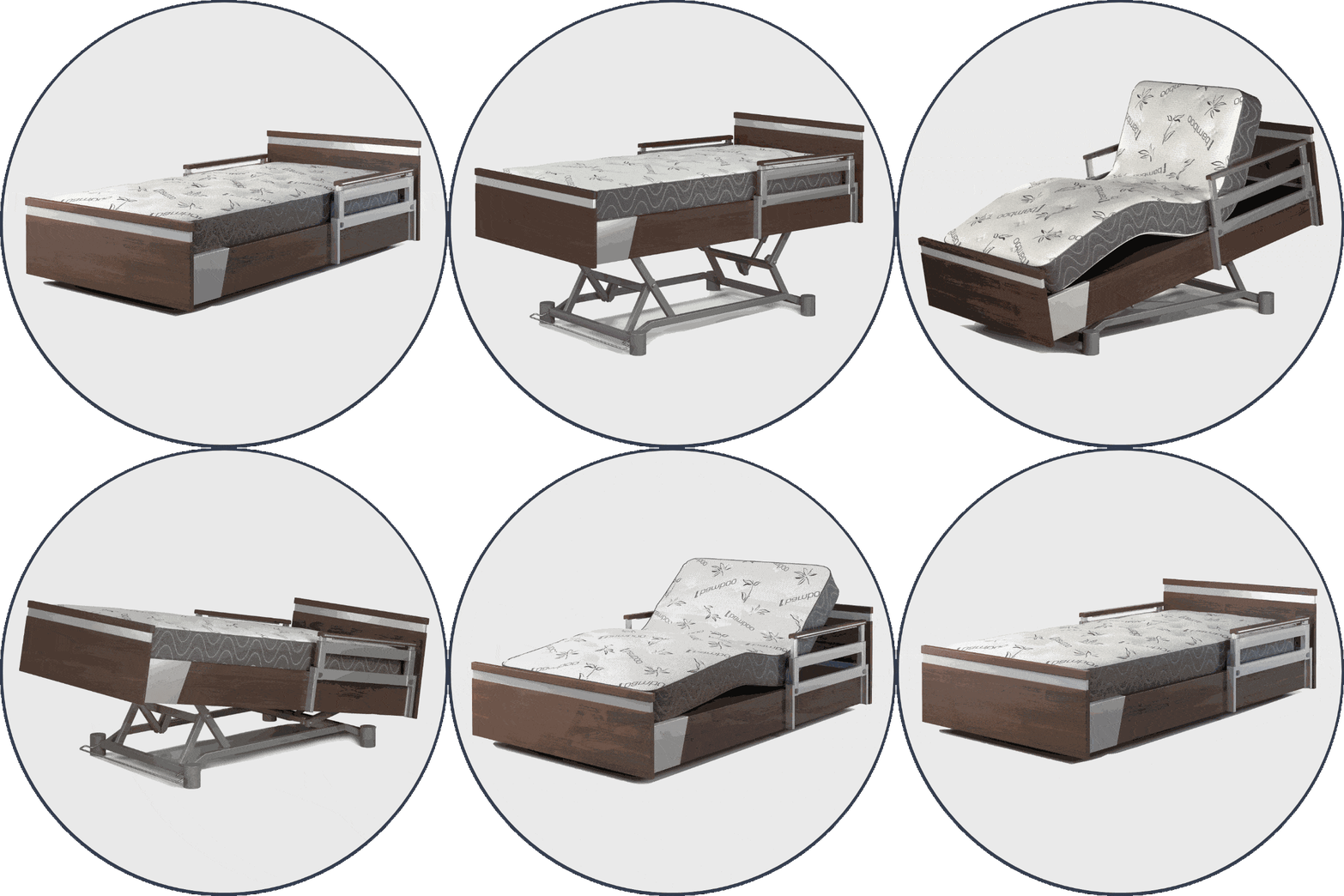
The Impulse Residential Bed at $3,999 provides head, knee, and hi-lo adjustment with a residential comfort design and 400 lb weight capacity. For families needing hospital-grade certification with advanced positioning, including FallSafe Ultra-Low height, Trendelenburg, Zero Gravity, and Cardiac Chair positions, the Aura Premium Home Hospital Bed at $6,999 delivers the full suite with a 500 lb capacity and furniture-grade design.
What many first-time buyers do not realize is that the bed frame is only part of the investment. A quality pressure redistribution mattress adds $899 to $2,999 depending on the type. Accessories like assist rails, an overbed table, or a trapeze bar add $89 to $789 each. White-glove delivery with full setup and walkthrough runs $599 to $1,199 depending on speed. Factor these into your total budget from the start.
However, once purchased, the bed is yours. No monthly fees. No worrying about return dates. A 5-year comprehensive warranty covers all parts, and you choose exactly the features and quality level your family needs. For many spousal caregivers, that control and peace of mind is worth the upfront cost.
The Break-Even Point: When Renting Stops Making Sense
The most straightforward way to compare renting and buying a hospital bed for home use is the break-even calculation. Divide the total purchase price by the monthly rental fee to find the number of months after which buying becomes cheaper. Based on current market pricing, that break-even point falls between 6 and 12 months for most bed types.1
This means if you expect to need a home hospital bed for longer than about 10 months, purchasing almost certainly saves money. And the savings compound every month beyond that break-even point.
The critical question, then, is how long you will need the bed. Research on typical durations by condition provides helpful guidance:3
| Condition | Typical Duration of Need | Rent or Buy? |
|---|---|---|
| Post-operative recovery (hip/knee replacement) | 30-75 days (1-2.5 months) | Rent usually makes sense |
| Stroke rehabilitation | 30-90 days for home rehab | Rent for short recovery; buy if long-term |
| Heart failure / COPD | Weeks to years (highly variable) | Buy if chronic and progressive |
| Neurodegenerative disease (ALS, Parkinson’s, dementia) | 6-12+ months, often years | Buy, almost always the better value |
| Cancer / palliative care | Days to months (wide range) | Depends on prognosis and goals |
| Hospice (all diagnoses) | Median 17 days; 17% need 6+ months | Hospice often provides bed; buy if upgrading |
For spousal caregivers, the reality is that most situations involving a progressive condition, the scenario that most commonly leads a couple to consider a hospital bed, extend well beyond the break-even point. If your spouse is living with Parkinson’s, ALS, advanced dementia, or another progressive condition, buying delivers better value and better quality from the start.
What Rental Beds Cannot Provide
The financial comparison tells only part of the story. The gap between what a rental bed offers and what a purchased premium bed provides affects daily life in ways that spreadsheets cannot capture.
Limited Positioning and Functionality
Most rental beds are semi-electric or manual models. They raise the head and knees but lack the full positioning capabilities that make a meaningful difference for both the person in the bed and their caregiver. Features like Trendelenburg positioning (feet elevated above the head for circulation), Zero Gravity for pressure relief and pain reduction, and Cardiac Chair positioning for breathing and eating are typically unavailable on rental equipment.
Medicare Part B covers only semi-electric hospital beds as DME, not full-electric models.4 This means even when insurance helps with rental costs, you are limited to basic functionality.
Caregiver Strain and Ergonomics
For spousal caregivers who are often aging themselves, the physical demands of caregiving take a serious toll. Research consistently shows that electrically adjustable hospital beds significantly reduce the physical burden on caregivers during repositioning, transfers, and daily care tasks. Biomechanical studies demonstrate reduced lumbar compression forces, lower muscle activity measured by surface EMG, and decreased perceived exertion on the Borg scale when caregivers use full-electric height-adjustable beds.5
The Aura Premium bed’s hi-lo adjustment range of 10 inches to 39 inches means you can raise the bed to a comfortable working height for changing linens or assisting with transfers, then lower it to the FallSafe ultra-low position for overnight safety. A rental bed with limited or no height adjustment forces you to bend, strain, and work at whatever fixed height the bed provides, a recipe for back injuries over weeks and months of daily caregiving.
Your Bedroom Becomes a Hospital Room
This matters more than many people anticipate. A standard rental bed, chrome rails, institutional frame, medical-grade appearance, transforms your shared bedroom into something that feels clinical. For spousal caregivers trying to preserve normalcy and intimacy, that visual shift carries emotional weight.
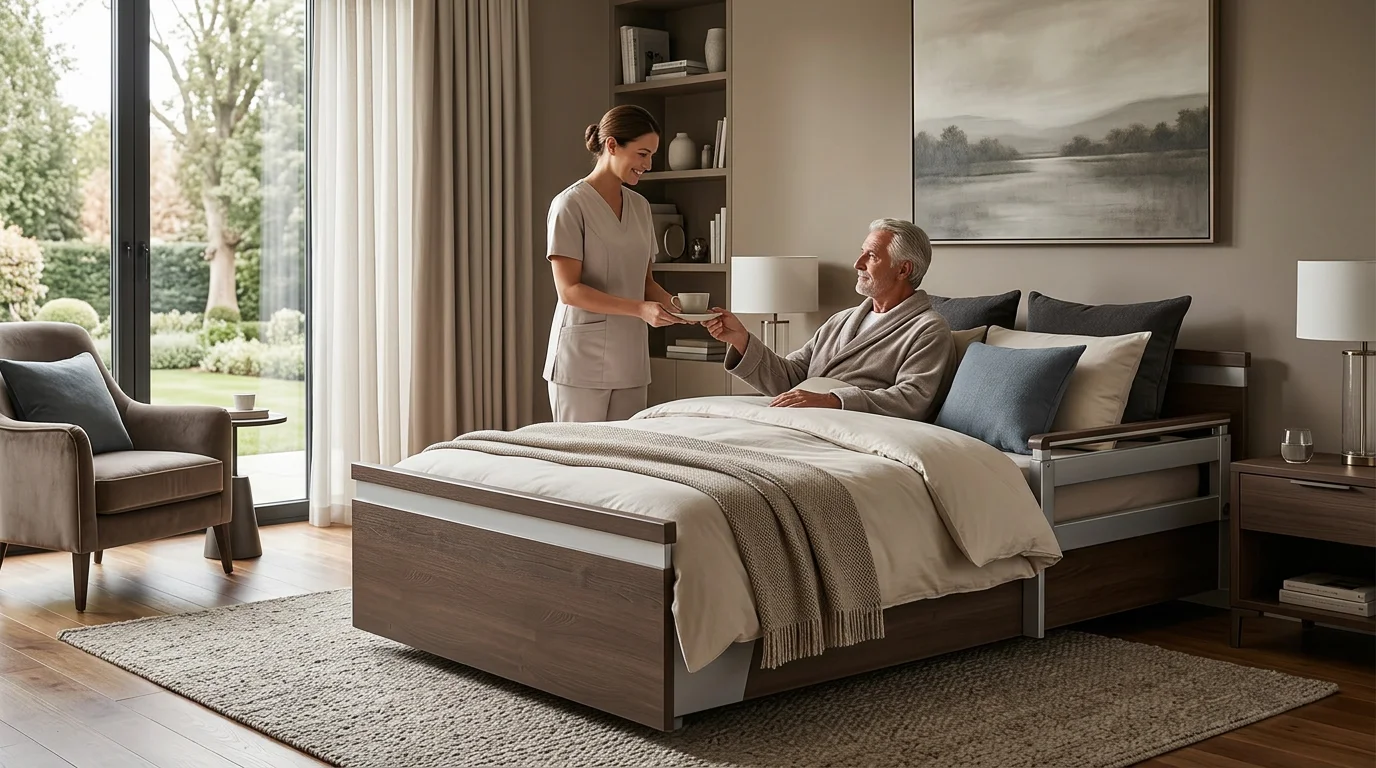
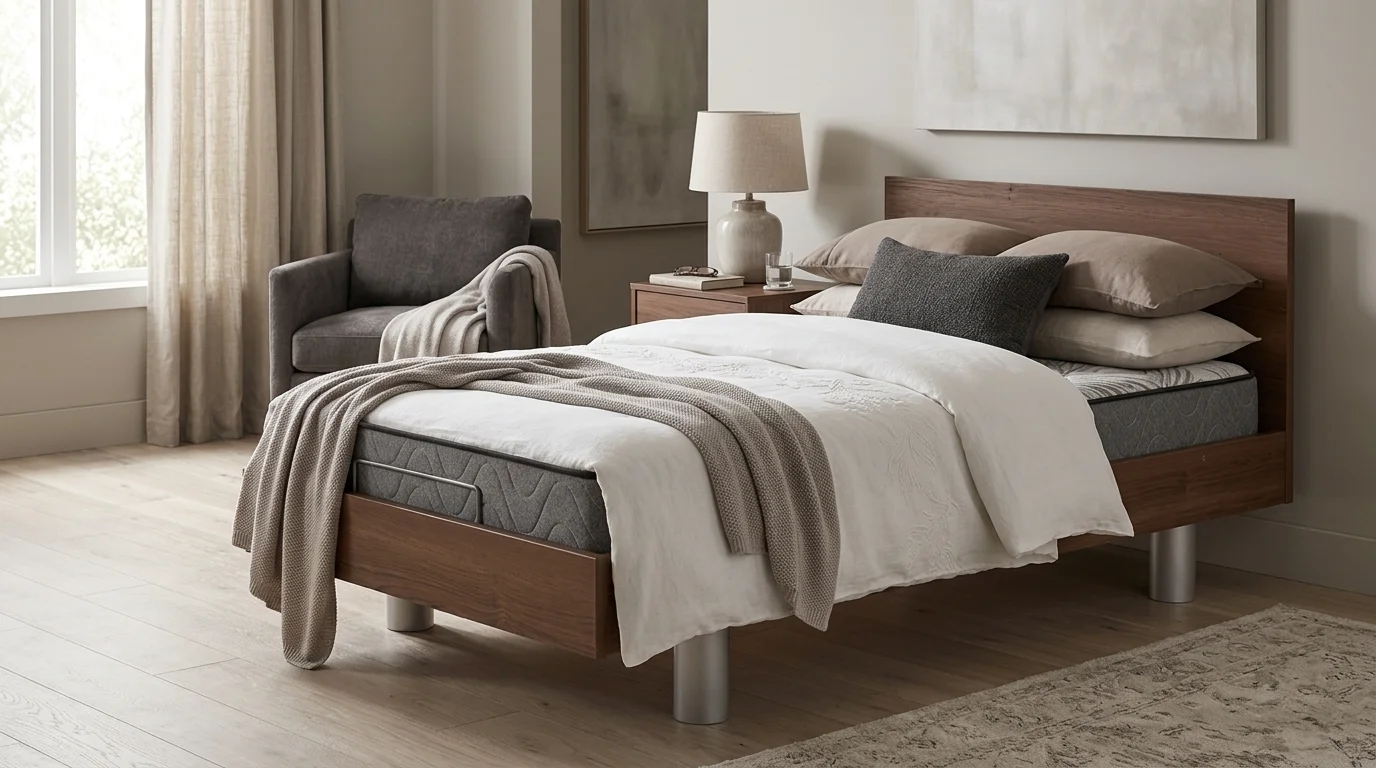
Premium home hospital beds with furniture-grade finishes, upholstered headboards, and residential design keep your bedroom looking and feeling like your personal space rather than a care facility. When you are already navigating difficult changes in your relationship, the environment you share matters. You can learn more about creating the right environment in our hospital-grade bedroom setup guide.
Insurance, Medicare, and Alternative Funding Options
Understanding your coverage options can significantly change the financial equation when deciding to rent or buy a hospital bed for home use. Here is what the major programs offer.
Medicare Part B (Capped Rental)
Medicare Part B covers hospital beds as Durable Medical Equipment when a doctor certifies medical necessity. Under the capped rental policy, Medicare rents the bed for up to 13 months, with the beneficiary paying 20% coinsurance. After 13 months of rental payments, ownership of the bed transfers to you at month 14.4 This creates an effective rent-to-own arrangement for long-term users.
Important limitations: Medicare covers only semi-electric beds, not full-electric models. The rental fee schedule is set at 10% of the purchase price for months 1-3 and 7.5% for months 4-13.4 A doctor’s prescription documenting medical necessity is required.
Veterans Administration (VA)
Eligible veterans can receive hospital beds through the VA’s Prosthetic and Sensory Aids Service (PSAS) at no cost, including full-electric models, setup, in-home training, and maintenance. The process begins with a consult to PSAS, and delivery often occurs within a few working days of approval.6
State Medicaid Waivers and Other Programs
State Medicaid Home and Community-Based Services (HCBS) waivers may cover hospital bed purchase or rental for qualifying individuals. TRICARE covers beds on a rental or purchase basis based on a cost analysis of expected duration.6 Private insurance DME benefits vary widely, check your specific plan for prior authorization requirements and coverage limits.
State Assistive Technology (AT) programs offer another option many families do not know about. These programs provide short-term device loans (often 30-45 days, free or low-cost), refurbished DME through reuse networks, and sometimes alternative financing for purchases. Find your state’s program through the AT3 Center directory.6
For a deeper comparison of rental versus purchase in a hospice context, our hospital bed rental vs buying guide for hospice covers additional considerations specific to comfort care.
Safety Considerations for Any Hospital Bed
Whether you rent or buy, safety must be a non-negotiable priority. The U. S. Consumer Product Safety Commission (CPSC) documented 310 fatalities associated with hospital beds between 2003 and 2021, with 284 of those deaths related to entrapment between the bed frame, mattress, and rails. An estimated 79,500 emergency department-treated injuries were reported in the same period.7
These numbers underscore why the bed you choose, and who manufactured it, matters. Key safety steps include:
- Verify the mattress fits the bed frame with no dangerous gaps where a person could become trapped
- Check bed rail compliance with current safety standards (IEC 60601-2-52 for medical beds; ASTM F3186 for portable rails)
- Search the CPSC recall database at CPSC.gov before accepting any rental bed or purchasing a used one
- Choose beds from manufacturers with hospital-grade certification and FDA registration
Recent recalls highlight the ongoing risks. Drive DeVilbiss Healthcare recalled 496,100 adult portable bed rails due to entrapment and asphyxiation hazards after two reported deaths.7 With a rental bed, you typically have no choice over the brand, model, or safety history of the equipment delivered to your home. Purchasing from a reputable manufacturer like SonderCare, whose beds are certified to International Hospital Standard and FDA-registered, gives you full control over the safety of your care environment.
Making Your Decision: A Step-by-Step Framework
Rather than guessing, work through these five steps to arrive at a confident decision about whether to rent or buy a hospital bed for your home.
Step 1: Estimate how long you will need the bed. Talk with your spouse’s healthcare team. A post-surgical recovery measured in weeks points toward renting. A progressive condition measured in months or years points toward buying. If uncertain, a short-term rental while you evaluate options is reasonable; just do not let inertia keep you renting beyond the break-even point.
Step 2: Calculate your break-even point. Get written quotes from at least two DME suppliers for both rental and purchase. Divide the total purchase price (including mattress, delivery, and setup) by the monthly rental fee. That number tells you the month where purchasing starts saving money.
Step 3: Evaluate your clinical needs. Does your spouse need full-electric positioning? Height adjustment for safe transfers? Trendelenburg for circulation? If the answer is yes to any of these, a standard rental bed will not meet your needs. Premium purchased beds like the Aura Premium provide the full positioning suite that most rental beds lack.
Step 4: Explore insurance and funding. Check Medicare eligibility, VA benefits if applicable, state Medicaid waivers, and private insurance DME benefits. Even partial coverage can shift the financial equation. Remember that Medicare’s capped rental program effectively converts to ownership after 13 months.4
Step 5: Compare quality, not just price. Visit our guide to choosing a home hospital bed for a detailed breakdown of what separates a basic DME rental from a premium home hospital bed. Consider aesthetics, noise level, positioning capabilities, mattress quality, warranty, and how the bed will affect your daily caregiving routine. For many spousal caregivers, these quality factors matter as much as cost.
The Bottom Line for Spousal Caregivers
If your spouse needs a hospital bed for a short recovery, a few weeks after surgery, a temporary health setback, renting makes practical sense. Pay the monthly fee, use it for the recovery period, and return it when your spouse is back on their feet.
But if you are caring for a spouse with a chronic or progressive condition, the math and the quality both favor buying. You will save money beyond the 6-to-12-month break-even point. You will get a bed with full-electric positioning that reduces your physical strain. You will choose a design that keeps your bedroom looking like a bedroom, not a medical facility. And you will own equipment that is new, safe, and backed by a manufacturer warranty, not a recycled rental with an unknown history.
The decision to rent or buy a hospital bed for home use is deeply personal. It depends on your finances, your spouse’s health trajectory, and what matters most to your family. Whatever you decide, make it an informed choice rather than a default one.
Need help deciding? SonderCare’s bed experts have helped thousands of families navigate this exact decision. Speak with a SonderCare expert for personalized guidance based on your situation, no pressure, just clear answers.
References
- Real-world hospital bed pricing analysis, 2026. Rental range: $195-$400/month for full-electric models; purchase range: $1,500-$3,000 for standard full-electric beds. Break-even point: 6-12 months. Sources: GoodRx Hospital Bed Cost Guide; Opera Beds Rental vs Buying Analysis.
- Community caregiver forums including AgingCare.com discussions on hospital bed rental quality, hygiene concerns, and cost experiences. Sources: AgingCare, Hospital bed rental, is it worth it?; AgingCare, Rent or buy if Medicare won’t cover.
- Duration of need estimates by condition. Post-operative orthopedic recovery: approximately 30-75 days (Stoicea et al., 2018; CMS Home Health QRP). Neurodegenerative diseases: exceeding 6-12 months, average hospice LOS 155 days (CDC ALS Registry; NHPCO Facts & Figures 2023). Hospice overall median: 17 days (CMS Hospice Monitoring Report 2025; NHPCO Facts & Figures 2023).
- Medicare Part B Capped Rental Policy for Durable Medical Equipment. Rental cap: 13 months; ownership transfer at month 14; beneficiary coinsurance 20%; fee schedule months 1-3 at 10%, months 4-13 at 7.5% of purchase price. Source: Centers for Medicare & Medicaid Services DME coverage guidelines.
- Biomechanical studies on caregiver strain with adjustable hospital beds. Electrically adjustable beds reduce lumbar compression, shear forces, and perceived exertion during patient handling. Budarick et al. (2020). “Turn-assist surfaces reduce the physical burden on caregivers during patient turning tasks.” Human Factors. Additional evidence from surface EMG and Borg scale measurements across multiple ergonomic studies.
- Alternative funding pathways for hospital beds: VA Prosthetic and Sensory Aids Service (PSAS) provides beds at no cost to eligible veterans; State Medicaid HCBS waivers cover specialized medical equipment; TRICARE authorizes rental or purchase based on cost analysis; State Assistive Technology (AT) programs offer device loans and refurbished DME. Source: Federal and state program documentation.
- U. S. Consumer Product Safety Commission (CPSC). Hospital bed safety data, January 2003 to December 2021: 310 total fatalities, 284 entrapment-related deaths, approximately 79,500 ED-treated injuries. Drive DeVilbiss Healthcare recall of 496,100 adult portable bed rails (CPSC Press Release #22-025).