






When a parent starts spending more time in bed, transfers become risky, or your own back begins to give out, the same question surfaces: would a hospital bed actually help, or is it an expensive, institutional-looking overreaction?
The honest answer is that a well-chosen home hospital bed is one of the highest-impact investments a family can make in safe home care, and not for the reason most people assume. Yes, it adjusts. But its real value is in preventing the specific, costly harms that derail home care: falls, pressure sores, and caregiver injury. This guide walks through exactly how a hospital bed helps a homecare patient and the family caring for them, what the evidence shows, and how Medicare coverage works.
Preventing Falls In and Around the Bed
Falls are the leading cause of injury death for adults over 65, and the bed is one of the most common places they happen. Over 14 million older adults, about 1 in 4, fall each year, resulting in roughly 3 million emergency-department visits and 800,000 hospitalizations, at a direct cost near $50 billion annually.1 The age-adjusted fall death rate climbed 21% between 2018 and 2024.1
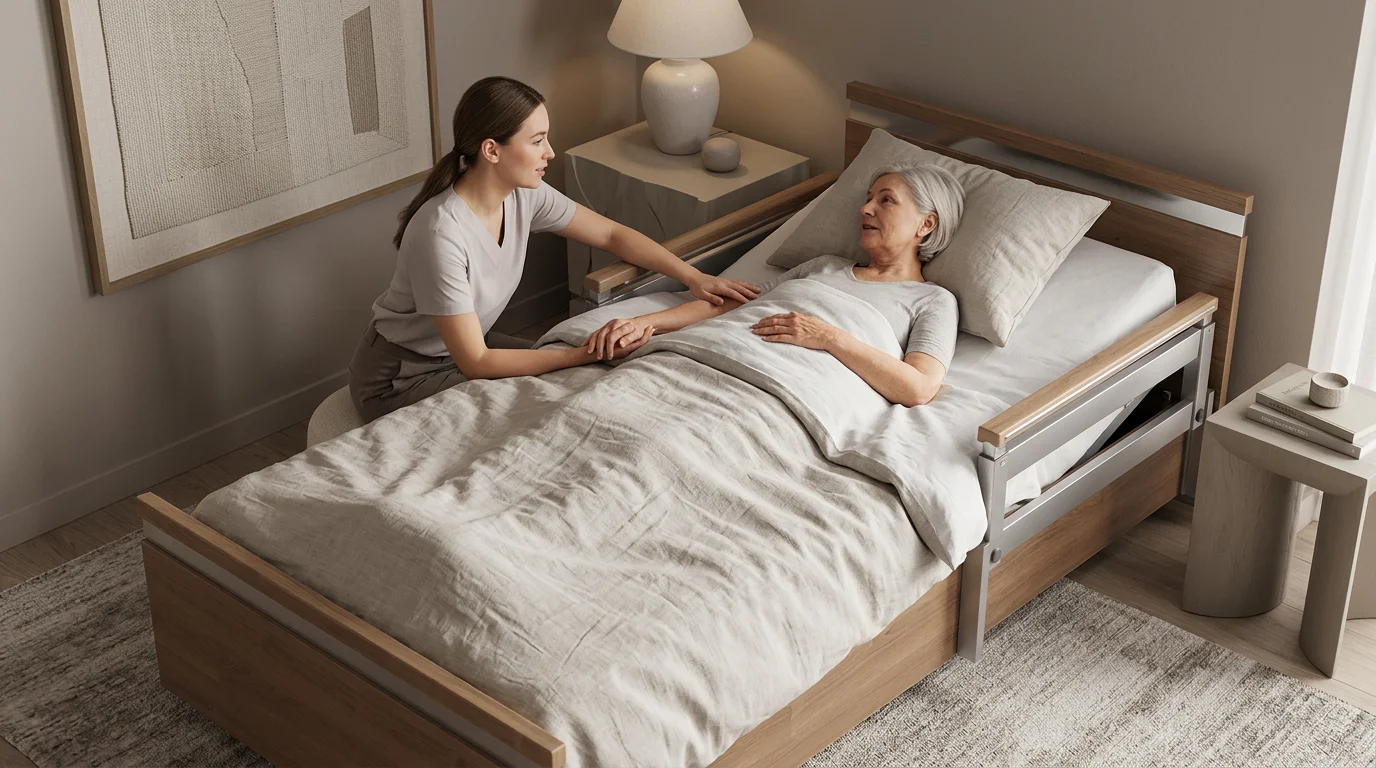
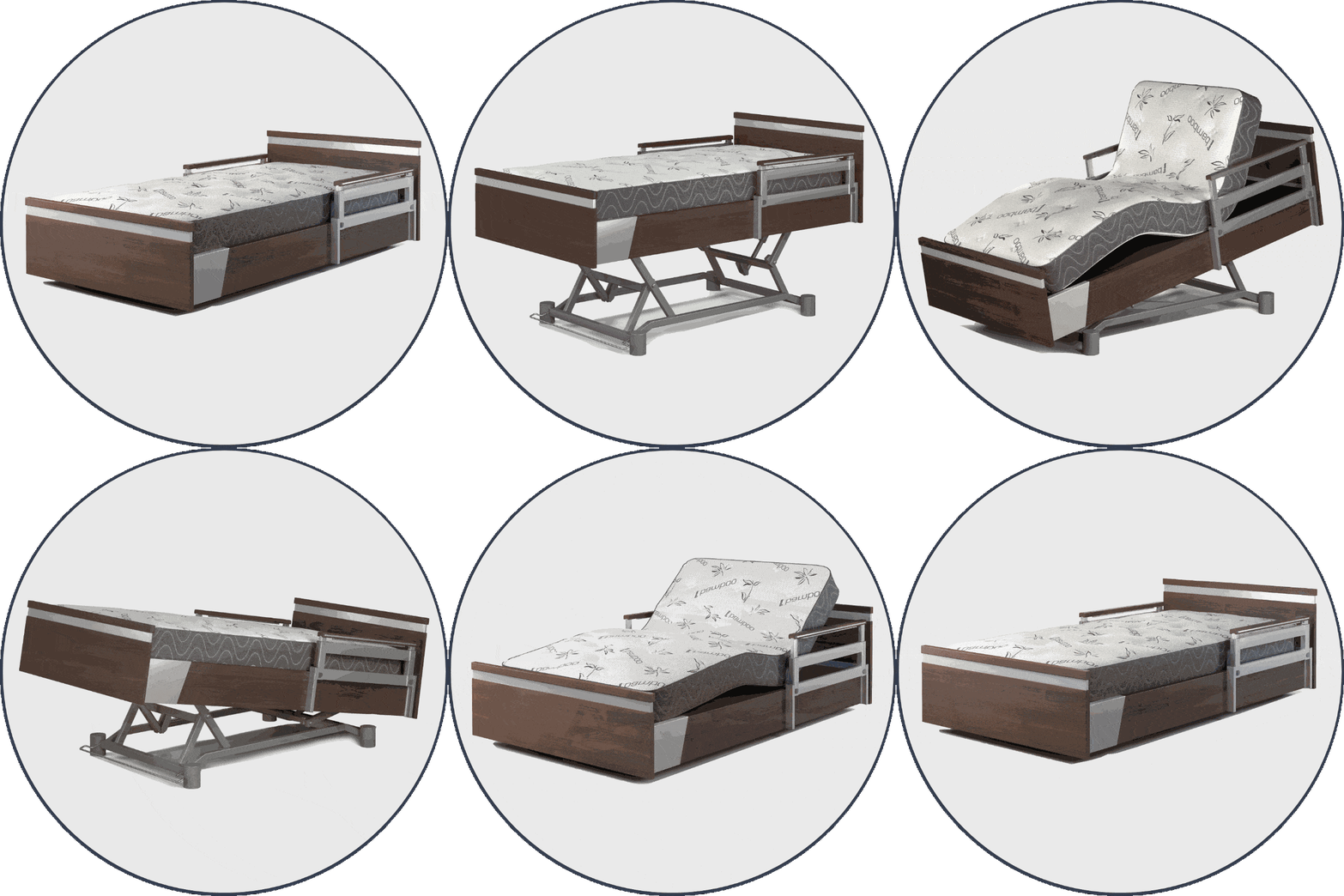
A standard bed works against a frail person in two ways: it’s often too high for a safe, feet-flat exit, and it offers nothing to hold onto. A home hospital bed addresses both. Variable height lets the bed lower so your parent can stand with both feet planted, and an ultra-low setting minimizes injury if they do slip. Assist rails give a stable handhold during the highest-risk moment, the transfer in and out of bed. A bed like the SonderCare Aura Premium is built around exactly these safety features, lowering near to the floor and raising to a safe working height with integrated assist rails.
Preventing Pressure Sores
For a patient who spends long hours in bed, pressure injuries (bedsores) are a serious, painful, and largely preventable threat. Pooled data put pressure-ulcer incidence around 12% in hospital settings, and immobile patients at home on an ordinary mattress face comparable risk.2 The intervention is well-proven: alternating-pressure mattresses reduce pressure-injury risk by roughly 69% compared with standard mattresses.3
A hospital bed is what makes this protection possible. Its frame supports powered, pressure-redistribution mattress surfaces, and its tilt and positioning functions make the regular repositioning that prevents sores far easier on both patient and caregiver. For anyone with limited mobility, pairing the right bed with a pressure-relief surface is one of the most clinically effective things a family can do. (Our pressure sore prevention guide covers the full protocol.)
Protecting the Caregiver’s Back
This is the benefit families discover too late, and it may be the most important of all: a hospital bed protects the caregiver. Caregiving is physically brutal. An estimated 72.5% of spousal caregivers develop musculoskeletal disorders, and about half of stroke-caregiver families experience low back pain from lifting and transferring.4 Home health aides, who at least have training, still suffered more than 40,000 nonfatal occupational injuries in a single year, with lifting and transferring the leading causes.5 Family caregivers face the same forces with no training and no equipment.
A height-adjustable bed changes the physics. Raising the bed to the caregiver’s waist height for care tasks, bathing, dressing, wound care, repositioning, eliminates the deep bending that compresses the lower spine, the mechanism behind most caregiver back injuries. Positioning functions do work the caregiver would otherwise do by hand: tilt and articulation help turn and reposition a patient with far less manual force, and some beds offer turn-assist features that reduce the load on the caregiver’s spine to a measurable degree. A task that used to require two people, or one person straining dangerously, often becomes a safe one-person job.
This matters because caregiver health is already fragile. CDC data show caregivers fare worse than non-caregivers on 13 of 19 health indicators; arthritis affects nearly 35% of caregivers versus 24.5% of non-caregivers, and frequent mental distress runs higher too.6 A caregiver sidelined by a back injury can’t provide care at all, which is how a single preventable injury can force a parent into a facility. Equipment that protects the caregiver’s body isn’t a luxury; it’s what keeps the whole care arrangement from collapsing. The right assist rails and accessories further reduce the strain of every transfer and reposition.
Improving Comfort, Breathing, and Positioning
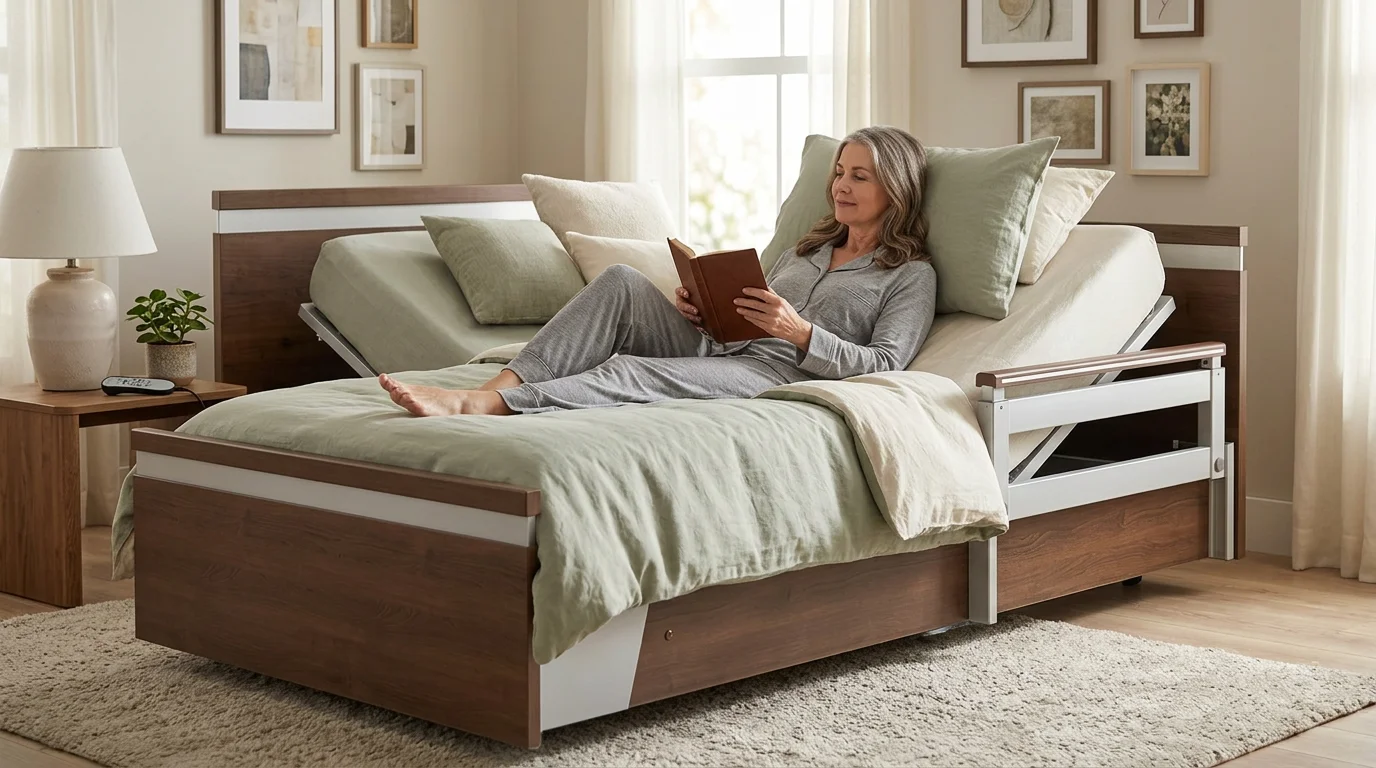
Beyond safety, a hospital bed directly improves how a patient feels day to day. Independent head and foot adjustment lets you elevate the upper body for easier breathing, valuable for conditions like COPD, heart failure, and acid reflux, and raise the legs to reduce swelling (edema). Proper positioning makes eating safer by reducing aspiration risk, eases pain by relieving pressure points, and lets a patient change position without a caregiver’s help, restoring a measure of independence and dignity.
For patients managing a specific diagnosis, this positioning control is therapeutic, not just comfortable. Several common conditions improve directly with the right position:
- Heart failure and COPD: elevating the upper body (a Fowler’s or semi-Fowler’s position) eases the work of breathing and reduces fluid pooling in the lungs, often the difference between a restful night and a frightening one.
- Acid reflux (GERD): keeping the head elevated during and after meals reduces nighttime reflux and the aspiration risk that comes with it.
- Edema (swelling): raising the legs above heart level helps fluid drain from swollen ankles and feet.
- Circulation and comfort: small, frequent position changes relieve pressure points and keep blood flowing, which a patient can do themselves with a handset rather than waiting for help.
The ability to find the one position that eases breathing or settles pain, on demand and without calling for a caregiver, changes the entire experience of being homebound, restoring both physical relief and a sense of control.
Supporting Better Home-Care Outcomes
Equipping the home properly isn’t a consolation prize compared with facility care, it can produce better outcomes. Hospital-at-Home programs, which depend on appropriate home equipment, have been shown to cut 30-day readmissions from 23% to 7% and reduce delirium rates from 24% to 10% versus traditional inpatient stays.7 A hospital bed is foundational to that model: it lets a patient be cared for safely at home, where infection risk is lower and recovery is often better, rather than in an institution.
How Medicare Coverage Works
Cost is the most common hesitation, and many families don’t realize a hospital bed is frequently covered. Medicare Part B covers a hospital bed as durable medical equipment (DME) when a physician documents medical necessity, for example, a need for positioning the body in ways a regular bed can’t achieve (such as head elevation greater than 30 degrees for heart failure, COPD, or aspiration risk), or a need for traction or special positioning.8
The practical path: ask your parent’s physician to evaluate the need and provide a Standard Written Order. Medicare distinguishes between a manual bed, a semi-electric bed (powered head and foot adjustment with a manual height crank), and a fully electric bed; coverage generally extends to a semi-electric bed when medical necessity is documented, while full electric height adjustment is often considered a convenience feature Medicare won’t cover. With approved DME obtained through an enrolled supplier, Medicare typically pays 80% of the allowed amount after the Part B deductible, leaving a 20% coinsurance for the patient.8
Two practical notes. First, the documentation is everything: the physician’s order must spell out the specific medical need (the positioning requirement, the diagnosis, the inability of a regular bed to meet it), so start that conversation early. Second, because Medicare’s covered bed is a basic model, many families who want true variable height, a residential appearance, specific dimensions, or premium pressure surfaces choose to purchase privately or pay the difference above the covered amount, weighing the one-time cost against years of safer, more comfortable care and a preserved bedroom.
What to Look For When Choosing a Bed
Not all home hospital beds are equal, and the features that matter most map directly to the benefits above. When evaluating options for a homecare patient, prioritize:
- True variable height with a low floor setting. This is the single most important safety feature, it drives both fall prevention (a low exit height) and caregiver protection (a high working height). Check how low the deck actually goes; an “ultra-low” position is ideal for fall-risk patients.
- Integrated, well-designed assist rails. Rails should provide a secure handhold for transfers and repositioning. Half- or quarter-length assist rails support mobility without the entrapment risks of full-length institutional rails.
- Pressure-surface compatibility. Confirm the frame supports a quality pressure-redistribution or alternating-pressure mattress, since that’s your proven defense against bedsores.
- Independent head and foot articulation for breathing, edema, and comfort positioning, and motorized control your parent can operate themselves.
- Weight capacity and dimensions that fit the patient and the room, including doorway and turning clearances.
- A residential design that fits the home and preserves dignity (more below).
Matching these features to your parent’s specific needs, fall risk, time spent in bed, caregiver involvement, and any diagnosis requiring positioning, is how you turn “a hospital bed” into the right hospital bed.
Does It Have to Look Like a Hospital?
For many families, the emotional sticking point isn’t function, it’s the fear of turning a parent’s bedroom into a hospital ward. It’s a real concern, and it no longer has to be a trade-off. Modern furniture-grade home hospital beds deliver the full clinical feature set, variable height, positioning, rail compatibility, pressure-surface support, in a design that looks like residential furniture, with wood finishes and a low profile rather than chrome and institutional rails. Choosing a bed your parent isn’t ashamed of is part of preserving their dignity, and it makes the whole household more willing to keep the care at home.
The Bottom Line
A home hospital bed helps a homecare patient on every front that matters: it prevents the falls and pressure sores that send people to the hospital, protects the caregiver’s body so they can keep providing care, and improves comfort, breathing, and dignity day to day. Backed by Medicare coverage for those who qualify and available in designs that don’t look clinical, it’s frequently the single piece of equipment that makes safe, sustainable home care possible. If your parent is spending more time in bed or transfers are becoming risky, it’s worth taking seriously, sooner rather than after the first fall.
To find the right bed for your parent’s needs and your home, you can speak with a SonderCare expert for personalized guidance.
References
- Centers for Disease Control and Prevention. Older Adult Falls Data, updated February 2026. https://www.cdc.gov/falls/data-research/
- Li Z, et al. Global prevalence and incidence of pressure injuries in hospitalised adults. International Journal of Nursing Studies, 2020. https://pubmed.ncbi.nlm.nih.gov/
- Shi C, et al. Alternating pressure (active) air surfaces for preventing pressure ulcers. Cochrane Database of Systematic Reviews. https://www.cochranelibrary.com/
- Musculoskeletal disorders among family and spousal caregivers: a review. Journal of Clinical Nursing. https://pubmed.ncbi.nlm.nih.gov/
- U.S. Bureau of Labor Statistics. Nonfatal occupational injuries, home health and personal care aides, 2020. https://www.bls.gov/iif/
- Centers for Disease Control and Prevention. Caregiving, health status of caregivers (BRFSS). https://www.cdc.gov/aging/caregiving/
- Levine DM, et al. Hospital-Level Care at Home for Acutely Ill Adults. Annals of Internal Medicine, 2020. https://www.acpjournals.org/
- Medicare.gov. Durable Medical Equipment (DME) Coverage, Hospital Beds. https://www.medicare.gov/coverage/durable-medical-equipment-dme-coverage