






Here is the reality: how much a hospital bed costs depends on the type of bed, the features it includes, and whether you are renting or buying. A basic manual bed starts around $500, while a premium full-electric bed with hospital-grade safety features can run $6,000 or more1. But the bed frame itself is only part of the total expense. Mattresses, accessories, delivery, and setup add significantly to the final number.
This guide breaks down actual pricing by bed type, reveals the hidden costs most families overlook, explains what Medicare and insurance will (and will not) cover, and helps you determine what is genuinely worth paying more for. Whether you are buying for the first time or comparing options before making a decision, you will walk away knowing exactly what to budget.
Hospital Bed Prices by Type: What You Will Actually Pay
Home hospital bed prices vary widely based on the type of motor system, frame design, and positioning capabilities. Here is what each category actually costs in 2026, based on current market data and retailer pricing1.
Manual Hospital Beds: $500 – $1,000
Manual hospital beds use hand cranks to adjust the head, foot, and sometimes height of the bed. They are the most economical option, but they require physical effort from the caregiver for every adjustment. For families providing daily care, that manual cranking becomes exhausting quickly, especially during nighttime repositioning1.
Manual beds work best for short-term recovery situations where adjustments are infrequent and a caregiver is consistently available to operate the cranks.
Semi-Electric Hospital Beds: $800 – $3,000
Semi-electric beds power the head and foot adjustments electrically while using a manual crank for height changes. This hybrid approach offers more convenience than a fully manual bed at a lower price than full-electric models1. Medicare covers semi-electric beds when medical necessity is documented, making this the most common insurance-reimbursed option2.
The limitation is meaningful, though. Without electric height adjustment, caregivers must manually crank the bed up and down for every transfer, a task that contributes directly to caregiver back injuries over time10.
Full-Electric Hospital Beds: $1,000 – $6,000+
Full-electric beds allow all adjustments, head, foot, and overall bed height, to be controlled electronically through a remote or pendant. This is the most common and recommended type for home care, with mid-range models typically priced between $1,000 and $2,5001. Premium, clinical-grade beds from brands like Hill-Rom or Joerns can exceed $5,000.
In forums where real buyers share their experiences, the $1,500 to $3,000 range is consistently described as the “sweet spot” for home use, offering reliable motors, solid construction, and the features that matter most for daily care11. One caregiver on the ALS Forums reported paying $2,700 for a Lynacare HC107 full-electric bed and called it “a life saver”9.
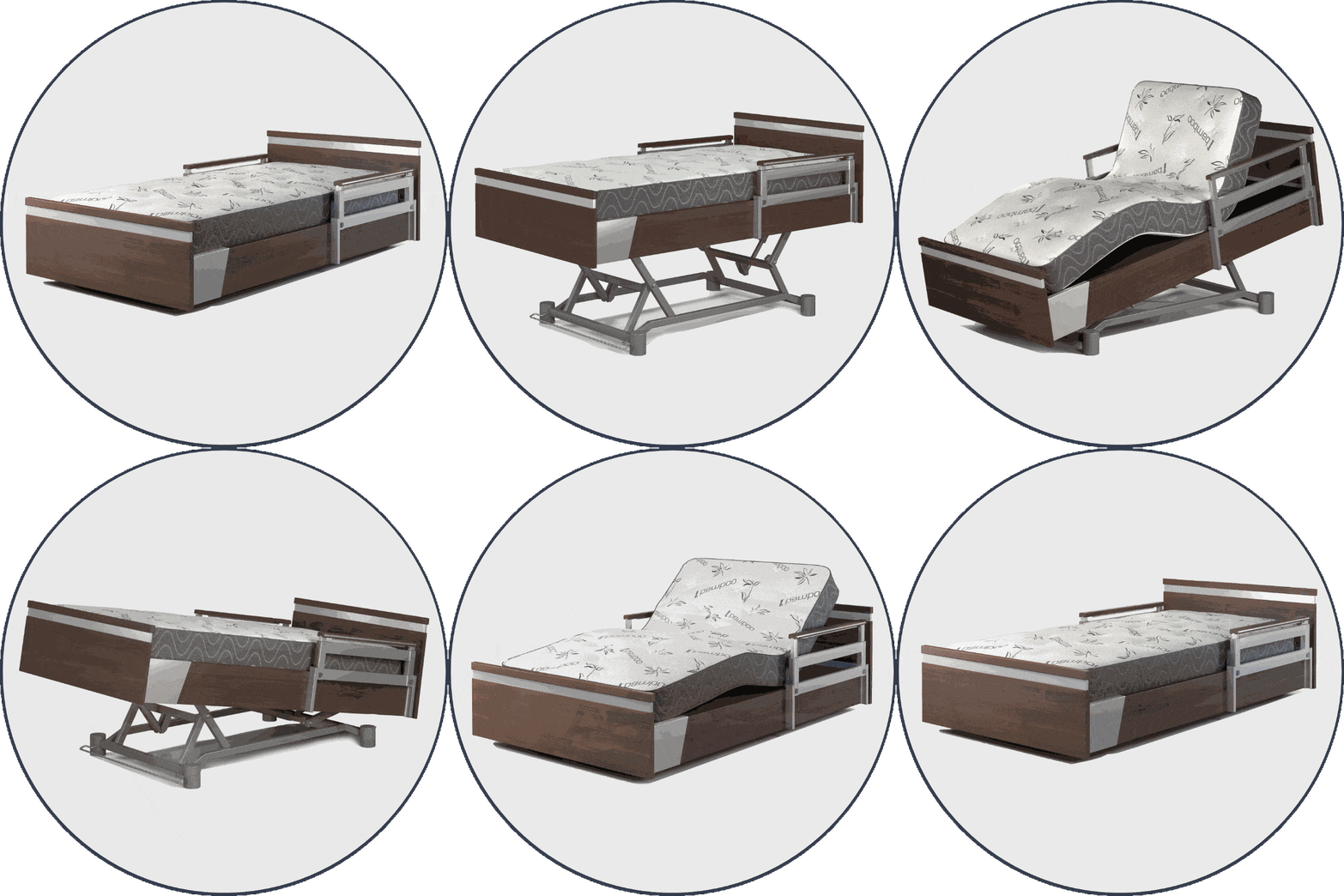
For families looking at premium home hospital beds with hospital-grade certification, furniture-quality aesthetics, and advanced positioning like Trendelenburg and Zero Gravity, SonderCare’s Impulse Residential Bed starts at $3,999 with a 400 lb capacity, while the Aura Premium at $6,999 includes FallSafe ultra-low height (10″ platform), Trendelenburg positioning, Zero Gravity, and a 500 lb weight capacity, features typically found only in clinical settings.
Bariatric Hospital Beds: $2,000 – $6,000+
Bariatric beds feature wider frames and reinforced construction for individuals weighing over 350 lbs. Prices start around $2,000 for basic models and can exceed $6,000 for advanced units with powered width expansion or integrated scales1. Bariatric bed rentals run significantly higher as well, from $315 to over $1,000 per month3.
Quick Comparison: Hospital Bed Cost by Type
| Bed Type | Purchase Price | Monthly Rental | Best For |
|---|---|---|---|
| Manual | $500 – $1,000 | $100 – $150 | Short-term, budget-conscious |
| Semi-Electric | $800 – $3,000 | $150 – $300 | Medicare-covered, moderate needs |
| Full-Electric | $1,000 – $6,000+ | $195 – $400 | Long-term care, daily adjustments |
| Bariatric | $2,000 – $6,000+ | $315 – $1,000+ | Individuals over 350 lbs |
| Specialty (ICU, low-entry, rotation) | $4,000 – $18,000 | $500 – $1,500+ | Complex medical conditions, clinical-grade needs |
| Reconditioned/Refurbished | $2,000 – $6,000 | N/A | Brand-name quality at reduced cost |
Renting vs. Buying a Home Hospital Bed
The rent-or-buy decision is one of the first financial questions families face. Monthly rental rates for a full-electric hospital bed typically range from $195 to $400, with delivery and setup fees adding $80 to $200 upfront3. Return or pickup fees can add another $25 to $120 at the end of the rental period.
A financial discussion on Bogleheads.org captured the breakeven math clearly: at $235 per month in rental fees, purchasing becomes the better financial decision at roughly nine months7. At lower rental rates around $150 per month, the breakeven point extends to 12 to 15 months. Medicare’s capped rental program effectively forces this calculation, after 13 continuous months of rental payments, the supplier must transfer ownership of the bed to you2.
When renting makes more sense: Recovery from surgery or temporary illness (under six months), uncertain care timeline, or testing whether a hospital bed is the right solution before committing. For a deeper look at this decision, see our guide on renting vs. buying a hospital bed.
When buying makes more sense: Chronic or progressive conditions, care needs expected to last a year or longer, or dissatisfaction with the quality of rental beds. Multiple caregivers on AgingCare forums noted that rental beds are often outdated and uncomfortable, and after 10 months of payments, the rental company may offer to sell it to you “for practically nothing”8.
Hidden Costs Most Families Do Not Budget For
The purchase price of a hospital bed frame is only 60 to 70% of the true total cost. Real buyers consistently report being caught off guard by the additional expenses that come with setting up a functional, comfortable care bed at home8.
Mattress Replacement: $200 – $3,000+
This is the hidden cost that surprises families most. The mattress included with most hospital beds, especially budget and rental models, is universally criticized as thin, uncomfortable, and inadequate for anyone spending significant time in bed8. One caregiver described the stock mattress as “really cheaply made,” while another noted it was “too hot since it was covered in plastic.”
A basic pressure-relief foam mattress like the Invacare Solace Prevention runs around $480, while a premium high-specification foam mattress like the Invacare Softform Premier costs approximately $1,0154. For patients at risk of pressure injuries, an alternating pressure air mattress system can cost $2,999 or more. SonderCare’s mattress lineup offers a range of options, from the Comfort Mattress at $899 to the Dream Bamboo Quilt-Top at $1,299 and the Signature Hybrid at $1,799, all designed specifically for home hospital bed use with fluid-proof covers included.
For families concerned about pressure injuries, our pressure sore prevention and treatment guide explains which mattress type matches different risk levels.
Delivery and Professional Setup: $100 – $1,199
“Free shipping” from most online retailers means your bed arrives at the front door in heavy boxes. It does not mean it is assembled, installed, or ready to use. Professional setup, sometimes called white-glove delivery, typically costs an additional $100 to $250 from most suppliers. YouTube reviewers who attempted self-assembly consistently described it as a two-person job requiring tools and patience11.
SonderCare includes full white-glove service with every delivery option: professional setup, installation, a walkthrough of all features, and debris removal. Standard white-glove delivery starts at $599, with expedited options (4 to 9 business days) at $899 and rush delivery (1 to 3 business days) at $1,199.
Essential Accessories: $50 – $800+
Most families discover they need several items beyond the bed and mattress. Side rails, commonly needed for fall prevention, cost $229 to $279 per pair for quality models13. A trapeze bar for independent repositioning runs approximately $319. An overbed table, essential for meals, medications, and daily activities, costs around $16213. Bed rail pads, battery backups for power failures, and nightlights add to the total.
Specialty Bedding: $50 – $269
Hospital beds are not standard twin or full size. Regular sheets will not fit properly. Budget $99 to $269 for properly fitting sheet sets and a fluid-proof mattress cover. If you add a mattress topper, you will need deeper fitted sheets to accommodate the extra height9.
True Total Cost Estimate
| Component | Budget Setup | Mid-Range Setup | Premium Setup |
|---|---|---|---|
| Bed frame | $800 – $1,500 | $2,000 – $3,500 | $4,000 – $8,500 |
| Mattress | $200 – $400 | $500 – $1,300 | $900 – $3,000 |
| Delivery/setup | $0 – $100 | $100 – $250 | $599 – $1,199 |
| Accessories | $100 – $300 | $200 – $600 | $300 – $900 |
| Bedding | $50 – $100 | $100 – $200 | $169 – $469 |
| Total | $1,150 – $2,400 | $2,900 – $5,850 | $5,968 – $14,068 |
| Maintenance/service (annual) | $0 – $100 | $0 – $200 | $0 (included in warranty) |
What Medicare and Insurance Actually Cover
Understanding insurance coverage is critical for managing hospital bed costs. The rules are specific, and many families learn them the hard way.
Medicare Part B Coverage
Medicare Part B covers hospital beds as Durable Medical Equipment (DME) when a doctor prescribes one for home use and specific medical necessity criteria are met2. The patient must have a condition requiring body positioning not achievable in an ordinary bed, need the head of the bed elevated more than 30 degrees for conditions like congestive heart failure or chronic pulmonary disease, or require traction equipment.
For semi-electric beds, the patient must also require frequent or immediate changes in body position. After the annual Part B deductible, you pay 20% coinsurance of the Medicare-approved amount2.
The critical limitation: Medicare considers the electric height adjustment feature on full-electric beds a “convenience” rather than a medical necessity2. Full-electric beds (HCPCS codes E0265, E0266) are generally denied as “not reasonable and necessary.” This means the feature most valued by caregivers, the one that prevents back injuries during transfers, is the one Medicare will not pay for.
As one moderator on the ALS Forums explained: “Medicare does not pay for a ‘total electric’ bed, considering it a ‘convenience item.’ The invoice is coded as the ‘semi-electric’ bed for which Medicare pays”9.
The 13-Month Capped Rental
Medicare uses a “capped rental” system. It pays for rental of the bed for up to 13 continuous months. After the 13th payment, the supplier must transfer ownership to you2. The DME company handles repairs during the rental period, but once you take ownership, those repair costs are yours. The bed must be obtained from a Medicare-enrolled supplier who accepts assignment, using a non-approved supplier means paying 100% out of pocket8.
Private Insurance and Medicaid
Major private insurers including Aetna and Cigna follow policies closely aligned with Medicare. Both explicitly consider full-electric beds (with powered height adjustment) a convenience feature and will not cover the cost5. UnitedHealthcare defers to InterQual criteria, which generally reach the same conclusion.
Medicaid offers a potential exception. New York State Medicaid covers total electric beds if the patient meets medical necessity criteria and can operate the controls independently6. California Medi-Cal also provides a pathway to coverage for total electric beds under specific conditions6. Coverage varies significantly by state, so checking your specific state’s Medicaid policy is worth the effort.
What Makes a Hospital Bed Worth the Investment
Not every feature justifies paying more. But based on thousands of real caregiver experiences shared in forums, reviews, and community discussions, certain features consistently deliver the most value for the money10.
Features Worth Paying More For
Full-electric operation tops every caregiver’s list. The most common reason families upgrade from manual or semi-electric to full-electric is caregiver strain10. When your parent spends 15 or more hours in bed daily, the ability to adjust height, head, and foot positions at the touch of a button is not a luxury, it is a physical necessity for the person providing care.
Height adjustment (hi-lo) is cited as the single most valuable feature for preventing caregiver back injuries10. Raising the bed to waist height for repositioning and lowering it to chair height for safe transfers eliminates the constant bending and lifting that leads to chronic pain.
Ultra-low height capability dramatically reduces fall injury risk. Beds that lower to 7 to 10 inches off the floor mean that if your loved one does roll or slide out of bed, the distance to the ground is minimal. The Aura Premium lowers to a 10-inch platform height (17 inches to mattress top), a safety feature that prevents serious fall injuries in home care settings.
Quiet motors matter more than you might expect. Budget bed motors are loud enough to wake everyone in the house during nighttime adjustments. Premium beds are consistently praised for “whisper quiet” operation, a quality-of-life factor that compounds over months of daily use11.
A quality mattress is the most impactful upgrade you can make. The stock mattress included with most beds is almost always inadequate. Investing $500 to $1,800 in a proper pressure-redistribution mattress prevents painful pressure injuries and dramatically improves sleep quality, for both the person in the bed and the caregiver who no longer needs to reposition as frequently4.
Budget vs. Premium: What You Get at Each Price Point
| Factor | Budget ($500 – $1,200) | Premium ($3,000 – $7,000+) |
|---|---|---|
| Motor quality | Loud, slow | Quiet, smooth operation |
| Frame durability | 2-3 years typical lifespan | Steel frames last 5-10+ years |
| Aesthetics | Institutional appearance | Furniture-grade finishes |
| Height range | Limited adjustment | Floor-level (10″) to nursing height (39″) |
| Positioning | Head/foot only | Trendelenburg, Zero Gravity, Cardiac Chair |
| Mattress included | Thin, uncomfortable | Often includes pressure-relief mattress |
| Warranty | 1-2 years, limited | 5 years comprehensive |
| Caregiver impact | Manual cranking required | Full electric reduces caregiver injury risk |
How SonderCare Beds Compare on Price and Value
SonderCare beds sit in the premium tier, and it is worth understanding what that price includes compared to budget alternatives where you pay separately for features that come standard.
The Aura Premium Home Hospital Bed at $6,999 includes hospital-grade certification (International Hospital Standard), FallSafe ultra-low height, Trendelenburg and reverse Trendelenburg positioning, Zero Gravity, Cardiac Chair and Comfort Chair positions, a 500 lb weight capacity, multi-height assist rails, and a 5-year comprehensive parts warranty. These features would require separate purchases and add-ons with most competitors.
For families seeking a more accessible entry point, the Impulse Residential Bed at $3,999 provides full-electric operation with head, knee, and hi-lo adjustments in a residential-style frame with a 400 lb capacity.
For those who prioritize aesthetics, because a bed that looks clinical can feel demoralizing for the person using it, the Aura Platinum at $8,499 adds fully upholstered side panels in Slate Gray Crypton fabric, turning a hospital bed into something that genuinely looks like premium bedroom furniture.
What separates SonderCare from both budget beds and clinical-grade alternatives is the combination: you get hospital-level safety and positioning capabilities without transforming your loved one’s bedroom into something that looks and feels institutional. If you are setting up a care space for the first time, our hospital-grade bedroom setup guide walks through the full planning process.
Smart Ways to Save on a Home Hospital Bed
Not every family can or should spend thousands on a bed. Here are practical strategies that real caregivers recommend12.
Check DME lending closets first. Many charitable organizations, churches, and community groups maintain lending closets with free hospital beds and other durable medical equipment. These are surprisingly common and significantly underutilized12.
Ask about hospice. If your loved one qualifies for hospice care, the hospice program typically provides a hospital bed at no cost, often delivered the same day12. Several forum users confirmed this as one of the most reliable paths to a free bed.
Explore the used market carefully. Craigslist, Facebook Marketplace, and Nextdoor frequently have hospital beds listed for $200 to $800, and many are available free to anyone willing to pick them up8. One buyer purchased a used bed on Craigslist for $800 and sold it two years later for the same price. However, always buy a new mattress with any used bed. A used mattress is a hygiene and infection risk that no savings can justify.
Consider reconditioned beds from known brands. Major manufacturers and certified refurbishment facilities sell reconditioned hospital beds in the $2,000 to $6,000 range, typically 30-50% below new pricing. These beds are professionally restored with replacement motors, new wiring, fresh powder-coat finishes, and updated safety components. You get brand-name reliability (Hill-Rom, Stryker, Joerns) at a significant discount, and most come with a limited warranty. This option bridges the gap between a cheap used bed and a premium new purchase.
Use Medicare’s rent-to-own pathway. If you qualify, the 13-month capped rental means Medicare covers most of the cost and you own the bed at the end2. Talk to your doctor about getting the necessary prescription and documentation.
Ask about payment plans. Many online hospital bed suppliers offer financing or payment plans9. When facing a $2,000 to $7,000 purchase, spreading payments over 6 to 12 months can make a significant difference in financial stress. SonderCare’s bed experts can discuss available options during a consultation.
Avoid large DME middlemen. Caregivers on AgingCare consistently warned against large DME suppliers describing frustrating experiences with service and pricing14. Buying directly from manufacturers or specialized local suppliers typically provides better value and support.
Making the Right Decision for Your Family
A good home hospital bed is a significant purchase, but it does not have to be an overwhelming one. For most families, a quality mid-range setup, a full-electric bed, a proper mattress, essential accessories, and professional delivery, lands in the $2,500 to $5,000 range. Budget options exist below that, and premium options above it, but the middle ground provides the safety features and daily comfort that matter most.
The question worth asking is not just “how much does a hospital bed cost” but “what does my family actually need?” A parent recovering from hip surgery for eight weeks has different requirements than a parent with a progressive neurological condition. A spouse providing daily care has different ergonomic needs than a family coordinating visits from a home health aide.
Start by understanding the care situation, then match features to those needs, and the right price point becomes clear. If you are unsure where to start, SonderCare’s bed experts have helped thousands of families navigate this exact decision, and a phone consultation costs nothing. Speak with a SonderCare expert for personalized guidance based on your family’s specific situation.
References
- DME of America Inc. and Accora pricing guides. “How Much Does a Hospital Bed Cost.” Market pricing data, 2025-2026.
- Centers for Medicare & Medicaid Services. Medicare Part B coverage for hospital beds as Durable Medical Equipment. HCPCS codes E0250-E0329. Capped rental and medical necessity criteria.
- Hospital bed rental rate analysis. Full-electric monthly rental rates $195-$400, with delivery fees $80-$200. Retailer and DME supplier pricing data, 2024-2026.
- Invacare product listings. Solace Prevention Foam Mattress (SPS1080), $480. Softform Premier Mattress (IPM1080), $1,015. Invacare and MedShopDirect, 2024-2026.
- Aetna Clinical Policy Bulletin 0543; Cigna Coverage Policy. Hospital bed medical necessity criteria and total electric bed non-coverage determinations.
- New York State Medicaid and California Medi-Cal hospital bed coverage policies for total electric beds under specific patient independence and medical necessity criteria.
- Bogleheads.org forum discussion. “Hospital bed needed for Mom, any advice?” Rental breakeven calculation at $235/month. Source thread.
- AgingCare.com forum discussions. Multiple threads on hospital bed pricing, rental vs. buying, and mattress quality. Rental thread; Best cost thread.
- ALS Forums community discussions. Hospital bed pricing data including Lynacare HC107 at $2,700 and $3K-$5K mid-range estimates. Recommendations thread; Cost discussion thread.
- Social research synthesis across Reddit, AgingCare, and ALS Forums. Caregiver back pain identified as the primary driver for upgrading to full-electric beds; height adjustment cited as the most valued feature, 2026.
- YouTube hospital bed review analysis. Mid-range beds ($1,500-$3,000) identified as “sweet spot” for home use; budget beds criticized for loud motors; premium beds praised for quiet operation and durability, 2024-2026.
- AgingCare and ALS Forums. DME lending closets, hospice free bed programs, and community resources. Used bed resources thread.
- Invacare accessory product listings. Clamp-On Half-Length Bed Rails (6630DS), $279/pair. Reduced Gap Full Length Bed Rails (6629), $229/pair. Trapeze Bar (7740A), $319. Overbed Table (6417), $162. 2024-2026.
- AgingCare.com forum discussion. Negative reviews of large DME suppliers i. Discussion thread.