





Your family member needs a hospital bed at home. Medicare approved a standard DME bed, and the equipment company just delivered it. Within days, you notice the mattress sagging. The motor groans every time the head section adjusts. The exposed metal frame transforms the bedroom into something that looks more like a clinic than a home. And when you try to crank the height for a transfer, your back reminds you why this matters.
You start wondering: is there something better? That question leads you to discover an entirely different category of home hospital beds, ones that look like furniture, operate in near silence, and offer positioning capabilities that standard DME beds simply do not have. But they cost several thousand dollars out of pocket, with no insurance reimbursement for the premium features.
This guide breaks down every meaningful difference between a high-end premium hospital bed and a standard DME hospital bed. No vague marketing claims. Feature-by-feature, dollar-by-dollar, so you can make the right decision for your family.
What Qualifies as a “Standard DME Hospital Bed”?
A standard DME (Durable Medical Equipment) hospital bed is any bed that meets Medicare’s criteria for medical necessity. These beds fall into specific categories defined by HCPCS codes, and each category determines what insurance will cover1.
The most common types include:
- Fixed-height beds (HCPCS E0250): Manual head and leg elevation with no height adjustment at all
- Variable-height beds (HCPCS E0255): Add a manual crank for height changes
- Semi-electric beds (HCPCS E0260): Electric head and foot adjustment, but height still requires a manual crank
The semi-electric bed is what most families receive through Medicare or Medicaid. It provides electric controls for raising and lowering the head and foot sections, but adjusting the overall bed height requires physically turning a hand crank2. Manufacturers like Drive DeVilbiss and Invacare produce most of the standard DME beds you encounter through rental companies.
Every feature on a standard DME bed must be justified by medical necessity. A physician provides a Standard Written Order, and the patient’s records must document a condition requiring positioning that an ordinary bed cannot provide3. Conditions like congestive heart failure requiring head elevation above 30 degrees, chronic pulmonary disease, or aspiration risk all qualify. If a feature does not address a documented medical need, Medicare classifies it as a “convenience item” and denies coverage.
What Makes a Hospital Bed “High-End” or Premium?
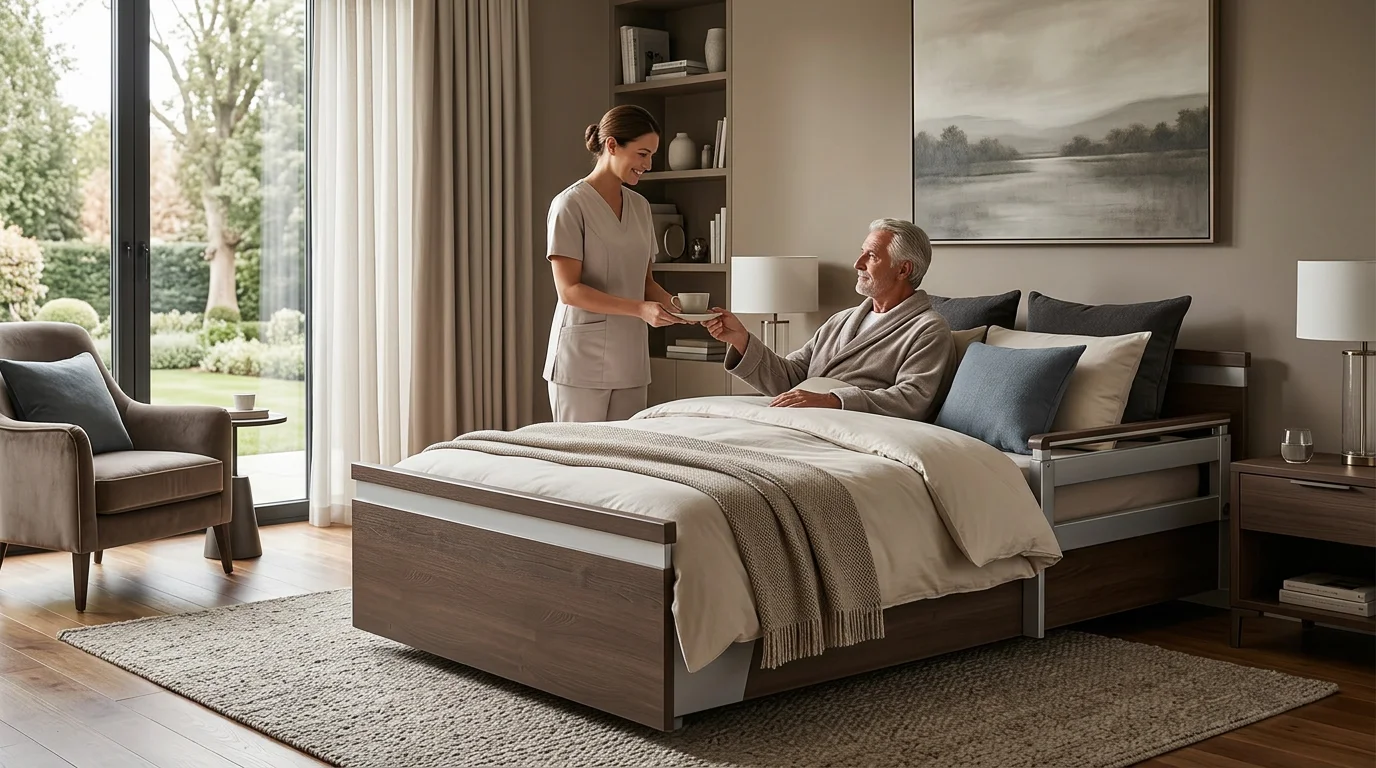
A premium home hospital bed is designed for a fundamentally different purpose than meeting Medicare’s minimum medical necessity requirements. It addresses the full spectrum of what families actually need: advanced positioning for complex conditions, safety features that prevent injuries, caregiver-friendly operation, build quality that lasts years, and a residential appearance that preserves dignity4.
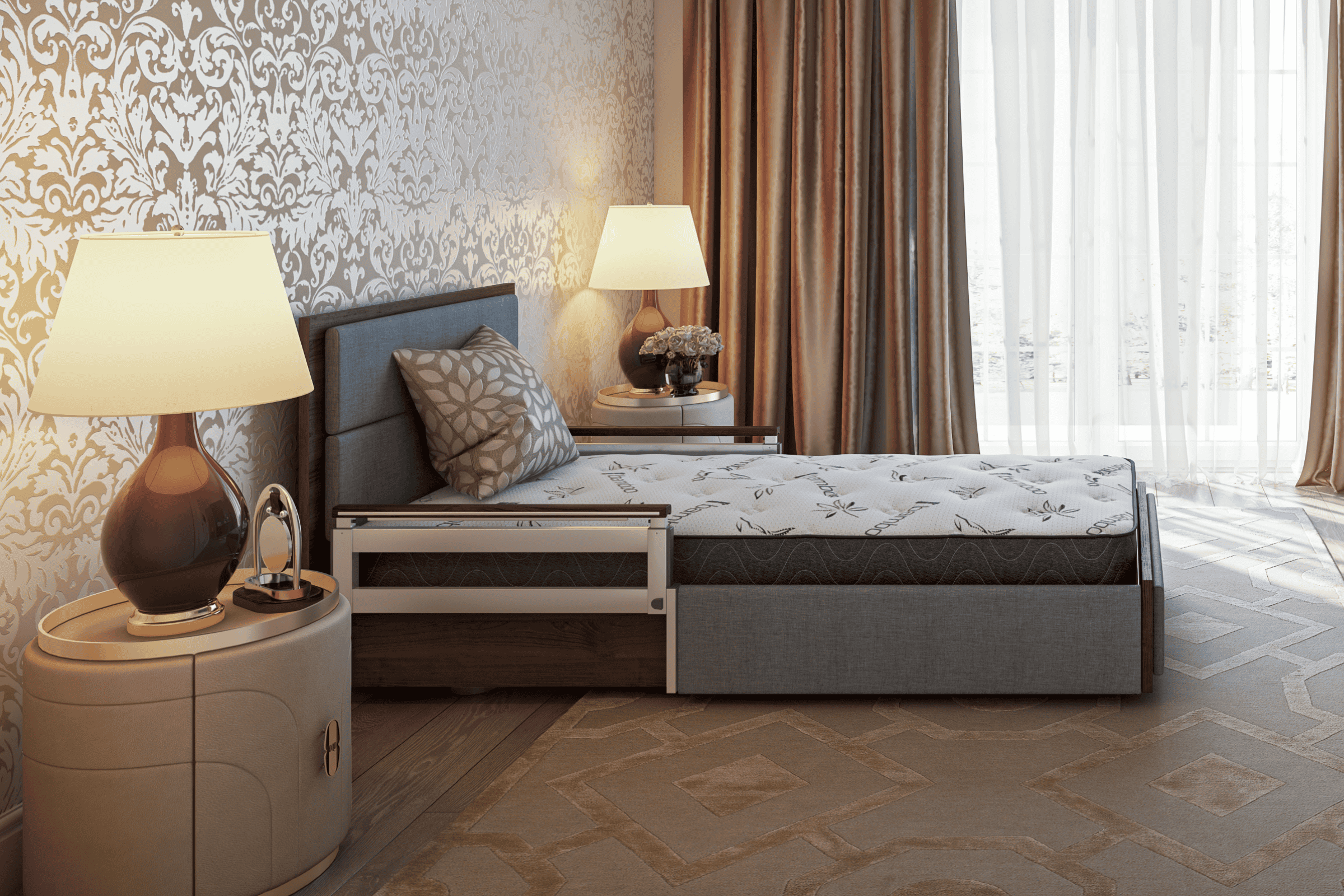
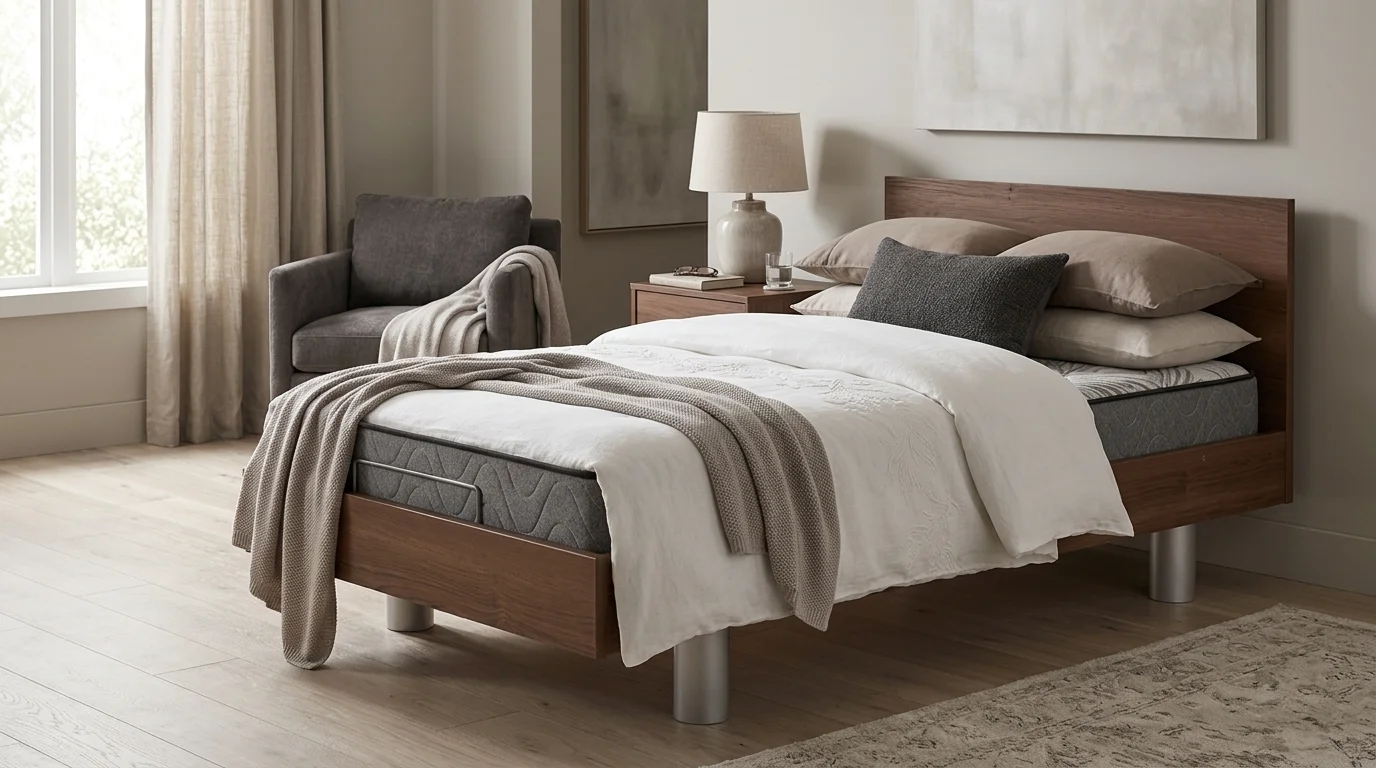
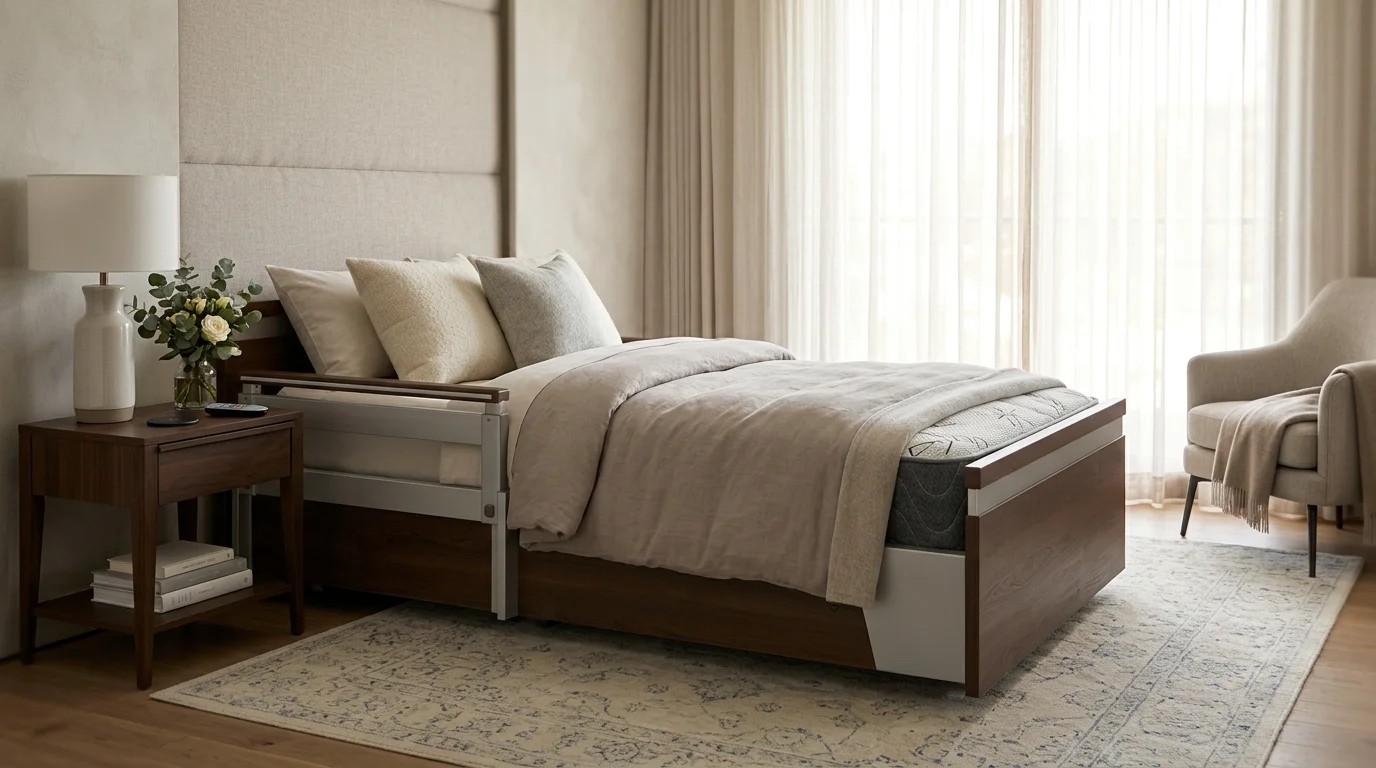
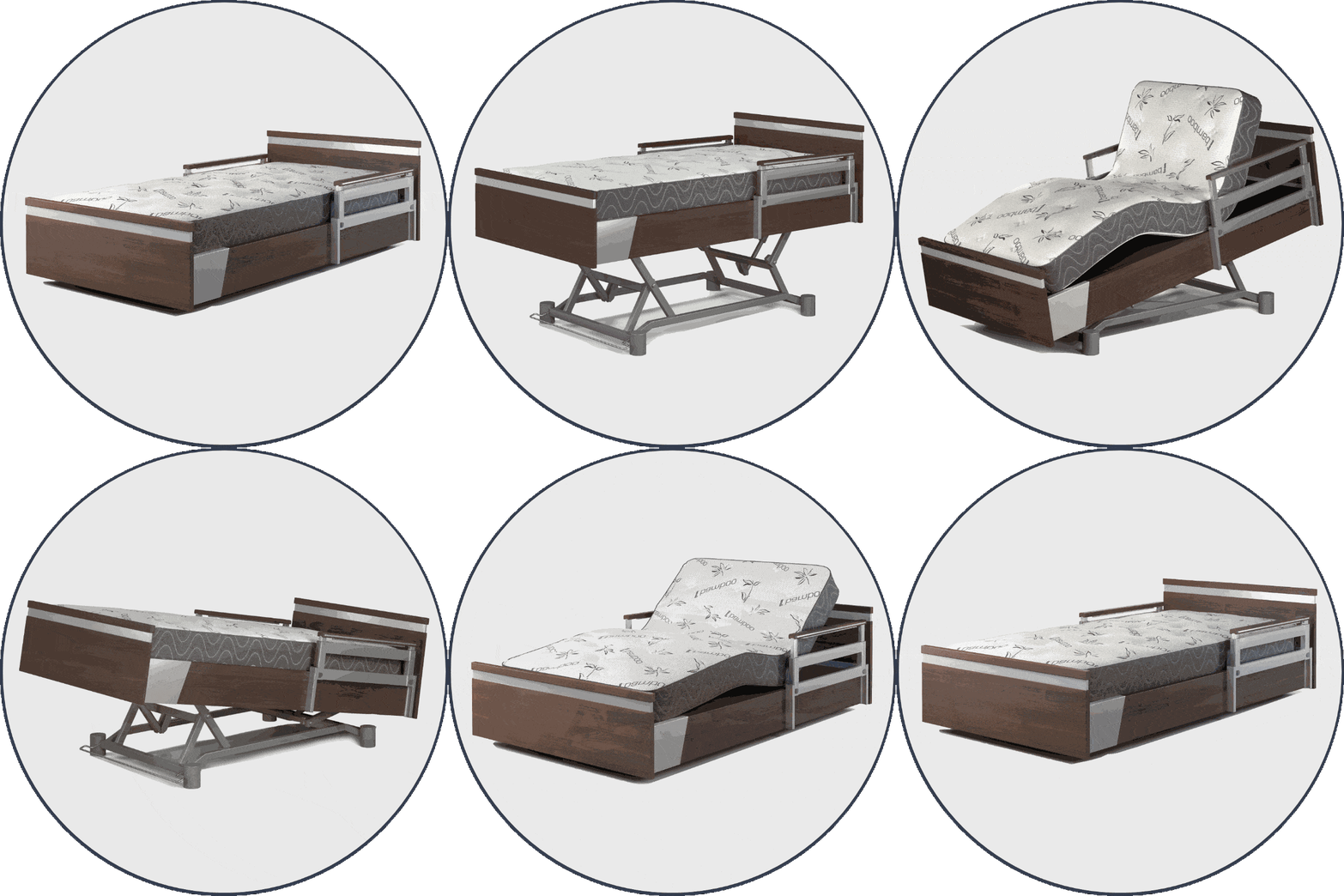
The SonderCare Aura Premium, for example, is certified to the International Hospital Standard (IEC 60601-2-52), FDA-registered, and offers a full-electric positioning suite that includes Trendelenburg, Reverse Trendelenburg, Zero Gravity, Cardiac Chair, and Comfort Chair positions. Its FallSafe Ultra-Low Height lowers the platform to just 10 inches from the floor. The bed frame features furniture-grade finishes rather than exposed institutional metal5.
These are not cosmetic upgrades. Each feature addresses a real clinical or practical gap that standard DME beds leave unfilled. The distinction matters because families often discover these gaps only after living with a standard bed for weeks, when the limitations become part of their daily frustration.
Feature-by-Feature Comparison: Premium vs Basic Hospital Bed
The differences between a high-end and standard DME hospital bed go far deeper than appearance. Here is a detailed hospital bed upgrade comparison across every category that affects daily life.
Positioning Capabilities
This is where the gap between a DME bed and a premium bed is widest. A standard semi-electric bed gives you two electric motions: head up/down and foot up/down. That is it. Height requires a manual crank, and advanced therapeutic positions do not exist on these beds6.
Premium beds offer what is called a “full positioning suite.” The Aura Premium home hospital bed provides:
- Trendelenburg: Tilts the entire mattress platform so feet are higher than the head. Prescribed for circulation issues, edema management, and postural drainage in pneumonia and COPD patients7.
- Reverse Trendelenburg: Head higher than feet. Reduces GERD symptoms, aids digestion, and assists breathing for respiratory conditions8.
- Zero Gravity: Distributes body weight evenly across the sleep surface in a NASA-inspired neutral position. Provides pressure relief and pain reduction9.
- Cardiac Chair: Configures the bed into a seated, chair-like position with knees bent and hips relaxed. Helps patients with cardiac or respiratory conditions breathe more easily10.
- Comfort Chair: Similar to Cardiac Chair but optimized for daily activities like eating, reading, or watching television.
- FallSafe Ultra-Low Height: Lowers the platform to 10 inches (17 inches to mattress top), reducing fall injury severity11.
- Pre-programmed 21-inch transfer height: One-button positioning for safe bed-to-wheelchair transfers.
ALS patients and caregivers on medical forums specifically cite Trendelenburg as a must-have feature for urinal use, breathing assistance, and pressure relief, yet standard DME beds never include it12. Forum users also note that the Cardiac Chair position prevents the patient from sliding down the bed, a constant problem with basic head-only elevation.
Height Adjustment: Electric vs Manual Crank
This single difference changes caregiver life more than any other feature. On a standard semi-electric bed, adjusting the bed height to facilitate a transfer requires turning a hand crank, often multiple rotations. Experts note that this “requires moderate upper body strength for manual cranking, which may be difficult for elderly caregivers or those with arthritis”13.
Caregiver back injuries are among the most common occupational hazards in home care, and the cranking motion exacerbates this risk14. If a patient requires multiple transfers per day (bed to wheelchair, wheelchair to bed, bed to commode), the cumulative strain on a caregiver’s back and shoulders is significant.
A full-electric premium bed handles height adjustment with the push of a button. The Aura Premium’s height range spans from 10 inches (ultra-low for fall prevention) to 39 inches, with a pre-programmed 21-inch transfer position that ensures consistent, safe positioning every time.
The price gap between semi-electric and full-electric is surprisingly small in the standard DME market: only $300 to $500 more15. Yet Medicare classifies electric height adjustment as a “convenience feature” and denies coverage. This classification forces families to choose between an insurance-covered bed that strains their back or paying out of pocket for the electric upgrade.
Build Quality and Motor Performance
The internal components of a hospital bed determine how long it lasts, how quietly it operates, and how reliably it performs during years of daily use.
Standard DME beds typically use entry-level actuators priced at $15 to $25 per unit. These actuators have shorter lifespans, louder operation, and higher failure rates. Caregivers on AgingCare forums report beds that “broke for the third time in a year” and rental equipment that “should have been disposed of before being provided”16.
Premium beds use high-quality actuators from manufacturers like LINAK or TiMOTION, priced at $80 to $120 per unit. These brushless DC motors offer 40% longer lifespans, noise levels below 45 dB, over 50,000 cycle durability, and failure rates under 0.5%17. The Aura Premium uses four ultra-quiet DC motors, providing smooth and reliable performance throughout its service life.
For patients spending 15 or more hours daily in bed, motor noise directly impacts sleep quality. Standard beds produce sound levels above 50 dB during adjustment. Premium hospital beds like the Stryker ELEGANZA 4 (57 dBA) and Hillrom Centrella (under 65 dBA) publish their noise specifications because quiet operation is a genuine differentiator18.
Safety Standards and Certifications
All hospital beds sold in the United States must be FDA-registered. However, the depth of safety testing and certification varies significantly between standard and premium models.
The Aura Premium is certified to IEC 60601-2-52, the international standard specifically governing medical bed safety19. This certification covers:
- Safe Working Load (SWL) testing that accounts for patient weight, mattress, and accessories
- Structural integrity testing under maximum rated loads
- Dimensional safety measurements to prevent patient entrapment between rails, mattress, and bed frame
- Side rail stability and latch mechanism testing
- Electrical safety for all motorized components
Standard DME beds meet basic FDA registration requirements but do not always carry the comprehensive IEC 60601-2-52 certification. Caregivers on forums describe side rails that are “not sturdy enough to trust” on standard models20, a complaint that highlights the gap between minimum regulatory compliance and rigorous international hospital standards.
Complete Comparison Table: High-End vs Standard DME Hospital Bed
The following table puts every major difference side by side, using the SonderCare Aura Premium as the premium benchmark and a typical semi-electric DME bed as the standard benchmark.
| Feature | Standard Semi-Electric DME Bed | SonderCare Aura Premium (High-End) |
|---|---|---|
| Price | $800 – $2,500 (purchase) | $6,999 |
| Medicare Coverage | Covered (80% after deductible) | Not covered (private pay) |
| Height Adjustment | Manual crank | Full electric (10″ to 39″) |
| Head/Foot Adjustment | Electric | Electric |
| Trendelenburg | Not available | Yes |
| Reverse Trendelenburg | Not available | Yes |
| Zero Gravity | Not available | Yes |
| Cardiac Chair | Not available | Yes |
| Comfort Chair | Not available | Yes |
| Ultra-Low Height | Not available (typically 15″+ minimum) | 10″ platform (FallSafe) |
| Transfer Position | Manual crank to approximate height | Pre-programmed 21″ one-button |
| Width | 36″ standard | 39″ standard (48″ extra wide available) |
| Weight Capacity | 350 – 450 lbs | 500 lbs |
| Motor Type | Entry-level actuators | Four ultra-quiet DC motors |
| Noise Level | 50+ dB | Under 45 dB |
| Appearance | Exposed metal, institutional | Furniture-grade panels, residential |
| Side Rails | Basic metal, functional | Integrated, upholstered, safety-tested |
| Certification | FDA-registered | FDA-registered + IEC 60601-2-52 |
| Warranty | 1-2 years motors/electronics; 5 years frame | 5-year comprehensive (all parts) |
| Delivery | Local dealer, basic setup | White-glove delivery, installation, walkthrough |
This comparison reveals why the premium vs basic hospital bed question is not just about comfort. It is about positioning capabilities, safety certification depth, caregiver ergonomics, and long-term reliability.
Medicare Hospital Bed vs Buying Better: Understanding Insurance Coverage Gaps
One of the biggest sources of frustration for families is discovering what Medicare actually covers versus what they assumed it would cover. Understanding these gaps is essential when deciding whether a standard DME bed is sufficient or whether investing in a premium bed makes sense.
What Medicare Part B Covers
Medicare Part B covers hospital beds classified as DME when a physician documents medical necessity21. Coverage typically includes:
- Fixed-height hospital beds for patients needing head elevation above 30 degrees (CHF, COPD, aspiration risk)
- Variable-height beds when transfers require height adjustment (manual crank)
- Semi-electric beds when the patient needs frequent body position changes
- Heavy-duty beds (HCPCS E0301/E0303) for patients weighing 351 to 600 lbs
- Extra heavy-duty beds (HCPCS E0302/E0304) for patients over 600 lbs
When approved, Medicare pays 80% of the approved amount after the annual deductible ($257 in 2025). The patient covers the remaining 20% coinsurance22.
What Medicare Does Not Cover
This is where the coverage gap becomes clear. Medicare classifies the following as “convenience features” and denies coverage23:
- Electric height adjustment (full-electric beds, HCPCS E0265): The single most requested upgrade
- Trendelenburg and Reverse Trendelenburg positioning: Despite clear therapeutic applications
- Zero Gravity and Cardiac Chair positions: Considered comfort, not necessity
- Advanced mattress systems: Alternating pressure and low-air-loss mattresses beyond basic models
- Residential aesthetic design: Furniture-grade finishes, upholstered panels
- Comprehensive warranties: Extended coverage beyond basic terms
Notably, New York Medicaid takes a different approach. It may cover a total electric hospital bed (HCPCS E0265) if the patient meets fixed-height bed criteria, requires variable-height for transfers, needs frequent position changes, AND can independently operate the controls24. This is a meaningful departure from Medicare’s blanket denial of electric height adjustment.
The Private Pay Reality
When you choose a premium bed like the Aura Premium over a Medicare-covered semi-electric, the entire cost is out of pocket. There is no partial reimbursement for the advanced features. This is why the decision requires an honest evaluation of what you actually need and for how long you need it. For guidance on navigating this decision, our guide to whether a premium home hospital bed is worth the investment walks through the complete financial analysis.
Total Cost of Ownership: The Long-Term Math
The sticker price comparison between a standard DME bed and a premium bed tells only part of the story. Total cost of ownership over three to five years paints a very different picture.
Renting a Standard DME Bed
Renting a standard DME bed costs approximately $115 per month25. Over three years, that totals $4,140. Over five years: $6,900. These costs typically include the bed itself but may carry additional charges for delivery and pickup. The bed remains the property of the rental company, and quality control is inconsistent. Forum users report receiving equipment that has clearly been through multiple patients without adequate maintenance26.
Purchasing a Standard DME Bed
A standard semi-electric bed costs approximately $2,350 to purchase. The three-year total cost of ownership, including one major repair and accounting for low resale value ($235), comes to roughly $2,515. At five years, with two major repairs and lower resale value ($118), the total is approximately $3,03227.
Purchasing a Premium Bed
The Aura Premium at $6,999 has a three-year total cost of ownership estimated at $5,349, including potential non-covered labor visits but offset by a higher resale value ($2,100). At five years, the total is approximately $6,349, with retained resale value of $1,40028.
The financial breakeven point where purchasing a premium bed becomes more cost-effective than long-term renting is around the four to five year mark. For families managing chronic conditions or long-term care needs, this math matters. To understand why home hospital beds cost what they do, the engineering, certifications, and warranty backing explain the price difference.
Cost of Ownership Summary
| Scenario | Year 1 | Year 3 | Year 5 |
|---|---|---|---|
| Rent standard DME | $1,380 | $4,140 | $6,900 |
| Buy standard DME | $2,350 | $2,515 | $3,032 |
| Buy Aura Premium | $6,999 | $5,349 | $6,349 |
For short-term needs under six months, renting makes sense. For anything beyond 12 to 18 months, purchasing delivers better value regardless of which bed you choose29. The premium bed’s 5-year comprehensive warranty covering all parts from headboard to footboard helps control long-term repair costs that erode the savings on a cheaper purchase.
The Impulse Essential: A Middle Ground Worth Considering
Not every family needs the full positioning suite of the Aura Premium. The SonderCare Impulse Essential at $3,999 offers a meaningful step up from standard DME beds without the full clinical feature set.
The Impulse Essential provides full-electric head, knee, and hi-lo adjustment with a 400 lb weight capacity. It lacks Trendelenburg, Zero Gravity, and Cardiac Chair positions, and it does not carry the IEC 60601-2-52 hospital certification. But it delivers the residential comfort design, quiet motor operation, and electric height adjustment that eliminate the biggest daily pain points of standard DME beds.
For families whose primary frustration is the manual crank, the institutional appearance, and the motor noise of their DME bed, the Impulse Essential addresses those concerns at a lower price point. If the care recipient needs advanced therapeutic positioning or is at high fall risk requiring ultra-low height, the Aura Premium remains the appropriate choice.
Who Actually Needs a Premium Bed? Scenario-Based Recommendations
The honest answer is that not everyone does. Here is a practical decision framework based on real clinical scenarios.
When a Standard DME Bed Is Sufficient
- Stable congestive heart failure requiring head elevation: A fixed-height or semi-electric bed meets the core medical need and is covered by Medicare30.
- Short-term recovery (under 3 months): Renting a standard bed is the most cost-effective option for temporary needs.
- Single-condition positioning: If the only need is periodic head or foot elevation, the semi-electric controls handle this adequately.
- Bariatric patients needing weight-rated frames: Medicare covers heavy-duty beds (E0301, E0303) for patients 351 to 600 lbs without requiring a premium purchase31.
When a Premium Bed Is Warranted
- High fall risk with frequent bed exits: The Aura Premium’s FallSafe ultra-low 10-inch height reduces fall injury severity. Research shows that while low-height beds may not prevent falls, they reduce the severity of injuries when falls occur32.
- Complex conditions requiring multiple positions: ALS, advanced COPD, severe edema, and post-stroke patients benefit from Trendelenburg, Reverse Trendelenburg, and Cardiac Chair positions unavailable on standard beds.
- Single caregiver performing daily transfers: Full-electric height adjustment with a pre-programmed 21-inch transfer position prevents caregiver back injury and reduces strain over months and years of daily use33.
- Long-term or progressive conditions (3+ years): The financial breakeven against renting occurs at four to five years, and the quality-of-life benefits begin on day one.
- Comfort care and palliative support: When dignity and comfort are the priorities, furniture-grade aesthetics and advanced positioning transform the care environment34.
- Patients spending 15+ hours daily in bed: The “15-hour rule” makes full-electric operation, quiet motors, and advanced positioning essential for both patient comfort and caregiver sustainability35.
What Families Say After Living with Both Types
Community forums and caregiver discussions reveal consistent patterns about what actually drives the upgrade decision from a standard DME bed to a premium model.
Mattress quality is the number one complaint about standard DME beds. Caregivers describe DME-provided mattresses as “absolutely terribly uncomfortable,” with immediate sagging and thin designs that compromise comfort36. Air mattresses draw specific complaints about being “too rubbery and hot,” with pump noise that disrupts sleep. Some families purchased their own premium mattresses to pair with the hospital frame, indicating how far the provided equipment fell from meeting actual needs.
Equipment condition is unpredictable with rentals. One caregiver reported a rental bed that “broke for the third time in a year and blew out a circuit breaker.” The forum consensus: “The bed should have been disposed of before being provided”37. Rental companies prioritize cost control over equipment replacement, and families who do not advocate aggressively receive the worst-maintained equipment.
The institutional appearance takes an emotional toll. Families consistently express that standard hospital beds make homes “feel like a hospital, not a home.” Some caregivers create DIY solutions like fitted slipcovers to mask the clinical look38. For the person in the bed, this is not a cosmetic issue. It is a dignity issue. Being surrounded by institutional equipment signals that they are a patient first and a person second.
The upgrade decision is often driven by caregiver exhaustion, not patient request. Semi-electric beds with manual height cranks cause cumulative back strain in caregivers performing multiple daily transfers. The physical toll on an aging spouse or adult child providing daily care is a legitimate health concern in its own right39.
How to Decide: Your Hospital Bed Upgrade Checklist
Use this checklist to evaluate whether your current DME bed meets your family’s needs or whether upgrading to a premium model is the right move.
- How long will the bed be needed? Under 6 months: rent standard. 6-18 months: buy standard. 18+ months: evaluate premium for long-term value.
- Does the care recipient need Trendelenburg, Zero Gravity, or Cardiac Chair? If yes, these are only available on premium beds.
- How many transfers happen daily? More than two transfers per day makes electric height adjustment a caregiver health necessity.
- Is fall risk a concern? Ultra-low height (10 inches) is exclusive to premium models and meaningfully reduces injury severity.
- How many hours per day is the person in bed? The 15-hour threshold makes motor quality, positioning variety, and mattress comfort essential.
- Does the bedroom appearance matter for dignity? Furniture-grade design is a premium bed feature that standard DME beds do not offer.
- What is the budget, and over what time frame? Premium beds break even with long-term rental costs at the four to five year mark.
For a broader view of what to consider when selecting any home hospital bed, the expert buyer’s guide to choosing a home hospital bed covers the full decision process from needs assessment through delivery.
Making the Right Choice for Your Family
The difference between a high-end and standard DME hospital bed is not just about more features or a higher price tag. It is about whether the bed you bring into your home addresses the full scope of what your family needs, or only the minimum that insurance will cover.
A standard DME bed serves a specific, valuable purpose. For short-term recovery, stable single-condition management, and situations where Medicare coverage is essential for the family budget, these beds get the job done. There is no reason to overspend for temporary needs.
A premium bed like the Aura Premium serves a different purpose. It is built for families managing complex, long-term, or progressive care needs where safety, caregiver health, patient comfort, and residential dignity all matter. The 5-year comprehensive warranty, hospital-grade certifications, full positioning suite, and furniture-grade design reflect an investment in daily quality of life, not just a bed purchase.
Whichever direction fits your situation, making an informed decision starts with understanding what each option actually delivers. The real difference between these two categories is not visible in a catalog photo. It shows up in the daily reality of care: the transfer that does not strain your back, the night without motor noise, the bedroom that still feels like home.
Questions about which bed fits your situation? SonderCare’s bed experts have helped thousands of families navigate this decision. Speak with a SonderCare expert for personalized guidance based on your specific care needs.
References
- Centers for Medicare & Medicaid Services. “Medicare Coverage of Durable Medical Equipment: Hospital Beds.” HCPCS codes E0250-E0265 define coverage categories for home hospital beds based on functionality and medical necessity criteria.
- MedShopDirect. “Semi-Electric Hospital Bed vs Full-Electric: Understanding the Difference.” Semi-electric beds use electric controls for head/foot adjustment but require a manual hand crank for height changes.
- Medicare.gov. “Hospital Beds Coverage.” Medicare Part B covers hospital beds as DME when a physician documents medical necessity, including a Standard Written Order and supporting medical records.
- SonderCare. “Premium Home Hospital Beds: Design Philosophy.” Premium beds address advanced positioning, fall prevention, caregiver ergonomics, and residential aesthetics beyond basic medical necessity.
- IEC 60601-2-52. International standard for medical bed safety covering electrical/mechanical safety, safe working load, structural integrity, and entrapment prevention dimensions.
- Harmony Home Medical. “Manual vs Semi-Electric vs Fully Electric Hospital Beds: Differences, Pros, and Use Cases.” Standard semi-electric beds offer only head and foot electric adjustment without advanced positioning capabilities.
- Innova Care Concepts. “What Is the Trendelenburg Position and Why Do We Use It?” Trendelenburg positioning facilitates postural drainage, promotes circulation, and assists with edema management.
- Opera Beds. “Trendelenburg and Anti-Trendelenburg Care Beds.” Reverse Trendelenburg aids digestion, reduces GERD symptoms, and assists breathing for patients with respiratory conditions.
- CVI Medical. “Trendelenburg and Reverse Trendelenburg Hospital Bed Positioning.” Zero Gravity positioning distributes body weight evenly to reduce pressure points and promote comfort.
- ALS Forums. “Hospital Bed Recommendations.” ALS patients and caregivers identify Cardiac Chair position as essential for preventing sliding and enabling comfortable seated positioning.
- Pragmatic cluster RCT evidence on ultra-low beds. Research indicates ultra-low bed heights reduce fall injury severity through lower impact energy, though they may not significantly reduce fall incidence.
- ALS Forums. “Specific Questions for Hospital Bed Search.” Forum users specifically recommend beds with Trendelenburg for urinal use, breathing assistance, and pressure redistribution.
- MedShopDirect. “Semi-Electric Hospital Bed vs Full-Electric.” Manual cranking “requires moderate upper body strength” and may be difficult for elderly caregivers or those with arthritis.
- Harmony Home Medical. “Caregiver back injuries are among the most common occupational hazards in home care, and the cranking motion required by semi-electric beds can exacerbate this risk.”
- Industry pricing data. The upgrade from semi-electric to full-electric costs $300-$500, yet Medicare denies coverage for the electric height adjustment feature.
- AgingCare Forums. “Broken Hospital Bed” and “Hospital Bed Battle.” Caregivers report repeated equipment failures with rental beds and inadequate maintenance by DME suppliers.
- Servo Linear Actuator Guide. “Selecting Quiet, Precise Actuators for Medical Devices.” Premium actuators (LINAK, TiMOTION) achieve under 45 dB noise, 50,000+ cycle durability, and less than 0.5% failure rates.
- Stryker ELEGANZA 4 specifications (57 dBA) and Hillrom Centrella Smart Bed specifications (under 65 dBA). Published noise levels for premium hospital bed models.
- IEC 60601-2-52 certification requirements. Covers safe working load, structural integrity, dimensional entrapment prevention, side rail stability, and electrical safety for medical beds.
- AgingCare Forums. “Hospital Bed Battle.” Caregivers describe standard DME bed rails as “not sturdy enough to trust,” highlighting gaps between minimum compliance and comprehensive safety testing.
- Medicare.gov. “Hospital Beds.” Medicare Part B covers hospital beds when medical necessity criteria are met, typically reimbursing 80% of the approved amount after the deductible.
- Centers for Medicare & Medicaid Services. Medicare Part B annual deductible was $257 in 2025, with 20% coinsurance required from the beneficiary for covered DME.
- Medicare coverage policy. Total electric beds (HCPCS E0265) are “generally not covered” because electric height adjustment is classified as a convenience feature, not medical necessity.
- New York Medicaid (eMedNY). NY Medicaid may cover total electric hospital beds (E0265) when the patient meets fixed-height criteria, requires variable-height for transfers, needs frequent position changes, and can independently operate controls.
- DME of America. “Hospital Bed Rental: Everything You Need to Know.” Standard DME bed rental costs approximately $115/month with additional delivery/pickup fees.
- AgingCare Forums. “Comfort in a Hospice Bed” and “Hospital Bed Battle.” Caregivers report poorly maintained rental equipment with repeated mechanical failures.
- Total cost of ownership analysis. Standard DME bed purchase ($2,350) with one major repair and $235 resale value yields $2,515 three-year TCO; two repairs and $118 resale value yields $3,032 five-year TCO.
- Total cost of ownership analysis. Premium bed purchase ($6,999) with non-covered labor visits and $2,100 resale value yields $5,349 three-year TCO; additional labor visits and $1,400 resale value yields $6,349 five-year TCO.
- Medical Equipment Solutions. “Rent vs Buy Durable Medical Equipment.” At $200/month rental for a basic bed, purchase breaks even at 12-18 months for long-term patients.
- Medicare coverage criteria. A fixed-height hospital bed (E0250) is covered for patients requiring head-of-bed elevation greater than 30 degrees for CHF, COPD, or aspiration management.
- HCPCS bariatric bed codes. E0301/E0303 cover heavy-duty extra-wide beds for patients 351-600 lbs; E0302/E0304 cover extra heavy-duty beds for patients over 600 lbs.
- Clinical evidence on low-height beds. A large pragmatic cluster RCT shows ultra-low beds reduce injury severity through lower impact energy, with a plausible biomechanical mechanism supported by observational data.
- Expert clinical guidance. Pre-programmed transfer heights ensure consistent, safe positioning and significantly reduce caregiver musculoskeletal strain during daily transfers.
- AgingCare Forums and Houzz. Families describe premium beds with residential aesthetics as transforming the care environment, preserving the person’s sense of home and dignity.
- SonderCare and Harmony Home Medical. The “15-hour rule”: patients spending more than 15 hours daily in bed require full-electric operation and advanced positioning for both comfort and caregiver sustainability.
- AgingCare Forums. “How to Make Mom’s Mattress More Comfortable” and “Comfort in a Hospice Bed.” Multiple caregivers describe DME mattresses as “absolutely terribly uncomfortable” with immediate sagging.
- AgingCare Forums. “Broken Hospital Bed.” Caregiver reports bed breaking three times in one year, with forum consensus that rental companies do not adequately maintain equipment.
- Houzz Forums. “Help on Decorating a Hospital Room.” Families create DIY solutions to mask institutional hospital bed appearance, including fitted slipcovers and decorative headboard covers.
- Social research consensus. The upgrade decision from standard to premium hospital beds is most frequently driven by caregiver physical exhaustion from manual cranking and transfer strain, not by patient request.