








You’re trying to order something for a family member, a hospital bed, perhaps, or a wheelchair, and you keep hitting a wall. The occupational therapist calls it a “medical device.” The supplier calls it “DME.” Medicare’s website uses both terms in the same paragraph, and your insurance company operates under its own framework entirely. After four phone calls, you still don’t know whether it’s covered.
This is not a knowledge failure on your part. It’s a genuinely fragmented system where the same terms carry different meanings depending on who is using them and why. Understanding the distinctions won’t cut through all the red tape, but it will help you ask the right questions, and anticipate what your insurer actually needs before you order anything.
The difference between medical equipment and medical devices comes down to a three-tier structure: medical device is the broadest regulatory category, covering nearly everything with a medical purpose. Medical equipment is a subset, typically durable, complex hardware that requires calibration and ongoing maintenance. Durable Medical Equipment (DME) is the specific subset that Medicare and private insurers cover under defined conditions. And medical supplies are disposable items that are also devices but handled differently for coverage.
Here is how each category works, and why the distinction matters for families providing care at home.
What Is a Medical Device? The Broadest Definition
Under U.S. law, a “medical device” is defined in Section 201(h) of the Federal Food, Drug, and Cosmetic Act as any instrument, apparatus, implement, machine, contrivance, implant, in vitro reagent, or similar article intended for use in diagnosing, curing, mitigating, treating, or preventing disease, or for affecting the structure or function of the body1. The definition explicitly excludes products that achieve their primary purpose through chemical, immunological, or metabolic means (those are drugs or biologics).
The World Health Organization extends this to include software: a medical device is “any instrument, apparatus, implement, machine, appliance, implant, reagent for in vitro use, software, material or other similar or related article, intended by the manufacturer to be used, alone or in combination, for a medical purpose.”3 WHO estimates there are approximately 2 million different types of medical devices on the world market, organized into more than 7,000 generic device groups3.
The key phrase in both definitions is intended use. The same physical product can be a medical device or not based on what it is marketed and designed for. A blood pressure cuff sold to diagnose hypertension is a regulated medical device. A similar-looking device sold purely as a fitness tracker operates under different rules.
The FDA’s Three Risk Classes
The FDA classifies medical devices into three risk tiers2:
- Class I, Low risk. Subject to general controls. Examples include bandages, tongue depressors, and many non-powered mobility aids. Approximately 74% of Class I devices are exempt from premarket notification (510(k)).
- Class II, Moderate risk. Requires special controls, including performance standards and post-market surveillance. Examples include powered wheelchairs, blood glucose monitors, and home hospital beds.
- Class III, High risk. Requires Premarket Approval (PMA), the FDA’s most rigorous pathway. Examples include implantable pacemakers and artificial heart valves.
A home hospital bed certified to international hospital standards sits in Class II, the same class as most equipment a family caregiver will encounter. Classification reflects risk profile, not price or complexity.
What Is Medical Equipment? Equipment Within the Device Universe
“Medical equipment” is not a separately defined FDA regulatory category. Everything called medical equipment is, by definition, also a medical device, it is just equipment-shaped. The distinction is operational rather than regulatory.
The World Health Organization defines medical equipment as “medical devices requiring calibration, maintenance, repair, user training, and decommissioning.”5 That operational framing captures what most people mean by the term: durable hardware with ongoing service requirements. A ventilator, a hospital bed with motorized positioning, an infusion pump, an oxygen concentrator, these require training to operate safely, periodic safety inspections, and defined maintenance schedules.
The international engineering standard IEC 60601-1 formalizes this further, governing the safety and essential performance of medical electrical equipment, specifically, devices powered by an external electrical source that transfer energy to or from the person7. Motorized hospital beds, powered wheelchairs, CPAP machines, and oxygen concentrators fall under IEC 60601 requirements. Passive devices (a walker, a bedside rail, a wound dressing) do not.
ISO 13485, the international quality management standard for medical device manufacturers, governs the full product lifecycle, design, production, installation, and decommissioning, for any product meeting the regulatory device definition8. A manufacturer’s ISO 13485 certification applies whether the product is a disposable lancet or a capital hospital bed.
The practical line: Medical supplies are used briefly and discarded. Medical equipment is reused, maintained, and carries a defined service life.
What Is Durable Medical Equipment (DME)?
This is where the confusion becomes financially consequential. Durable Medical Equipment, or DME, is an insurance and Medicare classification, not an FDA category. Many products that are FDA-regulated medical devices do not qualify as DME, and many that do qualify can still be denied coverage if the documentation is wrong.
The Centers for Medicare & Medicaid Services defines DME as equipment that:
- Can withstand repeated use
- Is used for a medical reason
- Is typically only useful to someone who is sick or injured
- Is used in the home
- Has an expected lifetime of at least three years6
Examples include hospital beds, wheelchairs, oxygen equipment, CPAP machines, and home blood glucose monitors6.
Medicare Part B DME coverage generally requires a physician’s written order, sometimes called a Certificate of Medical Necessity, and documentation that the equipment is medically necessary for a specific diagnosed condition. The equipment must also be purchased or rented through a Medicare-enrolled supplier.
Why powered height-adjustment on a hospital bed isn’t always covered: Medicare covers basic hospital beds as DME when medically necessary. However, full-electric models where the height-adjustment is motorized may face additional scrutiny. The powered height-adjustment function is sometimes categorized as a “convenience feature” rather than a medical necessity, which can result in the basic bed being covered while the full-electric version is not. Understanding this before ordering prevents unpleasant surprises.
Medical Supplies: The Disposable Category
Medical supplies complete the picture. Surgical gloves, wound dressings, catheters, syringes, adhesive bandages, these are medical devices under the FDA definition (they have intended medical purposes), but they are designed for single use or short-term use rather than repeated use over years.
Insurance coverage follows different rules. Catheter supplies for someone who requires intermittent catheterization, for instance, are covered under Medicare Part B as “ostomy and urological supplies”, a distinct billing category from DME. Wound dressings for home wound care fall under yet another category. The billing code, not the product type, determines the coverage pathway.
The practical takeaway: if you are ordering something disposable, the coverage rules differ from those governing reusable equipment, even if both items are technically medical devices under FDA’s definition.
Quick-Reference: Common Home Care Items by Category
| Item | FDA Category | Qualifies as DME? | Coverage Notes |
|---|---|---|---|
| Hospital bed (basic, prescribed) | Class II device | Yes | Medicare Part B covers with physician order |
| Hospital bed (full-electric, powered height) | Class II device | Sometimes | Height-adjust motor may be classified as convenience feature |
| Powered wheelchair | Class II device | Yes | Requires face-to-face exam + prior authorization |
| Manual wheelchair | Class II device | Yes | Medicare Part B, physician order required |
| CPAP machine | Class II device | Yes | Requires qualifying sleep study + 90-day compliance |
| Oxygen concentrator | Class II device | Yes | Medicare Part B, qualifying O2 saturation required |
| Blood glucose monitor (DME supplier) | Class II device | Yes | Must be purchased through Medicare-enrolled supplier |
| Blood pressure cuff (pharmacy / OTC) | Class II device | No | Not covered; purchase doesn’t meet DME supplier requirement |
| Alternating Pressure Air mattress | Class II device | Yes (for wound care) | Covered for Stage 3/4 pressure injuries with physician order |
| Foam pressure redistribution mattress | Class II device | Sometimes | Coverage depends on diagnosis and mattress type |
| Grab bars, shower chairs | Class I device | Generally no | Durable but typically excluded from DME coverage |
| Wound dressings, gauze, tape | Class I/II device | No (medical supplies) | Covered under separate medical supplies benefit |
Where Home Hospital Beds Fit, and Why It Matters
A home hospital bed occupies a specific and sometimes surprising position in this framework. Under the FDA, it is a Class II medical device, cleared through the 510(k) pathway and subject to quality system requirements2. Under Medicare, it qualifies as DME when prescribed for a qualifying diagnosis. The engineering standard IEC 60601-2-52, the international standard specifically for medical beds, governs its safety and essential performance requirements7.
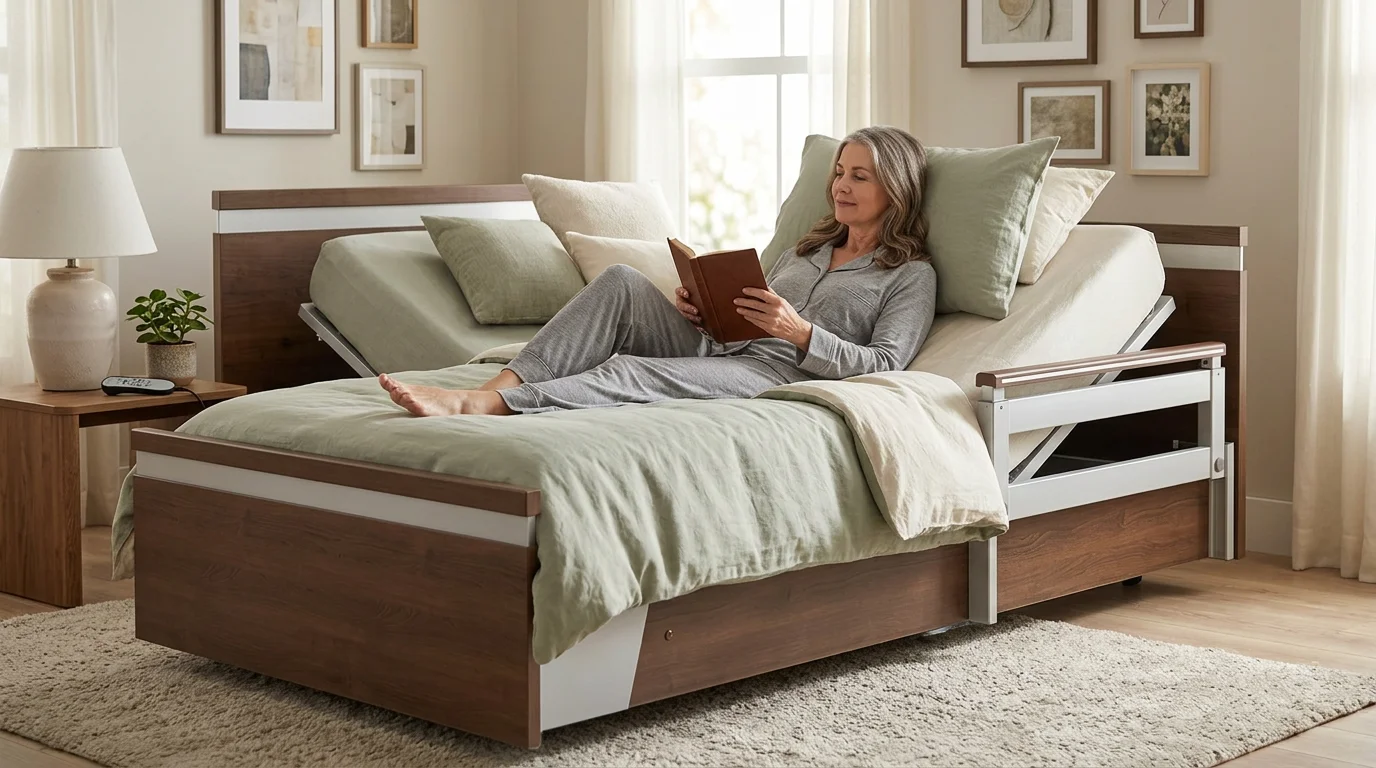
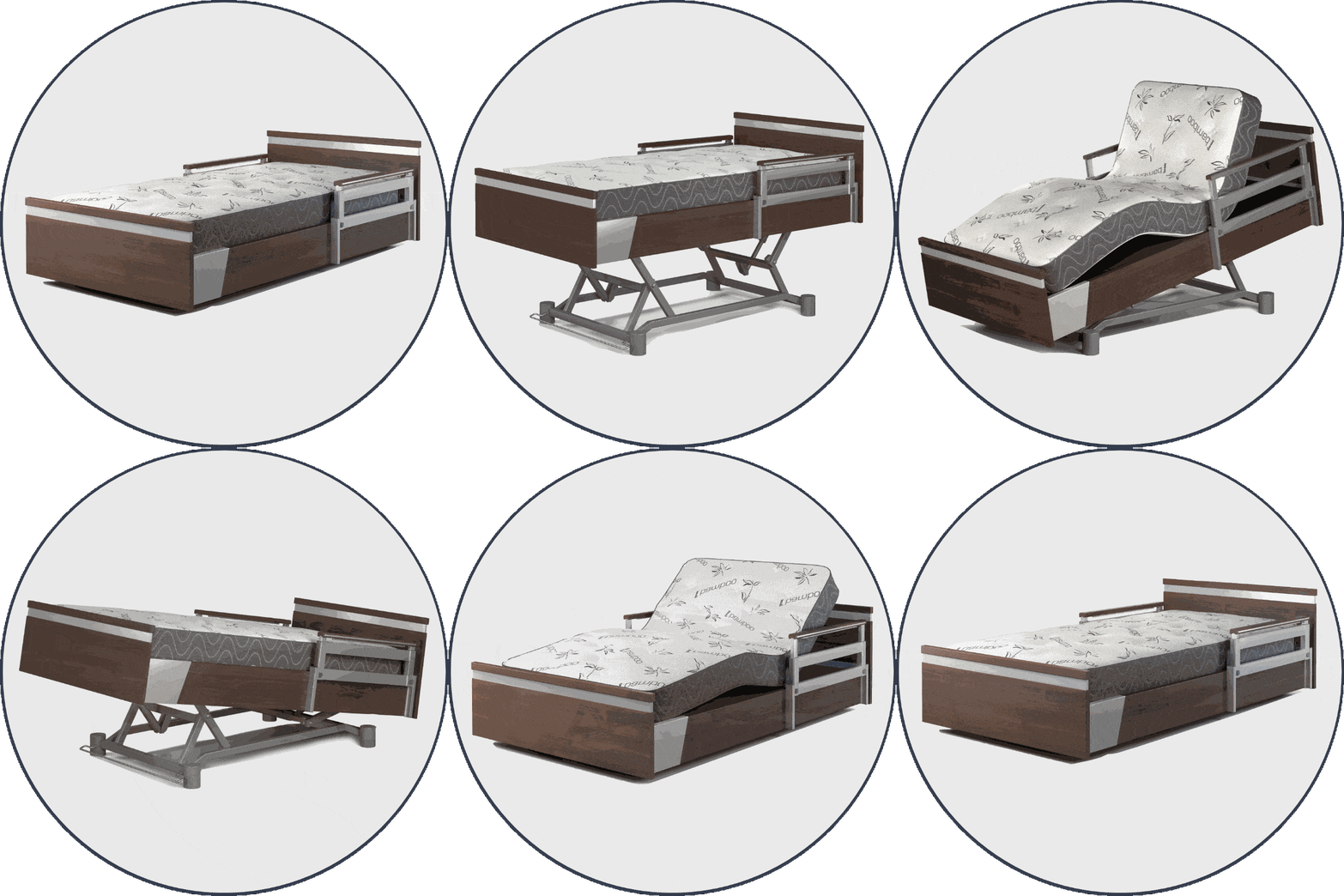
The Aura Premium home hospital bed is certified to the International Hospital Standard and built to IEC 60601-2-52. That places it firmly within both the medical device and medical equipment categories, hospital-grade certification, full clinical positioning suite (FallSafe ultra-low height, Zero Gravity, Trendelenburg), and hi-lo height adjustment from 10″ to 39″. What makes it different from standard DME is design: furniture-grade finishes, upholstered panels, and residential aesthetics that do not transform a bedroom into a clinical space.
This distinction matters because the regulatory classification does not determine what the bed looks like. A bed can meet every clinical standard and still look like the furniture already in the room. The gap between standard DME beds and premium home hospital beds is not in safety specifications, it is in design, material quality, and how the room feels to the people living in it.
For families working through Medicare coverage, the Aura beds may qualify as DME with a physician’s prescription, though coverage for the full-electric height-adjustment function depends on the specific Medicare determination. For those choosing to purchase privately, or selecting a bed that exceeds the Medicare-covered baseline, the investment reflects the quality difference between institutional DME and furniture-grade care equipment. Our detailed guide on what kind of hospital bed Medicare will pay for covers the documentation requirements and common points of claim denial.
If you are building out the complete home care setup beyond the bed, what equipment you need to care for an elderly person at home provides a full inventory covering mobility aids, pressure redistribution, and daily-living equipment.
The “Medical Grade” Myth
Caregivers frequently use the phrase “medical grade” to mean “covered by insurance” or “FDA-regulated at a higher level than consumer products.” Neither use is accurate.
“Medical grade” has no official regulatory meaning. What matters for quality assurance is the specific certification and standard: ISO 13485 for the manufacturing quality management system, IEC 60601-2-52 for electrical safety specific to hospital beds, and the relevant premarket clearance pathway the FDA required. When a product claims to be “medical grade,” the verifiable question is: which standard is it certified to?
The reason this matters practically: a CPAP machine purchased from a consumer electronics retailer and one obtained through a certified DME supplier may be the same FDA-cleared device. The difference is not the device itself; it is whether the purchase transaction meets Medicare’s supplier enrollment and documentation requirements. “Medical grade” and “Medicare-covered” are not the same thing, and neither term tells you whether a product is safe.
Understanding the Coverage Gap
The three-tier structure, medical device → medical equipment → durable medical equipment, creates a coverage gap that many families discover only after a claim has already been denied. The gap lives in several places:
- A product can be an FDA-regulated medical device without qualifying as DME.
- A product can qualify as DME and still be denied if the supplier is not Medicare-enrolled or the documentation is incomplete.
- A product can qualify as DME but have specific features excluded, like the powered height-adjustment motor on a full-electric hospital bed.
- A product can qualify as DME under Medicare but not under a private insurance plan that sets its own category definitions.
The most effective approach before ordering: contact your insurance provider with the specific HCPCS (Healthcare Common Procedure Coding System) code for the product. Every piece of DME has one. Armed with the code and a physician’s order, you will receive a clear answer about coverage before the purchase, not after a claim denial that triggers weeks of appeals.
For equipment you already own or are planning to transition out of, our guide to managing home medical equipment through its full lifecycle covers resale, donation, and recycling options.
Getting Clarity on Your Specific Situation
The terminology, medical device, medical equipment, durable medical equipment, medical supplies, does not change what a family member needs. But understanding the framework helps you navigate a system that treats these distinctions as meaningful, and advocate effectively when a claim is denied or a supplier gives inconsistent answers.
If you are selecting a home hospital bed and working through the coverage question at the same time, SonderCare’s bed experts have guided thousands of families through exactly this process. They can walk you through the documentation typically required for a Medicare DME determination, compare the covered baseline options against the full product range, and help you understand where a private-pay decision might close the gap between what Medicare provides and what the situation actually calls for.
Speak with a SonderCare expert to get guidance specific to your family’s situation.
References
-
U.S. Food and Drug Administration. “How to Determine if Your Product is a Medical Device.” FDA.gov. https://www.fda.gov/medical-devices/classify-your-medical-device/how-determine-if-your-product-medical-device (last reviewed Sep 29, 2022).
-
U.S. Food and Drug Administration. “Classify Your Medical Device.” FDA.gov. https://www.fda.gov/medical-devices/overview-device-regulation/classify-your-medical-device (updated Jan 15, 2026).
-
World Health Organization. “Medical devices.” WHO.int. https://www.who.int/health-topics/medical-devices; WHO Global Model Regulatory Framework for Medical Devices Including IVDs (2017, revised Mar 2023). ISBN 9789241512350.
-
European Parliament and Council. Regulation (EU) 2017/745 on Medical Devices (MDR), Article 2(1). Official Journal of the European Union, 5 May 2017. CELEX:32017R0745. https://eur-lex.europa.eu/legal-content/EN/TXT/PDF/?uri=CELEX:32017R0745
-
World Health Organization. “Priority Medical Devices for COVID Prevention, Diagnostic and Management.” WHO Health Product Policy and Standards. https://www.who.int/teams/health-product-policy-and-standards/assistive-and-medical-technology/medical-devices/priority-medical-devices-for-covid
-
U.S. Centers for Medicare & Medicaid Services. “Durable Medical Equipment (DME) Coverage.” Medicare.gov. https://www.medicare.gov/coverage/durable-medical-equipment-dme-coverage
-
International Electrotechnical Commission. IEC 60601-1:2005+AMD1:2012+AMD2:2020, Medical Electrical Equipment, Part 1: General Requirements for Basic Safety and Essential Performance. IEC Webstore. https://webstore.iec.ch/en/publication/2606
-
International Organization for Standardization. ISO 13485:2016, Medical Devices, Quality Management Systems, Requirements for Regulatory Purposes. ISO.org. https://www.iso.org/standard/59752.html