







You were sent home from the hospital with a short list of instructions and a vague directive: “get the right equipment.” No one explained what that means, which items Medicare will cover, or why a walker and a box of bandages belong to entirely different regulatory categories. For the millions of family caregivers navigating home care every year, understanding the definition of medical equipment is not an academic exercise, it directly determines what insurance pays for, what comes out of pocket, and whether a prescription you forgot to obtain costs you hundreds of dollars in denied claims.
This guide untangles the official definitions, explains the terms insurers actually use, and gives you a clear picture of where home hospital beds, including the adjustable care beds families choose for long-term home care, fit into the system.
What Is Medical Equipment? The Official Definition
The phrase “medical equipment” sounds straightforward, but its meaning depends on who is asking and why.
The World Health Organization offers the clearest international baseline: medical equipment consists of medical devices “requiring calibration, maintenance, repair, user training and decommissioning, activities usually managed by clinical engineers.”1 Under the WHO framework, medical equipment is a functional subset of the broader category of medical devices. A medical device, according to WHO, is “an article, instrument, apparatus or machine that is used in the prevention, diagnosis or treatment of illness or disease, or for detecting, measuring, restoring, correcting or modifying the structure or function of the body for some health purpose.”1 The key distinction: medical equipment is the portion of that universe that requires ongoing servicing to remain safe and effective.
In the United States, the Food and Drug Administration does not use “medical equipment” as a distinct regulatory category. Instead, the FDA regulates the broader class of medical devices, defined under Section 201(h) of the Federal Food, Drug, and Cosmetic Act as:
“An instrument, apparatus, implement, machine, contrivance, implant, in vitro reagent, or other similar or related article… intended for use in the diagnosis of disease or other conditions, or in the cure, mitigation, treatment, or prevention of disease, in man or other animals.”2
The critical qualifier in the FDA’s definition, the part that separates a medical device from a pharmaceutical drug, is that a device “does not achieve its primary intended purposes through chemical action within or on the body.”2 A wheelchair is a device. A blood pressure medication is a drug. The test is whether the mechanism is physical and mechanical rather than chemical or metabolic.
A useful plain-language working definition, drawn from peer-reviewed literature: medical equipment is a contrivance designed and manufactured for use in healthcare, that is not solely medicinal or nutritional.3 This holds across most regulatory contexts and is simple enough to apply when assessing whether a specific product qualifies.
On a global scale, the medical device market encompasses an estimated two million different kinds of devices, categorized into more than 7,000 generic device groups.1 This breadth, from a tongue depressor to a surgical robot, is why regulatory definitions are necessarily broad.
Medical Equipment vs. Medical Devices: Is There a Difference?
In everyday usage, the terms medical equipment and medical devices are often treated as interchangeable. In regulatory and clinical contexts, there is a meaningful distinction.
Under the WHO framework, all medical equipment is a medical device, but not all medical devices are medical equipment. A surgical implant, a pregnancy test strip, and a pacemaker are all medical devices. But they do not require calibration, ongoing maintenance, or user training in the same way that a hospital bed, infusion pump, or dialysis machine does.1
The European Union’s Medical Device Regulation (EU MDR 2017/745, Article 2(1)) defines a medical device as any instrument, apparatus, appliance, software, implant, reagent, material, or other article “intended by the manufacturer to be used, alone or in combination, for human beings for one or more of the following specific medical purposes: diagnosis, prevention, monitoring, prediction, prognosis, treatment or alleviation of disease.”4 Notably, the EU definition explicitly includes software and adds prediction and prognosis as covered purposes, a meaningful expansion over older regulatory language.
What this means practically: when a hospital administrator, an insurance company, or a clinical engineer refers to “medical equipment,” they typically mean larger, actively used devices that require setup, maintenance, and often a trained operator or caregiver. When a pharmacist or FDA reviewer says “medical device,” they may mean something as small as a glucose test strip or as large as an MRI machine.
Medical Equipment vs. Medical Supplies: The Crucial Divide
For families managing home care, the distinction that matters most is not “equipment vs. device”; it is equipment vs. supplies.
Medical equipment is durable: designed for repeated use over an extended period. A hospital bed, a wheelchair, a walker, a CPAP machine, a nebulizer, these are used day after day for months or years.
Medical supplies are consumable: used once or a limited number of times, then discarded. Gauze pads, surgical gloves, incontinence briefs, bandages, and blood glucose lancets all fall here. Even when they are medically necessary and prescribed by a doctor, consumable items belong to a separate coverage category, one with different rules, different deductibles, and different approval processes.
This durable-versus-disposable divide is precisely what most families miss until their first insurance denial. It is also the foundation of the regulatory term that governs Medicare and Medicaid coverage for home care equipment: Durable Medical Equipment.
Durable Medical Equipment (DME): The Category That Actually Matters for Coverage
When insurance companies, Medicare, and Medicaid discuss home medical equipment, they use the term Durable Medical Equipment, or DME. This is the classification that determines whether your plan pays.
The Social Security Administration defines durable medical equipment as equipment that:5
- Can withstand repeated use; it is built to be used many times, not discarded after a single use
- Is primarily and customarily used to serve a medical purpose, its main function is medical, not recreational or general use
- Is generally not useful to a person in the absence of illness or injury, a healthy person would not ordinarily use it
- Is appropriate for use in the home, it can be used outside a clinical facility
Under this framework, a home hospital bed qualifies as DME. So does a wheelchair, a walker, a CPAP machine, a home oxygen concentrator, and a blood glucose monitor. A box of bandages does not. Neither does a standard consumer mattress, even one marketed for medical conditions.
For Medicare Part B to cover DME, four additional requirements generally apply:
- A licensed physician must prescribe the equipment as medically necessary
- The prescription must be obtained before the equipment is purchased or rented
- The equipment must come from a Medicare-approved supplier
- The patient’s diagnosis must be documented in the physician’s clinical records
The prescription requirement is where most families lose coverage they were entitled to. Caregivers who buy a walker, raised toilet seat, or hospital bed out of pocket, then discover Medicare might have covered it, share nearly identical stories: no one told them a doctor’s order had to precede the purchase, not follow it. And even with a valid prescription, purchasing from a non-approved supplier eliminates coverage eligibility entirely.
If a DME claim is denied, the denial is frequently reversible. A physician letter documenting medical necessity is the single most important document in a successful appeal, and appeal success rates are considerably higher than most families expect before they give up and pay out of pocket.
Does a Home Hospital Bed Count as Medical Equipment?
Yes, a home hospital bed qualifies as durable medical equipment under Medicare Part B and as medical equipment under the WHO’s operational definition, provided it is used under a physician’s care for a medically documented purpose.
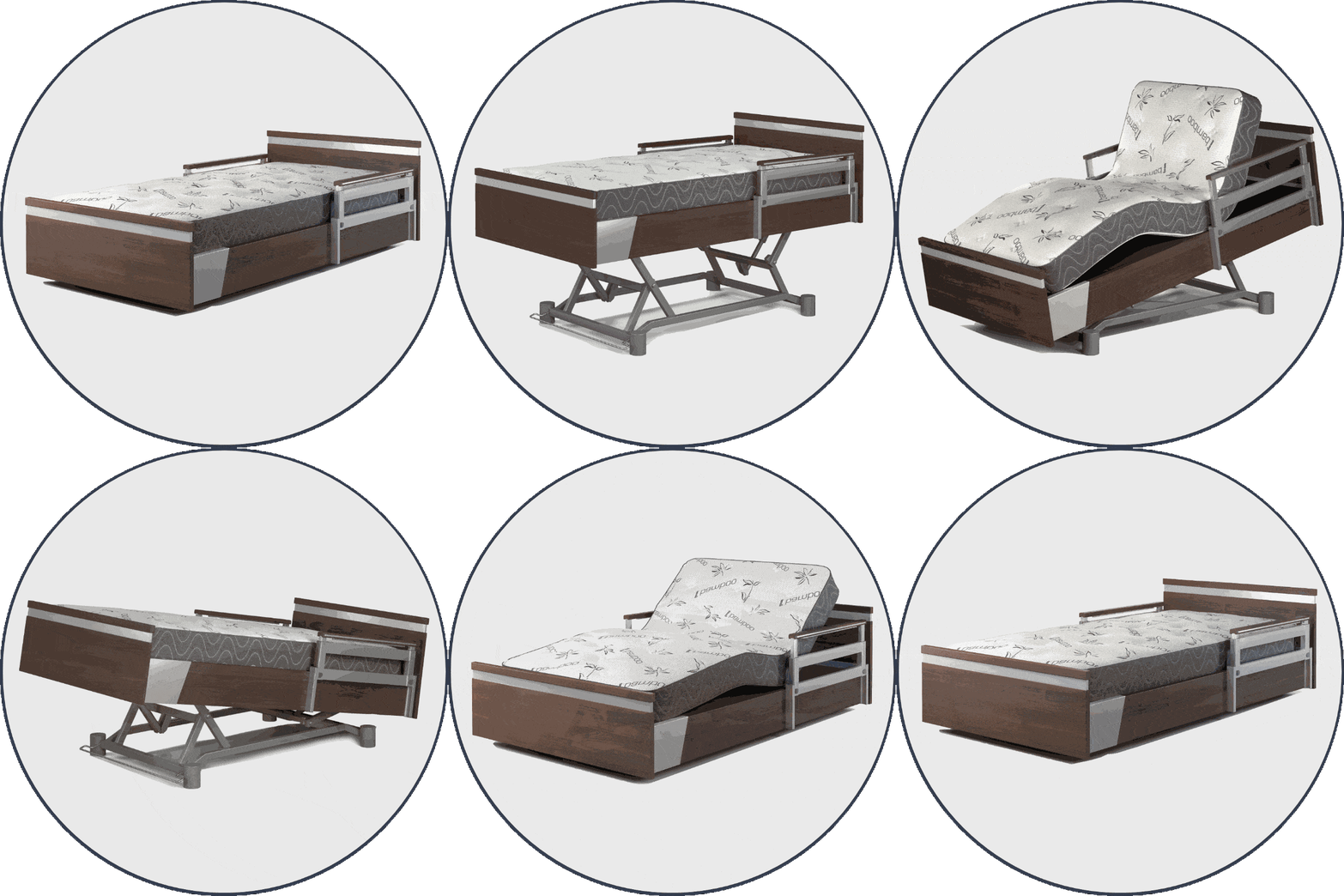
The coverage tier depends on the bed type. Medicare Part B generally recognizes three categories for home hospital beds:
- Fixed-height hospital bed, manually adjustable or semi-electric head/foot positioning
- Variable-height hospital bed, full electric hi-lo adjustment (the most common for home care)
- Heavy-duty or extra-wide hospital bed, for persons over the standard weight threshold
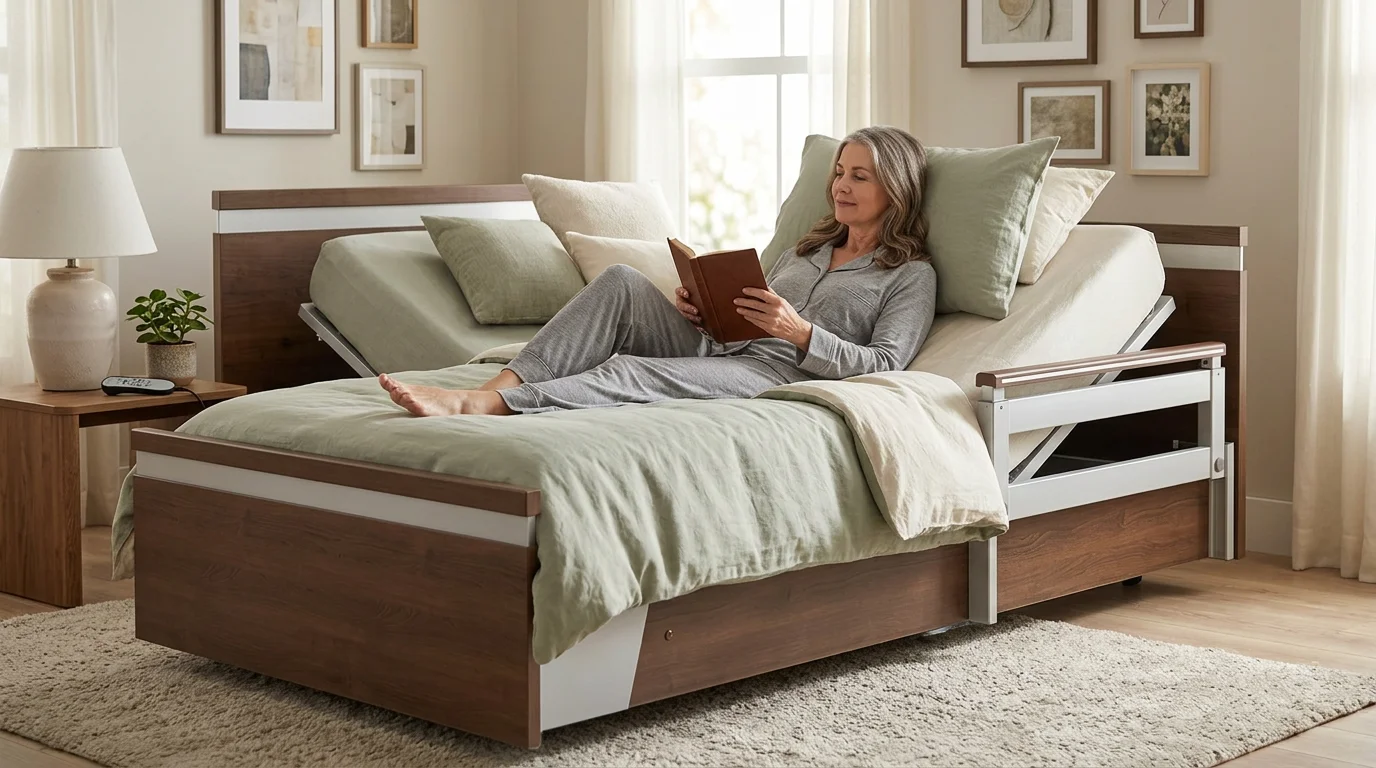
The SonderCare Aura Premium home hospital bed is a fully electric, hi-lo adjustable bed certified to the International Hospital Standard. Its positioning suite, including FallSafe ultra-low height (10-inch platform height, 17 inches to the top of the mattress), Trendelenburg tilt (17°), Zero Gravity positioning, and Cardiac Chair, reflects the functional capabilities that attending physicians document when prescribing home hospital beds. The Aura Platinum adds upholstered Slate Gray Crypton side panels for families who want hospital-grade function without a clinical aesthetic.
One important point: Medicare’s coverage is based on documented medical function, not brand or design. A physician’s prescription for a variable-height hospital bed with specific positioning capabilities applies whether you choose a standard DME supplier’s bed or a premium residential model. Families who choose a SonderCare bed as a private-pay upgrade over what insurance provides are not doing anything unusual; they are exercising a preference for ownership quality, residential aesthetics, and long-term durability over entry-level DME rental equipment. For a complete breakdown of Medicare’s coverage criteria, our guide to what kind of hospital bed Medicare will pay for covers every step of the process.
How Regulators Classify Medical Equipment
Once a product meets the definition of a medical device, the FDA assigns it a risk classification.
The FDA has classified over 1,700 distinct types of devices, organized into 16 medical specialty panels, from cardiovascular to dental to physical medicine.6 Each type falls into one of three classes:
| Class | Risk Level | Regulatory Pathway |
|---|---|---|
| Class I | Low | General controls (labeling, good manufacturing practices); many exempt from premarket review |
| Class II | Moderate | 510(k) premarket notification, manufacturer demonstrates substantial equivalence to an already-cleared device |
| Class III | High | Premarket Approval (PMA), used for life-sustaining or implantable devices with no adequate predicate |
Home hospital beds are Class II medical devices, regulated under 21 CFR 880.5100. The 510(k) pathway requires demonstrating that the bed’s safety and performance are substantially equivalent to a legally marketed predicate device. This matters: it means a home hospital bed cleared under 510(k) has been evaluated against established safety benchmarks, not simply self-declared compliant.
The European Union uses a parallel four-tier classification (Class I, IIa, IIb, III) under Regulation 2017/745, governed by 22 classification rules.4 Quality management standards apply at the manufacturing level regardless of jurisdiction: the SonderCare Aura line is manufactured by a partner certified to ISO 13485, ISO 9001, and ISO 14001, the internationally recognized standards for medical device quality management systems.7 There are more than 32,000 valid ISO 13485 certificates issued worldwide,7 representing the global baseline for serious medical device manufacturing quality.
What to Do Before Buying Home Medical Equipment
The definition of medical equipment matters in the context of what it requires you to do. These practical steps protect your coverage and ensure you get the right equipment:
1. Get a physician’s prescription before purchasing. If there is any possibility of Medicare, Medicaid, or private insurance coverage, the prescription must come before the purchase, not after. A physician’s note documenting medical necessity is the foundation of every successful DME claim.
2. Verify the supplier is Medicare-approved. Even with a valid prescription, buying from a non-approved supplier eliminates coverage eligibility. Check suppliers against the Medicare.gov supplier directory before ordering.
3. Understand the difference between equipment and supplies. Your family may need both, a hospital bed (durable equipment, potentially covered under Part B) and consumable supplies like wound dressings (covered differently, often under a separate benefit). These are separate coverage conversations.
4. Ask about rent versus buy. For many DME categories, Medicare Part B covers rental as well as purchase. For some items, including hospital beds, Medicare requires a rental period before triggering a purchase option. Understanding the structure in advance prevents surprises on your explanation of benefits.
5. If you’re considering a premium residential bed, understand what the upgrade means. When you choose a premium home hospital bed for its residential design, furniture-grade finishes, and advanced positioning capabilities, you are making a private-pay decision, not stepping outside the medical equipment category. Our guide to choosing a home hospital bed covers the full range from basic DME to premium residential models.
6. Plan for the full equipment lifecycle. Home medical equipment eventually moves on, recovery ends, care needs change, a loved one passes. Hospital beds and other durable equipment can often be resold, donated, or recycled. Our guide to reusing and reselling home medical equipment walks through the options so that equipment transitions as smoothly as the care situation did.
The definition of medical equipment is not a single, clean answer; it is a layered system. At the federal level, the FDA’s medical device category covers the broadest scope. The WHO’s operational definition of medical equipment carves out the subset that requires ongoing maintenance and servicing. And most practically for families, the Durable Medical Equipment (DME) classification is the framework that determines what Medicare and Medicaid will cover for home care.
For families navigating home care, the DME definition is the most actionable piece of this system. Equipment that withstands repeated use, serves a medical purpose, and is prescribed by a physician for home use qualifies. A home hospital bed, including models designed to look nothing like institutional equipment, sits squarely within that definition.
If you have questions about which bed is right for your situation, or what to document to support a Medicare claim, SonderCare’s care experts are available to help you understand your options. No pressure and no jargon, just guidance when you need it most.
References
- World Health Organization. “Medical Devices.” WHO Health Products Policy and Standards. https://www.who.int/health-topics/medical-devices (Retrieved June 2026).
- U.S. Food and Drug Administration. “How to Determine if Your Product is a Medical Device.” Updated September 29, 2022. https://www.fda.gov/medical-devices/classify-your-medical-device/how-determine-if-your-product-medical-device
- Aronson JK, Heneghan C, Ferner RE. “Medical Devices: Definition, Classification, and Regulatory Implications.” Drug Safety. 2020;43(2):83–93. DOI: 10.1007/s40264-019-00878-3. PMID 31845212. https://pubmed.ncbi.nlm.nih.gov/31845212/
- European Parliament and of the Council. Regulation (EU) 2017/745 on Medical Devices (MDR), Article 2(1). Official Journal of the European Union. May 5, 2017. https://eur-lex.europa.eu/legal-content/EN/TXT/PDF/?uri=CELEX:32017R0745
- Social Security Administration. “HI 00610.200, Definition of Durable Medical Equipment.” Program Operations Manual System (POMS). Updated November 28, 2022. https://secure.ssa.gov/poms.nsf/lnx/0600610200
- U.S. Food and Drug Administration. “Device Classification Panels.” Last reviewed January 15, 2026. https://www.fda.gov/medical-devices/classify-your-medical-device/device-classification-panels
- International Organization for Standardization. “ISO 13485, Medical Devices: Quality Management Systems.” https://www.iso.org/iso-13485-medical-devices.html