








If you’ve just been told someone in your family needs a hospital bed at home, you’re probably searching for a simple number, and finding anything but. One site says $500. Another says $6,000. The hospital discharge planner mentioned “insurance might cover part of it” but couldn’t say how much.
Here’s the honest answer: home hospital beds for home use range from about $500 for a basic manual model to $8,000 or more for a premium full-electric, depending on type, features, and quality. But the amount you actually pay often ends up higher once you factor in the mattress (not included with most beds), delivery, and the accessories your family member actually needs.
This guide covers what each type of hospital bed costs and what the differences mean in practice, what Medicare does and doesn’t pay for, whether renting or buying makes financial sense for your situation, where to find free or lower-cost options, and how to avoid the hidden costs that catch most families off guard.
Hospital Bed Price Ranges at a Glance
The ranges below cover home hospital beds, the beds families purchase or rent for home use, also called durable medical equipment (DME). This is a distinct market from what hospitals pay for institutional beds, which is covered separately.
| Bed Type | Typical Price Range | Key Limitation |
|---|---|---|
| Manual | $500–$1,000 | All adjustments by hand-crank |
| Semi-electric | $800–$3,000 | Head/foot electric; height still manual |
| Full-electric | $1,000–$6,000+ | Fully motorized including height |
| Premium residential-style | $3,999–$12,999 | Hospital-grade function with furniture design |
| Bariatric | $2,000–$6,000+ | For users over 350 lbs |
| Specialty (ICU-grade, rotation) | $4,000–$18,000 | Clinical or institutional use |
Price ranges confirmed across multiple DME pricing surveys.3,4
For a model-by-model breakdown with specific brand examples, see our detailed hospital bed cost guide.
What Type of Hospital Bed Do You Actually Need?
The type of bed determines what you’ll pay and how well it serves both the person using it and the caregiver providing daily care. Choosing the wrong type often means paying for a second bed within a year.
Manual hospital beds ($500–$1,000)
Manual beds are the least expensive option. Every adjustment, head elevation, foot elevation, and bed height, requires hand-cranking. For caregivers who need to raise and lower the bed multiple times daily for repositioning, transfers, or personal care, this adds up to hundreds of crank rotations per week. Caregivers with existing back problems or those who are older themselves consistently report that the physical toll of manual adjustments was not what they expected.
These beds work reasonably well for short-term recovery situations with minimal repositioning needs.
Semi-electric hospital beds ($800–$3,000)
Semi-electric beds motorize head and foot adjustments but leave bed height as a manual crank. This is the most common type covered by Medicare, and it’s frequently what families receive when insurance pays. The powered head and foot elevation helps with comfort, feeding, and respiratory positioning. But the manual height crank remains a significant physical burden for caregivers who need to lower the bed for fall prevention, raise it to a working height for personal care, and adjust it again for transfers, multiple times a day.
Understanding the full difference between semi-electric and full-electric is one of the most important decisions in the buying process. Our full comparison of full-electric vs. semi-electric hospital beds walks through each feature and who it affects.
Full-electric hospital beds ($1,000–$6,000+)
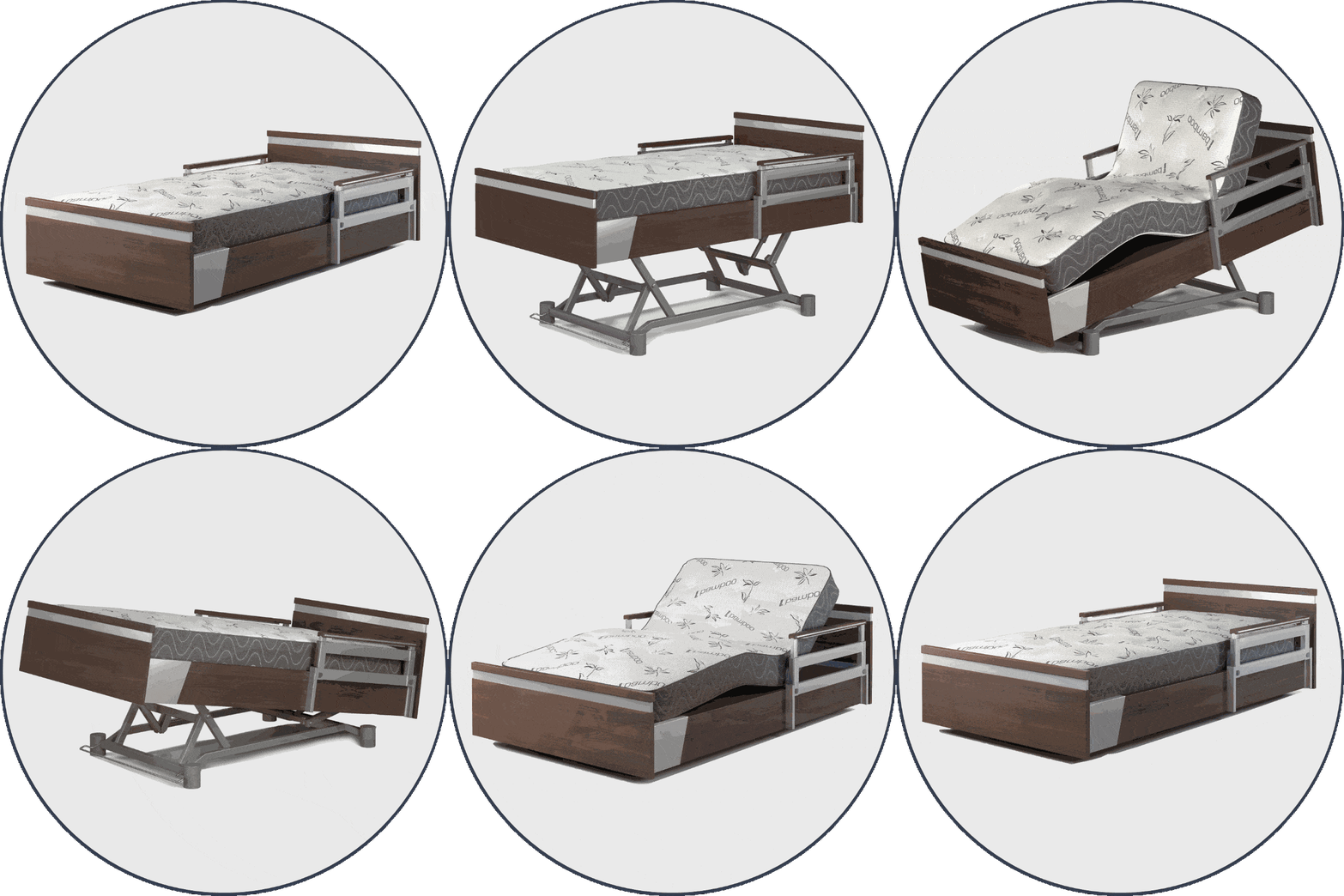
Full-electric beds motorize all adjustments, including height. The powered height function, which Medicare classifies as a “convenience” feature, is the single feature that most significantly affects caregiver safety and long-term sustainability. Raising and lowering the bed to the right height for each task (a lower height for fall risk reduction, caregiver height for personal care, a specific transfer height for wheelchair transitions) happens many times a day. Without a motor, each adjustment requires 30–50 manual crank rotations.
For most caregivers providing hands-on care at home over weeks or months, a full-electric bed is not a luxury, it is a practical injury-prevention tool.
Premium residential-style beds ($3,999–$12,999)
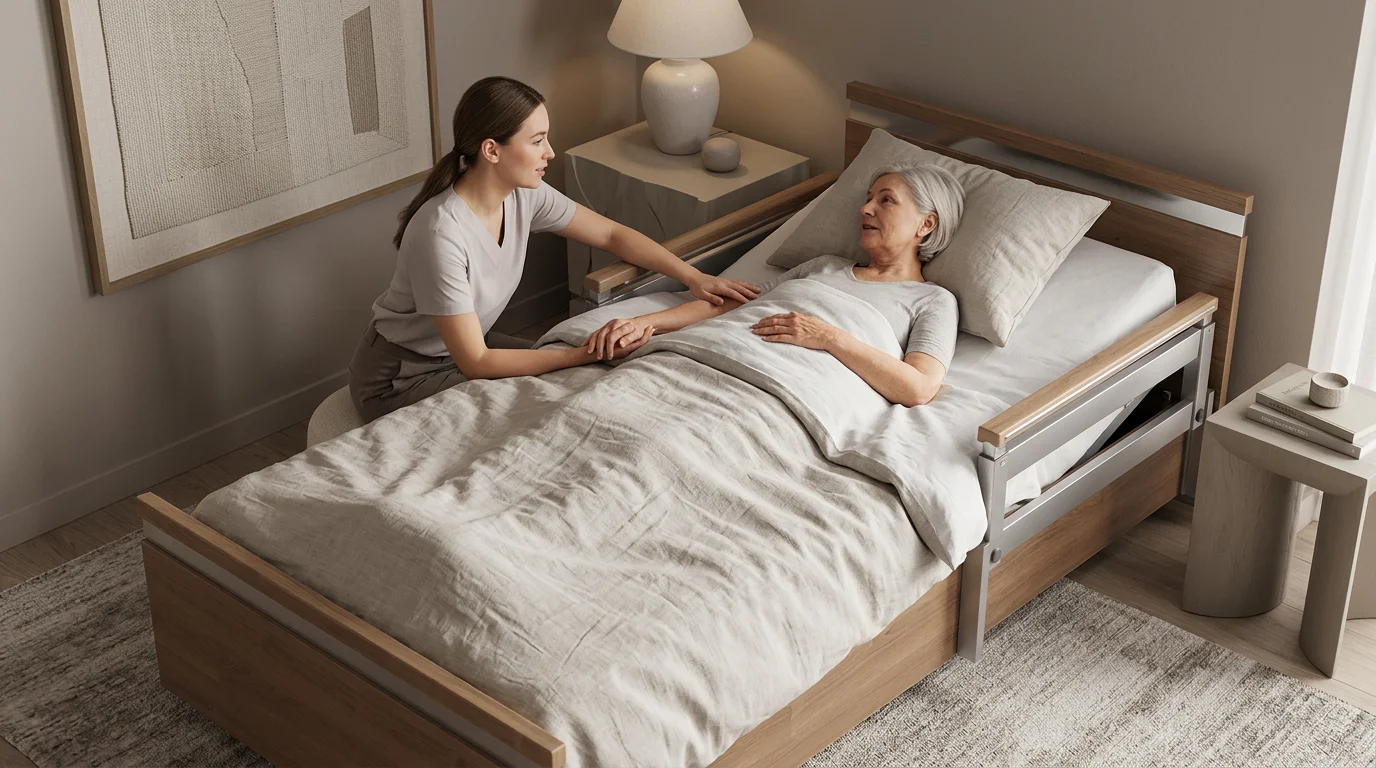
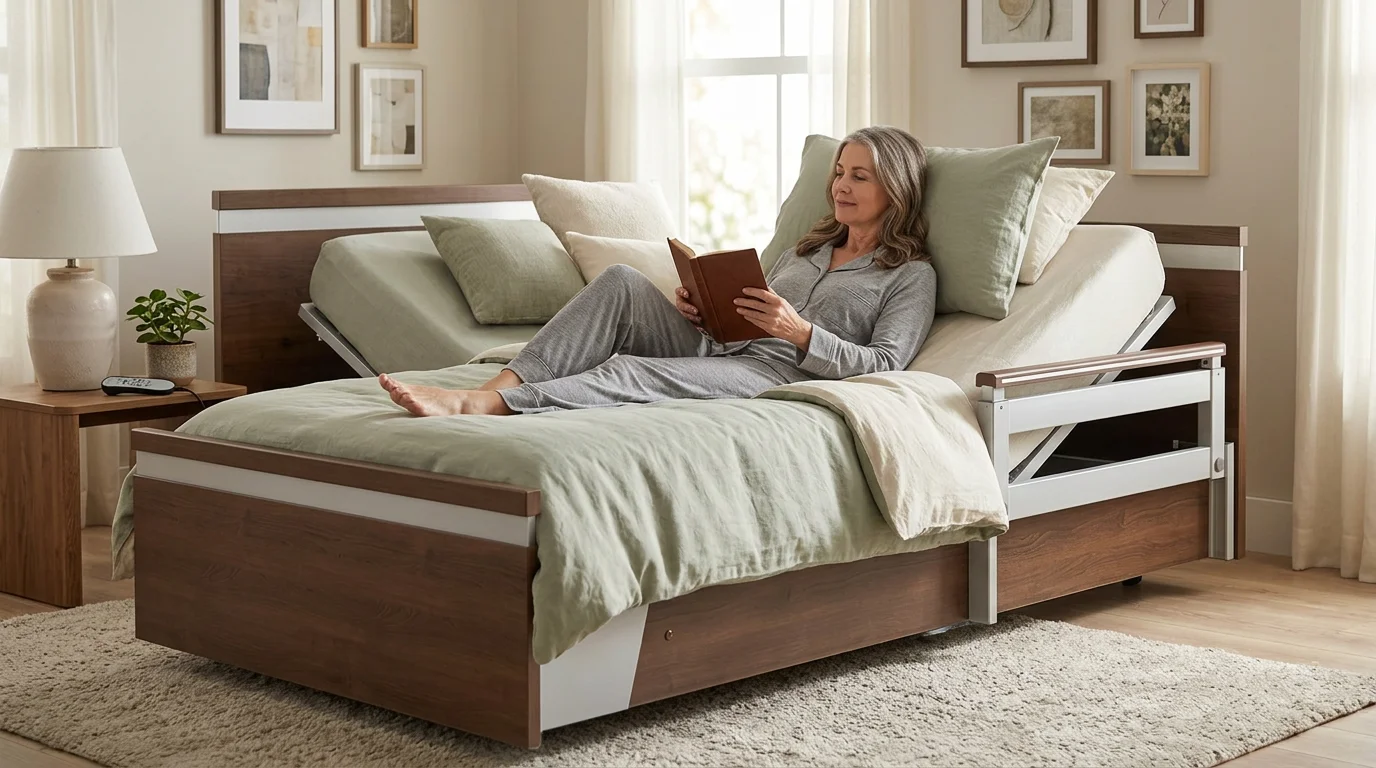
A growing category of home hospital beds combines hospital-grade clinical function with furniture-grade residential design. These beds meet clinical certification standards and offer the full positioning suite, including ultra-low height for fall prevention, Trendelenburg tilt, Zero Gravity positioning, and Cardiac Chair, while looking like quality bedroom furniture rather than clinical equipment.
SonderCare’s Impulse Residential Bed ($3,999) is an entry-level option in this category, offering head, knee, and hi-lo adjustment with a residential finish. The Aura Premium home hospital bed ($6,999) adds hospital certification to the International Hospital Standard, FallSafe ultra-low height at 10 inches (17 inches to the mattress top), and the full clinical positioning suite. For families where bedroom aesthetics matter significantly, spouses who want their shared bedroom to feel like home, or seniors who don’t want a clinical-looking setup, the Aura Platinum ($8,499) adds fully upholstered Crypton side panels and an elevated furniture-grade finish.
The Costs That Catch Families Off Guard
The sticker price of the bed frame is only the starting point. Families consistently describe being blindsided by necessary add-ons that weren’t included in the bed price.
Mattress ($200–$3,000+, not included): Home hospital beds are almost universally sold without a mattress. A standard pressure-redistribution foam mattress runs $200–$900. A bamboo quilt-top or memory foam comfort mattress runs $1,000–$1,500. An alternating pressure air mattress, designed for active pressure sore treatment or wound care, runs $2,000–$3,000 or more.3 For someone requiring extended bed rest, mattress selection directly affects skin integrity. Research confirms that advanced support surfaces meaningfully reduce pressure injury risk, adding a per-day cost that is small compared to the cost of treating a pressure ulcer once it develops.6
Side rails ($150–$600 per set): Most hospital beds don’t include a full set of side rails, or include only partial coverage. A second set runs $150–$600 depending on the model. Rails serve a fall-prevention function but are not rated as stand-up assistance, they should never be used to help someone transfer to standing.
Accessories ($89–$789 each): An overbed table, trapeze bar for self-repositioning, bed rail organizer, motion-activated nightlight, and battery backup are frequently needed and not standard. Budget $300–$800 for the accessories most caregivers actually use in the first months of home care.
Delivery and installation ($449–$1,199): Drop-ship delivery to the driveway, with no installation, typically runs $449–$599. White-glove delivery, full setup, installation, feature walkthrough, and debris removal, runs $599–$1,199 depending on the speed required.
The realistic all-in estimate: A semi-electric bed at $1,500, a pressure-redistribution mattress at $800, basic rails and two accessories at $450, and standard delivery at $599 brings the real cost to approximately $3,350, more than double the bed’s listed price. A full-electric setup with a mid-range mattress and white-glove delivery commonly lands between $3,500 and $6,000 total.
Does Medicare Cover a Hospital Bed?
This is where most families encounter their biggest surprise. Medicare does cover hospital beds, but only specific types, only for qualifying diagnoses, and only when the documentation is completed correctly before delivery.
What Medicare covers: Medicare Part B covers semi-electric and manual hospital beds when a physician certifies that the beneficiary requires head elevation above 30 degrees due to congestive heart failure, COPD, or aspiration risk, or when mobility impairment requires positioning assistance for pain relief or other documented conditions. The relevant HCPCS codes are E0250, E0251, E0265, E0266, and related classifications.5
What Medicare does NOT cover: Total electric hospital beds, including the powered height function, are classified by the Centers for Medicare & Medicaid Services as “convenience features” and are explicitly excluded from coverage.5 This creates a direct conflict with clinical reality: the powered height adjustment that Medicare won’t fund is precisely the feature that protects caregivers during the daily transfers and positioning tasks involved in home care. A caregiver moving someone who requires extended bed rest needs the height to change, and doing it manually dozens of times per week is how back injuries happen.
The paperwork requirement that causes most denials: A Written Order Prior to Delivery (WOPD), a signed physician order, must be in the DME supplier’s possession before the bed is delivered. If the bed arrives first and the physician order follows, Medicare will automatically deny the claim. This is the most commonly cited reason for denied claims among family caregivers. Confirm this documentation is complete and transmitted before scheduling delivery.
Bariatric coverage exceptions: Medicare does cover extra-heavy-duty beds for users over 350 lbs (up to 600 lbs) and extra-heavy-duty configurations for users over 600 lbs, under codes E0301–E0304.5
If your care situation requires a full-electric bed, which it likely does when hands-on caregiving is ongoing, you will pay out of pocket for the powered height function. Speaking with a SonderCare bed expert about which model fits your situation and what financing options are available is worth the conversation before committing to a purchase.
Rent or Buy, What the Math Actually Shows
Monthly rental rates for home hospital beds typically run $195–$500 per month depending on bed type and supplier. That makes renting feel like the cautious, low-commitment choice. But cumulative rental costs frequently exceed purchase prices well before the first year is up.
| Months Rented | At $250/month | At $350/month | At $500/month |
|---|---|---|---|
| 6 months | $1,500 | $2,100 | $3,000 |
| 12 months | $3,000 | $4,200 | $6,000 |
| 18 months | $4,500 | $6,300 | $9,000 |
| 24 months | $6,000 | $8,400 | $12,000 |
A quality full-electric home hospital bed costs $1,000–$6,000 to purchase. At a rental rate of $300–$350 per month, the break-even point arrives between nine and fourteen months for most mid-range beds. At $500 per month, a family is paying for a new bed every twelve months, and has nothing to show for it.
When renting makes more sense: Short-term recovery situations with a clear timeline, typically under three to four months, where the person is expected to return to a standard bed. Also situations where the care need is genuinely uncertain and a commitment-free period helps the family assess what’s required.
When buying makes more sense: Any situation involving ongoing care needs, a progressive condition, or a care timeline likely to extend beyond six months. Ownership also means access to a better-quality bed than most rental suppliers stock. You get to keep the equipment, maintain it, and use it for as long as needed without monthly fees.
For a complete framework on making this decision, see our guide to renting vs. buying a hospital bed for home.
Free and Low-Cost Options Worth Knowing
For families under significant financial pressure, several options exist that purely commercial content tends to skip over.
Hospice programs: If a family member has transitioned to hospice care, a hospital bed is typically provided at no charge through the Medicare hospice benefit. Many families pay months of rental fees before switching to hospice, and only then discover that the equipment would have been covered. If this transition is on the horizon, ask the hospice intake coordinator what DME is included before committing to any rental.
Medical equipment lending programs: Senior centers, nonprofit organizations, and some faith communities operate lending closets or medical equipment loan programs. Search “medical equipment lending program” along with your city or county name to find local options. Wait times and available inventory vary significantly.
Used and refurbished equipment: Hospital-grade beds in good working condition appear regularly on Facebook Marketplace and through medical equipment resellers. Refurbished commercial beds, from brands like Hill-Rom or Stryker, can offer strong value, often in the $2,000–$4,000 range.2 Confirm all motor functions work before paying, verify that replacement parts are available for that model, and understand that there is typically no return policy on used DME.
Nonprofit medical equipment organizations: Organizations such as MedShare, Goodwill Medical Equipment programs, and regional nonprofit DME groups accept donations of used medical equipment and distribute it to qualifying families at low or no cost. A call to your local Area Agency on Aging is often the fastest way to identify what’s available in your area.
For Context: What Hospitals Actually Pay for Hospital Beds
The prices discussed above are for home DME, a different market from what hospitals pay when purchasing beds for institutional use. Understanding this gap provides useful context.
A standard non-ICU hospital bed frame in a U.S. hospital typically costs $4,500–$7,000. Specialty configurations with advanced features push costs above $15,000. An ICU-capable bed runs $25,000–$30,000 per unit,1,2 and heavy-duty bariatric beds reach $35,000–$40,000.2 These figures don’t include the therapeutic mattress, which adds $2,000–$8,000 for ICU configurations.2
Hospital supply expenses, the category that includes beds, represent 15% of total U.S. hospital expenditures on average, rising to 30–40% at surgery-intensive facilities, making beds a meaningful line item within a sector that spent over $1.1 trillion in 2018 and continues to grow.7 The global market for medical beds was valued at $4.3 billion in 2025.8
This context matters for evaluating home bed pricing. A home hospital bed built to hospital certification standards, like SonderCare’s Aura line, certified to the International Hospital Standard, is engineered and tested to clinical specifications, at a fraction of what hospitals pay for institutional equipment. The $6,999–$8,499 price range for a hospital-certified residential-design bed represents a substantial reduction from institutional pricing while delivering equivalent clinical function in a residential form.
How to Get the Best Value on a Home Hospital Bed
The most common mistake is purchasing the cheapest available bed without considering the full cost of ownership or the caregiver’s physical reality. The second-most-common mistake is renting for 12–18 months and paying more in rental fees than a purchase would have cost.
A few principles that hold across most situations:
Match the bed to the actual care need. If positioning and transfers are involved daily, powered height is not a luxury. Don’t let what insurance will cover determine what kind of bed you get if the out-of-pocket gap is manageable.
Budget for the full setup, not just the frame. Mattress, rails, key accessories, and delivery should all be in your initial estimate. Assume $1,000–$1,500 above the frame price as a realistic add-on budget.
Think about the full term. A well-built bed with a five-year comprehensive parts warranty and a 10-year expected service life costs less per year than a series of rental payments or two lower-quality bed purchases.
Ask about white-glove delivery. Full setup, installation, and a walkthrough of all features at the time of delivery removes that burden from the caregiver at an already stressful time.
For a full decision framework tailored to your situation, our expert buyer’s guide to choosing a home hospital bed covers every major consideration. Or reach out to a SonderCare bed expert directly, they’ve helped thousands of families match the right bed to the right situation, without pressure.
The Bottom Line
The average price of a home hospital bed for most family care situations lands between $1,000 and $4,000 for a functional full-electric DME model. Premium residential-design beds with clinical certification start at $3,999 and reflect the engineering required to meet hospital standards with furniture-grade aesthetics. The full cost of a properly equipped home hospital bed setup, frame, mattress, rails, delivery, and a few essential accessories, typically runs $2,500–$5,500 for a mid-range configuration.
Medicare will cover part of the cost for qualifying semi-electric beds, but not the powered height function that most hands-on caregiving situations require. If a care timeline extends beyond six months, ownership almost always costs less than cumulative rental fees.
The right bed depends on the type of care involved, the caregiver’s physical capacity, and how long the need is likely to last. Those three variables are worth understanding clearly before the purchase decision.
References
-
American Hospital Association. Costs of Caring: Challenges Facing America’s Hospitals. 2025. aha.org/costsofcaring
-
SVI International, Inc. “How Much Do Hospitals Spend on Beds? Is There a Way to Save Money?” March 13, 2020.
-
SonderCare Learning Center. “How Much Does a Good Hospital Bed Cost? (2026 Pricing Guide).” Updated May 8, 2026. https://www.sondercare.com/learn/hospital-beds/hospital-bed-cost-guide/
-
CGS Administrators, LLC. “Dear Physician: Hospital Beds and Accessories.” Revised August 2024. Smitha M. Ballyamanda MD, Robert D. Hoover Jr. MD, Sunil V. Lalla MD, Angela S. Jenny DO. cgsmedicare.com
-
Chunhu Shi, Jo C. Dumville, Nicky Cullum, et al. “Beds, overlays and mattresses for preventing and treating pressure ulcers: an overview of Cochrane Reviews and network meta-analysis.” Cochrane Database of Systematic Reviews. 2021. DOI: 10.1002/14651858. CD013761. pub2. PMC8407250
-
Yousef Abdulsalam and Eugene Schneller. “Hospital Supply Expenses: An Important Ingredient in Health Services Research.” Medical Care Research and Review. 2019. DOI: 10.1177/1077558717719928. PubMed 29148349
-
Monali Tayade and Mayur Shinde. “Medical Bed Market Size & Share 2026–2035.” GM Insights, 2025. gminsights.com