








The doctor has said it: your parent needs a hospital bed at home. Then comes the next question, the one that sends most families into a spiral of phone calls: how does Medicare justify a hospital bed, and what exactly do you have to prove?
The confusion is understandable. Medicare’s coverage criteria for home hospital beds sit at the intersection of clinical documentation, supplier enrollment, and insurance bureaucracy, a combination that reliably produces frustration. Many families spend weeks making calls before they understand what documentation Medicare actually requires, who submits it, and what happens when the first claim is denied.
This guide walks through the Medicare justification process for a home hospital bed: the specific clinical language that makes or breaks a claim, the three coverage tiers and what each one requires, what your family will still owe after Medicare pays, and what your options are if the standard equipment doesn’t meet your needs.
Part A or Part B: Which Medicare Covers Your Situation?
Before diving into justification criteria, it’s worth clarifying which part of Medicare you’re dealing with, because “Medicare covers hospital beds” means two different things depending on context.
Medicare Part A covers inpatient hospital stays. When a person is admitted to a hospital as an inpatient, Part A pays for the bed, board, and care during that stay, provided the admission meets Medicare’s criteria. The key threshold is the Two-Midnight Rule: Medicare Part A generally covers an inpatient admission when the treating physician expects the person to require medically necessary hospital care spanning at least two midnights.1
What many families don’t realize is that patients who don’t meet that threshold may be classified as outpatient observation status under Part B instead, and observation patients are technically outpatients. That classification matters because it affects cost-sharing and, critically, does not fulfill the three-night inpatient stay requirement that qualifies someone for subsequent skilled nursing facility coverage.2 Since 2016, hospitals are required by law to notify patients in writing when they’re placed on observation rather than admitted as inpatients.2
Medicare Part B covers home hospital beds as durable medical equipment (DME). If your loved one is leaving the hospital and needs an adjustable care bed at home, this is the coverage path you’re navigating, and the rest of this guide focuses entirely on Part B DME coverage.
What “Medical Necessity” Means for a Home Hospital Bed
Medicare Part B covers home hospital beds when they are deemed medically necessary, but “medically necessary” is not a vague standard. The Centers for Medicare & Medicaid Services has established a National Coverage Determination (NCD 280.7) that defines exactly what justifies coverage for a home hospital bed.3
Under NCD 280.7, Medicare will cover a home hospital bed when all of the following apply:
- The person has a medical condition that requires positioning of the body in ways that a standard flat bed cannot provide, typically elevation of the head or legs, or both
- That positioning is medically necessary to treat an illness or injury, or to improve functioning
- A physician has ordered the bed and documented that these criteria are met
According to CMS NCD 280.7, and reinforced in Medicare carrier guidance issued to physicians, the bed “must be reasonable and necessary for the diagnosis or treatment of illness or injury, or to improve the functioning of a malformed body member.”4
What disqualifies a claim is equally important: a home hospital bed ordered primarily for comfort, convenience, or general preference does not meet the standard. The documentation must connect a specific medical condition to a specific positioning need that a regular bed cannot address.
The Medicare.gov hospital beds coverage page confirms this framework and is a useful reference to share with your physician’s office when initiating the process.
The Three Coverage Tiers: What Each Requires
Medicare does not cover just one type of home hospital bed, it covers three, and each tier carries progressively stricter qualifying criteria.3,4
| Bed Type | Description | Qualifying Criteria |
|---|---|---|
| Fixed Height | Non-adjustable frame; head and foot sections adjust manually | Medical condition requires positioning; standard flat bed is insufficient |
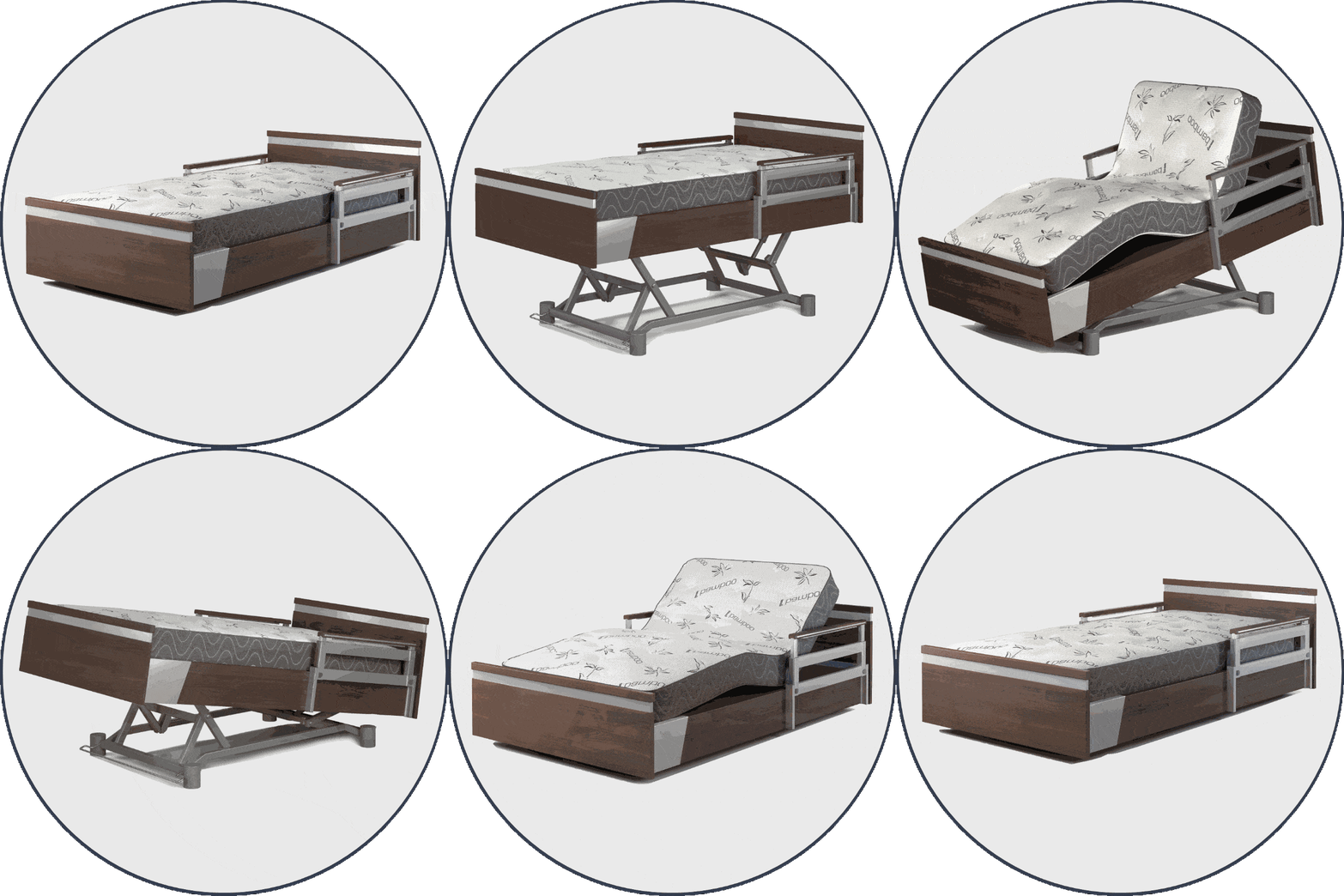
| Variable Height (Semi-Electric) | Electric head/knee adjustment; manual height change | All fixed-height criteria, plus patient’s condition prevents safe use of a fixed-height bed; patient can operate the manual height function |
| Fully Electric (Hi-Lo) | Electric head, knee, AND height adjustment | All variable-height criteria, plus documented inability to operate the manual height mechanism due to a medical condition |
The tier distinction is where many claims go wrong. A fully electric bed, where the entire height adjusts electrically, requires justification not just for the positioning need, but specifically for why the person cannot manually adjust the bed height themselves. The most common qualifying reasons are severe arthritis of the hands, significant upper extremity weakness, or neurological conditions affecting motor control.
This is where many families encounter a denial even when the underlying need is genuine: the physician orders a fully electric bed without documenting why the manual height function is not an option. The clinical need for the bed may be obvious; Medicare’s contractor still requires the documentation to be explicit.
Qualifying Medical Conditions
Medicare does not publish a single list of diagnoses that automatically qualify someone for a home hospital bed. What matters is the functional limitation the condition creates, the inability to be adequately positioned in a standard flat bed.
That said, certain conditions reliably justify coverage when properly documented:
Respiratory and cardiac conditions are among the most common qualifying diagnoses. Congestive heart failure (CHF), chronic obstructive pulmonary disease (COPD), and similar conditions make lying flat medically dangerous. The rationale is straightforward: sustained head elevation is clinically necessary to treat the condition, and a flat bed cannot provide it.
Neurological conditions, including ALS, multiple sclerosis, Parkinson’s disease, stroke, and spinal cord injury, frequently create both the positioning needs and the functional limitations (inability to reposition independently, inability to operate manual controls) that justify coverage, including the fully electric tier.
Pressure injury risk and wound care, conditions that require frequent repositioning to prevent or treat pressure injuries can justify coverage, particularly when the person cannot reposition independently and a caregiver cannot safely do so with a standard bed.
Severe arthritis or musculoskeletal conditions, when these prevent safe operation of a bed’s manual controls, they can justify the fully electric tier specifically.
The critical point is this: a diagnosis alone is not sufficient. Medicare contractors need to see the connection between the diagnosis and the specific functional limitation. “Patient has CHF” is not enough. “Patient has CHF with orthopnea requiring head elevation of at least 30 degrees during sleep; flat positioning causes respiratory distress and reduced oxygen saturation” is documentation that works.
The Certificate of Medical Necessity: What Your Doctor Must Document
The Certificate of Medical Necessity (CMN) is the document at the center of Medicare’s home hospital bed justification process. Your physician must complete this form, and the language they use determines whether the claim is approved or denied.
Based on Medicare carrier guidance published directly to physicians, the CMN for a home hospital bed must establish:4
- The specific diagnosis or diagnoses requiring the bed
- The positioning need, what body position is required and why a standard flat bed cannot achieve it
- The medical necessity of that position, how it treats the condition, prevents clinical deterioration, or improves function
- For fully electric models specifically: why the person cannot operate the manual height mechanism, and the condition that prevents them from doing so
Vague language invites denial. Language that works:
“Patient requires continuous head elevation of 30–45 degrees due to congestive heart failure with orthopnea; lying flat causes acute dyspnea and decreased oxygen saturation.”
“Patient has severe Parkinson’s disease with rigidity and cannot reposition independently; knee and head adjustment required throughout the night to relieve pain and prevent skin breakdown; standard flat bed is inadequate.”
“Patient has bilateral rheumatoid arthritis with deformity of the hands preventing safe operation of a manual bed crank; fully electric height adjustment is medically necessary for safe transfers.”
A signed written order from the physician is also required before a DME supplier can deliver the bed. In most cases, the DME supplier will provide the CMN form directly to the physician’s office for completion, but the physician must sign it, and the medical record must support every claim on it. Documentation inconsistencies between the CMN and the physician’s chart notes are a common reason for denials.
Step-by-Step: How the Medicare Justification Process Works
Understanding the full process, not just the paperwork, helps families navigate what caregivers routinely describe as a frustrating loop between three parties: the physician’s office, the DME supplier, and Medicare.
Step 1: Physician evaluation and clinical documentation
The physician evaluates the person, determines that a home hospital bed is medically necessary, and documents the clinical rationale in the chart. This documentation must support the specific language that will appear in the CMN.
Step 2: Written prescription/order
The physician writes a signed order specifying the bed type (fixed, variable height, or fully electric) and the qualifying diagnosis. This order is required before the DME claim can be processed.
Step 3: Find a Medicare-enrolled DME supplier
The supplier, not the physician, submits the claim to Medicare. You must use a DME supplier that participates in Medicare and accepts Medicare assignment. Not all suppliers do, and availability varies significantly by region.
Step 4: CMN completion and claim submission
The supplier obtains the completed, signed CMN from the physician. They may request additional medical records before submitting. Once the documentation is in order, the supplier submits the claim to Medicare.
Step 5: Rental begins
If the claim is approved, Medicare pays its share and the supplier delivers the bed on a rental basis. For further detail on what to expect at each stage, including what questions to ask a DME supplier before you engage them, see What to Know Before Getting a Medicare Hospital Bed.
What Medicare Pays, and What You’ll Still Owe
Medicare Part B covers 80% of the Medicare-approved amount for the home hospital bed after the annual Part B deductible is met.5 The 2024 standard Part B deductible was $240. The remaining 20% coinsurance is the beneficiary’s responsibility, or is covered by a supplemental Medigap policy if one is in place.
There are two other things families frequently don’t anticipate:
Medicare rents the bed, it doesn’t buy it. Medicare reimburses the DME supplier for rental of the bed for a period of up to 13 months. After month 13, ownership of the bed transfers to the beneficiary at no additional charge from the supplier. Throughout the rental period, the supplier retains responsibility for maintenance and service.
Accessories are separate. Medicare does cover some accessories, including bed rails for certain coverage criteria and hospital-style mattresses, but coverage requires its own documentation. The mattress provided through the DME program is a standard foam or innerspring model; upgrades to pressure redistribution or alternating pressure mattresses require separate medical justification.
For a direct comparison of what Medicare’s rental costs add up to versus the one-time cost of a private-pay home hospital bed, see the Rent or Buy a Hospital Bed guide, which covers the 13-month math in detail.
When Medicare Denies the Claim: Common Reasons and How to Appeal
First-round denials are common enough that experienced DME suppliers often treat them as part of the process. Knowing the most frequent denial reasons, and what to do, makes a significant difference.
Common denial reasons:
- Insufficient CMN documentation, The physician’s CMN doesn’t explicitly connect the diagnosis to the positioning need in language that satisfies the NCD criteria
- Tier mismatch, A fully electric bed was ordered without documenting why the person cannot use manual height controls
- Medical record inconsistency, The clinical notes don’t support what the CMN claims, or the documentation appears to have been completed without a recent exam
- Non-enrolled supplier, The claim was submitted by a supplier that doesn’t participate in Medicare DME
When a claim is denied, the denial letter will explain the reason and outline appeal rights. The Medicare appeals process begins with a request for redetermination from the Medicare Administrative Contractor and must be initiated within 120 days of the initial denial. Strengthening the physician documentation, returning to the physician to update chart notes and CMN language, is typically the most important step before filing the appeal.
Research on Medicare coverage decisions has documented that most beneficiaries are unfamiliar with the full implications of their coverage classifications and their rights when claims are denied.7 Federal oversight has consistently identified significant variability in how Medicare coverage determinations play out across different patients and suppliers.6 If a claim is denied and the clinical need is genuine, an appeal is almost always worth pursuing.
What Medicare-Covered Beds Look Like, and What Else Is Available
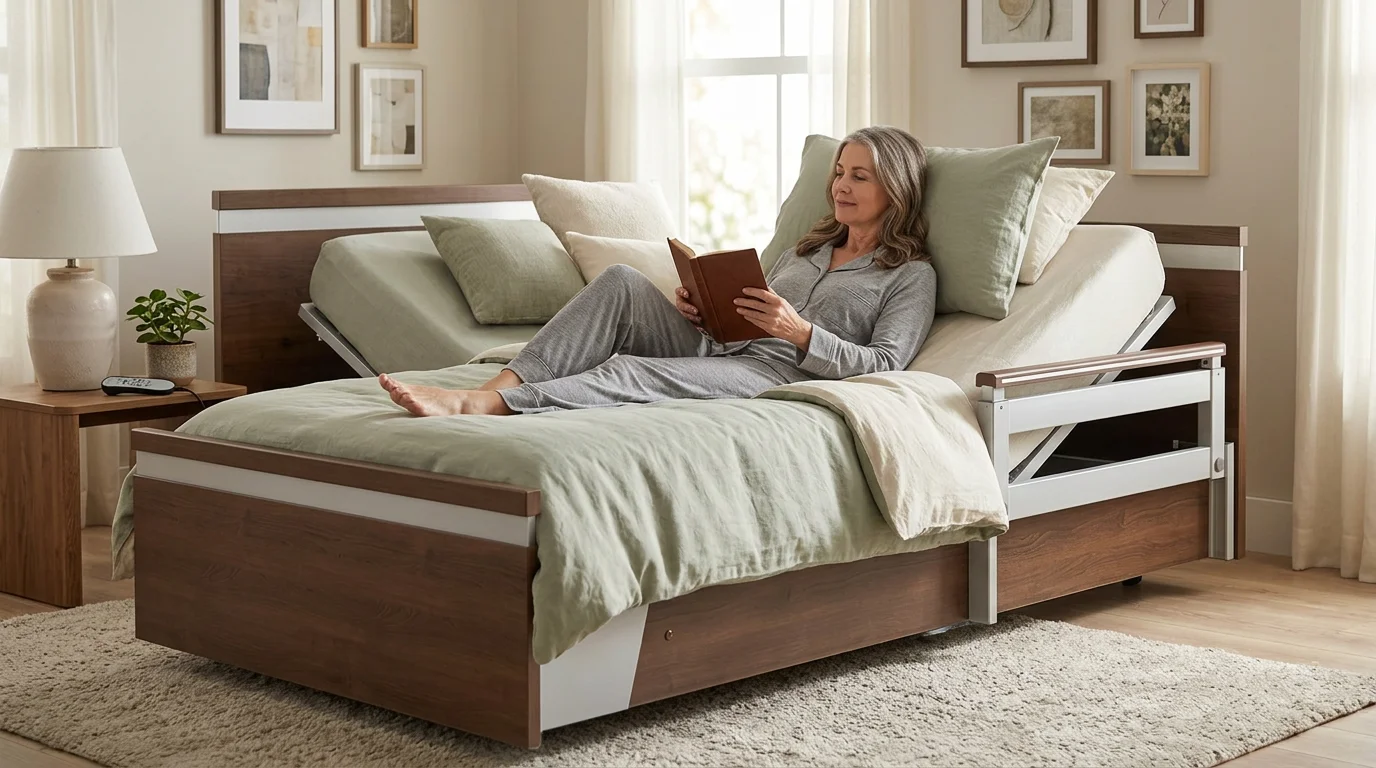
Medicare’s DME program covers home hospital beds at a standardized reimbursement rate. In practice, this typically means a metal-frame adjustable bed with basic electric controls. It adjusts. It meets the clinical requirements. It will not, however, look like a piece of residential furniture.
The standard DME bed has an appearance that announces medical need the moment you walk into the room. For families who want their loved one’s bedroom to remain a home, not a patient room, that gap can be significant. Many families describe receiving the Medicare-covered bed and immediately recognizing that the aesthetic reality didn’t match what they had hoped for.
Premium privately purchased home hospital beds offer a different outcome. The Aura Premium from SonderCare, for example, is certified to the International Hospital Standard and includes the same clinical positioning features as a DME hospital bed, Trendelenburg, Zero Gravity, Cardiac Chair, and FallSafe ultra-low height at 10 inches, built into the design of a residential furniture piece with upholstered panels and premium headboard options. For families whose primary need is head and knee adjustment without the full clinical positioning suite, the Impulse Residential Bed offers an entry point at $3,999.
Medicare will not cover these beds as DME. But for families who have worked through the Medicare process and concluded that the standard DME option doesn’t serve their loved one’s dignity or their household’s needs, private-pay alternatives exist. The Why Premium Home Hospital Beds Are Worth the Investment guide covers this decision in full, including how to think about the cost comparison honestly.
A Clear Path Through a Confusing Process
Medicare justifies a home hospital bed when a physician documents a specific medical condition that creates a specific positioning need a regular flat bed cannot address. The criteria are more precise than most families realize, and the language in the Certificate of Medical Necessity matters enormously to the outcome.
The practical path: physician evaluation and clinical documentation → written order → Medicare-enrolled DME supplier → CMN submission → 80/20 coverage on a 13-month rental. First-round denials are common; appeals work when the documentation is strengthened.
For the most detailed overview of what Medicare will and won’t cover, including which bed features are covered at each tier, the What Kind of Hospital Bed Will Medicare Pay For? guide covers the full coverage landscape.
If you’re also weighing whether a Medicare-covered bed will meet your family’s needs, or you want to understand what private-pay options look like alongside the Medicare path, SonderCare’s bed experts are available to help, no pressure, just honest guidance. Speak with a SonderCare expert.
References
-
Centers for Medicare & Medicaid Services. Fact Sheet: Two-Midnight Rule. Updated March 12, 2026. https://www.cms.gov/newsroom/fact-sheets/fact-sheet-two-midnight-rule-0
-
Centers for Medicare & Medicaid Services. Medicare Outpatient Observation Notice (MOON). Fact Sheet, December 8, 2016. https://www.cms.gov/newsroom/fact-sheets/medicare-outpatient-observation-notice-moon
-
Centers for Medicare & Medicaid Services. National Coverage Determination (NCD) for Hospital Beds (280.7). https://www.cms.gov/medicare-coverage-database/view/ncd.aspx?ncdId=227
-
CGS Administrators, LLC. Dear Physician: Hospital Beds and Accessories. CGS Medicare. https://www.cgsmedicare.com/jc/dpl/dpl_hospital_beds.pdf
-
Centers for Medicare & Medicaid Services. 2024 Medicare Parts A & B Premiums and Deductibles. October 12, 2023. https://www.cms.gov/newsroom/fact-sheets/2024-medicare-parts-b-premiums-and-deductibles
-
HHS Office of Inspector General. Hospitals’ Use of Observation Stays and Short Inpatient Stays for Medicare Beneficiaries. Report No. OEI-02-12-00040, July 29, 2013. https://oig.hhs.gov/reports/all/2013/hospitals-use-of-observation-stays-and-short-inpatient-stays-for-medicare-beneficiaries/
-
Goldstein JN. The Unintended Consequences of Medicare Observation Status. Delaware Journal of Public Health, 2019. DOI: 10.32481/djph.2019.12.006. https://pmc.ncbi.nlm.nih.gov/articles/PMC8389145/