






When the durable medical equipment van pulls away and you see what’s left, chrome side rails, a matte-white plastic headboard, industrial casters that already scratched the hardwood, you understand what caregivers mean when they say the room doesn’t feel like home anymore. A bedroom that was personal and warm now looks borrowed from a hospital ward.
Most families searching for a hospital bed for home use never encounter an alternative. The standard durable medical equipment (DME) category, the beds that insurance covers, that DME suppliers stock, that show up photographed against white backgrounds on clinical websites, is not designed for residential spaces. It’s designed for hospitals, adapted for home delivery.
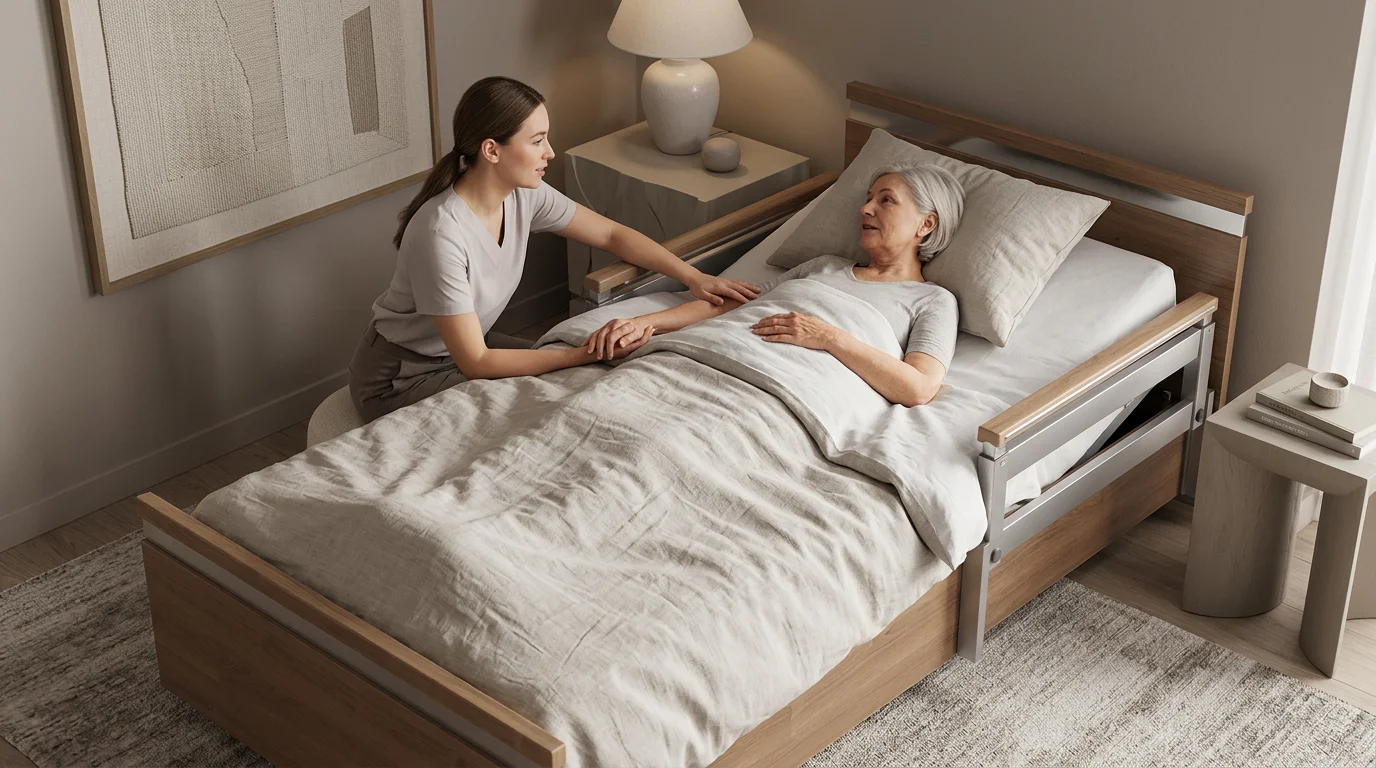
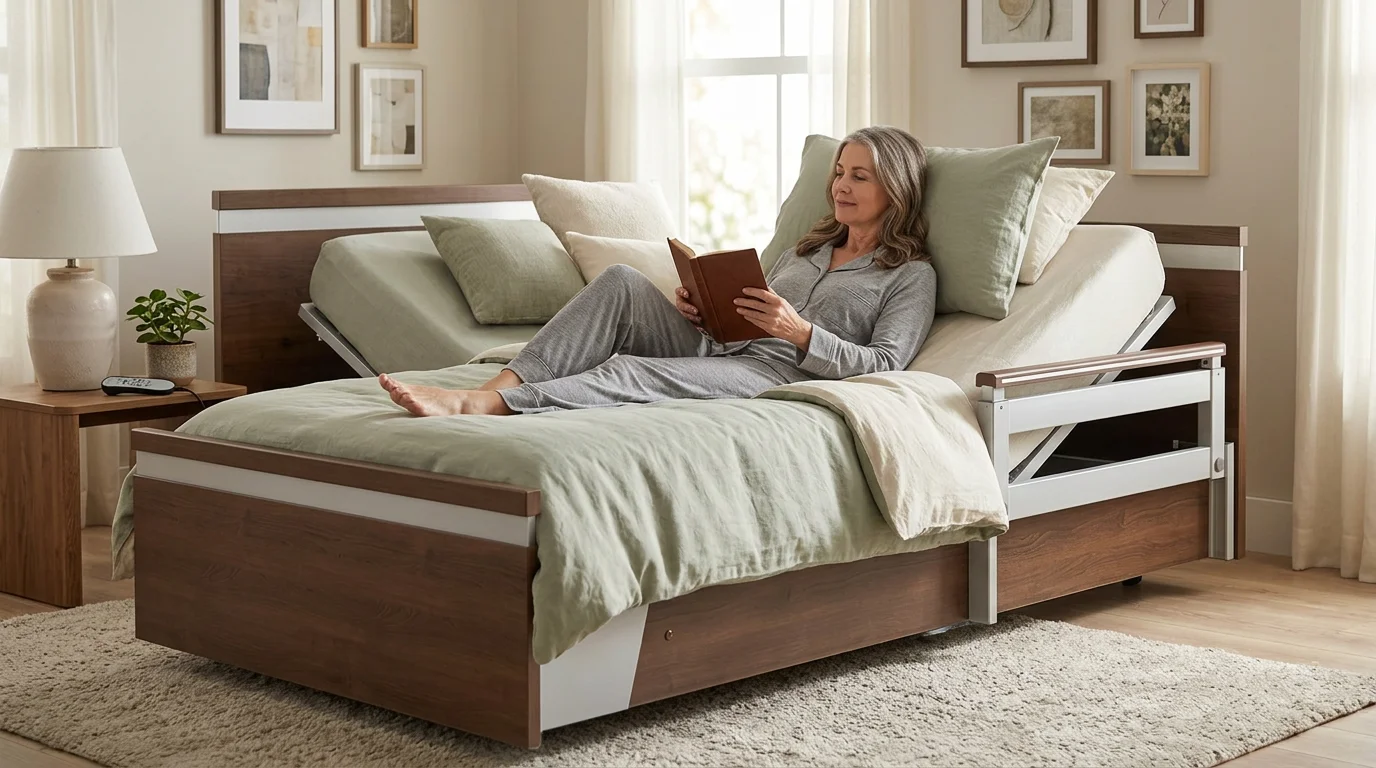
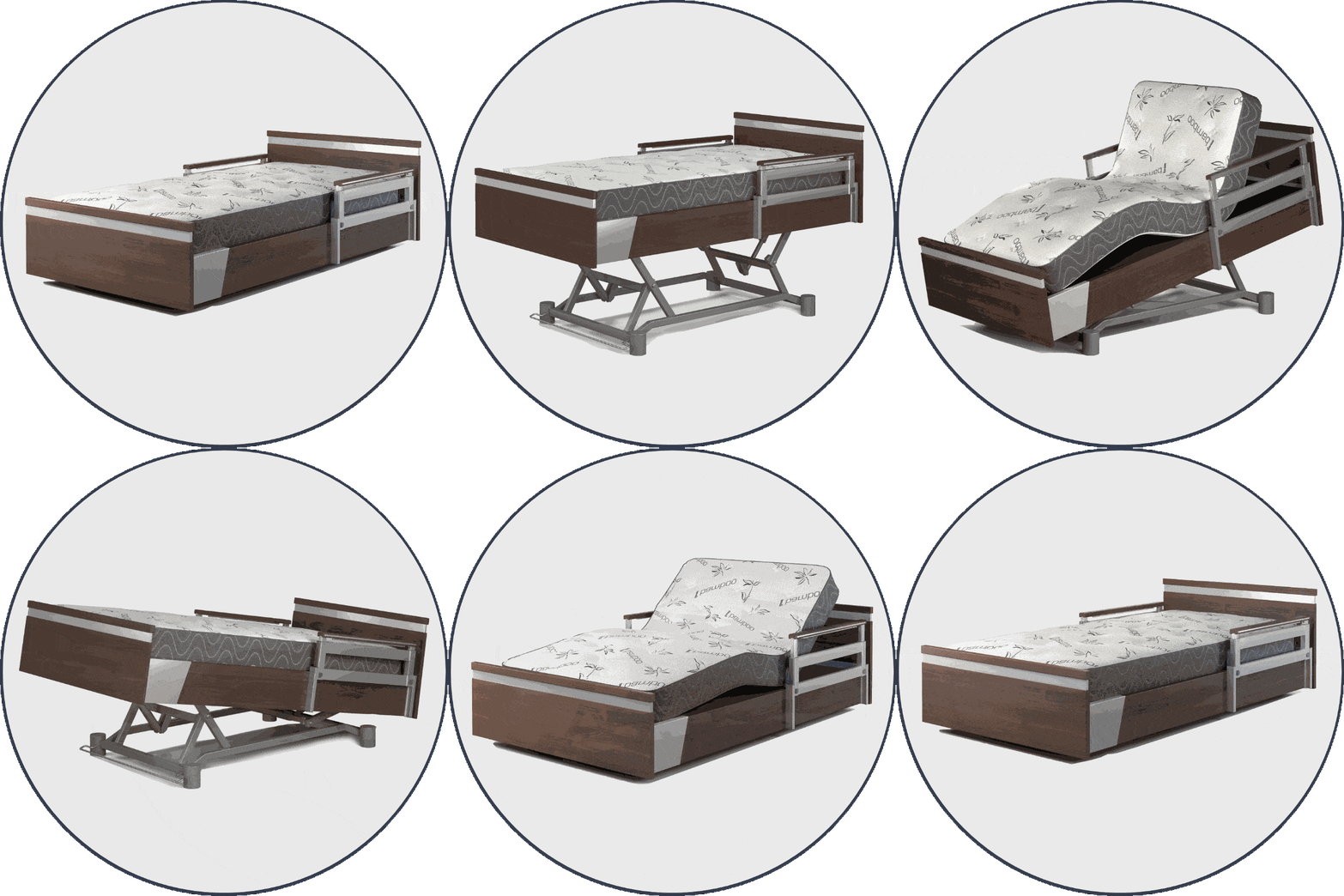
What many families don’t know is that a different category exists: upholstered hospital beds with headboards, fabric panels, and finishes built to look like bedroom furniture, not clinical equipment. These beds carry the same safety certifications as standard DME. They lower to 10 inches for fall prevention, adjust electrically for positioning, and meet international hospital safety standards. They just don’t look like hospital beds.
This guide explains which materials make that possible, what separates genuine medical-grade upholstery from fabric that only looks premium, and how to evaluate a premium-finish bed before you buy.
Why the Look of a Hospital Bed Matters
The resistance many aging adults and seniors feel toward a hospital bed is not stubbornness for its own sake. It’s a reasonable reaction to what a standard DME bed signals: that something has been lost, that the bedroom now belongs to a condition rather than to the person who has slept there for decades. In caregiver communities on Reddit and in home care forums, one pattern recurs constantly. A parent agrees to accept home care, the DME bed arrives, and then they refuse to use it. Not because of how it works, because of how it looks. A spouse promises the shared bedroom will stay feeling like home, and then it doesn’t. The standard hospital bed, through no fault of its design intent, visually announces “this is a medical space now.” For the person in the bed, that announcement is personal. Research into healing environments consistently finds that residential, non-clinical surroundings reduce psychological distress and support a person’s sense of identity. A clinical-looking care environment doesn’t just feel uncomfortable, it can affect how a care recipient relates to their own care. Families who understand this aren’t being sentimental. They’re responding to something real. That’s why hospital beds designed not to look like hospital beds represent a meaningful category, not a luxury add-on. The appearance of the bed affects whether the person accepts the bed, stays in it, and experiences care at home as living rather than waiting.What “Furniture-Grade” Actually Means in a Hospital Bed
“Furniture-grade” is a positioning term that covers several distinct design decisions. Understanding what those decisions actually are helps you evaluate whether a bed delivers on the promise or simply uses the label.Headboard Design and Material
The headboard is the most visible element of any bed. Standard hospital beds use interchangeable plastic headboards in clinical white or beige, functional, easy to sanitize, and visually unmistakable. Premium hospital beds replace this with upholstered headboards that read as residential: tufted fabric panels, nailhead detailing, arched silhouettes, and finishes that can coordinate with existing bedroom furniture rather than contrasting with it. The Aura line from SonderCare includes two fixed-height upholstered headboard options: a Graphite Gray panel with clean square tufting (42 inches high) and a Silverstone arched design with nailhead finish (44 inches high). Both mount directly to the bed frame and maintain alignment through all hi-lo adjustments. Across a room, they read as upholstered bedroom furniture, not hospital equipment.Side Panel and Frame Finish
Standard hospital beds expose the mechanical side rails and frame components. Premium beds conceal these within finished panels. The Aura Platinum home hospital bed uses fully upholstered side panels in Slate Gray Crypton fabric, a medical-grade performance upholstery used across high-end healthcare and hospitality environments. The mechanical hi-lo assembly, the structural rails, and the adjustment hardware sit behind an upholstered surface. From across the bedroom, the bed presents as a platform bed. At the bedside, it adjusts to every position a certified hospital bed offers. Frame finishes on premium beds are also differentiated from DME standard. Powder-coated steel in neutral residential tones replaces the bare metal or institutional-gray finishes of standard equipment. Where visible hardware exists, it matches rather than contrasts.Component Integration
Casters, hand controllers, and adjustment mechanisms on standard hospital beds are fully exposed. On premium beds, these integrate into the profile: central brake pedals recessed beneath the frame, hand controllers in coordinated colors with optional storage pouches, hi-lo columns inside the bed structure rather than flanking it. The result is a bed that operates with full clinical capability, adjusting silently with a 54-decibel motor, while looking like a piece of bedroom furniture when not in use.The Material Science: Medical-Grade Upholstery vs. Standard Fabric
The question that caregivers often have but don’t always ask: can an upholstered hospital bed, with fabric headboards and padded panels, actually be kept clean enough for someone with genuine care needs? Standard DME beds are easy to wipe down because they’re non-porous plastic and metal. Fabric introduces a different consideration. The answer lies in which fabric is used and how it’s constructed. Not all upholstery is equal, and in a care environment, the distinction matters.Why Woven Fabric Is Not Safe for Patient Care Areas
Research into healthcare surface contamination has been clear on this since the early 2000s. A widely cited study in the American Journal of Infection Control found that woven seat cushions in a healthcare facility remained positive for vancomycin-resistant enterococci (VRE) at both 72 hours and one week after contamination, and could not be adequately cleaned with standard surface disinfection methods. 12 The study’s conclusion: non-porous, easily cleanable surfaces are required for any patient care environment. This finding anchors industry guidance to this day. The Association for the Health Care Environment (AHE), in its Guidelines for Cleanability in Healthcare Furniture, explicitly prohibits untreated woven fabrics for patient care area upholstery. Acceptable materials are listed as: PVC (vinyl), polyurethane (PU), composites, silicone, and 100% polyester woven fabrics that carry both a fluid barrier and a validated stain-resistant finish. 10 This is the standard floor that any upholstered hospital bed panel or headboard must clear to be appropriate for home care use.What Crypton Fabric Is and Why It Matters
Crypton is a performance fabric engineered for environments that need both visual quality and durability under repeated cleaning. In its healthcare-grade form, Crypton meets the AHE’s acceptable materials list: it is a coated, non-porous textile that is fluid-proof at the substrate, compatible with EPA-registered healthcare disinfectants, and resistant to surface degradation from repeated cleaning cycles. The Chemical Fabrics and Film Association (CFFA), which sets performance standards for healthcare upholstery, specifies that coated fabrics must achieve a minimum grayscale rating of 4 after 84 standardized wipe cycles. The CFFA notes that with appropriate cleaning procedures, healthcare-grade coated surfaces can achieve greater than 99.9 percent pathogen reduction. 11 This is the category Crypton occupies, and it is the same category as PVC vinyl, the legacy healthcare upholstery material, but with the aesthetic quality of genuine furniture fabric. The visual difference between a Crypton panel and a woven fabric panel is minimal at a glance. The functional difference, in cleanability, fluid resistance, and long-term surface integrity, is significant.The Home Care Context
It is worth being clear about context. The AHE guidelines and the HAI research behind them are designed for acute-care hospital settings, where pathogen load, bed turnover, and exposure to multi-drug-resistant organisms are dramatically higher than in a private home. A single-occupant home care bedroom, with consistent caregiving and no cross-patient contamination, presents a substantially lower infection risk than a hospital ward. That said, the material standards remain a useful benchmark. An upholstered panel using medical-grade coated fabric is meaningfully more hygienic than one using untreated decorative fabric, and for families caring for someone with compromised immunity, wound care needs, or skin integrity concerns, this distinction is worth understanding before purchase. The CDC’s environmental infection control guidelines specify that mattress covers must be moisture-resistant and intact, and must be cleaned with EPA-registered disinfectants between patient episodes. 8 Premium beds that use medical-grade upholstery on their panels meet this threshold by design. Aftermarket fabric wraps or decorative headboard additions that use untreated textiles typically do not. Researchers have also documented that the bed itself, the mattress surface and its immediate surroundings, can function as a reservoir for pathogens that persist for weeks rather than hours. 5 The material integrity of any surface a care recipient contacts regularly is not a theoretical concern in long-term home care. Premium upholstery in medical-grade materials addresses this without requiring clinical-looking surfaces.Evaluating a Premium-Finish Hospital Bed: What to Ask
When comparing upholstered or premium-finish hospital beds, these questions separate genuine furniture-grade construction from surface aesthetics. 1. What is the specific upholstery material? Ask for the fabric specification: Crypton, PU (polyurethane), PVC, or coated polyester. A vendor who describes their upholstery only as “fabric” or “soft touch” without specifying the material type or performance ratings is not working from a medical-grade material standard. Genuine healthcare-grade upholstery comes with a product specification sheet. 2. Is the headboard fixed or detachable? Fixed upholstered headboards integrate with the bed frame and maintain dimensional alignment through hi-lo adjustment. Detachable or aftermarket headboards, including retrofitted headboards added to standard frames, can introduce entrapment gaps between the headboard and the mattress. The FDA’s dimensional guidance on hospital bed entrapment specifically addresses the gap between the mattress surface and any structural element at the head end. 9 A properly integrated headboard is both safer and more furniture-like in appearance than a retrofit. 3. Are mechanical components concealed or exposed? Look at where the casters, adjustment columns, and hand controller are positioned when the bed is at resting height. In premium beds, these integrate into the frame profile. A bed that describes itself as furniture-grade but exposes the hi-lo mechanism on the frame exterior has not completed the design work. 4. What finish and color options are available? A hospital bed that only comes in white, beige, or clinical gray is not designed for residential integration. Premium beds offer multiple headboard finish options, coordinated frame colors, and panel material choices, allowing the bed to coordinate with existing bedroom furniture rather than standing apart from it. 5. Does it maintain full hospital-grade positioning? Aesthetics should not require compromising function. Confirm the bed retains full electric positioning: independent head and knee adjustment, hi-lo height range from ultra-low (10 inches at the platform) to caregiver height, and for the Aura-class beds, full Trendelenburg, Zero Gravity, and Cardiac Chair positioning. A bed that looks like furniture but operates like a consumer adjustable bed is not an appropriate substitution for someone with genuine care needs.The Aura Platinum: What Medical-Grade Furniture Looks Like in Practice
The Aura Platinum home hospital bed is the direct answer to the question caregivers ask most often: can we get a hospital-certified bed that looks like it belongs in a bedroom? Its defining material feature is fully upholstered side panels in Slate Gray Crypton fabric, the same material category that the AHE identifies as appropriate for patient care environments. The panels run the full length of the bed frame on both sides, concealing the hi-lo mechanical assembly, the structural rails, and the electrical routing. From the doorway of a bedroom, the Aura Platinum presents as an upholstered platform bed. From the bedside, that same bed lowers to a 10-inch platform height for fall prevention, raises to 39 inches for caregiver access, and tilts through a full clinical positioning range including Trendelenburg and Zero Gravity. The two headboard options, Graphite Gray square tufting and Silverstone arch with nailhead, are residential designs that integrate with the frame rather than attaching as a clinical accessory. The Silverstone’s arched profile reads as a furniture headboard; the Graphite Gray’s clean tufting reads as contemporary bedroom design. Neither signals “hospital equipment” to someone entering the room. For families who have already worked to set up a hospital-grade bedroom at home and want the care equipment to remain consistent with the room’s character, the Platinum represents what that investment can look like. The Aura Premium home hospital bed covers the same functional ground, full hospital certification to the International Hospital Standard, FallSafe ultra-low height, five-year comprehensive parts warranty, white-glove delivery and installation, with a fixed upholstered headboard and residential-finish frame that reads as a home bed rather than DME. It is the entry point into furniture-grade construction for families who need hospital-level performance without the institutional appearance of a standard home care bed. Both beds are FDA-registered, certified to the International Hospital Standard, and manufactured under an ISO 13485-certified quality management system.The Price Conversation: What Premium Materials Actually Cost
The difference between a standard Medicare-covered hospital bed and a premium-finish option is real and worth naming honestly. Medicare’s durable medical equipment benefit covers standard home hospital beds when a physician prescribes them. Coverage applies to functional capability, not aesthetics. The Aura Premium ($6,999) and Aura Platinum ($8,499) are out-of-pocket purchases for most families. That premium pays for the upholstered panels, the furniture-grade headboard, the Crypton fabric, the residential frame finish, and the white-glove delivery that includes full installation and a feature walkthrough. The question that often shifts the calculation: what does it cost when the care recipient refuses the standard bed? A parent who won’t use a DME bed because of how it looks is a safety problem, not a personal preference problem. Repeated refusals, or a care recipient who accepts the bed but experiences the bedroom as diminished, create caregiving burden that has its own cost. The premium bed that gets used is often more cost-effective than the standard bed that doesn’t. Our detailed analysis of why premium home hospital beds are worth the investment walks through the full comparison, including the rent-versus-own calculation over a multi-year care span. At the five-year point, a bed owned outright, with no rental fees, no equipment returns, no degradation of quality over time, typically represents better value than monthly rental on a DME bed that never stopped looking like a hospital room.What the Right Materials Actually Make Possible
The families who find upholstered hospital beds often describe the same moment: they didn’t know this existed, and when they found it, they almost cried. Not because the fabric is beautiful, though it is, but because it meant the bedroom could stay a bedroom. The person who needed the bed could still walk in and recognize the room as theirs. That’s the purpose premium materials serve in a hospital bed. Not decoration. Not style for its own sake. The ability of a care recipient to look at the bed they need and see a bed, not a surrender. Crypton fabric, medical-grade polyurethane panels, fixed upholstered headboards, and concealed mechanical components are the engineering decisions that make that possible while maintaining the clinical performance a care environment requires. The bed still lowers to 10 inches for fall prevention. It still provides hospital-certified safety. It just does those things inside a form that belongs in a home. For a feature-by-feature comparison of what specific hospital beds look like in residential settings, including the full design breakdown of the Aura line, see our guide to home hospital beds designed to look like real bedroom furniture. To discuss which configuration fits your bedroom and care needs, contact us for a free consultation.References
- Magill SS, O’Leary E, Janelle SJ, Thompson DL, Dumyati G, Nadle J, et al. Changes in Prevalence of Health Care–Associated Infections in U.S. Hospitals. New England Journal of Medicine. 2018. DOI: 10.1056/NEJMoa1801550.
- Centers for Disease Control and Prevention. Current HAI Progress Report. Page last reviewed January 29, 2026. https://www.cdc.gov/healthcare-associated-infections/php/data/progress-report.html
- Marchetti A, Rossiter R. Economic burden of healthcare-associated infection in US acute-care hospitals. Journal of Medical Economics. 2013. DOI: 10.3111/13696998.2013.842922.
- Centers for Medicare & Medicaid Services. Hospital-Acquired Condition Reduction Program. Page reviewed March 16, 2026. https://www.cms.gov/medicare/payment/prospective-payment-systems/acute-inpatient-pps/hospital-acquired-condition-reduction-program-hacrp
- Witt LS, Sifri CD, Behm H, et al. The role of the hospital bed in hospital-onset Clostridioides difficile infection: A retrospective study with mediation analysis. Infection Control & Hospital Epidemiology. 2023. DOI: 10.1017/ice.2023.254.
- Hooker EA, Mallow PJ, McKinney C, Gnoni ML, Fernandez Gonzales F. Use of a Launderable Bed Barrier and Antibiotic Stewardship to Decrease Hospital-Onset Clostridioides difficile Infections in an Acute Care Hospital. Journal of Health Economics and Outcomes Research. 2019;6(2):108-118. DOI: 10.36469/001c.11149.
- Trinity Guardion. Soteria Bed Barrier: Hospital Bed Barrier for Infection Prevention. https://trinityguardion.com/hospital-bed-barrier/
- Centers for Disease Control and Prevention. Guidelines for Environmental Infection Control in Health-Care Facilities. 2003; updated 2019. https://www.cdc.gov/infection-control/hcp/environmental-control/
- U.S. Food and Drug Administration. Hospital Bed System Dimensional and Assessment Guidance to Reduce Entrapment. Published August 23, 2018. https://www.fda.gov/regulatory-information/search-fda-guidance-documents/hospital-bed-system-dimensional-and-assessment-guidance-reduce-entrapment
- Association for the Health Care Environment (AHE). Health Care Furniture Design – Guidelines for Cleanability. Published April 11, 2017. https://www.ahe.org/health-care-furniture-design-guidelines-cleanability
- Chemical Fabrics and Film Association (CFFA). FOCUS 10: Surface Disinfection for the Real World. Revised April 2024. https://www.cffaperformanceproducts.org/content/pdfs/FOCUS10_SurfaceDisinfection.pdf
- Noskin GA, Bednarz P, Suriano T, Reiner S, Peterson LR. Persistent contamination of fabric-covered furniture by vancomycin-resistant enterococci: implications for upholstery selection in hospitals. American Journal of Infection Control. 2000;28(4):311-313. DOI: 10.1067/mic.2000.108129.
- Medline Industries. Hospital Environmental Services: Keeping Soft Surfaces Clean. December 2021.
- Schneider G, Lazarotto TC, Schmitt L, et al. Textiles impregnated with antimicrobial substances in healthcare services: a systematic review. Antimicrobial Resistance & Infection Control. 2023. https://pmc.ncbi.nlm.nih.gov/articles/PMC10213888/