



Most bed rails aren’t fall prevention tools. They’re orientation aids — and that distinction matters a lot once someone you love is sleeping in a hospital-style bed at home.
Three myths trip up spousal caregivers in the first few weeks. All three lead to the same outcome: a false sense of security, or a new hazard they didn’t see coming.
Myth 1: Rails Keep People from Falling
All by themselves they don’t — it’s not a good mindset to rely on on feature for fall safety.
A rail gives a disoriented person something to orient to in the dark. It holds position. But it cannot stop someone who rolls, shifts, or decides they need to get up at 3 a.m. And when someone climbs over a tall rail, they fall from higher — not lower.
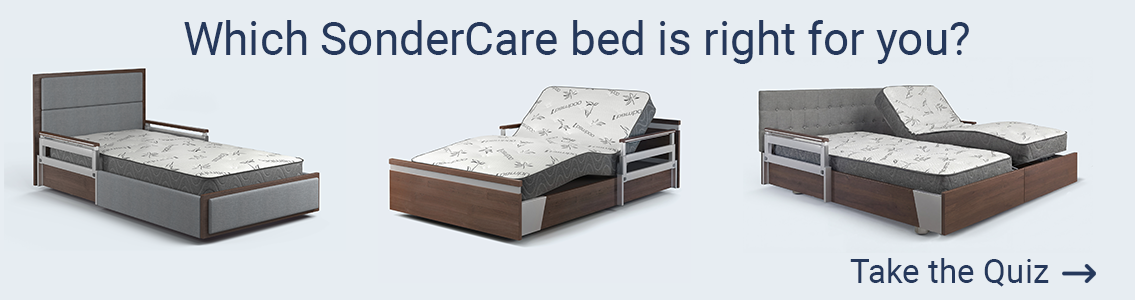
The real fall prevention tool is bed height. Drop the platform to 10 inches off the floor — the FallSafe Ultra-Low position on SonderCare Aura beds — and a fall from bed becomes a minor incident rather than an ER visit. Rails and low height work together. Neither is enough alone.
Myth 2: Any Rail Will Do
Since 2021, the CPSC has issued nine recalls and two safety warnings on adult portable bed rails, covering more than 3 million units in total. The culprit isn’t the concept of a rail — it’s the gap between rail and mattress where entrapment happens, often during repositioning in the middle of the night.
Portable clip-on rails were designed for consumer mattresses with standard dimensions. Put one on a thick therapeutic mattress and the clearances shift completely. The numbers change. The risk changes.
Integrated rails — built for the specific bed they ship with — are a different category. The Multi-Height Assist Rails included with every SonderCare Aura bed are sized and certified to IEC 60601-2-52, which mandates a minimum 8.7″ clearance between mattress top and rail top. That spec exists because entrapment is the primary danger, not rolling out. We cover what to check in our full guide to using bed rails safely at home.
Myth 3: Rails Are Restraints
This one bleeds over from institutional care settings, where rails were historically used to keep confused patients in bed. Home use is different.
A rail that helps your partner push off when rolling from their back to their side is assistive. A rail that traps someone who needs to reach the bathroom is a hazard. Same piece of equipment. The difference is in how it’s set up and whether it matches the person’s actual movement patterns.
Four Numbers Every Spouse Should Know
- Rail height above mattress: 13–15 inches. That’s the certified range on hospital-grade beds. Higher isn’t safer — it’s a climbing incentive.
- Entrapment-zone clearances, not a single gap number. IEC 60601-2-52 governs the specific zones where a head, neck, or limb could become trapped — upper and lower gaps are measured separately. On Aura beds, the upper gap measures 4.7″ and the lower gap 3.3″, both certified to the standard. For non-SonderCare rails, ask the manufacturer for their IEC 60601-2-52 measurements rather than guessing with a tape measure.
- Vertical load limit on assist rails: 165 lbs. Fine for repositioning grabs. Not rated for full standing transfer from body weight — use the trapeze bar or transfer position for that.
- Noise factor: A Protective Rail Pad ($99) stops overnight rattle and protects against bumps for restless sleepers — small thing, real difference.
If you’re managing this as a couple — one of you needing medical support, both trying to stay in the same room — the sleep disruption piece is just as important as the safety piece. We cover the full night-time dynamic in our guide to spousal caregiving at night, including how adjustable beds change the equation for both partners.
Start with the bed — see the full Aura line, rails included, at sondercare.com/beds.