



Your father came home from the hospital last month, and somewhere between the discharge paperwork and the third pharmacy run, you quietly became his care team. Nobody handed you a manual.
If that sounds familiar, you’re in a much larger group than you’d guess. Home caregiving has changed in ways that surprise even the people doing it every day. Here are five facts worth knowing — each one points to something you can actually change.
1. Family caregivers are doing nursing work — usually without training
Most people picture home caregiving as meals, errands, and companionship. The reality is far more clinical. AARP research has found that more than half of family caregivers now perform complex medical and nursing tasks — giving injections, changing wound dressings, managing tube feedings, operating care equipment — and only about one in five received any training for the complicated ones.
The reason is structural: hospitals discharge faster than they did a generation ago, so the home absorbs care that used to happen on a ward. You can’t train your way out of every gap overnight. But you can remove whole categories of risk with the right setup — and more of that setup centers on the bed than families expect.
2. The most common injury in home care may be the caregiver’s back
Families brace for the dramatic event — a loved one falling. The quieter, more frequent injury is the caregiver’s own lumbar spine, worn down by repeated lifting and bending. Transferring someone from a low, fixed-height surface forces you to lift from the worst possible angle, dozens of times a week, until one ordinary Tuesday it gives out.
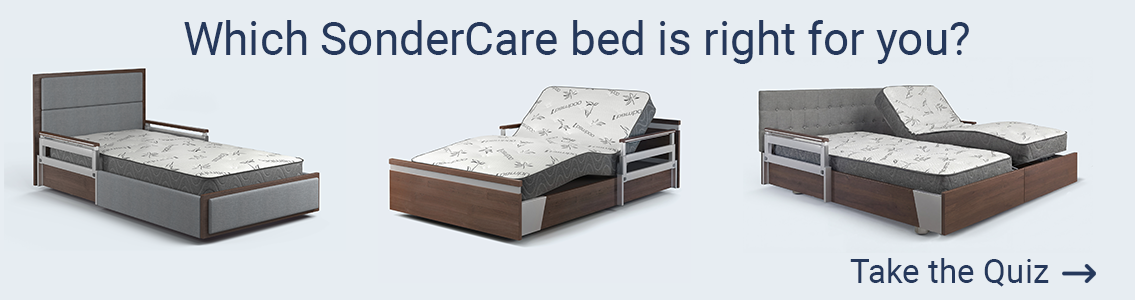
The fix is counterintuitive: raise the work surface to you, not the other way around. The Aura™ Premium Home Hospital Bed ($6,999) moves to a one-button transfer height of 21″ to the top of the mattress — so you’re working upright — then lowers to a 10″ platform (17″ to the top of the mattress) once your loved one is settled. One height protects your back. The other protects their fall risk.
3. Most falls happen during the dullest moments — the 3 a.m. bathroom trip
It’s rarely the icy front step. The bulk of nighttime falls happen during a routine transfer in the dark: half-awake, disoriented, on a surface that sits too high, with no light on the floor. The feet hit the ground before the body is ready.
Two cheap-to-fix variables remove most of that risk. The FallSafe™ ultra-low height (10″ platform / 17″ to the top of the mattress) shortens the distance to the floor, so a misjudged transfer becomes a stumble instead of a fall. Pair it with an under-bed auto-nightlight that lights the floor path the moment your loved one sits up — one of several accessories built for exactly this gap.
4. Most older adults want to stay home — and increasingly, they do
The cultural script says declining health leads to a care home. The data says otherwise. AARP’s 2024 Home and Community Preferences Survey found that 75% of adults aged 50 and older want to remain in their current homes as they age. Staying put is no longer the exception — it’s the plan.
But aging in place only works if the home can quietly do hospital-grade work without looking like a hospital. That’s the dignity piece families underestimate. A furniture-grade bed in a bedroom still reads as a bedroom; a chrome rental frame turns the room into a sick bay. The Aura™ Platinum ($8,499) — and the Aura™ Companion ($12,999), for couples who still want to sleep side by side — exist to prove that residential design and hospital-grade safety aren’t a trade-off.
5. Sleep — for both people — quietly decides how long home care lasts
Families pour energy into medications and appointments. The variable that most often forces a move into assisted living is simpler and easier to miss: broken sleep, wearing the caregiver down week after week until the situation stops being sustainable.
It compounds. Poor positioning means more night wakings — reflux, labored breathing, pressure discomfort, the need to reposition — and every one of those fragments the caregiver’s sleep too. Positioning is a lever most families don’t know they have. Head elevation, the Zero Gravity position, and pressure redistribution can all ease the things that wake people up. The mattress matters here as well: the Dream™ and Signature Hybrid are built for comfort and pressure redistribution, while the Alternating Pressure Air mattress ($2,999) is designed for active wound-care needs.
One more thing: the hard part is real, but a lot of it is changeable
Home caregiving is demanding, and no piece of equipment changes that. What’s surprising is how much of the daily difficulty traces back to four ordinary things — height, lighting, positioning, and dignity — and how many of them you can adjust this week.
If you do just one thing: raise the transfer height and light the floor path. Those two changes cut risk the fastest, and they cost almost nothing to start. When you’re ready to think through the rest, our bed experts have helped thousands of families find the right fit — and they’ll ask the right questions before recommending anything.